- A small travel-planning experiment with a much bigger question
- Why an AI agent is not just another chatbot
- What the teachers actually did
- Why the venue matters: a school with roots in 1894
- Japan’s N-E.X.T. High School reform backdrop
- The national rulebook starts with human judgment
- The information an agent must never casually receive
- Could automation return time to teachers?
- The risk of doing the student’s thinking
- What must happen before this becomes a school success story
A small travel-planning experiment with a much bigger question
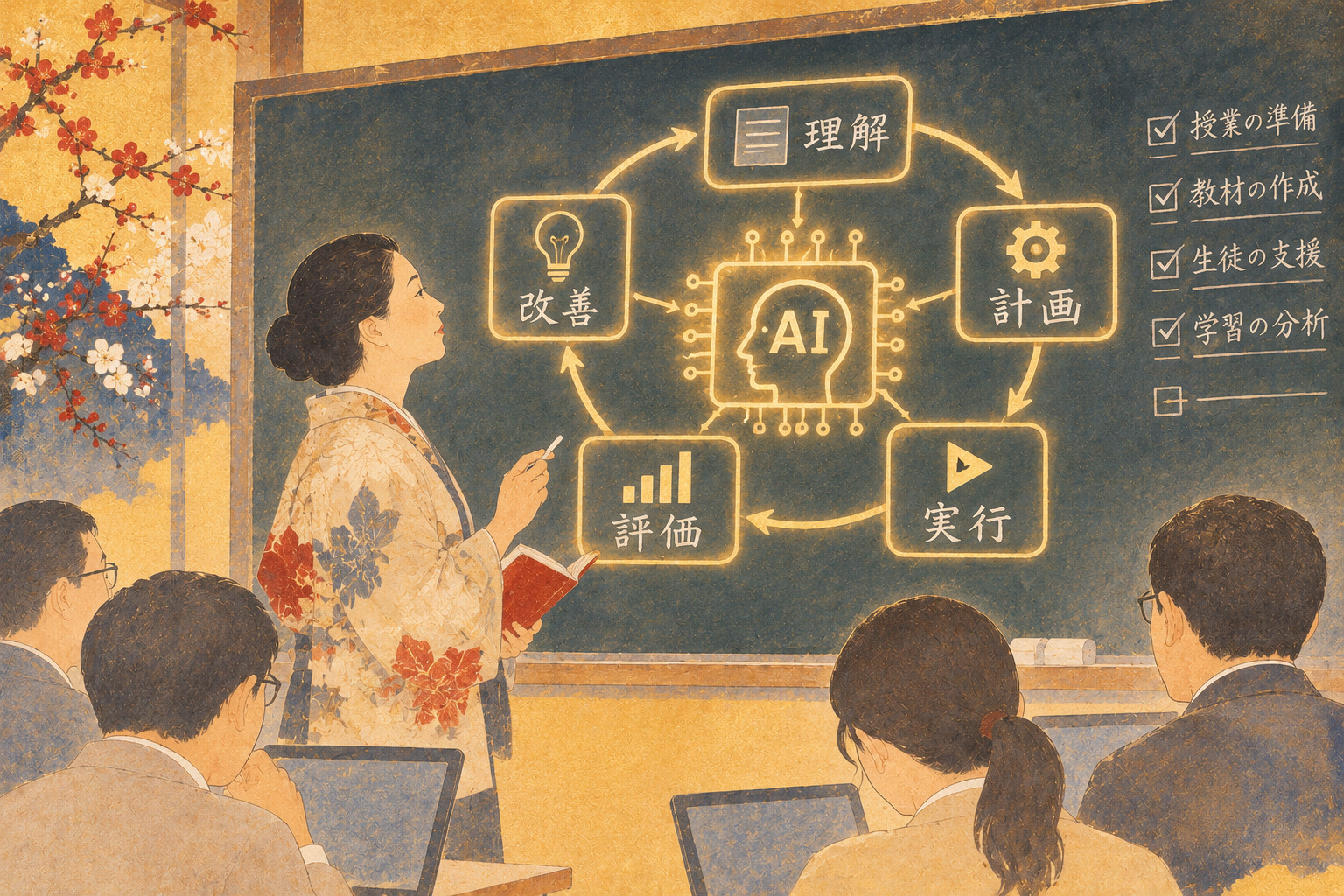
At Ogaki Kita High School in central Japan, teachers were asked to do something rarely associated with a conventional faculty seminar: create a piece of software that could plan a trip. Around 30 educators from Gifu Prefecture joined an October 27 workshop organized by the prefectural board of education. According to a report published in Gifu Shimbun on November 4, they worked in groups of two or three, adjusting instructions to create an AI agent that could propose travel arrangements. It was not a deployment of an automated school system. It was a hands-on exercise intended to help teachers understand a new generation of tools. The question that matters is what comes after the demonstration: can systems that perform sequences of tasks improve education without taking decisions away from teachers and students?
Why an AI agent is not just another chatbot
A generative AI chatbot can answer questions, draft lessons or summarize material. An AI agent goes further in its design: it can break a goal into steps, retrieve information, compare options and take permitted actions through connected tools. That description does not imply reliability, independent judgment or unrestricted access. Everything depends on what the software can read, how its tools are configured and which actions require human approval. A travel planner might invent a train time or recommend an impossible itinerary. The consequences are much greater when student information or school communications are involved. The Gifu workshop offered an introduction to this distinction, but the publicly available sources do not identify a product performance benchmark, validated accuracy rate or installation in an actual school workflow.
What the teachers actually did
The board of education’s October 21 announcement sets out a precise schedule: an opening session from 1 p.m., a lecture on agent concepts and examples, a practical learning activity, an application-building exercise, and a final exchange of work. The workshop ran until 4:30 p.m. Gifu Shimbun reported that staff from education technology company Life is Tech served as instructors. Participants first saw how changes in prompts affect generative AI responses, then built travel-planning agents and proposed other applications to help with everyday life. The newspaper quoted an electrical-engineering teacher at Gifu Technical High School expressing interest in applying AI to manufacturing education. That was an individual aspiration, not evidence that a new curriculum or a production-ready system had been approved.
Why the venue matters: a school with roots in 1894
Ogaki Kita is not an experimental school built for the AI era. Its official history begins in 1894 as an Ogaki branch of a prefectural middle school. A postwar combination of school traditions led to the establishment of its present name, Gifu Prefectural Ogaki Kita High School, in 1949. It moved to its current Nakagawa-cho site in 1961 and commemorated 130 years in 2024. In the school’s 2026 overview, the principal describes a long line of graduates working in government, industry, research and culture. The choice of this historic institution as a venue is telling: new teaching methods in Japan must operate not only in newly equipped specialist schools, but within established institutions and ordinary constraints of time, staffing and examinations.
Japan’s N-E.X.T. High School reform backdrop
In February 2026, Japan’s Ministry of Education, Culture, Sports, Science and Technology—MEXT—published a national high-school reform framework looking toward 2040, often called the N-E.X.T. High School vision. It emphasizes stronger science and interdisciplinary education, relationships with regional industries and access for students with different learning needs. Gifu is drafting its own high-school reform implementation plan during fiscal 2026, drawing on a prefectural advisory meeting that began discussing the outlines in September. Gifu Shimbun also reported that Ogaki Kita had been selected in June as a pilot reform base associated with the national vision. The AI-agent workshop is part of that broader discussion about learning environments. A planning document, however, is not evidence of successful implementation. Equipment, training, funding and evaluation will all matter.
The national rulebook starts with human judgment
MEXT first issued provisional guidance on generative AI use in schools in July 2023 and revised it on December 26, 2024, as version 2.0. The updated guidelines emphasize human-centered use and the development of students’ information literacy in a world where generative AI exists. For teachers, the ministry recognizes potential value in preparation and administrative work provided professionals can judge the appropriateness of the outputs. For student use, it calls for attention to age, skills and risks. This is not a blanket ban or a universal mandate. An agent might provide an attractive teaching outline, but a teacher must still check facts, align it with the curriculum and assess how pupils will learn from it. The workshop’s central practical lesson may be learning when not to trust a fluent answer.
The information an agent must never casually receive
School technology raises issues that a holiday itinerary does not. A public worksheet template is different from a child’s grades, health details, family circumstances or disciplinary record. Administrators need to understand whether information entered into a service is retained, who can access it, whether it is reused, and how permission to run external actions is managed. An agent given access to calendars or email can do more than produce text; without adequate controls it may send information or alter records. The prudent design is to minimize sensitive inputs, require authorization for consequential actions, keep appropriate records and provide a way to correct mistakes. These are principles that need to be assessed against each school’s systems and applicable requirements, not evidence of any failure at Ogaki Kita.
Could automation return time to teachers?
Japanese policymakers have a practical reason to be interested. MEXT’s 2022 survey of teachers’ working conditions found reductions in time spent at school compared with the 2016 survey, while also identifying continuing problems with long working hours. Drafting routine materials, sorting administrative requests and preparing the first version of documents could be plausible uses for AI support. But efficiency cannot be assumed from an impressive demonstration. A teacher may spend extra time checking a fabricated citation, rewriting an unsuitable lesson or managing software. Any serious trial should track time saved, errors, correction effort, security costs and effects on teaching quality. No such outcome data were reported from this one-day workshop, so a headline promising less paperwork would be premature.
The risk of doing the student’s thinking
The word “inquiry” in the workshop title matters. Japan wants students to ask questions, evaluate evidence and connect academic subjects to real problems. AI agents could help gather comparative information about regional transport, manufacturing or environmental conditions. Yet a system that produces an entire finished project can also remove the intellectual work the exercise was meant to cultivate. A better approach may ask students to disclose what assistance was used, verify independently selected sources, explain why they accepted or rejected machine suggestions, and defend their conclusions. That is an educational design proposition, not a result established by the Gifu event. The distinction between a convincing final presentation and demonstrated understanding will become more important as AI tools grow more capable.
What must happen before this becomes a school success story
The next credible milestones are concrete. Does the prefecture’s reform plan specify training, safeguards and measurement? Which schools adopt approved tools, under which data-access rules? Are teachers able to create useful lessons more quickly without sacrificing accuracy? Do students acquire stronger critical judgment? The reviewed materials do not identify the underlying agent platform, the continuing use of the prototypes, measurable savings or a decision to expand the workshop into operational school services. The October 27 gathering should be understood as exploration, not system-wide transformation. The larger value is that teachers, rather than technology vendors alone, are beginning to examine which choices should remain human. At a school whose history reaches to 1894, that is a conversation about the purpose of education as much as the future of software.
Sources and reporting method
The prefecture, school and ministry provide primary records. The description of the workshop itself is attributed to Gifu Shimbun’s reporting.
- Gifu Board of Education: AI agent workshop announcement, October 21
- Gifu Shimbun: reporting on the teachers’ October 27 workshop
- Ogaki Kita High School: school history and profile
- Gifu Prefecture: high-school reform implementation plan
- MEXT: N-E.X.T. High School reform vision
- MEXT: Generative AI Guidelines for Schools, version 2.0
- MEXT: resources for responsible use of AI in schools
- MEXT: national survey on teachers’ working conditions