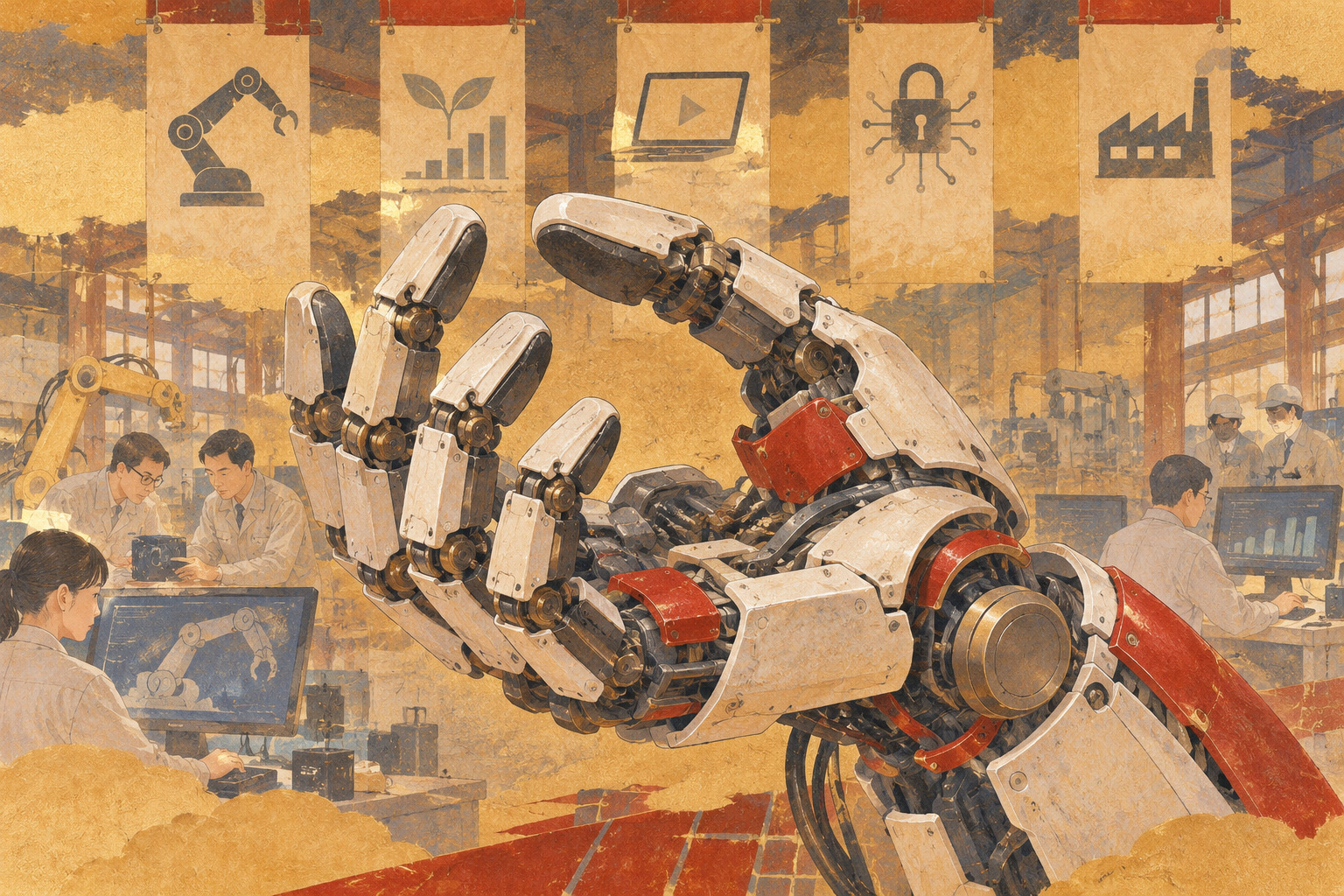
- The next product may not come from inside the factory
- What open innovation actually means
- Aoyama: automotive bolts meet embodied intelligence
- A 145-year-old newspaper searches for a service business
- Pacific Industrial: why measuring power is not enough
- Tokoro: giving physical paper a digital identity
- YKP Industry: making existing machines smarter
- A national startup search organized from Gifu
- The Gifu lesson for industrial Japan
The next product may not come from inside the factory
Five enterprises rooted in Gifu are putting a public question to Japan’s startup community: can capabilities developed over decades be used to build businesses that do not yet exist? The fields sound unrelated—automotive fasteners, local journalism, energy management, specialty paper and plastics manufacturing. Yet the companies share a problem familiar across industrial Japan. Their established knowledge is valuable, but finding a new customer, a new application or a new revenue model increasingly requires expertise beyond their own walls.
Gifu Prefecture named the five participants and their proposed collaboration themes on November 4, 2026, under the Gifu Open Innovation Program, known as Gifu-OI. The initiative supports Aoyama Seisakusho’s Kani plant, Gifu Shimbun, Pacific Industrial, Tokoro and YKP Industry in searching for startup partners. It is a call for potential collaboration—not an announcement that five finished technologies have reached the market. Three companies opened recruitment on November 4; the others were to follow in stages.
What open innovation actually means
Open innovation is often used as a slogan, but the commercial idea is concrete. A mature company may have machines, factories, trusted clients, data and specialist employees. A younger company may have software, sensors, materials or a business design that has never been tested at industrial scale. Combining them can shorten the path to a product neither could easily deliver alone.
The hard part starts after introductions. Who funds a prototype? Who owns improvements to the intellectual property? Which company bears the liability if a product fails? Can a pilot be fitted into an operating factory without stopping production? In its November statement, the prefecture described theme-setting, matching and project-development support. None of those activities alone proves that customers will buy the resulting product. The initiative should be judged against adoption and measurable outcomes, not the number of meetings.
Aoyama: automotive bolts meet embodied intelligence
Aoyama Seisakusho is an automotive-fastener manufacturer headquartered in Oguchi, Aichi Prefecture; its participation is through the Kani plant in Gifu. Founded in 1950, the company opened its first Kani plant in 1986. Its history records decades of investment in fastening, assembly and manufacturing consistency. It reported sales of ¥213.9 billion for 2025. Describing the company itself as headquartered in Gifu would be inaccurate.
The proposal applies skills in fastening and assembly to scalable physical hardware for drones and robots—the machines often described as physical AI. Popular discussion emphasizes the algorithms that make robots perceive and act. Manufacturing adds other constraints: a joint must not loosen after repeated motion, tolerance must remain consistent across thousands of units, and repairs must be economical. Aoyama has relevant industrial experience. The project statement does not, however, name a completed robot, a startup contract or a scheduled production launch.
A 145-year-old newspaper searches for a service business
Gifu Shimbun traces its history to July 19, 1881, when the Gifu Nichinichi Shimbun began publishing. Through wartime consolidation, subsequent name changes and its adoption of the present title in 1988, the newspaper has recorded the transformation of its prefecture. It marked its 145th anniversary in July 2026. Now it proposes to turn local information into actions and business activity rather than rely exclusively on publication as an end product.
The program lists fan marketing, recruiting support and sales support among possible areas. For a local publisher, relationships with businesses and knowledge of community needs may have commercial value. But any such initiative brings a serious obligation: readers must be able to tell independent news coverage from marketing and client services. Data consent, editorial independence and the use of subscriber information would require explicit safeguards. No new product launch has been established by the November announcement.
Pacific Industrial: why measuring power is not enough
Ogaki-based Pacific Industrial began in 1930 with an ambitious task: making automotive tire valve cores domestically at a time when Japan’s vehicle industry was small. It developed into a global supplier of press-formed and resin components, electronic and control systems, and tire-pressure monitoring technologies. The company lists consolidated revenue of ¥218.2 billion for fiscal 2025. Its proposed new business turns attention from making components toward helping smaller factories cut energy use.
The distinction in the prefectural theme is between visibility and action. Power-monitoring dashboards can show where electricity is consumed; they do not automatically reduce a factory’s bill. Engineers may need to alter machine scheduling, compressed-air systems, ventilation or equipment settings while maintaining product quality and output. A credible pilot would disclose energy use adjusted for production volume and operating conditions, installation costs and the payback period. No achieved savings rate appears in the new program announcement.
Tokoro: giving physical paper a digital identity
Tokoro began in Gifu City in 1952 as a paper merchant and became a corporation in 1963. It handles printing papers, Japanese paper, functional and specialty papers, and associated processing and distribution. Its history includes early adoption of automated warehousing in 1986. That accumulated materials knowledge is the starting point for an unusual proposal: combining specialty-paper substrates with individual identification and digital verification to authenticate physical objects.
The business possibilities extend from certificates and premium merchandise to records for which provenance matters. But there is an engineering difference between a label that looks distinctive and a security system that resists duplication. Which physical signals would be read? How would a verifier spot a copied pattern? Who controls the database and what happens if the service disappears? The stated theme suggests possibilities, not proof that a tamper-resistant commercial authentication product already exists.
YKP Industry: making existing machines smarter
YKP Industry was established in Nakatsugawa in 1985. It provides a production chain encompassing plastic mold design, injection molding, coating and assembly. The company’s own historical record says it introduced a self-developed IoT system in 2017 to make molding operations more visible. That experience is relevant to its proposal for a repeatable improvement system using a factory’s existing assets and workforce.
Many smaller manufacturers cannot replace a whole production line whenever a new generation of industrial software arrives. Some machines lack modern data interfaces; production knowledge is held in the experience of operators rather than documentation. The practical challenge is to capture useful signals cheaply, make improvements understandable to employees, and maintain the system after outside consultants leave. YKP can point to its own factory experience, but a scalable service for external clients still has to be demonstrated.
A national startup search organized from Gifu
Gifu Prefecture sponsors the initiative; Marubeni and eiicon operate it, with applications handled through eiicon’s AUBA platform. Eligibility is generally aimed at corporate startups established within approximately the past ten years and possessing a product or technology capable of commercialization. Recruitment opened November 4 for Gifu Shimbun, Pacific Industrial and YKP Industry. Aoyama and Tokoro were scheduled to open their searches later, so the statement should not be read as all five having active application windows on that date.
The announced program includes a November 5 interim meeting, partner matching and project-development support from December into February, and a results presentation planned for February 17, 2027. The statement does not establish what occurred at the interim meeting or give an independently verified number of applicants or concluded partnerships. Those are future reporting questions, not blanks to be filled with assumptions.
The Gifu lesson for industrial Japan
The five companies are not starting from the same position and cannot be assessed using one measure. A robotics component needs repeatable production quality and confirmed demand. An industrial energy service must demonstrate cost reductions after implementation. Authentication technology must survive attempted duplication. A local news business must maintain trust. A factory-improvement product must prove that existing machines and workers can actually use it.
The initiative illustrates an important national possibility: regional companies need not abandon old competencies to find new markets. They can attempt to redeploy them. But the distance from a thematic announcement to a sustainable company is long. The next milestones are identified startup partners, working trials, transparent performance data, commercial customers and clear treatment of intellectual property. Gifu has articulated five credible questions. The answers will be written in factory operations, client contracts and services that continue after the February showcase.
Sources and reporting method
Primary Japanese government and company sources are distinguished from analysis of what the proposed partnerships might achieve.
- 岐阜県・2026年11月4日発表 / Gifu Prefecture November 4 announcement
- Gifu-OI公式募集ページ / Program and application details
- eiicon・プログラム発表 / Program operator announcement
- 青山製作所・会社沿革 / Aoyama Seisakusho history
- 青山製作所・会社概要 / Aoyama company profile
- 岐阜新聞社・会社概要 / Gifu Shimbun profile
- 岐阜新聞・創刊145年 / Gifu Shimbun 145th anniversary
- 太平洋工業・歩み / Pacific Industrial history
- 太平洋工業・企業情報 / Pacific company profile
- トコロ・会社沿革 / Tokoro paper-company history
- ワイ・ケー・ピー工業・沿革 / YKP Industry history