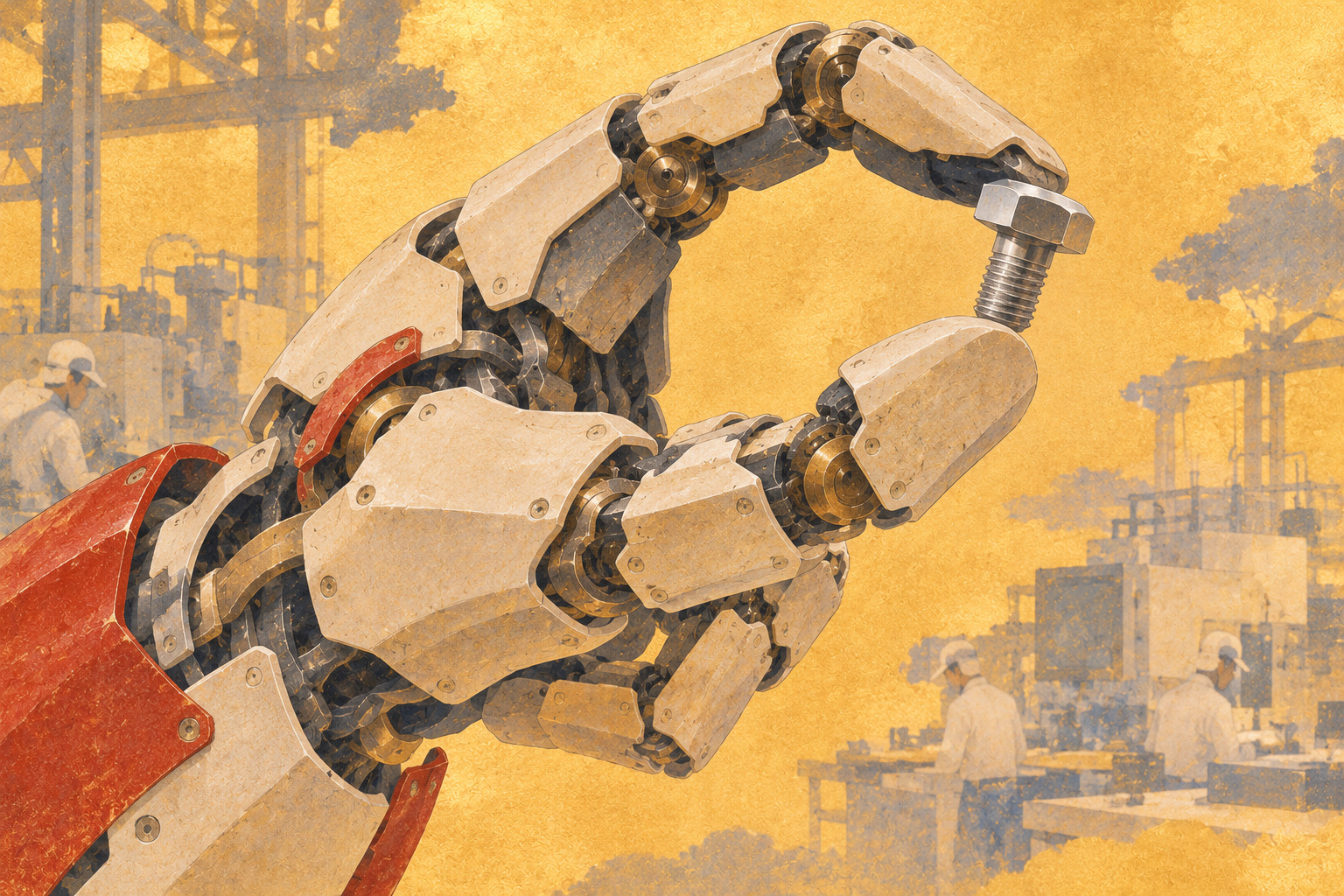
- The intelligence may be new. The fastener is not.
- What “physical AI” means once the demonstration ends
- From postwar Aichi to the industrial towns of Gifu
- What Kani actually makes
- First proposal: lighter, more vibration-resistant drone hardware
- Second proposal: make practical robots simpler to build and repair
- Third proposal: the crowded joints of humanoids
- A national robotics push provides the backdrop
- A startup search, not a production announcement
- The questions that will determine whether it matters
The intelligence may be new. The fastener is not.
Imagine a service robot opening a heavy door thousands of times, a drone landing after prolonged vibration, or a humanoid working through a long shift with its joints repeatedly accelerating and stopping. Software determines the action; the physical machine must endure it. A bolt that loosens, a joint too crowded to service or an assembly process that cannot be repeated economically can turn an impressive prototype into a poor commercial product. That is the opportunity identified by Aoyama Seisakusho, an established Japanese fastener manufacturer whose Kani factory is in Gifu Prefecture. On November 4, 2026, the prefectural government named the plant among five participants in its open-innovation program. Aoyama’s proposed focus: applying the fastening and assembly capabilities developed for automobiles to the mass production of drones, robots and other “physical AI” hardware. The announcement is an invitation to collaborate, not the launch of a finished robot.
What “physical AI” means once the demonstration ends
Physical AI refers broadly to systems that perceive and act in the physical world, often combining machine learning with sensors, control software and mechanical devices. It is an evolving industry term, not a single technical standard. In manufacturing, the challenge is to turn a machine that can perform a demonstration into a reproducible, safe and maintainable product. A prototype may use bespoke brackets, manual adjustment and carefully selected components. A factory must ask different questions: Can the joint be assembled the same way every time? Will vibration loosen it? How will technicians replace a damaged part? Can suppliers deliver compatible components at volume? These are precisely the questions that a supplier accustomed to demanding automotive production environments understands.
From postwar Aichi to the industrial towns of Gifu
Aoyama traces its establishment to November 1950 in Konan, Aichi Prefecture. Its headquarters later moved to Oguchi, also in Aichi, in 1968. The Gifu connection developed through successive factories: an Ena operation in 1970, a Gifu plant in 1974 and Kani No. 1 in 1986. Additional Kani factories followed in 1988 and 1990. The distinction matters: Aoyama is not a company headquartered in Gifu, but the new robotics proposal is explicitly associated with its Kani operation. Its published corporate profile lists automotive bolts, nuts and resin fasteners alongside aerospace components. For 2025, it reports revenue of ¥213.9 billion and 5,495 employees across the company, figures that should not be mistaken for the output or employment of the Kani plant alone.
What Kani actually makes
Aoyama’s own domestic facilities directory lists the Kani factory at 1000-1 Nagabora, Kani City. Its principal product categories include high-performance bolts, special multi-stage bolts and M8 bolts. Such products rarely attract the attention given to motors or AI chips, yet they represent an industrial capability: shaping materials with precision, maintaining dimensions, supplying consistent batches, inspecting parts and supporting customers’ assembly operations. An automotive fastener must remain dependable despite vibration, heat and years of use. For robotics, manufacturing expertise may become especially valuable when engineers move from a few hand-built machines to hundreds or thousands of units. Aoyama has not, however, published evidence that these particular robot applications have already met production qualifications.
First proposal: lighter, more vibration-resistant drone hardware
The program website spells out the first proposed collaboration: jointly develop lightweight fasteners capable of resisting vibration, supported by domestic manufacturing, to enable faster on-site assembly and dependable supply of drones and unmanned vehicles. Weight is a persistent design constraint in flying machines. A lighter fastening arrangement could help, but simply reducing metal is not enough. Connections must survive dynamic loading, remain inspectable and allow service in the field. Testing would need to establish fatigue life, loosening resistance, assembly consistency and compatibility with the actual airframe. The publicly available project description gives no flight-test results, percentage weight reduction, customer name or certification claim. These are targets for collaboration, not outcomes.
Second proposal: make practical robots simpler to build and repair
Aoyama’s second area concerns autonomous mobile machines, collaborative robots and service robots. The stated aim is to reduce part counts and assembly work while improving maintainability. This could matter more than a dramatic laboratory demonstration. Fewer assembly steps can reduce production time, and joints designed for straightforward access can shorten downtime after a failure. Yet simplification is a design problem, not a contest to use the fewest possible screws. A connection must carry the required loads, be resistant to loosening and allow the right replacement procedure. A robot maker may value standardization and modularity; a safety-critical application may demand added redundancy. The business case will depend on documented manufacturing costs, service times and reliability—not on the appeal of the concept alone.
Third proposal: the crowded joints of humanoids
The third proposal is ambitious. Aoyama wants to explore fastening structures that combine dense component packaging at humanoid joints with high-speed, automated assembly. Unlike an industrial robot designed around one repeated movement, a humanoid may require multiple degrees of freedom in an arm, wrist, hand, hip or ankle. Motors, bearings, wiring, sensors and structural elements compete for limited space. The joining method has consequences for assembly sequence, tool access, heat, weight and repair. Automotive production has long demonstrated the importance of designing a product for efficient manufacture. That does not mean car fasteners can simply be transplanted into a humanoid. It means an experienced supplier may help solve problems best addressed before a robot’s mechanical architecture is finalized.
A national robotics push provides the backdrop
The Japanese government has explicitly tied AI and robotics to industrial diversification. Its 2026 manufacturing white paper discusses the challenge of combining AI models with computing, control, actuation and sensing into useful physical systems. Separately, the New Energy and Industrial Technology Development Organization, NEDO, described a 2026 domestic general-purpose robot development competition in which prototypes would be assessed before advancing to improved designs and, potentially, a mass-production phase. Aoyama’s Gifu program is not part of that competition based on the sources reviewed. The connection is conceptual: Japan’s robotics ambitions will ultimately be tested not only by intelligence, but by production engineering and total operating cost.
A startup search, not a production announcement
Gifu’s November 4 notice named five corporate participants. Three—Gifu Shimbun, Pacific Industrial and YKP Industry—began recruiting startup partners that day. Aoyama and paper specialist Tokoro were scheduled to open recruitment later; the program website described Aoyama’s entry as being prepared. The wider Gifu-OI program is intended for startups established roughly within the past decade and is open to qualified companies nationally. The prefecture scheduled matching and commercialization support from December through February and a results presentation for February 17, 2027. Until the relevant partner and project are disclosed, it would be misleading to write that Aoyama has secured a humanoid customer, demonstrated production-ready components or begun deliveries.
The questions that will determine whether it matters
There are practical tests for judging this initiative over the coming months. Does a partner bring a real engineering problem and documented specifications? Can the proposed joint survive vibration, fatigue and thermal cycling? Does it reduce assembly time without compromising service access? Is inspection repeatable, and is the cost competitive at realistic volumes? Finally, does the resulting hardware reach a customer, or remain a prototype? The venture could fail to produce a commercial product; many such collaborations do. Yet its premise points to an underappreciated reality of the physical AI boom: progress in machine intelligence increases, rather than removes, the need for excellent mechanical engineering. The future robot may be judged by its behavior. The factory in Kani is betting that its reliability begins with the pieces holding it together.
Sources and reporting method
Based on primary releases from Gifu Prefecture, program operators, Aoyama and Japanese government bodies. Proposals and established results are distinguished throughout.
- Gifu Prefecture: November 4 project announcement
- Gifu-OI: Aoyama project specifications and recruitment status
- Aoyama Seisakusho: corporate history
- Aoyama Seisakusho: company profile
- Aoyama Seisakusho: Kani plant details
- NEDO: Japanese general-purpose robot development competition
- Japan 2026 manufacturing white paper
- 2026 manufacturing white paper summary