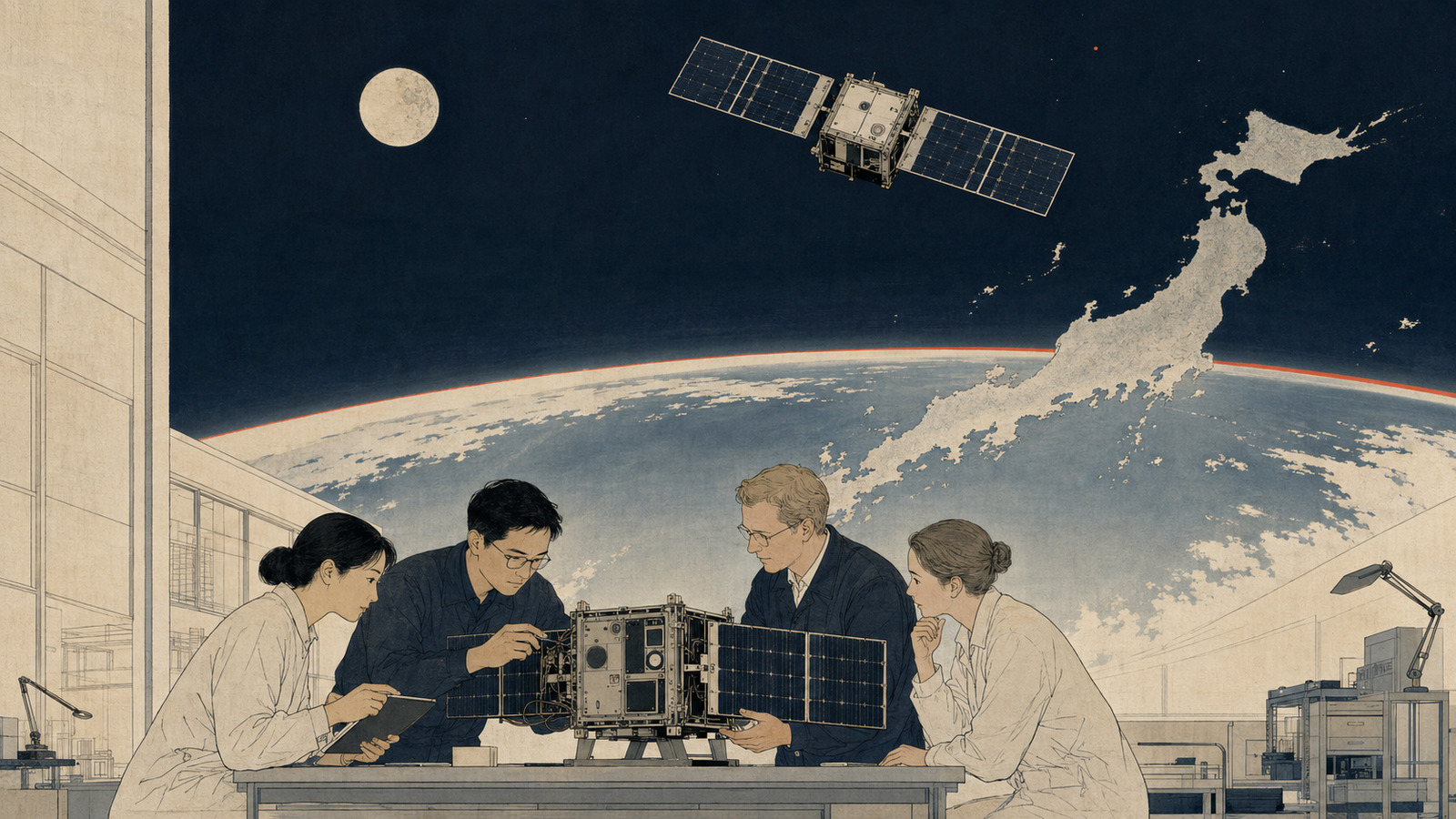
The small satellites were already built. Seven compact Earth-observation spacecraft from Tokyo’s Axelspace had been tested, shipped across the Pacific and attached to a launch stack at Vandenberg Space Force Base. What remained was a chain of work almost invisible to the public: reserve the right rocket and orbit, reconcile the spacecraft with the vehicle’s rules, move flight hardware across borders, integrate it without contamination, verify every electrical and mechanical interface, and make certain that seven satellites separated in the correct sequence after the Falcon 9 reached space.
That chain belonged to Exolaunch. On July 7, 2026, the Berlin-headquartered launch integrator deployed 49 customer satellites on SpaceX’s Transporter-17 rideshare mission. Seven were Axelspace’s new GRUS-3 optical microsatellites. All seven reached the intended orbit and transmitted their first signals. The same campaign carried spacecraft for more than 20 commercial, institutional and government customers and took Exolaunch’s disclosed flight heritage to 839 satellites across 48 missions.
For Exolaunch, this was more than another California launch. It was the most visible proof yet that its expansion into Japan had advanced from a Tokyo address to operating infrastructure. A year earlier, on July 7, 2025—a “triple seven” in Reiwa 7—the company formally established Exolaunch Japan Inc. It paired the incorporation with a 10-satellite launch agreement for radar operator Synspective and a strategic partnership with rocket developer Interstellar Technologies. By April 2026, Exolaunch had deployed eight experimental satellites for JAXA aboard a Rocket Lab Electron. In July, GRUS-3 turned the Japan strategy into a constellation-scale delivery.
A Satellite Company That Does Not Build the Satellite
The headline needs a precise definition. Exolaunch is a satellite deployment-technology and launch mission-management company, not a manufacturer of customer spacecraft. Its product is the connective layer between a satellite company and a rocket company. That layer includes purchasing launch capacity, selecting a mission and orbit, documenting interfaces, coordinating schedules, arranging testing and logistics, integrating spacecraft on the launch stack, and operating the hardware that releases them.
A rideshare launch resembles a container ship only from a distance. Dozens of satellites built by unrelated teams share a rocket, but each arrives with different mass properties, dimensions, electrical constraints, cleanliness requirements and orbital goals. The rocket operator cannot redesign the vehicle around every small customer. The satellite operator may launch too infrequently to maintain a permanent team fluent in every provider’s procedures. An integrator translates between the two.
Exolaunch also designs and manufactures the physical translation layer. Its EXOpod family encloses and releases CubeSats; the current product line includes 6U/8U, 12U and 16U configurations. The company says EXOpod Nova permits more lateral protrusion and mass than the traditional CubeSat design envelope. CarboNIX is its separation system for microsatellites, while EXOport and EXOtube aggregate multiple spacecraft on common structures. Sequencers and interface hardware ensure that deployment commands reach the correct mechanism at the correct time.
The moment of separation is brief, but its engineering consequences are permanent. A release that imparts too much shock can damage an instrument. An unintended rotation can complicate acquisition and power generation. A collision can destroy more than one mission. A failed door or clamp can leave years of work attached to an upper stage. Flight heritage therefore compounds: each clean deployment becomes evidence for the next customer, insurer and launch provider.
From a Berlin University Lab to the Rideshare Era
Exolaunch’s history begins at the Technical University of Berlin, not in a legacy aerospace conglomerate. Scientists and engineers from the university’s Department of Space Technology founded the company in 2010. It delivered its first commercial rideshare cluster—three small satellites—on a Soyuz mission in April 2013 and was recognized by TU Berlin as a startup of excellence.
The timing was important. Small satellites were becoming capable enough to perform serious Earth observation, communications and scientific work, but access to orbit remained organized around large primary payloads. Early commercial rideshare opportunities on Soyuz and India’s PSLV allowed small spacecraft to occupy otherwise unused capacity. The business problem was not merely finding spare mass. Someone had to collect customers, standardize their paperwork and hardware, and accept responsibility for the cluster as a system.
A July 2017 Soyuz mission showed the model scaling. Exolaunch procured capacity and supplied services for 15 satellites within a record-setting 73-smallsatellite manifest. The flight gave its EXOpod CubeSat deployer and EXObox sequencer their first flight heritage and included the 120-kilogram Flying Laptop from the University of Stuttgart, Exolaunch’s first microsatellite.
The center of gravity then moved toward SpaceX’s high-cadence Falcon 9 rideshares. Exolaunch signed a multi-launch agreement with SpaceX in 2020 and has flown on every Transporter and Bandwagon rideshare mission since those programs began, according to the company and its prospective owner. Standardized, frequently scheduled launches changed the integrator from a broker of rare opportunities into an operator of a repeating logistics network.
Transporter-17 illustrates the resulting scale. Exolaunch managed 19 microsatellites and 30 CubeSats from more than 20 customers on one Falcon 9. Its manifest ranged from Japanese optical imagers and Finnish radar satellites to Canadian, Czech, Spanish, British and American payloads. The company’s 800th deployment occurred inside that single campaign.
| Year | Exolaunch milestone | Why it changed the business |
|---|---|---|
| 2010 | Founded by TU Berlin space-technology scientists and engineers | University small-satellite expertise becomes a commercial integration company. |
| 2013 | First rideshare cluster, three satellites on Soyuz | Launch heritage begins in the early commercial rideshare market. |
| 2017 | 15-satellite cluster; first EXOpod and EXObox flight | Services and proprietary deployment hardware begin to reinforce each other. |
| 2020 | Multi-launch relationship with SpaceX | Regular Transporter and Bandwagon missions create repeatable global capacity. |
| 2025 | Tokyo office and Exolaunch Japan Inc. | Sales and mission support move closer to Asian satellite operators. |
| 2026 | JAXA deployments, GRUS-3 launch, 839 total satellites | Japan presence is validated by institutional and constellation-scale work. |
Why Japan, and Why Now
Japan is becoming a market in which launch integration is no longer an occasional procurement. Optical and synthetic-aperture-radar operators are building constellations that must be replenished and expanded. Universities need orbital demonstrations. Component makers need flight heritage. JAXA is creating routes for private technology to reach orbit. Defense, disaster response, maritime monitoring, agriculture and climate services are increasing demand for timely observation.
The policy signal is unusually large. Japan’s government aims to double the domestic space industry from roughly ¥4 trillion in 2020 to ¥8 trillion in the early 2030s. The Space Strategy Fund administered by JAXA is intended to reach ¥1 trillion over as many as ten years, supporting transportation, satellites, exploration and related technologies. Funding does not automatically produce flight opportunities, but it expands the number of projects that will eventually need rockets, integration and deployment hardware.
The legal architecture has also matured. The 2008 Basic Space Act explicitly connected space activity with citizens’ lives, national security, industrial competitiveness and private-sector commercialization. The 2016 Space Activities Act established licensing and liability rules for launching and controlling spacecraft, while a parallel remote-sensing law governs sensitive satellite data. Together, these measures shifted Japan from a program centered almost entirely on public institutions toward a regulated public-private market.
Yet Japan’s launch supply remains a constraint. H3 is designed to become the country’s competitive main vehicle, and private developers are pursuing smaller rockets, but constellation operators cannot wait for a single domestic schedule. They require access to Falcon 9, Electron and other vehicles while preserving the option to fly Japanese rockets as those services mature. A launch-vehicle-agnostic integrator benefits from precisely this mixed environment.
Three Deals Built the Japanese Beachhead
The first pillar is Synspective. The Tokyo radar-imaging company agreed in July 2025 to place 10 StriX satellites across multiple Exolaunch-managed missions, beginning in 2027. A synthetic-aperture-radar constellation derives value from repetition: radar can image through cloud and at night, but faster revisit requires more satellites in coordinated orbits. A multi-launch agreement reduces the risk that one unavailable rocket or one delayed slot stalls the entire buildout. Exolaunch’s Tokyo office promised direct collaboration and round-the-clock support through mission phases.
The second pillar is Interstellar Technologies. The Hokkaido rocket and communications company designated Exolaunch as a preferred provider of separation systems for its ZERO launch vehicle. Exolaunch received priority for future multi-launch contracts and access to unused payload capacity. The arrangement matters in both directions: ZERO can gain flight-proven deployment hardware and an international customer channel, while Exolaunch can add a Japanese launcher to the portfolio it offers satellite operators.
The third pillar is Axelspace. A December 2025 multi-launch agreement and related bookings covered eight launch opportunities across the company’s AxelGlobe Earth-observation and AxelLiner in-orbit demonstration businesses. Seven of those spacecraft became the July 2026 GRUS-3 formation. From about 585 kilometers above Earth, Axelspace says the new optical satellites can observe the same location daily north of 25 degrees latitude, with 2.2-meter ground resolution and a combined imaging capacity of 2.3 million square kilometers per day.
The GRUS-3 campaign made the value chain visible. Axelspace designed, built and will operate the spacecraft and sell the imagery. SpaceX supplied the Falcon 9 and conducted the launch. Exolaunch procured and managed the ride, integrated the satellites and deployed them. Each company owned a different layer, and none could complete the service alone.
The JAXA Mission That Demonstrated Institutional Trust
Commercial contracts establish a market; a national-agency mission establishes a different kind of confidence. On April 23, 2026, Rocket Lab’s Electron lifted off from Māhia, New Zealand, carrying eight satellites in JAXA’s Innovative Satellite Technology Demonstration-4 program. Exolaunch supplied EXOpod Nova deployment systems and integration services. All eight were released into orbit.
The payloads came from Japanese universities, research institutes and companies. They included educational spacecraft, an ocean-monitoring satellite, a multispectral-camera demonstrator and OrigamiSat-2, whose tightly packed antenna was designed to unfurl to 25 times its stowed size. The mission had been assembled to give new technologies the hardest credential in the space business: evidence from orbit.
For Exolaunch Japan, the mission joined local support with a global launch chain: Japanese payload owners, a German integrator, a U.S.-New Zealand rocket company and a New Zealand launch site. This is how a national space ecosystem now works even when sovereignty is an explicit goal. Resilience comes not only from owning every component, but also from retaining multiple trusted routes when one vehicle or schedule is unavailable.
A Longer German–Japanese Space Relationship
Exolaunch did not arrive in a vacuum. Germany and Japan have spent years learning to divide difficult space missions into complementary pieces. DLR and JAXA expanded their strategic partnership framework in 2022, covering research in space, aeronautics and related technologies. Their cooperation ranges from Earth observation to exploration and reusable launch systems.
The German-French MASCOT lander rode Japan’s Hayabusa2 spacecraft to asteroid Ryugu and operated on its surface in 2018. Its successor in spirit is IDEFIX, the compact rover built by Germany’s DLR and France’s CNES for Japan’s Martian Moons eXploration mission. JAXA received the rover in 2024 for integration with MMX, which is designed to explore Phobos and return a sample to Earth.
On the transportation side, DLR, JAXA and CNES are developing CALLISTO, a 13-meter demonstrator intended to test vertical takeoff and vertical landing technologies for a reusable rocket stage. On Earth observation, JAXA and DLR signed an arrangement in 2024 for cooperation around the EarthCARE mission. These projects created institutional familiarity with one another’s engineering culture, quality systems and long planning horizons.
Exolaunch represents the commercial turn in that relationship. The earlier model exchanged instruments and research among national agencies. The new model also exchanges launch slots, integration labor, deployment mechanisms and customer access among private firms. The object moving across the border is no longer only a scientific instrument. It is a repeatable service.
From the Pencil Rocket to a Market of Launch Choices
Japan’s own space story began at a very different scale. In 1955, Hideo Itokawa’s University of Tokyo team tested a 23-centimeter Pencil rocket. Fifteen years later, after four failed attempts with the L-4S launcher, Japan placed OHSUMI into orbit on February 11, 1970, becoming the fourth nation to launch its own satellite. The achievement fused spacecraft and rocket development inside a national project.
The decades that followed produced scientific Mu rockets, NASDA’s practical satellite and liquid-launcher programs, the H-II family, and JAXA’s creation in 2003 through the merger of ISAS, NASDA and the National Aerospace Laboratory. Japan learned to build the mission, the satellite and the vehicle as a coordinated state system.
NewSpace unbundles that system. A university may buy a standardized satellite bus. A data company may operate dozens of spacecraft. A launch provider may sell a port rather than a whole rocket. An integrator may combine customers that never meet. This modularity lowers entry barriers, but it creates more interfaces. Exolaunch’s business exists because those interfaces are now numerous enough to be an industry.
The historical irony is productive. Japan’s earliest triumph was sovereign, vertically integrated access to orbit. Its next growth phase depends partly on being able to use many vehicles, countries and suppliers without losing control of safety, schedules or strategic technology.
What “Full-Scale Expansion” Does—and Does Not—Mean
Exolaunch has crossed several thresholds: a Tokyo office; a Japanese corporation; a local head and growing team; long-term agreements with Japanese satellite operators; a partnership with a prospective Japanese launcher; and completed work for JAXA and Axelspace. Those facts justify describing the move as a full commercial expansion rather than a trade-show visit.
They do not demonstrate a Japanese manufacturing plant. Exolaunch’s disclosed industrial expansion remains centered in Berlin, where the company said in early 2026 that it had enlarged its headquarters to about 1,400 square meters and its integration and launch-hardware facilities to more than 750 square meters. The Tokyo operation provides local business development, mission support and customer collaboration. If hardware production, environmental testing or launch-site integration is localized in Japan later, that would be a separate and material step.
Investors are preparing for such scale. In June 2026, EQT agreed to acquire Exolaunch from founder Dmitriy Sternharz. At announcement, the company reported more than 790 satellites across 47 missions and more than 200 commercial and government customers. EQT said it would invest in international expansion, product innovation and additional services. The transaction terms were not disclosed; completion remained subject to customary conditions.
Before that deal, Exolaunch projected that its team would grow by about 30 percent in 2026 and that revenue would be 250 percent higher than its record 2025 level. It also targeted more than 20 missions and several hundred satellite deliveries during the year. Those are management forecasts, not audited outcomes. Transporter-17 and the 839-satellite count show the operating base beneath the forecast; they do not guarantee the projection.
The Strategic Tension: Global Access Versus Sovereign Capacity
Japan wants both. Its satellite companies need the cheapest, fastest and most reliable routes available in the global market. Its government also wants domestic launch capacity, secure supply chains and less exposure to foreign political or scheduling decisions. Exolaunch can support both objectives only if it remains genuinely vehicle-agnostic.
The present business is heavily intertwined with SpaceX. Participation in every Transporter and Bandwagon mission is a powerful advantage: it provides cadence, data and trusted interfaces. It is also concentration risk. A launch failure, policy change, export restriction, pricing shift or manifest bottleneck at one provider would affect many customers at once. Adding Rocket Lab, emerging European vehicles and Japan’s ZERO can turn a marketing claim about choice into operational resilience.
Security adds another layer. Earth-observation and communications satellites increasingly serve both civil and defense users. Customer data, orbital parameters, payload specifications and deployment sequences may be sensitive. Japanese remote-sensing law, export-control regimes, launch-country rules and the requirements of the rocket operator can overlap. A local corporation helps with language and contracts, but it does not remove those obligations.
Orbital sustainability is equally practical. A launch integrator cannot decide every spacecraft’s end-of-life plan, yet it sits where manifests, orbit selection and deployment sequencing come together. As constellations multiply, customers and regulators will ask not only whether a satellite separated successfully but whether it can be tracked, controlled, deorbited and kept clear of other objects.
- Launch certainty: Is the capacity firmly contracted, and what happens after a delay or vehicle change?
- Interface ownership: Who approves mass properties, testing, waivers and late spacecraft changes?
- Flight heritage: How many deployments use the exact mechanism and configuration proposed?
- Data and cyber controls: Where are technical files stored, and who can access them?
- Export and customs responsibility: Which party handles licenses, temporary imports and controlled hardware?
- Failure allocation: What liability, insurance and reflight terms apply if the rocket or deployer fails?
- Orbital stewardship: How are tracking, collision avoidance and end-of-life requirements verified?
- Local support: Which decisions can the Tokyo team make without waiting for Berlin or the launch provider?
What Success in Japan Would Look Like
The first measure is repeat business. One spectacular launch can be a project; multi-launch agreements become infrastructure. Synspective’s 10-satellite plan, Axelspace’s eight booked opportunities and Interstellar’s longer-term relationship create a pipeline rather than a collection of announcements.
The second is diversity. If Exolaunch Japan serves only Japanese satellites riding Falcon 9 from California, it is a useful sales and support office. If it also brings foreign payloads to Japanese rockets, integrates Japanese technology demonstrations on multiple vehicles, and supports missions from Asian launch sites, it becomes a two-way regional hub.
The third is local technical depth. Customers will judge whether the Tokyo team can resolve interface questions, participate in design reviews and manage anomalies in Japanese, not merely introduce them to Berlin. Exolaunch’s appointment of Ichitaro Arisaka—an engineer and operations veteran with 16 years at Mitsubishi Electric—as head of Japan signals an attempt to build that credibility.
The fourth is resilience. Japan’s constellation builders need schedules that survive a delayed rocket, a failed test or a sudden change in orbit. The best integrator is not the one with a single cheap seat. It is the one that can re-plan a manifest without turning a one-month problem into a one-year interruption.
The Quiet Machinery Behind a Space Power
A launch is remembered as fire: engines, a bright plume, a vehicle rising from the coast. Exolaunch’s work is quieter. It is the manifest that balances. The customs document that arrives before the spacecraft. The fit check that catches an interference. The test record that convinces a launch provider. The sequencer that opens the right deployer. The spring or separation mechanism that pushes a satellite away cleanly enough for its own mission to begin.
That is why the German company’s Japanese expansion matters. Japan is already a spacefaring nation and a formidable satellite builder. What its emerging commercial sector needs is cadence—more experiments, more launches, more replenishment and more ways to recover when a schedule breaks. Integration is the discipline that converts ambition into cadence.
Transporter-17 supplied a vivid closing image. Seven Japanese satellites left one rocket, separated through German-designed infrastructure, called home, and began forming a new optical constellation. No single country or company owned the whole chain. Yet the chain worked.
Exolaunch’s wager is that this interdependence is not a temporary workaround on the way to a fully sovereign system. It is the permanent architecture of commercial space: national capability joined to global capacity through trusted, repeatable interfaces. In Japan, the company has moved beyond making that argument. It has begun to demonstrate it in orbit.
Sources, method and reporting note
Japan.co.jp identified the company in this story as Exolaunch and checked its Japan expansion against company releases, Japanese customers’ disclosures, JAXA and Rocket Lab mission records, Japanese law and government policy documents. Counts and growth projections attributed to Exolaunch are company figures. The article distinguishes a Tokyo subsidiary and signed customer work from a Japanese factory: Exolaunch has disclosed the former, not the latter. The company integrates and deploys satellites; it does not manufacture the customer spacecraft shown in the illustration.
- Exolaunch: Transporter-17, 49 deployments and the 839-satellite milestone, July 2026
- Axelspace: seven GRUS-3 satellites launched and communicating, July 2026
- Exolaunch / EQT: acquisition agreement and company scale, June 2026
- Exolaunch: eight JAXA satellites deployed on Kakushin Rising, April 2026
- Rocket Lab: Kakushin Rising mission record
- Exolaunch and Synspective: 10-satellite multi-launch agreement and Tokyo support
- Synspective: customer statement on the 10 StriX launches
- Axelspace: multi-launch agreement for eight launch opportunities
- Exolaunch and Interstellar Technologies: strategic launch partnership
- Interstellar Technologies: Exolaunch selected as preferred separation-system provider for ZERO
- Exolaunch: company origin at TU Berlin and launch history
- Exolaunch: EXOpod deployment-system description
- Exolaunch: 2026 growth plan and product outlook
- JAXA: Space Strategy Fund overview and ¥8 trillion industry goal
- Government of Japan: Basic Space Act
- Government of Japan: Space Activities Act
- JAXA: from the 1955 Pencil rocket to OHSUMI in 1970
- DLR: expanded German–Japanese aerospace partnership
- DLR: German–Japanese–French CALLISTO reusable-launch demonstrator
- JAXA/ISAS: handover of the German–French IDEFIX rover for MMX
