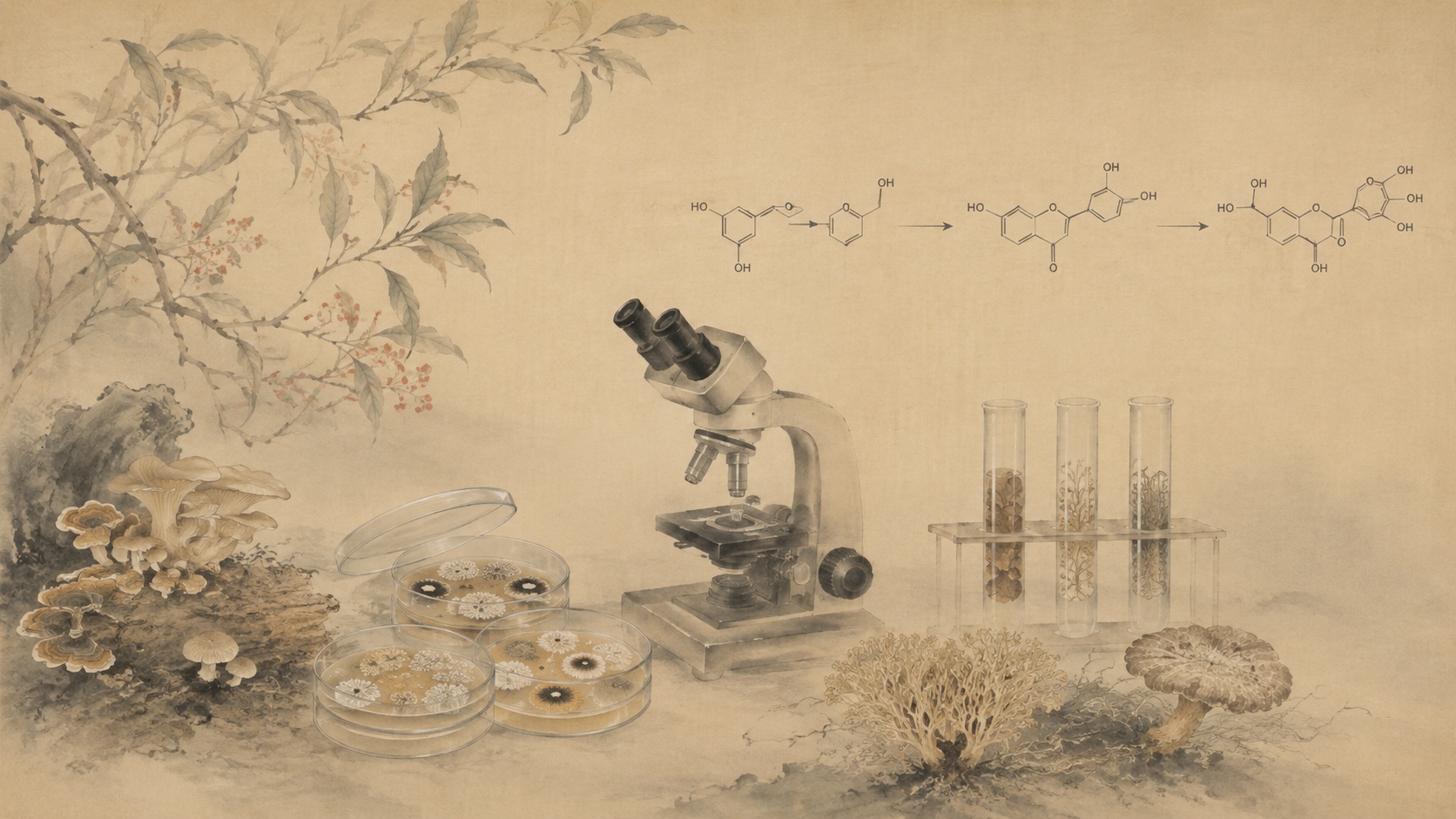
For more than half a century, chlorflavonin was an answer without a mechanism. Chemists knew its structure. They knew molds such as Aspergillus candidus could produce it. Isotope experiments had even suggested that the fungus assembled its flavonoid skeleton differently from higher plants. What remained missing was the complete molecular choreography: which genes encoded the enzymes, which intermediate followed which, and how the pathway avoided dissolving into a mixture of side products.
A team led by Teigo Asai, professor at Tohoku University's Graduate School of Pharmaceutical Sciences, with associate professor Taro Ozaki and researcher Sho Furumura, has now filled in that map. Their paper, published online in the Journal of the American Chemical Society on August 29 and announced by Tohoku University on September 2, reconstructs the full biosynthesis of chlorflavonin. It also explains a striking design principle: the pathway contains two equilibrium states, yet selective downstream enzymes pull only the needed molecular species forward.
Flavonoids were supposed to be plant chemistry
Flavonoids are one of the great chemical families of the plant kingdom. Their C6-C3-C6 skeleton gives rise to anthocyanins, flavones, flavonols, isoflavones and many related molecules. In plants they help color flowers and fruit, screen ultraviolet light, mediate interactions with microbes and contribute to defense. In human use, the same enormous family has become a source of pigments, nutraceutical ingredients and pharmaceutical leads.
The canonical plant pathway is so familiar that it became textbook chemistry. Since the first chalcone synthase gene was identified in 1983, chalcone synthase — a type III polyketide synthase — has been understood as the gateway enzyme that builds chalcone, which chalcone isomerase and other tailoring enzymes then convert into flavanones and the wider flavonoid family. Modern microbial-production programs often transplant those plant enzymes into yeast or Escherichia coli.
Chlorflavonin never fit comfortably inside that picture. It is a flavone made by filamentous fungi and decorated with chlorine and methoxy groups in a pattern unlike common plant flavonoids. The new JACS paper describes chlorflavonin and its congeners as the only known natural flavonoids from nonplant sources. The molecule looked plant-like. The machinery behind it was fungal.
A molecule discovered in 1969 left a 57-year puzzle
A. E. Bird and A. C. Marshall reported chlorflavonin's structure in 1969 after it was isolated as a new antifungal metabolite from cultures of Aspergillus candidus. In 1970, researchers at Beecham Research Laboratories described pilot-scale fermentation: one wild strain produced about 25 micrograms per milliliter after four to five days under strongly aerated conditions.
The early biosynthetic work was unusually ambitious for its era. Through the 1970s and into 1981, investigators fed labeled acetate, phenylalanine, cinnamate and benzoate to fungal cultures and traced where the carbon ended up. The pattern pointed to a route unlike higher-plant flavonoid biosynthesis — one built from a C6C1 starter and multiple C2 units. That was a powerful clue, but isotope maps could not identify the genes responsible or establish every enzymatic step.
The missing technology arrived decades later: genome sequencing, biosynthetic-gene-cluster analysis, heterologous expression and structural biology. Fungal genomes are crowded with clusters of genes that encode natural-product pathways, many of them silent under ordinary laboratory growth. Genome mining lets researchers search those sequences for unusual enzyme architectures, express the candidate genes in a tractable host, and see what chemistry appears.
In 2023, Tohoku found the fungal entrance ramp
Asai's group reported a decisive step in 2023. Mining fungal genomes for unconventional polyketide synthases, the researchers identified a new chalcone-forming system unlike the compact type III enzymes used by plants. In the chlorflavonin gene cluster, the polyketide synthase CfvA makes the chalcone precursor from a benzoate-derived starter, while the neighboring enzyme CfvF acts as a chalcone isomerase, cyclizing the molecule stereoselectively into a (2S)-flavanone.
That work showed that fungi had reached a familiar flavonoid architecture with unfamiliar machinery. Tohoku described CfvF as the first fungal example of a chalcone isomerase. The group also used Aspergillus oryzae — koji mold — as a heterologous host and built a route to the common flavonoid intermediate (2S)-naringenin.
Koji mold carries a cultural association with sake, miso and soy sauce, but in this context it is a laboratory chassis. A. oryzae is widely used in natural-products research because it grows well and can express large fungal biosynthetic gene clusters. The food connection should not be confused with the experiment: genetically engineered laboratory strains are being used as chemical factories, not as food fermenters.
The 2026 breakthrough was getting from the entrance to the exit
The new work reconstructed the complete chlorflavonin pathway in A. oryzae. The team expressed the full set of biosynthetic genes, confirmed production of chlorflavonin, and then built combinations of transformants that stopped or altered the pathway at different points. By isolating the accumulated intermediates and testing enzymes both in cells and in vitro, the researchers could establish the actual reaction sequence rather than infer it from gene annotations alone.
That matters because many of the enzymes were chemically promiscuous. A simple gene-by-gene list did not by itself reveal which reaction occurred first inside a living cell. The full-pathway reconstruction exposed two places where the intermediates did something that a tidy textbook arrow diagram hides: they existed as mixtures of interconverting forms.
Equilibrium one: CfvF moves a methoxy group between positions
CfvF had already been identified as the chalcone isomerase that helps create a flavanone. The new study shows it has a second role. It interconverts 6-methoxy and 8-methoxy flavanones, probably by reopening the flavanone through a chalcone-like state and reclosing it. Tohoku's Japanese release describes the net effect simply: the position of the methoxy group switches.
The two products behave as though they are in chemical equilibrium. That might sound inefficient. If a biosynthetic pathway wants one final compound, why generate two versions of the same intermediate?
The answer is downstream selectivity. The next enzyme accepts only one of the two forms. As that preferred species is consumed, the reversible CfvF reaction replenishes it from the other side of the equilibrium. The pathway therefore does not need to prevent the unwanted form from appearing; it can continuously harvest the wanted form from a dynamic mixture.
Equilibrium two: five molecular forms, one enzymatic exit
The late pathway is even more striking. The flavin-dependent oxygenase CfvI oxidizes an otherwise unreactive 2,3-double bond and produces a hemiacetal-containing intermediate. That product does not remain as a single structure. According to the Tohoku release, it exists as a mixture of five chemical species.
Then CfvK, a dehydratase, performs the decisive act of molecular sorting. It selectively converts only the D-iv form into the product stream that leads to chlorflavonin. The group solved the crystal structure of CfvK, analyzed complexes with substrate and product, and used site-directed mutagenesis to identify residues that determine the enzyme's selectivity.
That turns an abstract statement — “the enzyme is selective” — into a structural explanation. The protein's binding site recognizes one geometry from a fluctuating five-member ensemble. The overall pathway becomes reliable not because every earlier reaction is perfectly exclusive, but because the next enzyme makes a stringent choice.
Its pathway behaves more like molecular traffic control: chemistry creates options, enzymes keep choosing the exit that moves production forward.
Two ways to build a flavonoid skeleton
| Feature | Typical plant pathway | Chlorflavonin pathway |
|---|---|---|
| Chalcone formation | Type III chalcone synthase | Unconventional fungal polyketide synthase CfvA |
| Early cyclization | Plant chalcone isomerase | Fungal CfvF forms a (2S)-flavanone |
| Pathway behavior | Usually depicted as sequential tailoring | Contains two equilibrium states |
| Late selectivity | Varies by pathway | CfvK selects one species from a five-form mixture |
| Production platform | Plant enzymes often moved into yeast or bacteria | Fungal enzymes reconstructed in A. oryzae |
Why would evolution keep such an apparently messy pathway?
Biochemical diagrams encourage us to imagine metabolism as an orderly series of handoffs. Real chemistry is less obedient. Intermediates can rearrange, equilibrate, hydrate, dehydrate or be accepted by more than one enzyme. The engineering problem is not necessarily to eliminate all that chemical freedom. It is to keep flux moving toward a useful endpoint.
Chlorflavonin provides a vivid example. CfvF and CfvI allow molecular diversity to arise; downstream enzymes impose selectivity. From a synthetic-biology perspective, that suggests a useful design principle. Instead of demanding that every upstream catalyst generate a single pure intermediate, engineers may be able to exploit reversible or promiscuous chemistry and place a highly selective enzyme at the branch where control matters most.
It also changes how biosynthetic pathways are discovered. Gene annotations can tell researchers that an enzyme resembles an oxygenase or methyltransferase. They cannot necessarily predict equilibrium behavior, unexpected second functions or which member of a dynamic mixture will be accepted next. Those features only become visible when the pathway is rebuilt and its intermediates are physically isolated.
Koji mold becomes a test bed for making molecules nature rarely supplies
Once the complete pathway had been reconstructed, the team could do more than explain chlorflavonin. It could treat the enzymes as a toolkit. By combining the biosynthetic logic with alternative substrates and pathway configurations, the researchers report preparing 46 flavonoids, including rare compounds and structures not found in nature.
This is the practical appeal of a fungal production platform. Natural products can be scarce because the source organism makes them only under particular conditions or in tiny amounts. Plant-derived flavonoids may require agricultural material, extraction and complex purification. Total chemical synthesis can become costly as structures gain stereochemistry and multiple decorations. Engineered microbes offer a third route: feed carbon to a cell and let enzymes perform the difficult transformations.
But “platform” is not the same as “factory.” The Tohoku announcement does not establish industrial titers, commercial cost, long-term strain stability or manufacturing economics for all 46 products. The achievement is a rational framework for biosynthetic access. Scaling it is a separate engineering problem.
The tuberculosis angle is important — and easy to overstate
Chlorflavonin's pharmacological history is one reason chemists keep returning to it. Tohoku describes the compound as showing strong activity against tuberculosis bacteria and pathogenic fungi and as a prospective lead for drug discovery. A 2025 independent study screening a marine-derived fungal library reported a chlorflavonin MIC90 of 2.6 micromolar against Mycobacterium tuberculosis; several semisynthetic derivatives reached 0.7 to 1.0 micromolar in the same type of laboratory testing.
Those are meaningful discovery-stage numbers, not a clinical result. A molecule can inhibit a pathogen in vitro and still fail because it is toxic to human cells, poorly absorbed, rapidly metabolized, chemically unstable or ineffective in an animal or patient. The new biosynthetic platform helps at an earlier bottleneck: it may make it easier to produce analogues in sufficient diversity to test which structural changes improve potency, selectivity and drug-like behavior.
The medical need is real. The World Health Organization's 2025 Global Tuberculosis Report estimated 10.7 million people developed TB in 2024 and 1.23 million died. Yet it would be a mistake to jump from that burden to a claim that chlorflavonin is a future TB drug. The scientifically defensible statement is narrower and still significant: the pathway now gives medicinal chemists another way to access and diversify an unusual natural-product scaffold.
From an antifungal curiosity to a synthetic-biology toolkit
1969: The chemical structure of chlorflavonin from Aspergillus candidus is reported.
1970: Pilot-scale fermentation conditions are described.
1973–1981: Isotope-labeling studies point to a fungal biosynthetic route unlike that of higher plants.
2023: Tohoku researchers characterize fungal chalcone-forming machinery, including CfvA and CfvF, and establish an A. oryzae flavonoid platform.
2025: An independent study revisits chlorflavonin's antitubercular activity and semisynthetic analogues.
2026: The full pathway, its two equilibrium states and CfvK's structural basis for selectivity are resolved; the platform is expanded to 46 flavonoids.
The history is a reminder that natural-products research does not proceed in a straight line either. In 1969, chlorflavonin was a strange antifungal molecule. In the 1970s, isotope tracers showed that its carbon skeleton followed an unusual route. In 2023, genome mining exposed the enzymes that build the entry scaffold. Now structural biology and synthetic biology have turned the old mystery into a programmable system.
The next questions are engineering questions. Can CfvF's interconversion be biased to favor different substitution patterns? Can CfvK's binding pocket be redesigned to accept another member of the five-form equilibrium? Can methylases, halogenases and oxygenases from other fungal pathways be mixed into the system without collapsing flux? And can any useful product be made at industrially relevant yield and cost?
Fungi have always been extraordinary chemists. Penicillin made that obvious to medicine; statins, immunosuppressants and countless research molecules reinforced the lesson. The chlorflavonin pathway adds a subtler one. Biological precision does not always mean preventing molecules from wandering. Sometimes it means allowing them to wander — and placing the right enzyme at the point where a choice must finally be made.
Sources
- Tohoku University, “Elucidation of the biosynthetic pathway of a flavonoid made by mold” — September 2, 2026; Japanese primary release for the study.
- Tohoku University full press release (PDF) — detailed pathway, equilibrium states, enzyme terminology and 46-flavonoid platform.
- Furumura et al., “The Biosynthesis of a Fungal Flavonoid, Chlorflavonin, Precisely Controlled by Two Types of Equilibrium States,” Journal of the American Chemical Society — published online August 29, 2026.
- Tohoku University, 2023 release on fungal chalcone synthase and chalcone isomerase — earlier CfvA/CfvF work and the A. oryzae platform.
- Furumura et al., “Identification and Functional Characterization of Fungal Chalcone Synthase and Chalcone Isomerase,” Journal of Natural Products — 2023.
- Bird & Marshall, “Structure of chlorflavonin” — 1969.
- Munden et al., “Production of Chlorflavonin, an Antifungal Metabolite of Aspergillus candidus” — 1970.
- Burns et al., “Biosynthesis of chlorflavonin in Aspergillus candidus: a novel fungal route to flavonoids” — 1979.
- “Screening, Discovery, and Optimization of the Natural Antitubercular Chlorflavonin from a Marine-Derived Fungal Library” — 2025 in vitro antitubercular work.
- World Health Organization, Global Tuberculosis Report 2025 — global disease-burden context.
This report was checked against public sources available in the early hours of September 4, 2026 JST. Japanese names, titles and technical terminology were prioritized from Tohoku University primary materials; official Japanese sources support the readings Teigo Asai (浅井禎吾/あさい・ていご), Taro Ozaki (尾﨑太郎/おざき・たろう) and Sho Furumura (古村翔/ふるむら・しょう). Chlorflavonin is described as a drug-discovery lead, not an approved medicine. Antitubercular potency values are in vitro results. The reported panel of 46 flavonoids demonstrates research-scale biosynthetic access, not industrial manufacturing performance.
Image rights: © 2026 Japan.co.jp. AI-assisted editorial illustration. Unauthorized republication or reuse is prohibited. For licensing, use the contact page.