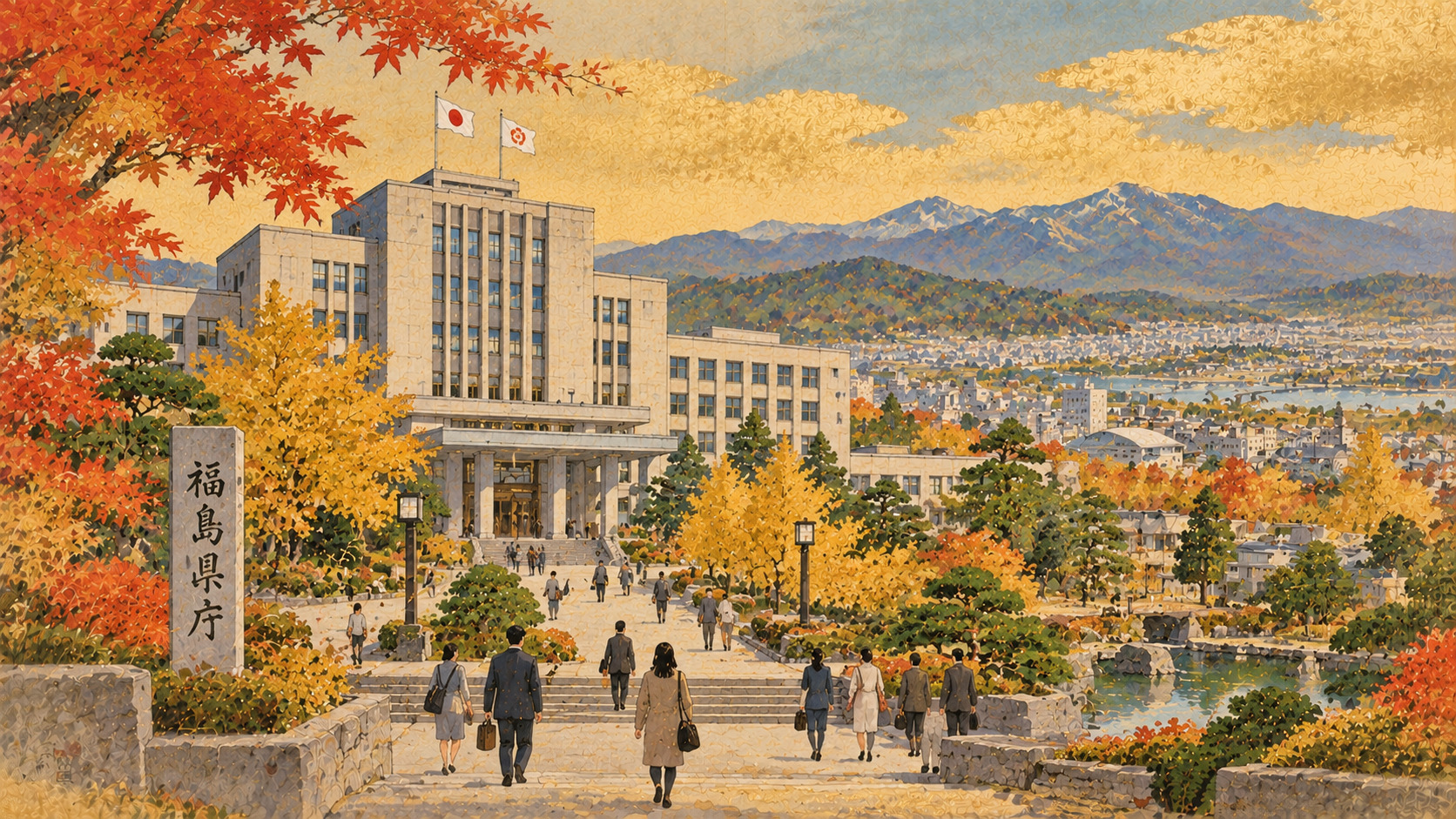
A landslide victory, a minority turnout
Fukushima Governor Masao Uchibori won a fourth term in the October 25, 2026 election with 585,641 votes. Election-commission data put turnout at 44.05 percent, versus 42.58 percent four years earlier. Local reporting calculated his share of valid ballots at 90.76 percent. Seven candidates, including six challengers, contested the race—a record field for a Fukushima governor election.
A victory margin this large has political meaning, but percentages require careful denominators. The 90.76 percent figure refers to valid votes cast, not all eligible voters. More than half the electorate did not turn out. A mandate for continuity therefore coexists with a serious question about democratic participation. The result is neither an uncontested election nor a survey of every resident’s views.
The fourth term has not begun yet
The election was held October 25, and Uchibori’s next four-year term is scheduled to begin November 12. For a November 1 report, “reelected” and “preparing to begin a fourth term” are accurate; “now serving his fourth term” would be premature.
Japanese election paperwork may show his registered campaign form as 内堀まさお. The governor’s official name is 内堀雅雄, read Uchibori Masao. Japan.co.jp has checked these forms against the prefecture and election authorities.
A governor shaped by the nuclear-disaster years
Born March 26, 1964, in Nagano Prefecture, Uchibori graduated from the University of Tokyo’s Faculty of Economics and entered Japan’s Home Affairs Ministry. He later held senior Fukushima prefectural posts and served as vice governor from December 2006 until September 2014. He was part of the prefectural leadership when the 2011 earthquake, tsunami and Fukushima Daiichi nuclear disaster changed the region’s future.
He first became governor in November 2014, subsequently winning in 2018 and 2022. Such continuity can help sustain long-term programs, yet it also concentrates public responsibility: decisions across three completed terms can now be evaluated against their stated goals rather than only their intentions.
Fifteen years after 2011, recovery remains uneven
Fukushima’s post-disaster recovery cannot be captured by a single success-or-failure verdict. The prefecture says difficult-to-return areas remain in parts of seven municipalities: Minamisoma, Tomioka, Okuma, Futaba, Namie, Katsurao and Iitate. Other evacuation classifications have been lifted, but an administrative change does not automatically restore a school, clinic, grocery store, employment base or household’s willingness to return.
At an October 5 press conference, Uchibori said the evacuation-designated share of prefectural land had fallen from roughly 12 percent after the accident to about 2.2 percent. That is his publicly stated measure of progress; it should not be mistaken for the percentage of displaced residents who have rebuilt their lives.
The demographic clock: 1.69 million residents
Fukushima Prefecture’s estimate for October 1, 2026 counted 1,693,692 residents. The latest monthly movement recorded 641 births and 1,933 deaths, producing natural decrease of 1,292. With 1,879 arrivals and 2,012 departures, net migration was negative 133. The combined monthly change was minus 1,425.
Population contraction reaches well beyond electoral politics. It affects employers, hospitals, elder care, school systems and the finances of dispersed municipalities. These are administrative population estimates, not a count of people who voted or a forecast of every community’s future.
Why retaining young people and women matters
In a preelection questionnaire published by Fukushima TV, Uchibori described demographic decline as the combined effect of births and deaths and of migration. He advocated support from marriage and pregnancy through child-rearing, while specifically acknowledging the continuing outflow of younger residents and women. He also called for policies to encourage people to stay, return or move into the prefecture.
The policy challenge is larger than a slogan about population. Better career opportunities, predictable wages, accessible child care, education and mobility may determine whether people can build lives locally. The test will be whether measurable trends change, not whether another strategy document is published.
Three regions, different definitions of success
Fukushima’s coastal Hamadori region faces distinctive reconstruction and decommissioning questions. Inland Nakadori includes major administrative and commercial centers. Aizu has important tourism, agriculture and manufacturing communities. A prefecture-wide investment headline can conceal differences in housing, wages, transport access and job creation between these places.
New laboratories, robotics facilities and industrial initiatives may generate opportunity, but physical construction is not itself proof of durable local prosperity. Independent assessment should track local procurement, worker retention, new businesses, pay and employment outcomes—not simply announced capital expenditure.
The quieter election story lies in participation
Municipal election notices show that turnout differed substantially even within Fukushima. Namie recorded 36.97 percent and Okuma 37.47 percent, compared with 44.05 percent prefecture-wide. Those numbers deserve investigation, not quick moral conclusions: displacement, registered residence and local circumstances may influence participation.
The existence of six challengers also matters. Fukushima voters were offered a contest, even if the incumbent faced no rival approaching his eventual support. Presenting the result as an unopposed acclamation would erase both the other candidates and those who supported them.
A new mandate meets a long budget calendar
Uchibori’s next term is set to run from November 12, 2026 to November 11, 2030. Policy, however, is implemented through annual budgets, municipal agreements and national funding decisions. In the four years ahead, the administration will need to demonstrate how its plans translate into functioning services and resilient local economies.
Potential scorecards include access to essential services in reopened areas; long-term housing and business occupancy; youth retention; demographic trends by municipality; and independently audited reconstruction outcomes. These are proposed tests of policy, not promised government targets.
What election night cannot resolve
The future of Fukushima is more than a nuclear-recovery story. Residents seek good schools, interesting work, affordable housing, transport, healthcare and the chance to participate in cultural and civic life. Some communities are rebuilding after extraordinary disruption; others face demographic pressures common throughout rural Japan.
Uchibori’s 585,641 votes establish an emphatic reelection. The 44.05 percent turnout warns against equating it with universal agreement. The lasting verdict on his fourth term will depend on how much practical choice Fukushima residents gain over the next four years.
Sources and verification
Cross-checked election authorities, prefectural statistics, the governor’s published statements and local reporting through October 29, 2026. No direct interview with the governor or candidates was conducted.
- National association of election commissions: gubernatorial results
- Fukushima Prefecture: 23rd gubernatorial election
- Date City: certified local election returns
- Fukushima: October 1, 2026 population estimate
- Fukushima: governor profile
- National Governors Association: Uchibori biography
- Fukushima: reconstruction of evacuation areas
- Fukushima: governor press conference October 5
- Fukushima TV: result and turnout
- Fukushima TV: candidates on population decline
- Fukushima: 2011 disaster and displacement records