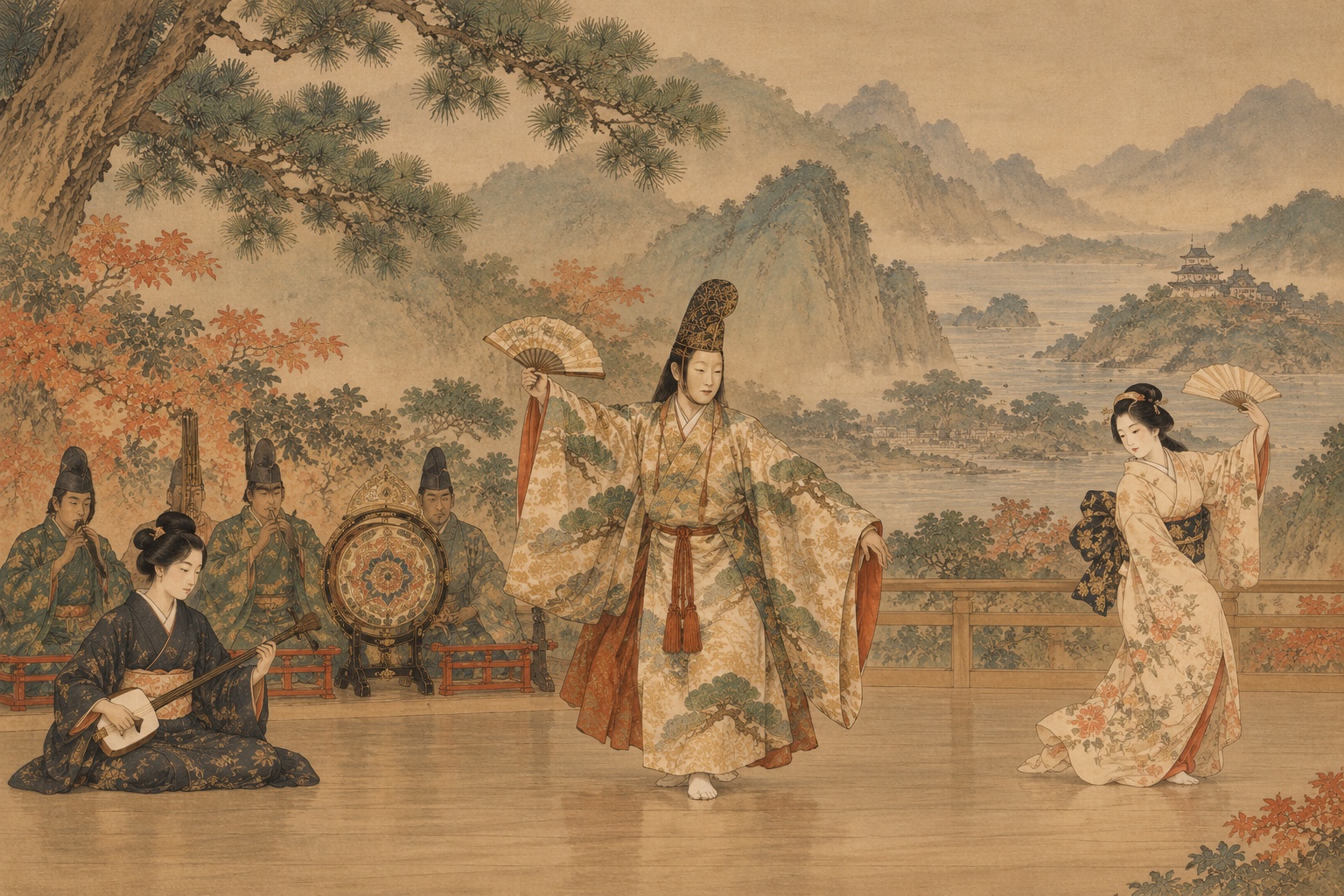
A Noh stage does not have to hold only Noh. On October 17, the 40-year-old Ohori Park Noh Theater in Fukuoka will host the 2026 Fukuoka Traditional Performing Arts Festa — FUKUGEI — with Japanese dance, Chikuzen biwa, Noh, shigin, a gagaku/contemporary-dance collaboration, kagura, shamisen and rakugo appearing in the same afternoon. The program announced by Fukuoka Prefecture on September 11 brings together eight forms whose histories, performance conventions and relationships with audiences are very different.[1]
The distinction matters: FUKUGEI is not fusing all eight traditions into one hybrid show. Noh remains Noh; Chikuzen biwa remains a sung narrative tradition; rakugo remains solo storytelling. The explicit cross-genre experiment in the official 2026 program is gagaku with contemporary dance, featuring ryūteki player Hiroshi Nakayama, dancer KOTOHA and textile artist loco. The festival’s larger idea is therefore not homogenization. It is adjacency — allowing one audience to move across several traditions in a single venue.
A theater built forty years ago for Noh becomes a shared platform
Ohori Park Noh Theater opened in 1986. Fukuoka Prefecture says that from the beginning it has hosted not only Noh but rakugo, concerts and other cultural events. The auditorium holds 562 people. The Noh stage itself is 5.64 meters square, and the hashigakari — the bridge-like passage from the mirror room to the main stage — stretches 10.35 meters.[2] [3] [4]
A Noh theater has a directional logic unlike a modern proscenium house. Main front, middle front and side front seats see different relationships among performers, pillars and the hashigakari. The pine painted at the back, the bare floor and the performer’s entrance route remain constant. Rather than rebuilding the set for every world, Noh asks the audience to rebuild the world mentally.
Put biwa, shigin, shamisen, kagura and rakugo into that architecture, and the same stage begins to mean something else. FUKUGEI’s interest lies partly in seeing how different performance practices occupy a space designed around one of Japan’s most codified theatrical traditions.
Noh is medieval — but Fukuoka’s Noh culture still produces new work
The Agency for Cultural Affairs describes Nohgaku as the combined tradition of Noh and kyogen, with Noh reaching mature form around the 14th century. It was designated an Important Intangible Cultural Property in 1957 and entered UNESCO’s Representative List of the Intangible Cultural Heritage of Humanity in 2008.[5]
For FUKUGEI 2026, Noh performer Hirono Kunuki is associated with selections from Yashima, Hagoromo and Funa Benkei, all connected to well-established repertory worlds. Yet Noh in Fukuoka is not maintained only through classical revival. Fukuoka Prefecture has also documented contemporary efforts around a newly created Noh work, Hibaru Zakura, based on the local story of cherry trees saved from road expansion. Kunuki’s husband, Takayasu-school ōtsuzumi performer Yasuyuki Shirasaka, was involved in developing that new work.[10]
That is useful context for FUKUGEI. Conserving form and creating new subject matter are not necessarily opposites. Shared technique is what makes deviation legible.
Chikuzen biwa is not simply “the ancient biwa tradition”
The word biwa can pull the imagination straight back to medieval blind priests chanting The Tale of the Heike. But Chikuzen biwa has a more recent history. The Agency for Cultural Affairs notes that the biwa itself arrived in Japan before the Nara period and later developed strong narrative traditions, while Chikuzen biwa emerged in Kyushu in the mid-Meiji period. Together with Satsuma biwa, it spread nationally from the late Meiji into the early Shōwa period.[7]
That modern Fukuoka origin makes its place in FUKUGEI particularly apt. Chobi Terada will perform Nasu no Yoichi. Fukuoka Prefecture’s previous FUKUGEI material identifies her as head of the Chikuzen Biwa Preservation Society and a master of the Reisei school; in the 2025 festa she performed Mimi-nashi Hōichi.[8] [9]
The story of Nasu no Yoichi is medieval. The Chikuzen-biwaretelling form is modern. That separation between story age and performance-form age is a reminder that “tradition” contains several historical layers at once.
Gagaku is older still — which makes contemporary dance feel genuinely distant
Gagaku occupies another time scale. The Agency for Cultural Affairs defines it as a broad tradition combining ancient Japanese court-related music and dance with forms introduced between roughly the fifth and ninth centuries from continental Asia and the Korean Peninsula, later reorganized in Japan. It became an Important Intangible Cultural Property in 1955 and entered UNESCO’s intangible-heritage list in 2009.[6]
FUKUGEI pairs Etenraku and other material with ryūteki player Hiroshi Nakayama, contemporary dancer KOTOHA and textile artist loco. The point need not be to make contemporary movement look “traditional.” The productive distance may be the opposite: long-breathed phrasing, the horizontal architecture of the Noh stage and the very different weight and timing of a contemporary dancer’s body can be allowed to remain different.
This is not FUKUGEI’s first deliberate crossing around gagaku. In 2025, the festival included a gagaku-and-keyboard collaboration with Hiroki Haruta and the Dazaifu Rengakai. In 2026, the experiment shifts from electronic harmony toward body and textile.[8]
Japanese dance, shigin, kagura and shamisen carry different histories too
The rest of the program widens the spectrum. Jugiku Wakayagi presents Japanese dance pieces including Tsuru Kame, Fuji Musume, Yūzen-zarashi and Sakura Sakura. Kosei Morita performs shigin including Sanju no Shutei ni Asobu. Iyasaka Kaguraza presents Shiki; Sae Fujimoto performs the shamisen piece Tanuki. Rakugo storyteller Bunta Tachibanaya closes another part of the program with a piece kept as a surprise.[1]
All can be placed under a broad cultural-policy label of traditional performing arts, but they are not the same kind of inheritance. The Agency for Cultural Affairs separately classifies gagaku, Nohgaku, biwa music, Japanese dance traditions and folk performing arts such as kagura. The shared umbrella is administratively useful; history still requires distinctions.[12]
That may be FUKUGEI’s real educational advantage. One audience can hear how silence works differently in Noh and biwa, how rhythm shifts between gagaku and shamisen, how a narrative voice changes from shigin to rakugo, and how a ritual-linked kagura body differs from Japanese dance.
On the day before the show, spectators become performers
FUKUGEI begins before the main performance. On October 16, Kunuki leads a Noh-mask experience for 30 participants, from elementary-school children through adults. Later that day, Tachibanaya leads a rakugo workshop for 20 participants, inviting them to climb onto the kōza and experience the storyteller’s position. Both workshops require advance registration and are free.[1]
That matters because unfamiliarity is one of the largest barriers to traditional performance. Put on a Noh mask and the limited field of vision immediately explains why tiny changes in head angle alter what an audience reads as expression. Sit alone on a rakugo platform and the difficulty of producing multiple characters and spaces with voice, gaze and minimal props becomes physical knowledge.
FUKUGEI 2025 included a kyogen workshop, and the prefecture says last year’s event filled to capacity. A free performance can reduce the cost barrier; a workshop addresses a different barrier — not knowing how to look or listen.[1] [8]
The lobby extends the idea beyond performance
The 2026 program also reaches into the theater’s common space. Chajiyu Kūkan will serve Japanese tea, while Iyasaka Kaguraza will display costumes and small performance objects.[1]
Bringing a kagura costume closer to the audience shifts it from a moving field of color into an object with weight, fabric, stitching and repair history. It reminds visitors that performing traditions are also material cultures maintained between performances — stored, cleaned, repaired, dressed and handed to the next performer.
The tea service is not a tea-ceremony performance, and the festival does not claim it is. But it changes the theater from a place where the audience arrives, sits and leaves into one where people can circulate among stage, lobby and workshop.
The theater’s 40th anniversary is being celebrated through several kinds of tradition
FUKUGEI is one part of a broader 40th-anniversary year. On September 23, “OHORI BLUE TRADITION 2026” uses the theater and surrounding park for Kokura Gion Daiko, regional furyū, Buzen kagura, Hakata Niwaka and Hakata spinning tops, alongside craft experiences and lighting. On October 11, six days before FUKUGEI, the theater presents a formal 40th-anniversary Noh program centered on Dōjōji.[11] [2]
That sequence is telling. One anniversary event goes deep into a major Noh work. Another spreads into the park and emphasizes local folk performance and craft. FUKUGEI asks audiences to cross between multiple stage traditions. A cultural institution does not have to choose only one role.
Transmission needs specialization — masters, schools, rehearsal, exact technique. It also needs entry points for people who do not yet know the vocabulary. The 40th anniversary becomes a test of whether one Noh theater can serve both.
- Notice how biwa, rakugo, kagura and Japanese dance each adapt to a stage architecture built for Noh.
- In the Etenraku collaboration, watch how gagaku’s timing and contemporary bodily movement meet without needing to become the same style.
- Listen to how a medieval tale such as Nasu no Yoichi is carried by Chikuzen biwa, a form that emerged in Meiji-era Fukuoka.
- Use the Noh-mask and rakugo workshops to see how physical experience changes what becomes visible in performance.
- After eight forms in one day, ask whether “traditional performing arts” feels more unified — or more diverse.
FUKUGEI’s strength may be that it refuses to make tradition singular
From a distance, “Japanese traditional performing arts” can look like one old cultural category. Up close, court gagaku, medieval Noh, Meiji-era Chikuzen biwa, spoken rakugo and community-rooted kagura come from different institutions, eras and social worlds.
FUKUGEI does not need to erase those differences to make them accessible. It can place them beside one another and let contrast do the teaching. Ancient repertory, later traditions and a 2026 cross-genre collaboration can occupy the same building without pretending to be the same thing.
Transmission requires two movements. Inside each form, technique must be passed accurately. Outside it, someone new needs a reason to take the first step toward the stage. At Ohori Park Noh Theater on October 17, FUKUGEI is not trying to blend eight traditions into one. It is opening eight doors in the same place.
- Fukuoka Prefecture: FUKUGEI 2026 announcement, Sept. 11, 2026
- Fukuoka Prefecture: Ohori Park Noh Theater 40th anniversary — opened in 1986
- Fukuoka Prefecture News, September 2026: 40 years of Ohori Park Noh Theater and its 562-seat auditorium
- Ohori Park Noh Theater: facility outline — construction, 562 seats, stage and hashigakari
- Agency for Cultural Affairs: Nohgaku — history, Important Intangible Cultural Property and UNESCO listing
- Agency for Cultural Affairs: Gagaku — historical components, Important Intangible Cultural Property and UNESCO listing
- Agency for Cultural Affairs: biwa — emergence of Chikuzen biwa in Kyushu in the mid-Meiji period
- Fukuoka Prefecture: FUKUGEI 2025 program — gagaku/keyboard, Chikuzen biwa, rakugo and other forms
- Fukuoka Prefecture: FUKUGEI 2025 program and performer profiles, including Chikuzen biwa artist Chobi Terada
- Fukuoka Prefecture: Noh performer Hirono Kunuki, Yasuyuki Shirasaka and contemporary Noh activity in Fukuoka
- Fukuoka Prefecture: OHORI “BLUE” TRADITION 2026 and the theater's 40th-anniversary cultural program
- Agency for Cultural Affairs: categories of intangible cultural properties in performing arts
Editorial note: The 2026 repertoire, performer names/readings, workshop capacities and registration terms are anchored in Fukuoka Prefecture's September 11 primary announcement. Only gagaku × contemporary dance is described as an explicit cross-genre collaboration; the other forms are not treated as if they share one historical lineage. The histories and cultural-property status of Nohgaku, gagaku and biwa are checked against Agency for Cultural Affairs sources. The event is scheduled for October 17, so this is a preview/history report, not a performance review.