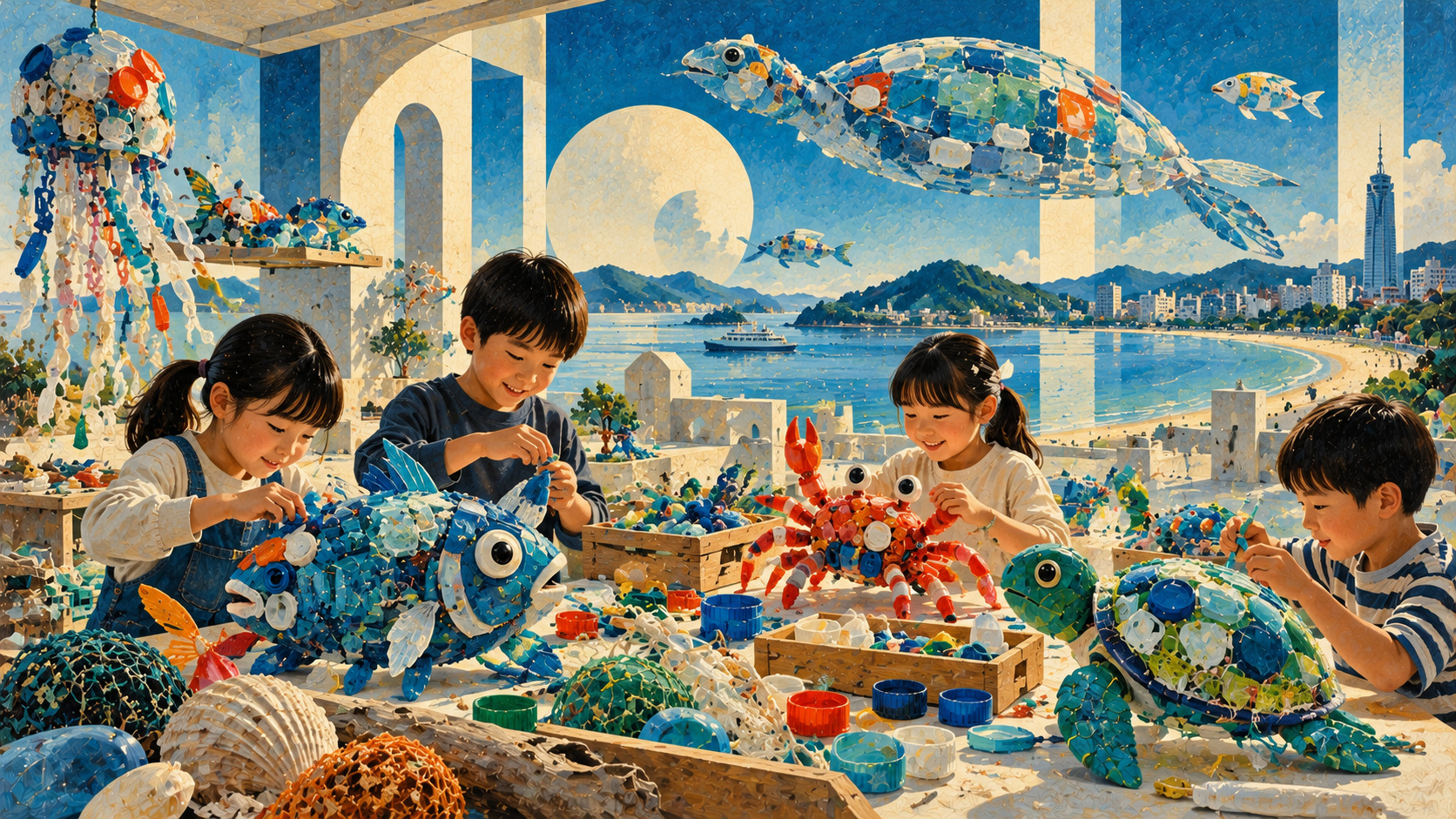
A decoration can begin a conversation about ocean pollution. It cannot by itself measure how much plastic is prevented from reaching the sea.
A message from the shoreline reaches a nursery school
On October 28, an unusual lesson is scheduled inside Shimizu Nursery School in Fukuoka City: children will examine the problem of marine plastic litter and turn material collected from local beaches into Christmas ornaments. The prefectural government announced the workshop on October 22.
It is a modest event, but it raises a serious question for a coastal prefecture. Can the simple act of handling recovered waste make the journey from consumption to the ocean understandable to children who may never have seen a beach cleanup?
What is scheduled—and what has not happened
The one-hour workshop is scheduled for Wednesday, October 28, from 1:30 to 2:30 p.m. at Shimizu Nursery School in Hakata Ward, operated by social welfare corporation Rin no Kai. The participants are the oldest children in the Kiku class.
Artist Minami Shibata, the organization Idobeta and other contributors are listed in the announcement. Fukuoka Prefecture says this is the first such nursery-school session in the current fiscal year, not the first time the prefecture has used recovered marine litter in an art project.
The project is specifically about Christmas ornaments
The planned program has two parts: learning about marine plastic waste and making and decorating ornaments with items gathered from prefectural shorelines. The announcement does not describe a workshop in which each child makes a sea animal, although the subject is ocean pollution.
That distinction matters for both journalism and illustration. The class is still in the future as of the October 25 edition. There are no confirmed finished ornaments, children’s remarks or measured changes in their attitudes to report.
From classroom tables to a government lobby
The children’s ornaments are scheduled to be shown in the first-floor lobby of the Fukuoka prefectural government building from December 15 through December 25. Work created inside a nursery school is thus intended to become a public installation seen by adults as well.
The broader program has used ornaments made from cleanup materials to decorate an object created by Shibata. The precise appearance of this year’s eventual installation and the number of items made by each child are not specified in the announcement.
Why the prefecture began putting waste into art
Since fiscal 2024, Fukuoka has operated an awareness campaign called Kaigan Hyōchaku Gomi Cleanup Daisakusen, approximately a “Coastal Washed-Ashore Litter Cleanup Campaign.” Beach-cleanup events supply recovered material for art-making and public displays.
The strategy is not to claim that a sculpture can clear the seas. It is to make discarded objects visible to people who might otherwise have no reason to examine where plastic packaging, fragments and other refuse eventually go.
A prefecture facing several different seas
Fukuoka borders waters including the Genkai Sea, Hibiki-nada, Suō-nada and Ariake Sea. Waste found on a shoreline can have many origins: improperly discarded consumer materials, fishing and marine operations, or items washed downstream by rivers.
Without inspecting an item and its recovery context, neither its country nor its original source can be inferred with certainty. The official notice does not offer a breakdown of the types or provenance of the material children will use.
The policy history goes back to 2012
Fukuoka adopted a regional coastal-litter action plan in March 2012 and revised it in March 2016 to expand designated priority areas. The policy aims to protect coastal scenery, wildlife habitat and living conditions by combining collection and treatment with prevention.
The nursery event belongs to this longer public-policy effort. Creative education may build interest, but physical cleanup, prevention, monitoring, waste management and enforcement are separate responsibilities with measurable consequences.
Why beach litter often begins far inland
Japan’s Ministry of the Environment emphasizes the connection between waste scattered on land, rivers and marine environments. Litter may enter watercourses, travel through catchments and ultimately become coastal or ocean debris.
That geography changes the central lesson. Keeping a beach clean is important, but a person can reduce marine litter without ever visiting one: by preventing waste from escaping into streets, streams and drainage systems.
The microplastic problem is larger than visible fragments
Sunlight, abrasion and other processes can break larger plastics into increasingly small pieces. Very small plastic particles are hard to recover once dispersed. The Japanese government has developed survey guidance covering litter types, quantities and movement from land to coastal waters.
Not every suspected effect on human health or ecosystems is fully established. Explaining uncertainty is compatible with explaining why leakage prevention matters. Young children do not need alarming claims to grasp that discarded materials can move into places where they do not belong.
Safety must be part of the story
Recovered marine debris can include sharp edges, contaminated surfaces, tangled line and small items that can be swallowed. Preparing such material for a nursery-school craft therefore requires deliberate adult screening and supervision.
The announcement does not spell out cleaning, disinfection, item-size rules or other workshop safeguards. These may well be in the organizers’ plan, but the available documents do not permit reporters to claim that any specific procedure has already been carried out.
Can an artwork change behavior?
A hands-on activity can give an abstract issue a concrete form. The deeper test is whether participants and families later connect that lesson to reducing avoidable waste and keeping discarded items out of waterways.
No follow-up evaluation has been published for this scheduled session. Responsibility should not be transferred onto preschool children: producers, municipal services, policymakers and consumers all shape the amount of plastic that escapes into the environment.
A public display—and an opportunity to follow up
Questions for the organizers include where the material was recovered, how it was screened for safety, how instructors explain ocean pollution to young learners and what messages will accompany the December display. After the event, the children’s actual experiences can be described with appropriate consent and careful observation.
The ornaments are not yet made. That is precisely why the next chapter matters: a day of crafting may become a lesson remembered long after the decorations come down, but proving its effect will take more than a colorful photograph.
Sources & reporting method
Based on the prefecture’s October 22 event notice, its coastal-litter policy, and Ministry of the Environment guidance. The workshop is scheduled, not completed. Handling procedures, exact litter origins and educational outcomes have not been independently verified.
- Fukuoka Prefecture: official October 22, 2026 event announcement
- Fukuoka Prefecture: marine-litter prevention policies
- Fukuoka Prefecture: 2012 coastal-litter plan, revised in 2016
- Japan Ministry of the Environment: marine plastic monitoring guidelines
- Japan Ministry of the Environment: legal framework for coastal litter
- Ministry of the Environment: national marine-litter policy