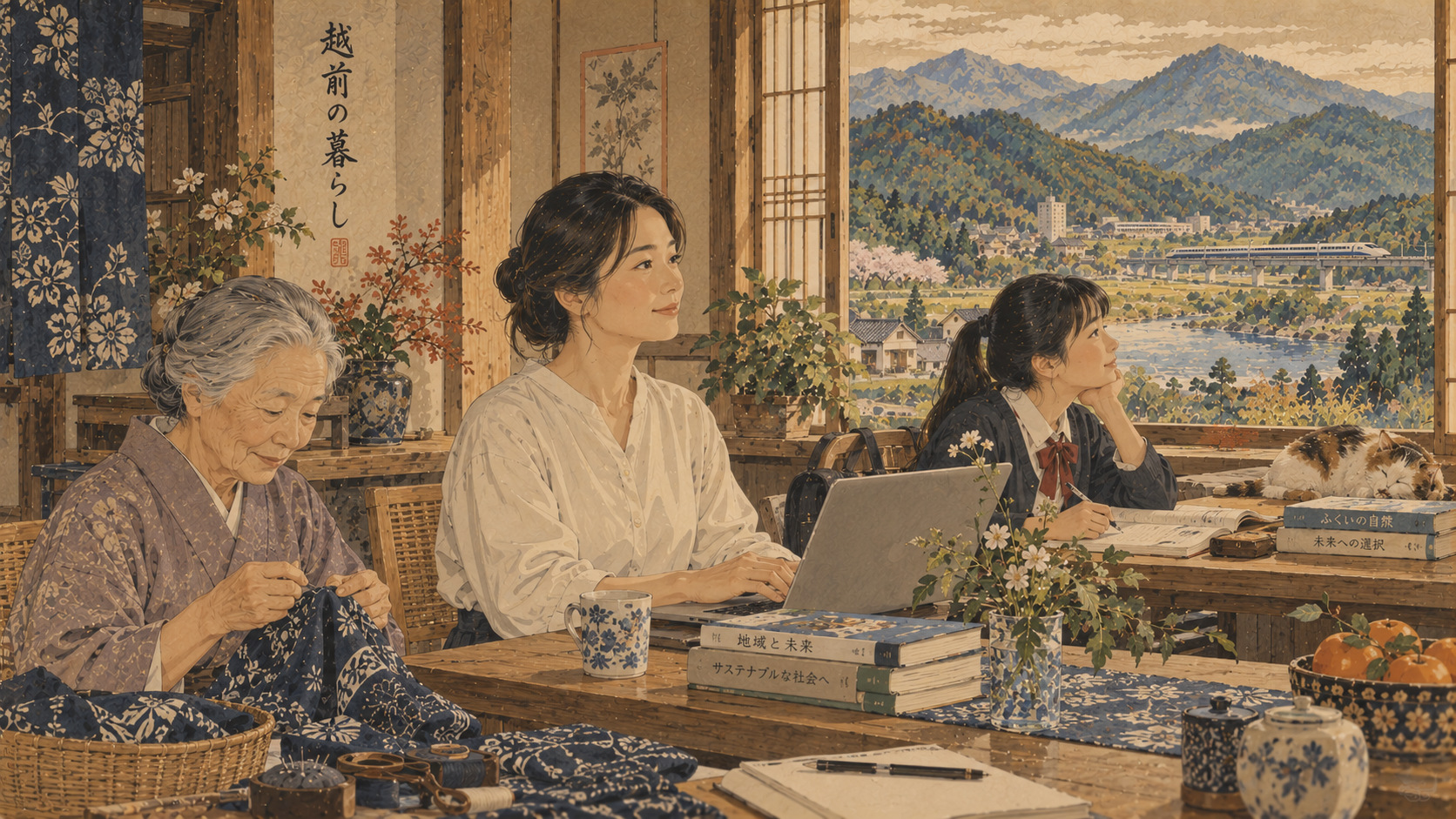
From a place where women work to a place where everyone can choose how to live.
A national distinction with a complicated meaning
Fukui has long occupied an unusual place in Japan’s labor statistics. In the 2020 census, 100,844 households with a married couple had both spouses employed. The resulting 61.2 percent dual-earner rate was Japan’s highest. Women’s employment rate, 55.6 percent, ranked second among the prefectures. Those figures reveal how central women’s paid work has become to the local economy. They do not, by themselves, reveal whether those women enjoy equal opportunities, adequate pay, leisure, or an equitable division of care at home. The difference between being employed and being empowered is the central question of Fukui’s family story.
Why work became a part of family life
Fukui’s economy developed through an unusually extensive landscape of specialized regional industries: textiles, eyewear, metalworking, agriculture, commerce and services. Women have long contributed to household businesses and local workplaces, though the conditions of that work have changed across generations. Kinship and intergenerational assistance are often part of the explanation for the prefecture’s high dual-earner rate. Yet that assistance is not equally available to newcomers, single parents or households living far from relatives. Census data show the rate climbing from 56.8 percent in 2010 to 58.6 percent in 2015 and 61.2 percent in 2020. The indicator covers general households containing a married couple, not every woman or every type of family.
Work is not the same as advancement
The challenge is to look beyond whether a woman has a job. How secure is it? Can she move into management, switch employers, retrain, start a company, or return after parental leave? Is unpaid domestic labor shared? Does caring for an older relative end an otherwise promising career? None of those questions can be answered by the dual-earner ranking. A prefecture can be successful at bringing women into employment while still confronting unequal earnings, underrepresentation in leadership and the invisible burden of care. Fukui’s own 2026 initiatives addressing domestic work and external mentoring indicate that these remain live policy issues.
A shrinking population and more households
A freshly published census provides the wider context. Fukui’s population was 728,588 in October 2025, a drop of 38,275 people, or 4.99 percent, from 2020. Yet households rose by 4,104 to 295,766. The average number of people in a general household declined from 2.57 to 2.40. These numbers describe a region in which household structures are changing even as the overall population falls. They do not prove a single cause. More single-person households, older households and smaller families can create different demands for housing, transport, social care and community services. Policies framed only around a conventional two-parent family risk missing those needs.
What the Fukuiku initiative can do
The prefecture’s Fukuiku childcare portal assembles information on pregnancy, medical support, nursery and kindergarten options, temporary care, support for returning to work and events for families. In 2026, prefectural guidance also described vouchers for specified households using Fukuiku support providers or childcare taxis. These included a 48,000-yen shared-use voucher for eligible single-parent, multiple-birth and medically complex child-care households, and a 5,000-yen scheme for eligible expectant mothers. Such initiatives should not be mistaken for universal cash payments. Eligibility, prior application and actual service availability matter. A benefit listed online is not necessarily a service that a parent can readily use in a remote town or outside conventional working hours.
The hours between school and home
A parent’s workday rarely fits neatly inside a school day. After-school clubs, medical appointments, illness, travel between facilities, school holidays and the needs of multiple children can turn apparently straightforward employment into a complicated daily operation. Fukui maintains programs for after-school provision, childcare advisers, temporary assistance and places where children can play. These may make a material difference. Their reach should be judged by geography, availability, affordability and what families themselves report—not solely by the number of programs on a government website. As municipalities lose population, maintaining an accessible network of schools and childcare becomes harder, not less important.
A new era of pay transparency
Changes to Japan’s Women’s Advancement Act took effect in April 2026. Employers with 101 or more regularly employed workers became subject to expanded obligations to publish information on gender pay differences and the share of women in management. The Fukui Labour Bureau has explained the requirements, while the prefecture offers businesses support for preparing disclosures. There are already useful but narrowly defined figures: Fukui’s prefectural government reports that women held 25.3 percent of its management positions in fiscal 2025; the University of Fukui disclosed a 21.0 percent share among its managers in 2026. Neither is a prefecture-wide measure of private-sector leadership. Transparency offers the possibility of accountability only when figures are comparable and action follows.
Higher education and the next generation
Universities, vocational institutions and employers form a crucial bridge between school and a lifetime of choices. The University of Fukui’s 2026 gender-disclosure report offers a case study in why composition matters. It reported an overall women-to-men earnings ratio of 94.4 percent, while the ratio for regular employees was 75.1 percent. The university noted that occupational mix and the limited representation of women among managers influence the aggregate figures. These ratios are not proof that two people doing identical jobs are paid differently, nor are they representative of all Fukui employers. They do, however, show why career paths, recruitment, seniority and promotion deserve attention alongside starting salaries.
Industry can build pathways—or bottlenecks
Sabae eyewear, Echizen textiles, medical services and Fukui’s numerous local enterprises provide different routes into work. Some are highly specialized; others offer opportunities for entrepreneurship, creative design or professional practice. In July 2026 the prefecture publicized exchanges for women working in manufacturing and an external mentoring program connecting them with experienced women leaders. These are promising mechanisms for broadening networks beyond one workplace, but the number of people reached, career progression after participation and retention over time are the proper tests. A strong regional economy needs room for more than one idea of a successful woman.
A family policy should support choices, not prescribe them
Declining births and population are serious administrative questions, but they should not turn women’s lives into instruments of a demographic target. A person’s decision to have children, and when, remains personal. Public policy can instead make choices more feasible by reducing the costs and obstacles around childcare, fertility treatment, accessible healthcare, secure employment and parental leave. Fukui’s 2025–2029 execution plan describes its aspiration to develop a “Fukuiku Prefecture” in which children, young adults and families can pursue diverse ambitions. Outcomes will require careful measurement: the use of services, the division of care between parents, economic security and the experiences of children themselves.
Government as an employer under scrutiny
Fukui’s new 2026–2030 prefectural-employee plan brings the story full circle. Government is not only a provider of benefits and a regulator of employers; it is itself an employer whose promotion practices, schedules and parental-leave policies can be examined. The prefecture says it intends to improve support for balancing work and childcare and to advance women’s careers. Those are commitments, not evidence that every objective has been achieved. Annual disclosures can show whether men actually take caregiving leave, whether employees returning from parental leave progress professionally and whether leadership roles become more compatible with family life.
The best measure of Fukui’s future
What makes Fukui compelling is not a single employment ranking. It is the daily life built across workshop towns, fishing communities, hospitals, schools, offices and neighborhoods. Some residents want children; others do not. Some rely on extended family; others build entirely different networks of support. Some want careers at home; others will leave and return. Fukui’s challenge is to preserve the economic participation that distinguishes it while widening the range of viable lives. The most meaningful measure of progress will be the ability of women, men and children to choose their futures without paying an unnecessary penalty for who they are or whom they care for.
The Conversation Continues
Japan.co.jp invites Fukui residents, families, employers, schools and researchers to share documented experiences and evidence about work, care and education. We welcome corrections and follow-up interviews; no firsthand interviews are implied in this report. Contact the editorial desk.
Sources and Methodology
Statistics are identified by population, definition and reference year. Employment measures come from 2020; population and household figures from 2025; policy information is current through October 2026. No original interviews are claimed.
- Fukui Prefecture, 2020 Census employment and dual-earner households
- Fukui Prefecture, 2025 Census population and households, September 2026
- Fukui Prefecture, 2026–2030 public employee childcare and women’s advancement plan
- Fukui Prefecture, gender equality programs and 2026 annual report
- Fukui Prefecture, childcare services and assistance
- Fukui Prefecture, Fukuiku childcare portal
- Fukui Prefecture, 2025–2029 prefectural policy execution plan
- Fukui Labour Bureau, Women’s Advancement Act changes
- University of Fukui, women’s advancement disclosure, June 2026
- Fukui Prefecture, employment and work conditions