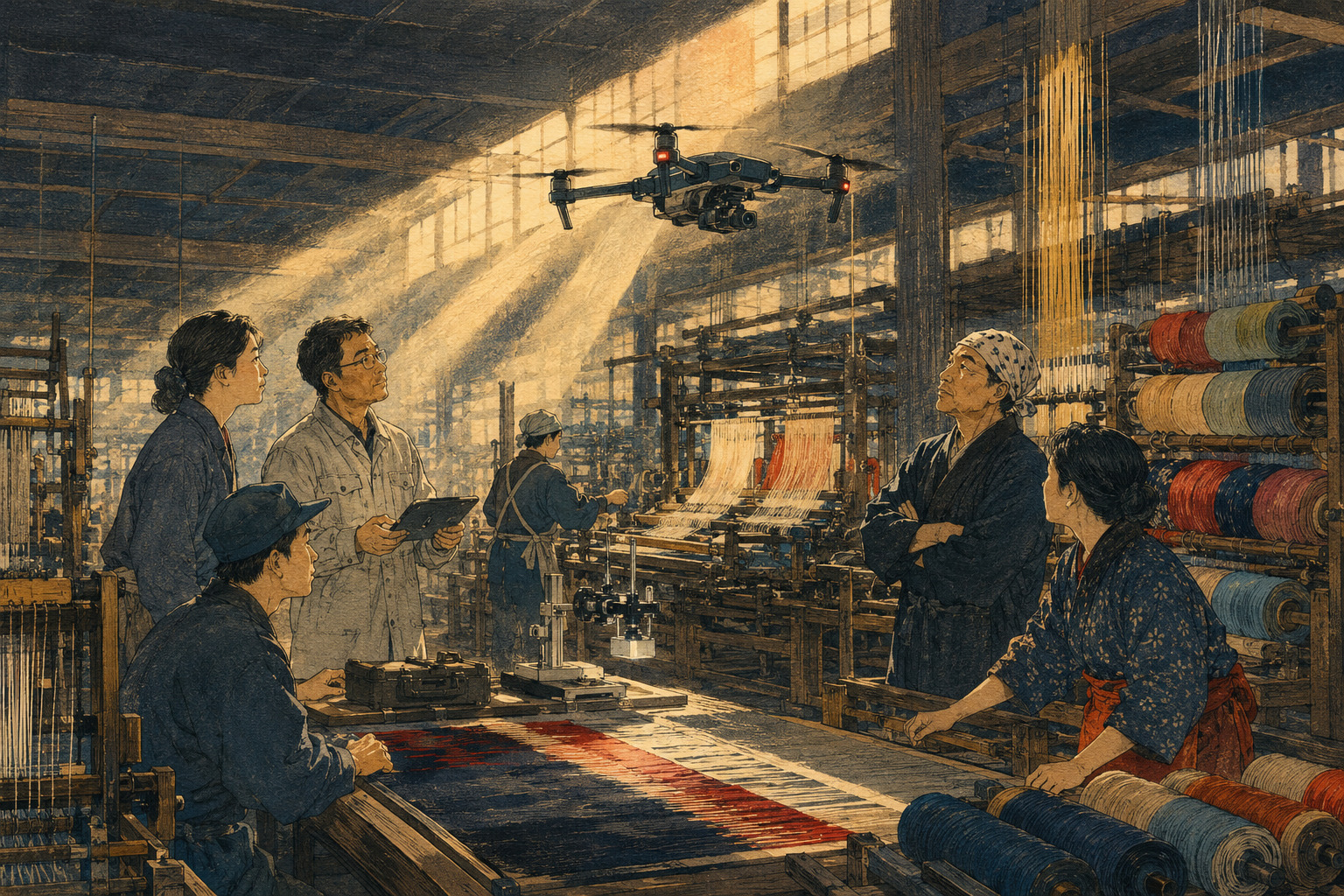
One proposal starts with the most disposable part of a chicken. Another starts with carbon-fiber composite that is notoriously difficult to take apart. A third asks whether a plant-derived textile can become both a locally woven amulet and a material collected after use. Two flying machines complete the slate: one intended to press an ultrasonic sensor against industrial equipment, the other to remain aloft by generating electricity with a gas turbine.
Those are the five projects selected for the second year of Sakai City’s New Industry Co-Creation Program, operated with ReGACY Innovation Group. At an August 26 kickoff, three textile and materials teams and two drone teams presented what they intend to test through the end of fiscal 2026.
The distinction between intention and evidence is essential. The announcement does not establish that feathers have been spun commercially, that recycled carbon fiber has found a buyer, that amulets have been recovered for chemical recycling, that an airborne ultrasonic system meets an inspection code, or that a hybrid aircraft has completed a long-duration Fukui flight. The program calls every named local partner a “planned” collaborator, and it is still recruiting additional companies willing to supply expertise, samples, prototypes or test locations.
Sakai originally advertised “about six” places during its June recruitment. It chose five. The city and ReGACY say the projects passed a rigorous review, but, as of August 28, they had not published the number of applications, project-by-project scores, public support per team or common quantitative milestones. The trials may be technically ambitious; their public accountability will depend on what is measured and disclosed by the March 2027 demo day.
Five experiments, five different bottlenecks
The three materials proposals all invoke circularity, but they are not interchangeable. The Tsuruoka College team must establish whether feather protein can become a consistent industrial feedstock at an acceptable cost. ENCARMAS must move beyond recovering carbon fiber and show what form of recycled fiber a composite manufacturer can actually process and sell. Bioworks already has PlaX yarn and textile products; its Sakai problem is to design a valuable local item and the reverse logistics that could bring that item back.
The drone projects divide just as sharply. Muroran Institute of Technology is not primarily testing aerial photography or navigation. It is trying to move an ultrasonic inspection instrument to difficult surfaces and define the accuracy an industrial customer would require. HIEN Aero Technologies is testing the endurance case for a gas-turbine-electric architecture and plans work with a large helicopter-type uncrewed aircraft.
| Selected team | Published plan | Planned collaborator | The decisive question |
|---|---|---|---|
| Textiles/materials National Institute of Technology (KOSEN), Tsuruoka College Lead: Professor Takashi Morinaga | Add a proprietary agent to protein derived from poultry feathers; develop pellets and a fiber-formable material; survey performance and price; seek partners for molded-resin and fiber prototypes. | Industrial Technology Center of Fukui Prefecture | Can variable biological waste become stable feedstock that survives real processing at a credible unit cost? |
| Textiles/materials ENCARMAS Co., Ltd. | Break down the resin in carbon-fiber-reinforced plastic, recover carbon fiber, explore applications and prototypes, and identify prospective customers. | Maruhachi Co., Ltd. | What fiber length, format and retained performance will fit a local composite process and a buyer’s specification? |
| Textiles/materials Bioworks Corporation | Prototype higher-value PlaX products such as woven amulets; design collection infrastructure with governments, shrines and temples, with chemical recycling in view. | Matsukawa Repiyan (株式会社松川レピヤン) | Can product value pay for collection, sorting, transport and recycling rather than merely promise a circular future? |
| Drones Muroran Institute of Technology Lead: Assistant Professor Naruki Shoji | Mount couplant-gel-free ultrasonic nondestructive inspection technology on a drone; test it and define the required precision for detecting cracks, corrosion and other degradation. | Mugen no Sora (むげんのそら株式会社) | Can contact, attitude and repeatability be controlled closely enough to compare with established inspection methods? |
| Drones HIEN Aero Technologies Co., LTD. Lead: CEO Gaku Minorikawa | Demonstrate prolonged hovering by a gas-turbine-electric hybrid drone and conduct a trial using a large helicopter-type UAV. | Fukui Prefecture’s Fukui Airport Office | Under a fixed payload and test profile, what endurance, fuel use, noise and safe-stop behavior can be documented? |
The hardest part of a feather fiber may be the price
Takashi Morinaga is a professor of polymer chemistry and organic-inorganic composite materials at Tsuruoka College in Yamagata Prefecture. The Sakai plan adds an undisclosed proprietary additive to protein from poultry feathers and aims to make both processing pellets and material that can be formed into fiber.
The appeal is immediate: turn an animal-industry residue into something durable. Industrial qualification is less poetic. A usable feedstock requires a repeatable source and cleaning process. It must tolerate heat and moisture, flow through equipment, hold adequate mechanical properties and avoid unacceptable odor or contamination. Yield and pretreatment cost matter as much as whether a laboratory strand can be pulled.
That is why the published scope includes a performance and price survey rather than only a prototype. The planned partner, the Industrial Technology Center of Fukui Prefecture, is a public testing and development institution with the equipment and industrial network to help translate a polymer concept into processing questions. A credible March result would disclose a property range, process window, yield and estimated cost—not simply display a piece of fiber.
Recycled carbon fiber meets a company that knows intermediate materials
ENCARMAS is exceptionally young: it was incorporated in April 2026. The Japan Science and Technology Agency identifies it as a startup originating at Shizuoka University and the Institute of Science Tokyo. The company says it uses supercritical and subcritical fluid technology to decompose the resin portion of used carbon-fiber-reinforced plastic, or CFRP, and return higher-quality recycled carbon fiber to use.
Recovering fiber is one stage of a longer chain. A composite manufacturer needs to know fiber length, surface condition, sizing, alignment and strength retention. It must decide whether the material should become chopped reinforcement, a nonwoven, a woven substrate, a prepreg or another intermediate. The final part must have a customer willing to qualify it.
That makes Maruhachi more than a convenient hometown name. The Sakai manufacturer works with carbon, glass and aramid fibers and describes capabilities in substrates, prepregs and preforms—the steps that arrange reinforcing fiber and combine it with resin before a final composite part is molded. The pilot’s strategic logic is therefore unusually concrete: match a separation process from outside Fukui with a local firm that understands how recovered fiber must arrive to re-enter production.
The public record still leaves central questions unanswered. The feedstock type, recovery yield, retained properties, prototype target and comparison against virgin carbon fiber are not specified. Nor is it clear whether the prospective customer will evaluate price, environmental benefit or mechanical performance first. Those omissions are appropriate before testing, but they should become the project’s scorecard rather than remain promotional gaps.
PlaX already has a Sakai connection; collection is the new experiment
Bioworks describes PlaX as polylactic acid, or PLA, made from plant feedstock such as sugarcane and modified with a proprietary plant-derived additive. The company says the modification improves durability, heat resistance and dyeability that have constrained conventional PLA in textiles. It markets filament and staple yarns and is developing chemical-recycling pathways.
Unlike a first-time matchmaking exercise, the proposed relationship with Matsukawa Repiyan has already produced something. In June 2026, the two companies announced a high-density woven label made with 100 percent PlaX. Matsukawa Repiyan, founded in 1925 in Sakai’s Maruoka district, makes woven brand labels, patches, straps and amulet pouches. Existing loom knowledge and an existing material sample should shorten the distance to a Sakai-specific product.
The fiscal 2026 proposal goes further by naming amulets and a collection model involving local government, shrines and temples. That creates practical and cultural questions. Who receives an item after its useful life? How are non-PlaX cords, paper, metal or packaging separated? Where is material aggregated, and who pays for transport? How is the handling of a religious object explained to the institution and the holder?
Bioworks’ own used-sock recycling pilot is instructive. The company reported that laboratory- and pilot-scale processing recovered high-purity monomer and produced PLA with performance comparable to ordinary material. It also explicitly identified separation yield and commercialization cost as unresolved. Sakai should build on that candor. A locally woven product is not circular merely because its polymer can be recycled under controlled conditions; the collection system must deliver sufficient clean material at a manageable cost.
A drone carrying ultrasound is not just a camera with another sensor
Nondestructive testing examines a component without cutting it open or making it unusable. Ultrasonic testing sends sound into material and interprets reflections that can indicate internal discontinuities or thickness loss. Conventional contact testing commonly uses a couplant between the probe and the surface so sound can enter the test object efficiently.
Naruki Shoji, an assistant professor in Muroran Institute of Technology’s mechanical and robotics unit, works in ultrasonic sensing, flow measurement and process monitoring. His university profile also records research in laser-assisted ultrasonic imaging for remote infrastructure diagnosis. The Sakai plan proposes an ultrasonic system that does not require gel application and places it on a drone for cracks, corrosion and other degradation in plant equipment.
For inspection, reaching the surface is only the beginning. The aircraft must control probe angle, pressure or stand-off, vibration and position. The surface may be curved, painted, hot or corroded. A repeat reading should agree with the first, and results should be compared with a reference defect or accepted method. The program appropriately says it will organize the “precision and level” required of the inspection. That phrase should lead to published detection limits, false calls, repeatability and time per inspection point.
Mugen no Sora, the planned collaborator, is a Fukui-based operator of a national drone-qualification training network and a registered training institution under Japan’s transport ministry. Its operational experience can support aircraft handling and procedures. It does not, by itself, certify the ultrasonic result. Aviation competence and inspection validity are separate layers, and the trial needs to document both.
Why a small airport with no scheduled flights matters
HIEN Aero Technologies is pursuing a different limitation: energy. Batteries simplify electric propulsion but become heavy as designers seek more endurance and payload. HIEN’s architecture uses a gas turbine to generate electricity for motors, with batteries supporting the power system. The company positions its large uncrewed Dr-One as a step toward scalable eVTOL aircraft.
The company publishes specifications and long-term ambitions for its aircraft family. The Sakai announcement, however, does not identify the exact test vehicle, test weight, target hover time or flight profile. Readers should not substitute a brochure number for a measured Fukui result. The useful outcome will be a controlled test under a disclosed payload, weather envelope and operating procedure.
Fukui Airport gives Sakai unusual physical infrastructure for that work. The prefectural airport opened in 1966 with Tokyo service. Traffic declined after nearby Komatsu Airport gained jet service, and scheduled flights at Fukui were suspended in 1976. Today, the 1,200-meter runway supports disaster-response, police and medical helicopters, private and business aircraft, pilot and glider training, and research by organizations including JAXA.
No timetable of passenger departures means flexibility, not an absence of rules. Japan’s transport ministry states that drone operations around airports require advance coordination with the airport operator and relevant authorities, and some flight airspace or methods require permission or approval. Large-aircraft demonstrations also demand ground exclusion, emergency procedures and coordination with crewed aviation. The regulatory work is part of the proof of concept, not paperwork outside it.
A textile region built by changing material before
Sakai’s program can sound like a collision between an old textile town and futuristic technology. Fukui’s history tells a different story: the region has survived by repeatedly transferring weaving and materials knowledge into a new feedstock or market.
According to the official History of Fukui Prefecture, habutae silk production began in 1887 after local manufacturers brought in technical instruction from Kiryu. Growth was rapid. By 1904, habutae accounted for 96.5 percent of the prefecture’s textile production value, and Fukui became known as a “habutae kingdom.” The industry later moved through rayon and synthetic fibers into narrow fabrics, warp knits, technical textiles and composites.
A second-phase Reihoku regional plan published by Fukui Prefecture in 2026 calls textiles a core manufacturing industry. Using the 2022 Economic Structure Survey, it ranks textiles first among prefectural manufacturing categories by establishments and employees and third by shipments. Using the 2021 Economic Census, the plan reports national shares above 30 percent for Fukui-made polyester filament woven cloth, narrow fabrics and warp-knitted fabric.
Maruoka, now part of Sakai City, specializes in woven labels used for brands, uniforms, sports patches, straps and amulet pouches. Maruhachi, founded in 1936, moved from textile machinery and apparel-related knitting toward carbon-fiber composites. Matsukawa Repiyan, founded in 1925, applies high-density narrow weaving to detailed labels and graphic objects. These are not picturesque remnants. They are processing businesses that can judge whether an unfamiliar fiber breaks, dyes, weaves, impregnates, molds and sells.
The city also acknowledges structural weakness. Its industrial-funding page says establishments have been declining and cites population loss, youth outmigration, dependence on business-to-business orders and the overseas movement of production. The policy case for an accelerator is that small manufacturers busy with current orders may lack time and staff for speculative research, while outside researchers lack production knowledge and local customers. Pairing them can be productive—but only if the relationship outlives the program calendar.
Year one proved that Sakai could host experiments, not yet that it could retain them
The program began in fiscal 2025 with five teams. Over roughly seven months, participants worked on wood-derived “Mokuito” yarn, microbial cellulose, smart-textile concepts, non-GNSS tracking for evacuation support and a high-payload, long-range cargo drone.
Some work reached prototypes. HIRAXIS and local knit manufacturer Asahi Makam made trial T-shirts and underwear from Mokuito. Other work remained exploratory, such as identifying applications and partners for microbial cellulose. A Kanazawa Institute of Technology team attempted a winged vertical-takeoff cargo-drone flight at Fukui Airport in March 2026. Sakai’s own account says bad weather prevented sufficient flying and data collection.
That qualified result is more informative than a generic claim of success. A test program should reveal constraints: weather, permissions, runway operations, communications, hardware, processing or cost. The first year showed that the city could convene manufacturers, universities, public labs and aviation authorities around real trials. It did not yet demonstrate a new industry or permanent employer.
The physical hub, SAKAI WEAVE, opened in October 2025 in a former agricultural-cooperative branch two minutes on foot from Harue Station. Selected teams can use it for work, meetings and local networking. The program advertises business-development advice, support for collaboration, finance and intellectual property, and assistance for a stay of up to six months. Its stated end goal is continuing business in Sakai, including local offices, startups and employment.
1887 Habutae silk production begins in Fukui.
1925 Matsukawa Repiyan is founded in Maruoka.
1966 Fukui Airport opens.
1976 Scheduled service at Fukui Airport is suspended.
August 2025 The first five co-creation teams announce plans.
October 2025 SAKAI WEAVE opens near Harue Station.
March 2026 Year-one teams present prototypes and test results.
August 26, 2026 Five second-year teams present their plans.
March 2027 The second demo day is scheduled.
The March scorecard should be designed now
Municipal innovation programs are easiest to photograph at selection and kickoff. Industrial policy becomes assessable later, when the same question is asked of a failed run and a successful one: what did the evidence change?
- Feather protein: process yield, fiber or molding properties, heat and moisture behavior, variability and estimated unit cost.
- Recycled carbon fiber: recovered-fiber length and retained strength, prototype route, performance gap versus virgin material and customer feedback.
- PlaX: product durability, collection rate, sorting method, recycled output and collection-plus-processing cost per item.
- Ultrasonic drone: smallest reference defect detected, repeatability, false positive and missed detection rates, and time versus conventional access.
- Hybrid aircraft: hover endurance under a stated payload, fuel and electric use, noise, safe shutdown and the complete operating approval process.
A second set of measures belongs to the city. How many local companies did paid prototype work? How much local procurement occurred? Were joint-development or intellectual-property agreements signed? Which selected teams will still operate in Sakai in fiscal 2027? Did any role become a durable local job? Event attendance and mentoring hours cannot answer those questions.
As of publication, public material did not disclose the applicant count, individual selection rationale, project-level public spending, intellectual-property allocation or shared success metrics. Their absence is not evidence of misconduct. It is an unresolved transparency problem for a program whose justification is regional economic return.
Fukui’s textile economy did not persist by preserving silk production unchanged. It moved knowledge from silk to synthetic fiber, from garments to industrial materials, and from ordinary yarn to carbon composites. Fukui Airport also changed function, from a passenger gateway to a site for emergency aviation, training and research. Sakai’s five pilots fit that longer pattern only if they do more than attach novelty to heritage.
By March, the most persuasive artifact will not be a feather thread in a display case or a drone hovering for a camera. It will be a test sheet with reproducible numbers, a price that a manufacturer can challenge, a recovery route that someone has agreed to operate, and a purchase order or next experiment that keeps the work in Sakai.
- ReGACY Innovation Group — Fiscal 2026 kickoff and the five selected project plans (August 27, 2026)
- Sakai City and ReGACY — Program purpose, process and support
- Sakai City — Fiscal 2026 recruitment terms and year-one examples (June 11, 2026)
- Sakai City — Fiscal 2025 demo day and project results (March 30, 2026)
- Sakai City — Industrial challenges and the case for co-creation
- Fukui Prefectural Archives — Official history of habutae production
- Fukui Prefecture — Second Reihoku Regional Plan and textile-industry statistics
- Sakai City — Maruoka woven labels and Echizen-ori
- National Institute of Technology, Tsuruoka College — Takashi Morinaga’s title and specialties
- ENCARMAS — CFRP recycling technology
- Japan Science and Technology Agency — ENCARMAS startup record
- Maruhachi — Carbon-fiber substrates, prepregs and preforms
- Bioworks — PlaX composition, textile properties and recycling
- Bioworks and Matsukawa Repiyan — 100% PlaX high-density woven label
- Bioworks — Used-sock chemical-recycling pilot and remaining issues
- Muroran Institute of Technology — Naruki Shoji’s title and research fields
- HIEN Aero Technologies — Dr-One hybrid-aircraft development
- Mugen no Sora — Company and registered drone-training operations
- Fukui Prefecture — Fukui Airport history
- Fukui Prefecture — Fukui Airport facilities
- Ministry of Land, Infrastructure, Transport and Tourism — Uncrewed-aircraft flight rules