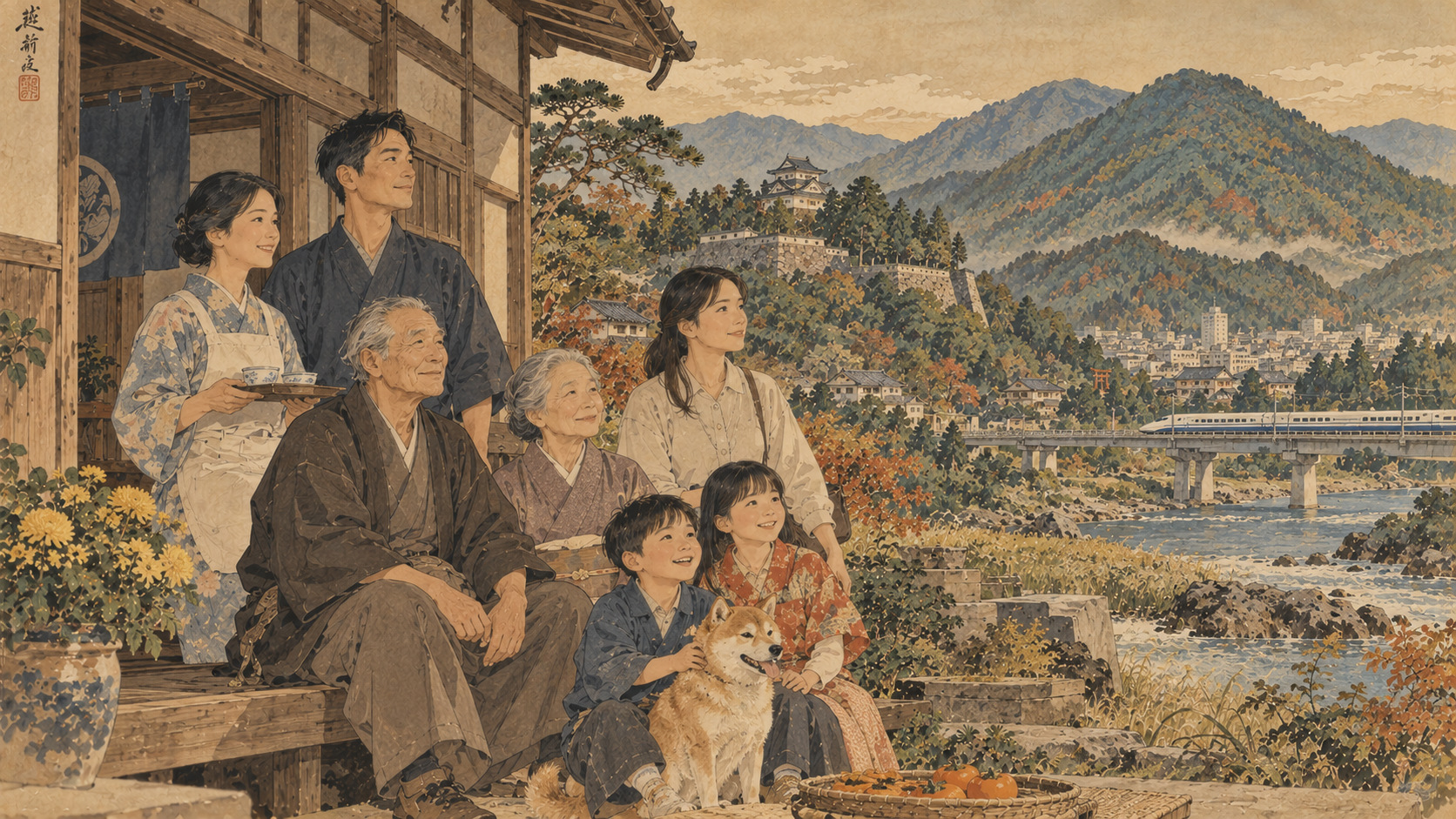
Fewer residents, more households: Fukui’s numbers tell a story of changing lives, not simply decline.
Two old provinces, one modern prefecture
Look west from the Hokuriku mountains and Fukui unfolds as an unusually varied stretch of Japan: river plains, traditional manufacturing towns, ancient Buddhist temples, precipitous coastal cliffs and bays sheltered by wooded hills. Its northern Echizen and southern Wakasa regions have different histories and connections. Modern administration joins them; geography never made them identical.
Fukui should be understood through both of those identities. Fukui City is a seat of government and commerce; Sabae and Echizen are associated with specialist manufacturing; Katsuyama and Ono face mountain economies and winter conditions; Tsuruga has long been a port and transport crossroads; Obama and the Wakasa coast retain maritime traditions and historical relationships with Kyoto.
The prefecture consists of nine cities and eight towns. Its future will be decided not only by what happens in the prefectural capital but also by whether smaller communities can maintain livelihoods, schools, care services and connections to one another.
The population is shrinking. Households are growing.
On September 29, 2026, the prefectural government released the basic results of Japan's 2025 census. Fukui counted 728,588 residents on October 1, 2025, down from 766,863 in 2020. The five-year decline was 38,275 people, or 4.99%. According to the prefecture, the census population has fallen at every five-year count since its 2000 peak.
At the same time, the number of households rose from 291,662 to 295,766. The average size of an ordinary household fell from 2.57 people to 2.40. This apparent paradox is central to the region's future. A community can have fewer residents while needing more separate dwellings and more services for people living in smaller households.
The latest monthly estimate available for this edition, dated September 1, 2026 and posted October 9, put the population at 722,475 and households at 297,932. The previous month brought a population decline of 273: natural change was minus 378, partly offset by net inward migration of 105. These are different census and post-census estimation dates, not contradictory totals. Neither single-month migration nor population loss should be extrapolated mechanically into an annual forecast.
| Measure | Value / change |
|---|---|
| 2020 census population | 766,863 |
| 2025 census population | 728,588 |
| Five-year population change | −38,275 (−4.99%) |
| 2020 households | 291,662 |
| 2025 households | 295,766 (+4,104) |
| People per ordinary household | 2.57 → 2.40 |
| September 2026 estimate | 722,475 (−273 month on month) |
| September 2026 households | 297,932 (+205 month on month) |
Wakasa’s food routes, Echizen’s workshops
The story begins long before Fukui took its present shape. In the old provincial system, Wakasa was a maritime territory that supplied seafood and other goods toward Japan's early capitals. The routes later remembered as the Saba Kaido, or Mackerel Roads, were networks of exchange, carrying more than fish: ideas, religious practices and the habits of daily life traveled with merchants and porters.
Farther north, Echizen developed craft traditions in paper, forged blades, pottery and lacquerware. These industries were not frozen remnants of a distant age. Successive generations adapted materials, products and markets, a pattern still visible in contemporary eyewear and textile manufacturing.
Dogen established Eiheiji in 1244, embedding the region in the history of Soto Zen. The monastery remains a living institution rather than simply a monument. Together the ports, factories and temples challenge the idea that Fukui is somehow isolated. Its distinctiveness was created through centuries of connections to other parts of Japan and beyond.
The rise and fall of a samurai city
During the Sengoku era, the Asakura clan developed Ichijodani into a castle town with residential districts, workshops, gardens and temples. In 1573 the Asakura regime fell amid Oda Nobunaga's campaigns and the settlement was destroyed. Archaeological investigation has since disclosed street patterns and artifacts that illuminate ordinary medieval urban life, not just the decisions of warlords.
In the Edo period, the Fukui domain became associated with the Matsudaira house, related to the Tokugawa family. Wakasa's Obama domain followed its own political path. Late-Tokugawa Fukui figures such as Matsudaira Shungaku and the reformer Hashimoto Sanai entered the larger national debate about government reform, external threats and political change.
A serious history cannot stop with samurai. Farmers, merchants, craftsmen, women, monks and fishers kept these communities functioning. Their presence survives more often in tools, records and local practices than in the formal portraits of rulers.
The prefecture created in 1881
Today's Fukui Prefecture did not appear fully formed when the domains were abolished in 1871. Administrative mergers and reversals created, combined and dissolved prefectures, and at one stage the northern territory was attached to Ishikawa while southern districts were assigned to Shiga.
On February 7, 1881, the areas corresponding substantially to Echizen and Wakasa were reunited as present-day Fukui Prefecture. The date is now observed locally as Furusato Day. The Ministry of Land, Infrastructure, Transport and Tourism's regional history traces the administrative changes, which explain why the two regional identities remain meaningful today.
These distinctions matter when discussing modern infrastructure. The pattern of transport, shopping, employment and cultural ties in Wakasa is not identical to that in northern Fukui. A policy designed exclusively around a single prefectural center may overlook everyday distances experienced elsewhere.
A phoenix after two disasters
War and disaster left a deep imprint on the modern capital. The 1945 air raids inflicted extensive damage. Then, on June 28, 1948, an earthquake of magnitude 7.1 struck the Fukui Plain while the city was still recovering.
Japan's Earthquake Research Headquarters and the local meteorological office record 3,728 deaths, 21,750 injuries and 35,382 destroyed houses. Those figures demand more than a story of inspiring resilience: they represent lives lost, families displaced and years of reconstruction. Fukui City later made the phoenix a symbol of its recovery.
The lesson remains contemporary. Earthquakes, severe winters, flooding and other hazards complicate the maintenance of roads, housing and public utilities. Disaster preparedness is inseparable from demographic planning when the number and age profile of residents are changing.
An economy of many different places
Precision eyewear from Sabae, advanced textiles and traditional crafts attract attention, but Fukui's economy is more varied. Rice farms on the plains, fishers in Wakasa Bay, local tourism operators, workshops, port businesses and energy facilities support different communities and different kinds of employment.
The question for a young resident is not simply whether a job exists. It is whether that job pays sufficiently, offers advancement and fits with housing, education, childcare, mobility and a desired way of life. High industrial specialization may create strong opportunities for some workers while leaving others with limited choices.
As family-owned businesses change hands, succession becomes important. So does the relationship between inherited skills and technical education. An economic policy that measures only factory output will miss what happens to the small towns in which workers and their families actually live.
Migration changes the meaning of home
One hopeful detail from the latest monthly estimate is that migration into the prefecture exceeded departures by 105 people during the measured month. Yet the natural population loss of 378 was larger, leaving an overall decrease. This illustrates why no single migration announcement can solve a long-running demographic shift.
People moving from abroad are also part of Fukui's future. Communities with Brazilian roots, as well as Vietnamese, Filipino and other residents, contribute to local enterprises, schools and neighborhoods. A workforce-only description overlooks the larger questions of language access, children's education, health services and participation in community life.
People from Fukui who live elsewhere may remain involved through family ties, remote work, visits, investment or eventual return. Measuring success only by a headline in-migration figure risks missing whether newcomers can put down roots and whether long-established residents can stay.
A new railway, and the places it cannot reach
On March 16, 2024, the Hokuriku Shinkansen extension from Kanazawa to Tsuruga opened, giving Fukui new high-speed rail connections. The improved access changes the possibilities for tourism, business travel and relationships with Tokyo and the Hokuriku region.
But speed to a railway station is not the same as access to a mountain settlement or a fishing village. Local buses, conventional rail, medical transport, winter road maintenance and links to schools remain essential for people whose daily journeys do not begin at a Shinkansen platform.
The railway's impact should be judged over time, separating visitor counts and station-area business from durable changes in income, population and services. A more accessible Fukui is an opportunity, not proof that the challenges have disappeared.
The place people choose to make
It is tempting to end a prefecture profile with a spectacular sunset over the Sea of Japan. Fukui offers many. But the question of what makes the prefecture worth staying in is answered less by scenery than by ordinary life: a school that remains open, an aging parent who can receive care, a workshop with a successor, a community welcoming a new family.
The 2025 census describes a region that has fewer people but more households than it had five years earlier. Those trends create real pressures, yet they do not erase the resources of history, expertise and mutual dependence that sustain local life.
Fukui has repeatedly adapted: old provinces became a prefecture, trading routes evolved, industries changed and a devastated city rebuilt. Its next transformation will be judged by what residents are able to preserve, improve and create together. That is the living history still being written.
Japan.co.jp invites documented responses, community histories, photographs, corrections and follow-up interviews from residents, historians, municipalities and families across Fukui. No interviews are implied where none have been conducted. Contact our newsroom.