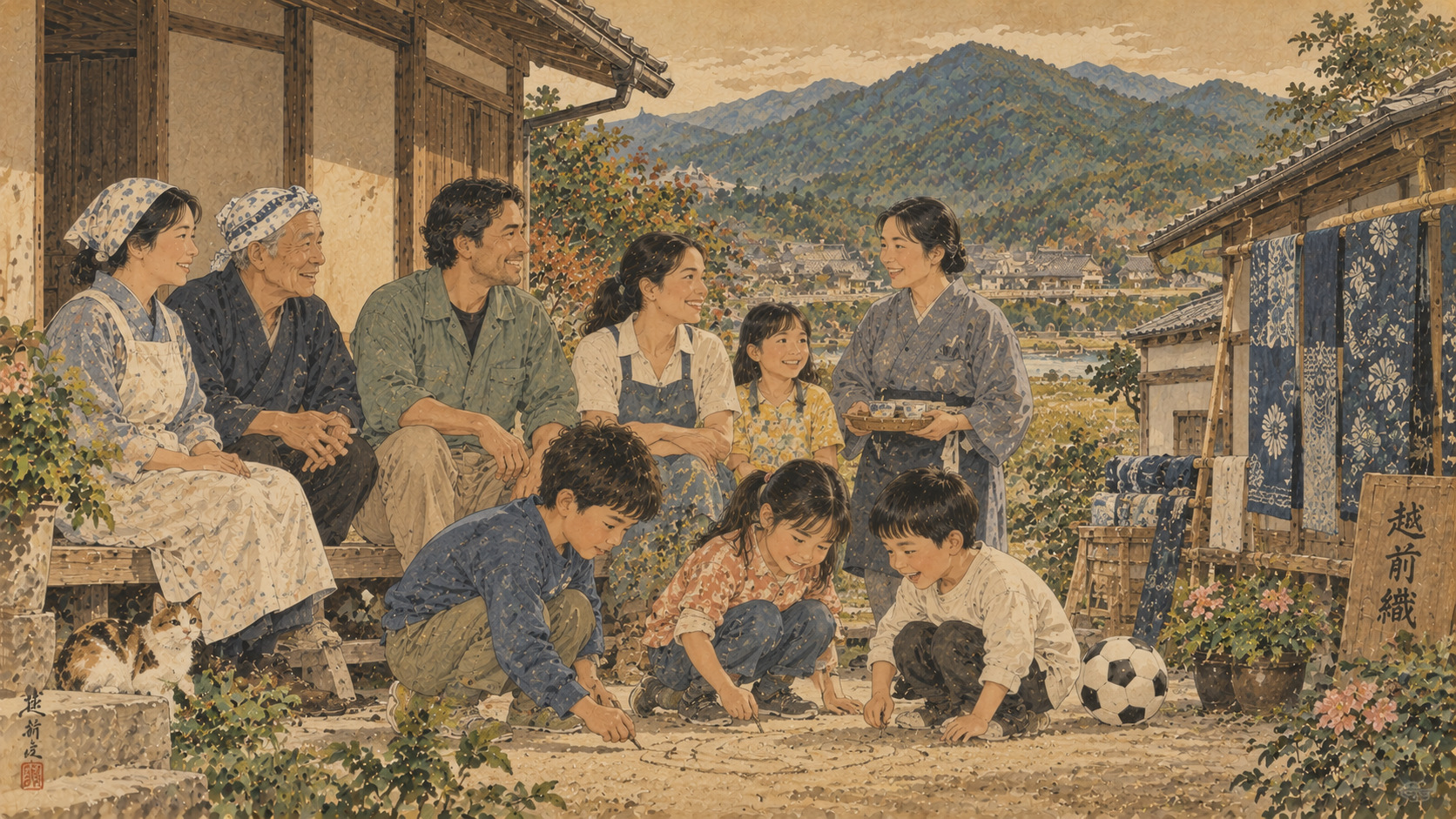
Not only workers. Neighbors, parents, students and citizens of their community.
A Japanese manufacturing city with a Brazilian story
Echizen is known for papermaking, forged blades and generations of industrial craft. It is also home to a community whose history reaches across the Pacific and the South Atlantic. Brazilians of Japanese ancestry, other Brazilian residents, Vietnamese workers and families from many countries have become part of its everyday life. The story is often described as one of labor shortages and factory recruitment. But a family is not a labor-market category. Its concerns run from school and language to housing, medical care, friendship and whether a town feels like home. Echizen's municipal multicultural plan explicitly frames foreign and Japanese residents as participants in building the same community.
1908: the migration that came before
On June 18, 1908, the Kasato Maru reached Santos carrying 781 Japanese migrants. It became a landmark in Japan–Brazil history, though not the first occasion on which an individual Japanese person had arrived in Brazil. Many early migrants worked on coffee plantations in difficult conditions. Japanese settlement expanded over generations through farming, shops, professional life and Brazilian civic institutions. The history also includes prejudice, restrictions and wartime upheaval. JICA's 2026 historical account underscores both hardship and the long contribution of migration to Brazil's society. Those earlier journeys matter because today's movement toward Japan is not an isolated twentieth-century staffing arrangement.
When descendants traveled in the opposite direction
Changes in Japan's immigration framework around 1990 widened routes for eligible people of Japanese descent to live and work in Japan. Industrial demand encouraged migration from Brazil to factory regions. Yet the phrase “returning home” can be misleading. Someone born and educated in São Paulo or Paraná may never have visited Japan before accepting a job there. Being ethnically Japanese, holding Brazilian nationality and feeling culturally at home in Japan are three different things. Residence statuses—including Long-Term Resident and Permanent Resident—also differ; ancestry cannot by itself establish anybody's legal status. The experience of settling in Fukui is best understood in the words of individual families, not a single romantic narrative of return.
What the numbers actually count
Echizen City reported 4,928 foreign residents as of April 1, 2024, approximately six percent of its population, when explaining its second multicultural plan for fiscal 2024–2028. It would be inaccurate to call that the city's October 2026 total. Separately, the Fukui Labour Bureau recorded 15,169 foreign workers across the prefecture at the end of October 2025, up 11.6 percent in a year. Vietnamese workers numbered 3,823; Brazilians 3,554; Filipinos 1,801; and Indonesians 1,603. A total of 1,974 workplaces employed foreign nationals. The Takefu public employment-office district accounted for 5,818 workers, but its geographic coverage must not be mistaken for Echizen City alone. Resident registration and employer notifications measure different populations at different dates.
More than the hands behind a product
Fukui's manufacturing economy creates demand for skilled and reliable workers. Foreign nationals help sustain production, yet the employment relationship should not be their only claim to belonging. Contract security, health and safety, language support, recognition of qualifications and pathways to advancement affect whether a household can plan a future. The national employment classifications encompass technical interns, specified skilled workers, professionals and people with residence rights based on family or status. Their conditions and ability to change employers are not identical. Official aggregate statistics do not tell us whether a particular factory is a good employer; that requires interviews, documents and independent reporting.
The next generation is not a workforce statistic
A child may speak Japanese at school, Portuguese with a grandparent and another language with friends. Another may arrive as a teenager with little Japanese. Both deserve an education that takes their circumstances seriously. Schools must manage Japanese-language instruction alongside ordinary teaching, communications with parents, bullying prevention and informed decisions about further education. Echizen treats school collaboration and Japanese-language support as parts of its multicultural agenda. This article does not invent a family's testimony or pretend that all Brazilian-background children share the same needs. Understanding outcomes will require updated enrollment data and first-hand conversations with educators and parents.
The practical meaning of a multilingual city
A municipality becomes accessible through small, unglamorous details: how to register an address, read a tax notice, find a clinic, understand a school form or prepare for heavy snow. Echizen maintains a multicultural consultation one-stop center and provides information in Portuguese, Vietnamese, Chinese and Japanese. Its multicultural plan is also available in multiple languages. These measures recognize that civic participation requires more than a welcoming slogan. The harder test is whether assistance is timely, intelligible and usable, particularly for people working shifts or facing an emergency. The publication of translated documents is an important step, not proof that every barrier has disappeared.
Disasters put belonging to the test
Fukui knows the risks of earthquakes and heavy snow. In a crisis, language can determine whether a warning makes sense, where a household seeks shelter and whether neighbors can help one another. Disaster preparedness is therefore a community question, not just a translation task. Echizen's information portal includes training related to support for foreign residents during emergencies. Schools, neighborhood groups, employers and support organizations can help bridge gaps before an alarm sounds. The degree to which that happens in practice deserves direct reporting, especially from people who have experienced local emergencies.
Meeting outside the factory gate
Community life is also built in shops, sports clubs, neighborhood events and schoolyards. Echizen advertises exchange initiatives including its Connect Festival and multilingual cultural resources. These events create opportunities for residents to meet, but a festival is not automatically evidence of lasting inclusion. The better question is who participates afterward—in volunteer groups, parent associations and local decisions. Brazilian culture is far more than carnival imagery or a particular cuisine. Residents may identify with many traditions, or none, while sharing ordinary ambitions for work, education and friendship.
Can a shrinking prefecture build an inclusive future?
Fukui is experiencing long-term population decline. It is tempting to present foreign workers simply as an answer to a demographic equation. That view misses the agency of people who may choose to stay, move elsewhere or raise children with ties to several countries. A durable community asks whether residents can access services, find decent work, be heard and build their own futures. Echizen's 2024–2028 plan promises a city made together by people of varied origins. Evaluating the promise means examining measurable outcomes, not merely counting arriving residents.
From Brazil to Echizen—and onward
In 1908, the migrants aboard the Kasato Maru could scarcely have known where their descendants would live or which languages they would speak. More than a century later, Fukui is one place where parts of that history have converged. But residents should not be reduced to symbols of a transnational relationship. They are neighbors with particular stories, achievements and concerns. The next chapter of this reporting belongs to them: an invitation to describe the Fukui they know, the changes they welcome and the changes they still need.
The conversation continues
Japan.co.jp welcomes corrected statistics, documented policy outcomes and firsthand perspectives from residents, educators, employers and community organizations. No interview is represented here as having taken place. Contact the editorial desk for follow-up reporting.
Sources and further reading
- Echizen City: Second Multicultural Coexistence Plan (2024–2028)
- Fukui Prefecture: foreign residents, December 2025
- Fukui Labour Bureau: foreign employment, October 2025
- JICA: migration history between Japan and Brazil, July 2026
- Immigration Services Agency: residence-status categories
- Echizen City: multicultural consultation one-stop center
- Echizen City: multicultural initiatives and community events
- JICA: Japanese migration to Brazil historical background