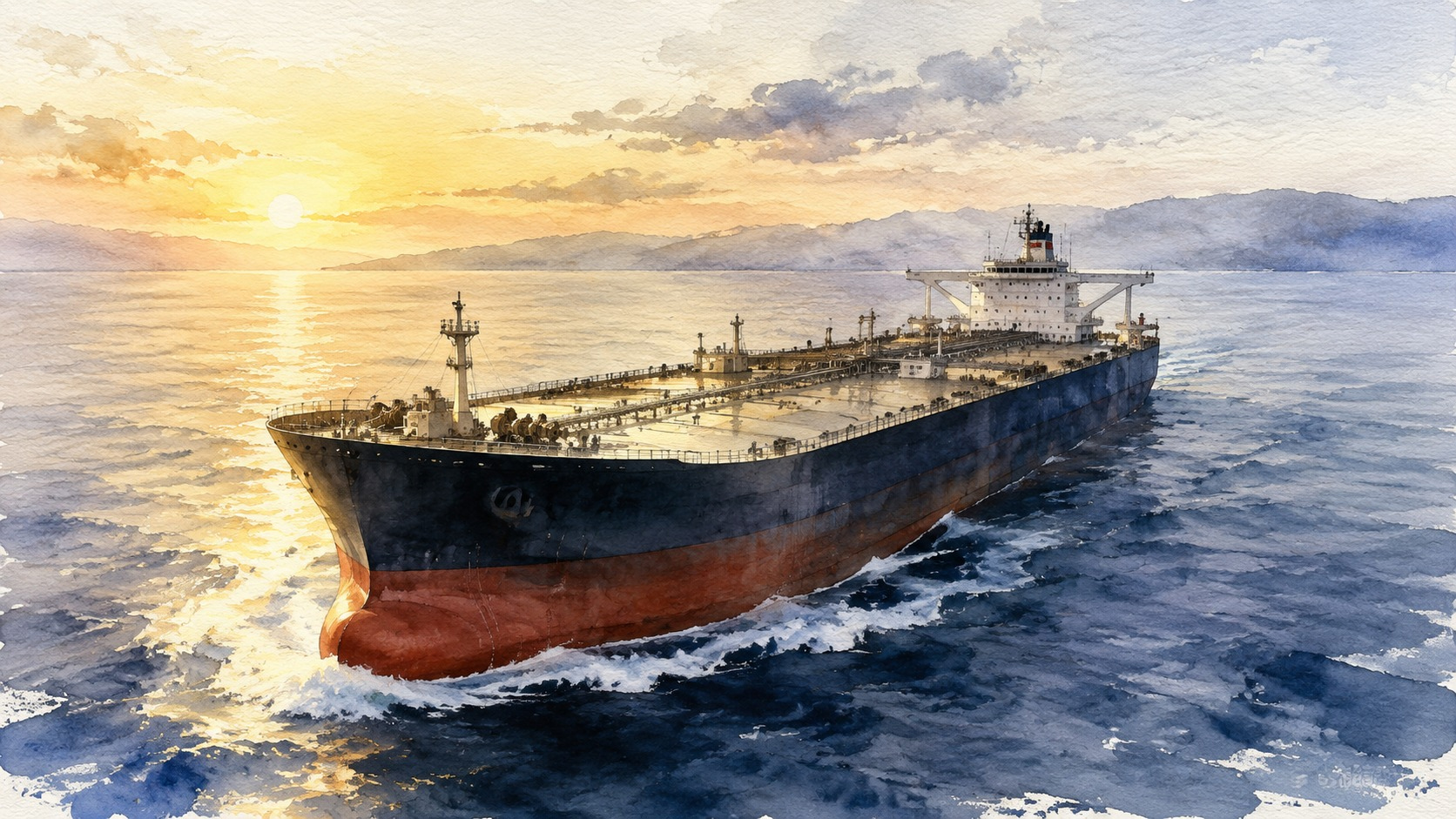
A refinery cannot run on a promise that a tanker may eventually arrive. Crude grades must be selected, ships chartered, tanks scheduled and processing units configured weeks before gasoline, diesel, jet fuel and petrochemical feedstocks reach customers. When traffic through the Strait of Hormuz was disrupted in 2026, ENEOS had to redesign that choreography while the music was still playing.
Japan’s largest refiner said in early July that it had secured a good crude-supply outlook through September. It replaced lost Middle Eastern volumes mainly with U.S. oil, supplemented by rare Azerbaijani and Latin American cargoes and by some Gulf supply moved through export routes that bypass the strait. The achievement buys operational time. It does not remove the structural fact that Japan sourced 94% of its crude from the Middle East in 2025.
What “secured through September” means
ENEOS Chief Financial Officer Soichiro Tanaka told Reuters that procurement had stabilized and the company had a good supply outlook through September. That means cargoes, replacements and inventory were sufficient for expected refinery needs under current plans. It is not a guarantee against every new military escalation, shipping loss, sanctions change or refinery outage.
Oil security has several layers: crude must exist, a producer must be willing to sell it, a tanker and insurance must be available, the route must remain open, the refinery must be able to process the grade, and finished products must reach consumers. ENEOS improved the first four for a defined window.
Hormuz is a narrow gate for a vast energy system
The Strait of Hormuz connects the Persian Gulf with the Gulf of Oman. At its narrowest, shipping lanes carry crude and LNG from Saudi Arabia, Iraq, Kuwait, Qatar, the United Arab Emirates and other producers toward Asia. A threat to navigation raises freight, insurance and oil prices even before physical flows stop.
Japan’s exposure is unusually concentrated. Before the 2026 conflict, about 70% of its crude imports passed through Hormuz. Saudi Arabia alone supplied roughly 1.6 million barrels a day to Japan in the period cited by Reuters. A closure therefore affects not just one supplier but a common route shared by several suppliers.
Some Gulf oil can avoid the strait. Saudi Arabia’s East-West Pipeline moves crude to the Red Sea port of Yanbu. The UAE’s Habshan–Fujairah pipeline reaches the Gulf of Oman outside Hormuz. Those systems have finite capacity, and Red Sea routes face their own security risks. “Rerouted” barrels are valuable but cannot simply replace every Gulf cargo.
American crude becomes the principal substitute
The United States offers large, transparent and politically aligned supply. Japan imported a record 103,784 barrels a day of light sweet U.S. crude in 2025; in the first two months of 2026, imports nearly tripled from a year earlier. After the crisis, U.S. purchases became the main replacement for lost Middle Eastern supply.
WTI Midland and similar grades are lighter and sweeter than much of the medium-sour Gulf crude for which Japanese refineries were designed. They yield more light products and contain less sulfur, but buying them changes refinery balances. A plant may need heavier feedstock for some units, and the price must include a much longer voyage across the Pacific or around other routes.
U.S. supply is diversified by producer but not free of bottlenecks. Gulf Coast export terminals, pipelines, weather and tanker availability matter. If Europe and Asia compete simultaneously for replacement barrels, the price advantage can disappear.
Azerbaijan: small cargo, large signal
In May a tanker delivered about 45,000 kiloliters—roughly 283,000 barrels—of Azerbaijani crude to an ENEOS refinery in Yokohama. It was the first Central Asian cargo received by Japan after the conflict began. Against national consumption, it was modest; against a procurement system long concentrated in the Gulf, it was symbolically important.
Azeri Light is produced in the Caspian region and exported mainly through the Baku–Tbilisi–Ceyhan pipeline to Turkey’s Mediterranean coast, avoiding Hormuz. That route itself crosses multiple countries and sits near geopolitical fault lines. Diversity moves risk; it does not abolish it.
Latin American cargoes add another non-Hormuz source, but voyage length, canal and port constraints, crude quality and carbon from shipping affect economics. A refiner needs an adaptable slate, not a list of distant producers that are technically possible but commercially unusable.
ENEOS carries several histories inside one name
The group traces one lineage to Nippon Oil, founded in 1888 to develop domestic crude during the Meiji industrial transformation. Another predecessor, Nippon Mining, began in 1905. Mitsubishi Oil was established in 1931 to build domestic refining around imported crude, while the TonenGeneral line grew from businesses dating to the 1890s.
Japan’s domestic oil resources were never sufficient for its industrial ambitions. Refiners grew by importing, processing and distributing fuel through nationwide service-station networks. Successive combinations—Nippon Oil with Mitsubishi Oil, JX with Nippon Mining, and JXTG with TonenGeneral—created today’s ENEOS.
Consolidation improved refinery efficiency as Japanese fuel demand declined with population aging, efficient vehicles and electrification. It also concentrated responsibility: when ENEOS procurement or refinery runs change, the effects move through a large share of the national fuel market.
The 1973 shock that redesigned Japanese policy
Japan entered the 1973 Arab oil embargo after a period of extraordinarily oil-intensive growth. Prices surged, panic buying emptied stores of toilet paper and household goods, and inflation exposed the vulnerability of an economy dependent on imported fuel.
The response transformed the country. Industry improved efficiency and shifted some power generation away from oil. Japan strengthened relations with producers, built national and mandatory private stockpiles, joined the International Energy Agency system and diversified energy into LNG, nuclear power and later renewables.
Yet crude sourcing reconcentrated in the Middle East. Mature, enormous fields, long relationships, suitable grades and direct tanker economics beat politically safer but more expensive alternatives. Security policy stored oil against interruption; commercial logic kept buying from the efficient source.
Strategic reserves buy time, not independence
At the end of 2025 Japan held 263 million barrels in government inventories, the world’s third-largest strategic government stock according to the U.S. Energy Information Administration. Japanese law also requires industry stocks, and joint storage with producer countries adds another layer.
The government began its largest-ever release in March 2026 as part of an IEA-coordinated 400-million-barrel action. By early June Japan still reported about 201 days of total stocks across government, private and joint holdings. Releases helped refiners normalize runs while replacement cargoes arrived.
| Security layer | What it solves | What it cannot solve |
|---|---|---|
| Government reserve | National emergency buffer | Permanent replacement supply |
| Private mandatory stocks | Operational continuity | Unlimited refinery throughput |
| Alternative crude | Reduces route and supplier concentration | Quality and cost mismatch |
| Bypass pipelines | Avoids Hormuz for some Gulf barrels | Finite capacity and other chokepoints |
| Demand reduction | Lowers every import requirement | Immediate substitution for aviation and industry |
A reserve is a bridge. Its purpose is to prevent panic and economic shutdown while diplomacy, production and logistics adjust. If the disruption lasts longer than the bridge, only new supply or lower demand closes the gap.
The refinery is where diversification becomes physical
Crude oils are not interchangeable. Density, sulfur, acidity, metals and product yield determine which units must run. Japanese refineries invested heavily in desulfurization and conversion to process Middle Eastern grades and meet strict fuel standards.
A sudden influx of light sweet crude can produce too much naphtha or gasoline relative to middle distillates, while starving heavy-oil conversion units. Operators blend grades, adjust temperatures and cut points, alter hydrogen use and trade intermediate products. Those changes affect margin and utilization.
ENEOS had expected an 86% utilization rate early in fiscal 2026 but disruption reduced it to about 81%, according to Reuters. Higher overseas product prices cushioned the earnings impact. The company still targets 90% utilization by fiscal 2027, a goal made harder if crude logistics remain unstable.
Diversification carries a price
Middle Eastern dependence persisted because it was economically rational in normal times. Large cargoes, shorter routes than the Atlantic, established contracts and refinery compatibility lower cost. Alternative supply can require smaller parcels, longer voyages, more working capital and operational adjustment.
The proper comparison is therefore not normal Gulf cost versus normal U.S. cost. It is total expected cost after assigning value to disruption risk. A slightly more expensive annual portfolio may be cheaper than emergency purchases, refinery slowdowns and fuel shortages during a crisis.
ENEOS says it wants to work with the government on economically viable diversification. Policy options include joint stockpiles with non-Middle Eastern producers, port and tank investments, flexible refinery equipment, long-term contracts, shipping support and transparent recognition of resilience costs.
Oil security and decarbonization are linked
Japan cannot rapidly eliminate oil. Aviation, shipping, petrochemicals, construction, emergency vehicles and much existing transport still depend on liquid fuels. A disorderly shortage would hurt households and industry before it reduced emissions intelligently.
But every durable reduction in demand also reduces exposure to Hormuz. Efficient vehicles, EVs, rail, sustainable aviation fuels, recycling of plastics and industrial electrification are security measures as well as climate measures. Unlike a new tanker route, they shrink the volume that must cross any chokepoint.
ENEOS is trying to transform from a petroleum company into an energy and materials group while still supplying “today’s normal.” That creates a capital-allocation tension: spend enough on resilient oil infrastructure for the transition, but not so much that long-lived assets become stranded as demand falls.
What success looks like after September
Securing three months is crisis management. Structural diversification must be measured over years: Middle East and Hormuz shares, number of viable crude grades, replacement lead time, shipping and insurance cost, refinery yield, inventory days and customer fuel availability.
Japan should also avoid replacing one concentration with another. Heavy reliance on U.S. light crude would create new route, currency and grade risks. A resilient portfolio combines Gulf supply, bypass routes, the Americas, the Caspian, Southeast Asia, domestic stocks and falling demand.
At the July 27 Japan.co.jp rate, dollar-priced crude is especially expensive when the yen is weak. Supply security cannot be separated from currency security: even available oil can damage the economy if import costs surge.
Nippon Oil was founded in 1888 to find Japanese crude for a nation racing to industrialize. ENEOS in 2026 faces the mirror image: a mature economy must combine far-flung barrels, strategic inventories and lower demand to keep moving when its dominant route fails. The supplies secured through September are a bridge over a dangerous season. Whether Japan uses that bridge to reach a more diverse energy system will determine the historical importance of the moment.