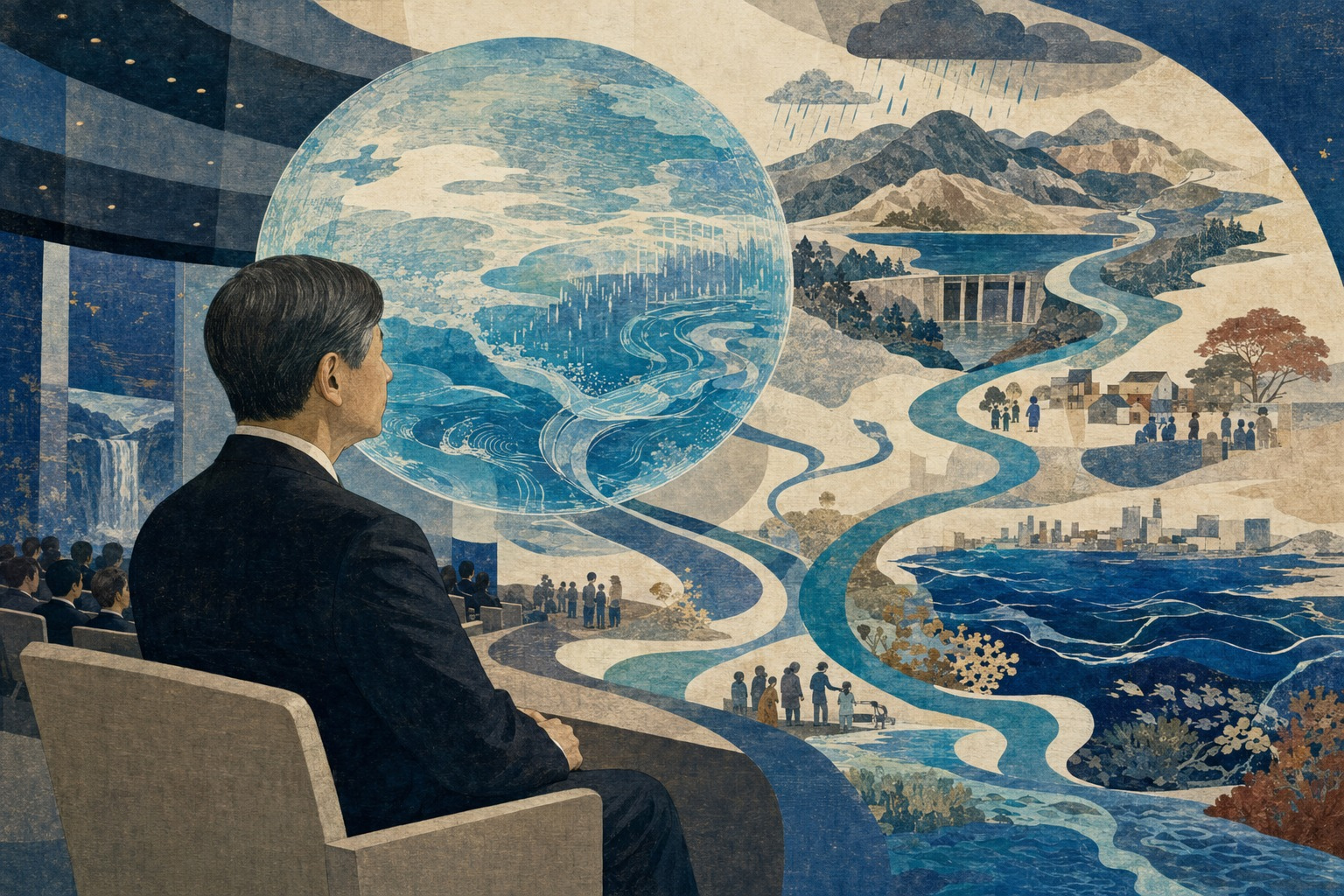
Onstage were government figures from Egypt and the United Arab Emirates, representatives of international organizations and experts accustomed to speaking about water in the language of risk. In the front row, Emperor Naruhito took notes. When speakers called for international cooperation, he applauded. After the programme, he met Han Seung-soo, the former South Korean prime minister who chairs the High-level Experts and Leaders Panel on Water and Disasters, and others. According to an escort quoted in reporting from the event, the Emperor said he wished to remain interested in water.
Seen narrowly, it was a royal attendance at a technical conference. Seen across time, the morning contained half a century. Japan designated August 1 as Water Day in 1977. That same year, governments gathered in Mar del Plata, Argentina, for the first United Nations Water Conference and warned of a gathering global crisis. In 2026, Japan observes Water Day and Water Week for the fiftieth time. The third UN Water Conference is due to meet in Abu Dhabi in December.
There is a second timeline, belonging to Naruhito himself. It begins not with climate diplomacy but with a historian's question: how did people and cargo move? Medieval traffic on the Seto Inland Sea, eighteenth-century transport on the Thames, the rivers, canals and quays of Edo. Before he approached water as a resource or a hazard, he studied it as a road. That road widened into drinking water and sanitation, floods and tsunami, cities and culture, cooperation across borders and the memory of disaster.
Too Much Water Meets Too Little
The symposium's formal subject was comprehensive water management integrating flood control, water use and the environment. Bureaucratic wording conceals conflicts woven into daily life. A reservoir kept low has more space to catch a flood. A reservoir kept high offers more water for power generation, farms and drought. Straightening a river may move a surge past a city faster, but can damage wetlands, fish habitat and groundwater recharge. Forests upstream, irrigation, urban taps, factories, sewers and an estuary belong to one water cycle even when their laws, managers and budgets do not.
When delegates from Egypt and the UAE described scarcity, they were not presenting a distant desert problem to a water-abundant country. The essential questions are not only how much rain falls, but when and where usable water arrives, in what condition and for whom. A community can be cut off from safe water immediately after torrential rain. A shrinking municipality can lose rate revenue while retaining hundreds of kilometers of pipe. Fields, cities and hydropower can need the same stored water at the same time. A rainy country can still run short of water it can deliver.
Globally, the WHO and UNICEF estimated in 2025 that 2.1 billion people lacked safely managed drinking water and 3.4 billion lacked safely managed sanitation. Among them, 106 million drank directly from untreated surface sources. “Safely managed” means more than the presence of a tap: water must be on the premises, available when needed and free from contamination. The crisis is manufactured as much by poverty, conflict, discrimination and failed maintenance as it is by nature.
1977: Two Beginnings
A Cabinet agreement created Japan's Water Day and Water Week in 1977. August 1 came at a season of high demand, when public attention could be directed to the value of water and the importance of developing water resources. The country was still extending the dams, transfer systems, waterworks and sewers that supported rapid growth while learning, often painfully, to confront industrial pollution and drought.
That year also brought the first UN Water Conference in Mar del Plata. It placed supply, sanitation, agriculture, cities and the environment on a global agenda. Forty-six years passed before the next major UN conference devoted to water, held in New York in 2023. The 2026 conference, co-hosted by the UAE and Senegal at Abu Dhabi from December 8 to 10, is mandated to accelerate Sustainable Development Goal 6: water and sanitation for all, sustainably managed.
The change across fifty years is visible in Japan's anniversary theme: “Passing on a healthy water cycle to the next generation—harmony among flood control, water use and the environment.” Development remains necessary, but is no longer sufficient as the master idea. The 2014 Basic Act on the Water Cycle gave Water Day a statutory foundation. The 2024 Basic Plan on the Water Cycle put “comprehensive river-basin water management” at the center.
A new phrase does not dissolve institutional boundaries. Rivers, farms, drinking water, sewers, forests, energy and land use remain divided among organizations. An upstream choice can become a downstream cost. The anniversary matters only if it tests whether systems inherited from the previous fifty years can survive the next.
A Life's Work That Began With Roads
Calling Naruhito simply an environmental advocate misses the unusual origin of his interest. He trained as a historian of transport. At Gakushuin University he studied medieval maritime movement on the Seto Inland Sea. Beginning in 1983, he spent about two years at Oxford researching navigation on the eighteenth-century Thames. River improvements, locks, cargo and carriers showed how waterways enabled the Industrial Revolution and the growth of London. The work became his 1989 English-language book, The Thames as Highway.
At the Third World Water Forum in Kyoto in 2003, he discussed the waterways connecting the old capital to its provinces. At the Fourth Forum in Mexico City in 2006, his keynote “Edo and Water Transport” traced how rivers and canals helped make the shogunal capital. Edo's network moved food and fuel, but it also embodied a long contest with floods and the need to reconcile competing uses. On the Thames, disputes between millers and carriers around weirs and locks had posed the same lesson: no single user could possess the river's purpose.
This beginning in transport history helps explain the breadth of his later work. A waterway is engineering, commerce, authority, labor and cultural exchange at once. A flood barrier is never only concrete; it expresses a decision about which people and places receive which level of protection. Water is a natural force managed through social arrangements.
1983–85 Researches eighteenth-century transport on the Thames at Oxford.
1989 Publishes The Thames as Highway.
2003 Speaks on Kyoto's waterways at the Third World Water Forum.
2006 Delivers “Edo and Water Transport” at the Fourth World Water Forum.
2007–15 Serves as honorary president of the UN Secretary-General's Advisory Board on Water and Sanitation.
2021 Addresses the UN thematic session on passing down disaster memories.
2024 Visits the Thames Barrier and addresses the Tenth World Water Forum by video.
2025 Emphasizes cooperation and partnership at the seventh UN water-and-disasters session.
2026 Visits the Dutch water institute Deltares and attends the Tokyo symposium.
Putting One Basin Back on One Map
Japan's policy of comprehensive river-basin water management does not replace flood control. It layers two more aims onto it: maximize the benefits of water use and maximize a rich water-connected environment, while all stakeholders in the basin reconcile their conflicts. The government has described an ambition to extend the approach to all 109 Class A river systems. Geography, industry, population and history differ, so a single replicated formula will not work.
Pre-releasing a dam before forecast rain creates room for floodwater. If the forecast is wrong and rain does not come, however, farms, households and generators may lose stored water. A flood-retention area can shelter a city and become wildlife habitat, but requires agreement over land. Taking water at a higher elevation can reduce pumping energy while diminishing flow in the reach below. Integrated management is not a promise that every interest wins at once.
Its real work is to expose who gains, who bears risk or cost, and how data, compensation and consent will be arranged. The symposium's host list—Japan's Water Cycle Policy Headquarters, the land ministry, Tokyo, the Water Week committee, HELP and the UN Centre for Regional Development—was itself an admission that no single agency owns the answer.
| Problems sharing one basin | Purpose | Potential conflict |
|---|---|---|
| Flood control | Reduce damage from floods, storm surge and sediment | Reservoir levels, retention land, downstream transfers of risk |
| Water use | Secure drinking water, farming, industry and power | Drought allocation, prices and fairness among regions |
| Environment | Protect water quality, biodiversity, groundwater and coasts | Withdrawals, channel works, pollution and ecological flow |
| Daily life | Maintain hygiene and health through disasters | Costs for older people, islands, shrinking towns and low-income households |
| Climate and energy | Adapt while decarbonizing | Dam capacity, pumping power and investment priorities |
Scarcity Beneath a Water-Rich Country
Japan's monumental dams and levees are easy to see. The next crisis is often under the road. A land-ministry review found that at the end of fiscal 2021, about 170,000 kilometers of water pipe—22 percent of the network—had exceeded the statutory service life of forty years. On the assumptions used in the review, the share is projected to reach about 41 percent a decade later and 66 percent after two decades. Crossing forty years does not mean a pipe instantly fails. It signals a rapidly accumulating renewal obligation.
The same review found that at the end of fiscal 2023, only about 9 percent of designated important facilities had both their connecting water and sewer pipelines made earthquake-resistant. A working treatment plant cannot serve a hospital if the network between them is broken. In the 2024 Noto Peninsula earthquake, as many as roughly 140,000 households lost water. Damage to non-resistant critical facilities, broken roads and difficult terrain slowed restoration. Heavy rain then struck the recovering peninsula in September—the “compound disaster” and “double disaster” Naruhito later described.
Population decline sharpens the bind. Fewer customers mean less rate revenue, but a municipality's pipes do not immediately become shorter. Skilled staff are also becoming scarcer. Keeping rates low can starve renewal; raising them concentrates hardship on poorer households and small businesses. Regional operation, public-private work, leak sensors, consolidation and decentralized supply can help, but each requires a choice about geography, accountability and service.
The familiar image of water-rich Japan can make the tap seem like a direct gift of rain. In reality, intakes, treatment, electricity, chemicals, pipes, technicians, fees and mutual aid between utilities must connect every day. Scarcity arrives not only when a reservoir empties. It arrives when maintenance workers, money, parts or alternative routes run out.
Resilience Beyond the Levee
Climate change moves the assumptions beneath engineering. A land-ministry flood-planning study estimated that under a scenario corresponding to two degrees of global warming, design rainfall would be about 1.1 times higher in most Japanese regions, flood discharge about 1.2 times higher and flood frequency roughly doubled. For parts of Hokkaido and northwestern Kyushu, the planning rainfall multiplier is 1.15. These are modeled planning factors, not claims that observed rainfall everywhere has already increased by exactly those amounts.
Higher levees and stronger dams remain essential. But a system depending on structures alone can fail catastrophically beyond its design event. Fields and wetlands that retain water, parks designed to flood, restrictions on new development in dangerous places, raised buildings, warnings, evacuation routes, backup supply for hospitals and care homes, and neighbors checking on one another all become layers of defense.
- Gray infrastructure: dams, levees, pipes, treatment, drainage and seismic reinforcement.
- Green and blue infrastructure: forests, wetlands, retention areas, rice fields, natural banks and groundwater recharge.
- Forecasts and data: rainfall and flow observation, flood prediction, leak detection and open risk maps.
- Institutions: forums where municipalities, companies, farmers and residents can decide across silos.
- Society: drills, storytellers, registries of people needing help and mutual aid.
- Equity and finance: renewal funding, insurance, support for low-income users and fair intergenerational rates.
Resilience is not merely the ability never to break. It is the capacity to keep essential functions alive, and to restore them quickly and fairly when they stop. If protecting one district raises its land value while another becomes a retention zone, how are benefits and burdens shared? If forecasts improve, can people without smartphones or independent mobility act on them? Technical performance must be translated into social performance.
Memory Is Infrastructure
The distinctive element in Naruhito's public work on water is his insistence that historical evidence belongs inside disaster policy. In a 2021 address to the UN Special Thematic Session on Water and Disasters, he described disaster records and survivors' experience as common social property. He moved from storytellers of the 2011 disaster to tsunami monuments and ruined buildings, then to documents and boulders recording the 1771 Meiwa tsunami. He called such inheritances a “baton of memory” passed between generations.
Memory is not sentimentality. A carved inundation height can tell people how far to climb. Documents listing deaths, flooded fields and recovery can be combined with geology and tsunami simulation. Evidence about where damage fell—and why it fell unevenly—can revise hazard maps and evacuation plans. School drills, warnings between neighbors, the sharing of food and water, and ties maintained during reconstruction are infrastructure of another kind.
Memory also decays. Witnesses die, markers blend into the landscape and data formats become obsolete. An archive must be interpreted again for a changed community. Does a warning reach foreign residents and visitors? Is it accessible to people with visual or hearing disabilities? Does it work at night or in a power failure? Memory protects the future only when a society continues to operate it.
The Emperor Does Not Make Water Policy
A constitutional boundary matters. Japan's Emperor has no powers related to government. Naruhito decides neither dam budgets nor water rates nor Japan's negotiating position. Attendance at a symposium should not be read as a political instruction or endorsement. The published programme recorded no speech by him; reporting described listening, note-taking, applause and conversation.
His presence can still carry three forms of significance. The first is continuity: more than four decades of attention, from research on locks and navigation as crown prince to water and disaster after accession. The second is connection: history, engineering, sanitation, culture and diplomacy are placed inside one story. The third is public attention: a specialized meeting enters wider view, and a time horizon longer than an electoral or budget cycle enters the room.
There are limits and dangers. Reverence for the institution must not blur policy failures or conflicts of interest. A pleasing story about “the Emperor's water concern” is worthless if it becomes a substitute for financing pipe renewal, reaching agreement over land, protecting low-income customers or accounting for ecological loss. The symbol can open a space of attention; governments, utilities, companies, researchers and citizens must turn it into verifiable action.
From Tokyo to Abu Dhabi: A Test for Promises
The 2026 UN Water Conference has six interactive themes: water for people, prosperity, planet and cooperation; water in multilateral processes; and investments for water. Japan and Egypt have co-chaired preparatory work on “Water for Planet,” linking ecosystems from glaciers to the sea with climate resilience and disaster-risk reduction. Tokyo's symposium was, in part, an anteroom where Japan could place fifty years of experience before that process.
The December conference should not be judged by attendance or the elegance of a declaration. Do commitments name an actor, deadline and source of finance? Is maintenance treated with the same seriousness as new construction? Can institutions connect flood, drought, water quality and ecology at basin scale? Will they measure the unequal burden on women and children, people in conflict, rural and Indigenous communities, and low-income neighborhoods? Will data be public enough to follow progress after the delegates leave?
The same tests return to Japan. Can comprehensive management in 109 river systems resolve an actual conflict instead of simply assembling a committee? Can wider water-utility operation preserve local voice while adding expertise? Can rates fund renewal without denying service to those unable to pay? Can planning multipliers alter risky land use, not merely engineering calculations? Can disaster memory change evacuation behavior rather than remain inside a museum?
| Question for a real commitment | Weak answer | Strong answer |
|---|---|---|
| Who does what, by when? | Promote cooperation | Name the actor, deadline, location and people served |
| Who pays? | Mobilize investment | Define public funds, rates, private capital and user protection |
| What is measured? | Share good practice | Publish quality, downtime, damage, recovery and inequality |
| How is nature treated? | Take conservation into account | Set goals for flow, habitat, groundwater and the coast |
| What happens after failure? | Call it unexpected | Provide redundancy, emergency supply, review and revision |
From Controlling Water to Choosing With It
The problem did not remain in Miraikan after the Emperor left. Tokyo's water runs from mountain rain through reservoirs, rivers, treatment plants and pipes beneath roads, into homes, then through sewers toward Tokyo Bay. Break one hidden connection and the routine of a metropolis can change within hours. Conversely, inconspicuous choices—maintaining an upstream forest, training the engineer who replaces an old main, arranging water at a shelter—can reduce the loss of the next disaster.
The water Naruhito first studied was a road. A road connects two points, but always raises questions about who may use it, what it carries and who maintains it. Today's water problems do the same. They connect tap and source, city and countryside, present users and future generations, disaster memory and the next evacuation, domestic policy and international cooperation.
Twentieth-century water management often measured progress by the power to control nature and deliver large quantities where people wanted them. Those achievements supported longer lives, sanitation, food, industry and cities. The next fifty years must renew that inheritance while accepting its limits and conflicts. The task is not total mastery. It is a common choice about which risks to reduce, which benefits to share, which environments to retain and whom to protect first.
Naruhito taking notes on July 28 was not policy. Yet the historian's method—follow the flow, examine why interests collide, preserve evidence and pass it forward—offers a way to approach water's future. The fiftieth anniversary matters not because it is celebrated. It matters because a question begun in 1977 is being asked again in 2026, when climate assumptions are shifting, pipes are aging, Japan is shrinking and the world's water inequalities remain immense.
Reporting Notes and Principal Sources
This article is based on material made public by July 29, 2026, 11:30 a.m. JST. The official plan establishes the symposium's time, organizers and purpose; Mainichi reporting establishes the Emperor's actions and attendance of about 200. The published programme does not record a speech by him. Climate multipliers are presented as future flood-planning estimates, not observed uniform national increases. A pipe exceeding statutory service life is not necessarily unusable.
- Official plan for the 50th Water Day and Water Week (PDF, Japanese)
- Mainichi distribution: Emperor attends symposium on water issues (Japanese)
- Mainichi photograph: Arrival at the symposium
- Ministry of Land, Infrastructure, Transport and Tourism: Water Day and Water Week
- MLIT: Announcement of 50th-anniversary events
- Imperial Household Agency: The Emperor's research
- Imperial Household Agency: Water activities and UN advisory-board service as Crown Prince
- Imperial Household Agency: “Edo and Water Transport”
- Imperial Household Agency: “Passing on Memories of Disasters”
- Imperial Household Agency: Emperor's 2025 birthday press conference
- Imperial Household Agency: Emperor's 2026 birthday press conference
- MLIT: Comprehensive river-basin water management (PDF, Japanese)
- MLIT: Future rainfall multipliers for flood planning (PDF, Japanese)
- MLIT: First review toward resilient, sustainable water and sewer systems (PDF, Japanese)
- WHO and UNICEF: Latest drinking-water, sanitation and hygiene estimates
- United Nations: 2026 UN Water Conference
- United Nations: Dates, venue and SDG 6 mandate
- UN-Water: United Nations World Water Development Report 2023
- Japan Water Forum: Asia-Pacific regional preparatory meeting for the 2026 conference
- Deltares: The Emperor's 2026 visit