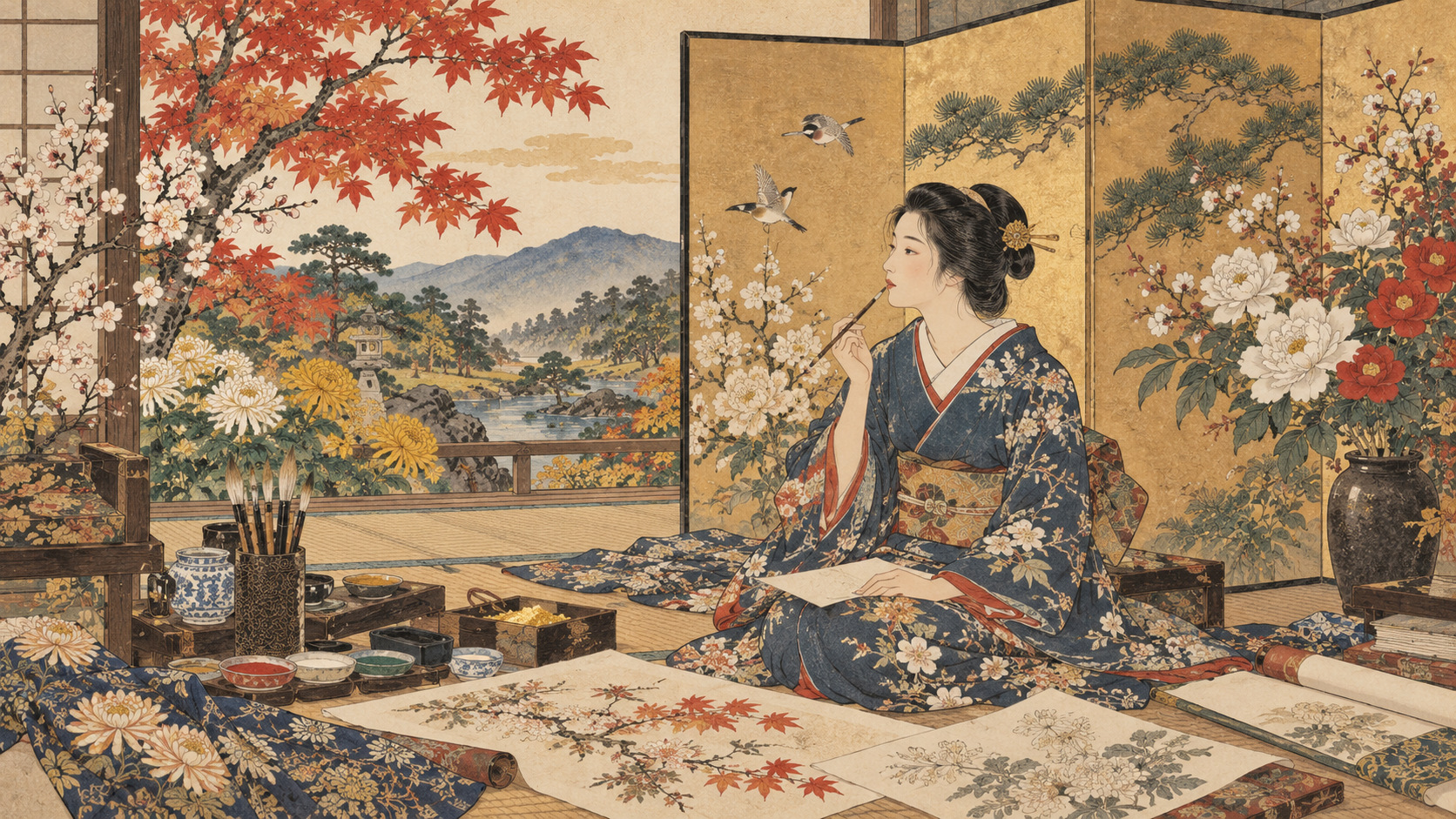
The women behind an artist’s changing vision
What does a portrait preserve? The face of a woman, the tastes of her era, the intentions of the artist—or some uneasy combination of all three? On October 15, Kyoto Prefectural Insho Domoto Museum of Fine Arts opens “Muses – The Models Who Inspired Insho’s Art,” an anniversary exhibition following nearly six decades of the painter’s representations of women. The show continues through December 20 and includes works that the museum says will be displayed publicly for the first time.
The subject is more ambitious than a parade of beautiful faces. Domoto Insho (1891–1975) moved from sharply observed everyday scenes to classical Japanese painting, postwar figurative work and, ultimately, abstraction. His images of women offer an unusually continuous thread through a career that repeatedly changed direction.
A young observer in the streets of Kyoto
Born in Kyoto in 1891 as Domoto Sannosuke, the future painter began as a designer rather than an established fine artist. After graduating from the Kyoto Municipal School of Arts and Crafts in 1910, he worked with commercial design and textile patterns, including designs associated with the Nishijin weaving industry. It was work requiring close attention to material, ornament and how an image could be translated into another medium.
The exhibition begins with small illustrative images made while he was still a teenager. In his twenties he also sketched women in Kyoto’s traditional entertainment districts. The museum describes an interest in their lived presence and inner character. But viewers should be cautious about mistaking the curator’s description of a “muse” for biographical evidence about the identity, wishes or experience of any particular sitter.
An unexpected route to the imperial salons
At 27, Domoto entered the Kyoto Municipal Special School of Painting, later part of the institutional ancestry of Kyoto City University of Arts. His painting “Fukakusa” was accepted into the inaugural Imperial Art Exhibition in 1919. “Chōmarizu” received a special selection in 1921, and his monumental Buddhist-themed “Kegon” earned the Imperial Academy of Fine Arts Prize in 1925.
The sequence matters. Japan’s painting establishment was attempting to negotiate inherited pictorial languages and the visual experience of a rapidly modernizing country. Domoto did not choose between decoration and observation, between religious narrative and fashionable urban subjects. He made the tensions productive, bringing habits developed in commercial design into increasingly ambitious painted compositions. This is an interpretive connection rather than a documented statement of the artist’s intent.
A goddess rather than a sitter
One of Domoto’s key works, “Konohanasakuya-hime” (1929), presents the goddess associated with cherry blossoms and the mythology of Japan’s imperial origins. The work was shown at the tenth Imperial Art Exhibition and is highlighted in museum materials concerning the artist’s career.
It complicates the exhibition’s title. Some figures derive from people an artist encountered; others are imagined through religion, storytelling and idealization. An image can convey an era’s expectations of womanhood without being a straightforward record of a woman who once sat in a studio. Distinguishing these categories makes the exhibition more revealing, not less.
Three images, three different publics
Kyoto Shimbun, a co-organizer, identifies “Sakuragari” (1928), “Bijin” (1934), and “Two Figures with Chairs” (1949) among the exhibited examples. “Sakuragari” belongs to the Kyoto Prefectural museum; “Bijin” is an original cover image created for the magazine Fujin Kōron and is privately owned; and the 1949 painting is held by the museum.
That magazine cover opens a door beyond the gallery. Women in modern Japanese visual culture did not appear only in unique paintings hung in institutional exhibitions. Their images circulated in periodicals, design, fashion and advertising, addressing audiences who might never encounter the original artwork. Domoto’s early design experience and the public life of his images make this an important part of the story.
War, reconstruction and visual reinvention
By the 1930s Domoto was teaching younger painters, and in 1944 he was appointed an Imperial Household Artist. After the war, the museum says, he made figurative works addressing contemporary social life. “Two Figures with Chairs,” dated 1949, offers an opportunity to examine how his forms and settings changed as Japan itself was changing.
In 1952 Domoto traveled through Europe, visiting countries including Italy, Germany, Spain, France and Switzerland. From the middle of that decade, he ventured decisively into abstraction. This evolution should not be narrated as an inevitable march from conservative to progressive. A more illuminating question is what he discovered he could do with gesture, color and pictorial space—and what that meant for a theme to which he returned throughout his life. In 1961, he received Japan’s Order of Culture.
A museum he designed himself
In 1966 Domoto opened his own museum beside his Kyoto residence. Its architecture and interiors, according to the institution, were designed under his own artistic direction. The building was not merely a neutral home for finished paintings: it was an extension of the artist’s vision of how art should be encountered.
The museum and its collection were donated to Kyoto Prefecture in 1991, and the institution reopened as the prefectural museum in 1992. Its 60th-anniversary programming has already explored the building’s creation; this autumn presentation shifts attention to the recurring human subject within Domoto’s art. It follows a separate 2025 retrospective marking 50 years since his death, but proposes a more tightly focused argument.
The garden becomes a contemporary companion
From October 15 to 18, the museum’s garden and entrance will host a free outdoor ikebana exhibition, “My Insho and Each Muse.” Kyoto Prefecture lists ten emerging flower-arrangement artists contributing 19 works, and says visitors will be able to watch arrangements being installed on opening morning. The juxtaposition of flower art and historical female imagery gives visitors another way to think about inspiration and interpretation.
The museum also plans limited public access to Domoto’s restored “Mountain Atelier” on October 18 and November 22. The studio was registered as a national tangible cultural property in 2025. Rather than only seeing the products of a career, visitors can briefly enter part of the environment in which that career took shape.
What the title “muse” cannot tell us
Art history often preserves an artist’s name much more thoroughly than the lives of those represented in the work. Calling someone a muse may convey admiration, but it can also obscure the decisions, labor and individuality of the women concerned. The museum’s curatorial invitation is worth taking seriously, while separating an image’s visual qualities from claims about a sitter that surviving evidence does not establish.
The exhibition runs October 15–December 20, 9:30 a.m.–5 p.m., with last admission at 4:30. Adult admission is ¥600; high-school and university students pay ¥450, and visitors aged 65 or above pay ¥300 with identification. It is generally closed on Mondays, except November 23, when it opens and instead closes November 24. Curator-led talks are scheduled for November 3 and 28. For international visitors, the exhibition offers both a vivid introduction to one of modern Kyoto’s restless artistic careers and an invitation to ask whose stories survive in the finished painting.
Sources and research
- 京都府立堂本印象美術館:展覧会公式案内
- 京都府立堂本印象美術館:作家略歴
- 京都府立堂本印象美術館:印象の画業
- 京都新聞:展覧会概要・作品例
- 京都府:野外いけばな展
- 京都国立近代美術館:2025年回顧展
- 京都府立堂本印象美術館:美術館開館の歴史
Research checked October 13, 2026. Exhibition scheduled to open October 15.