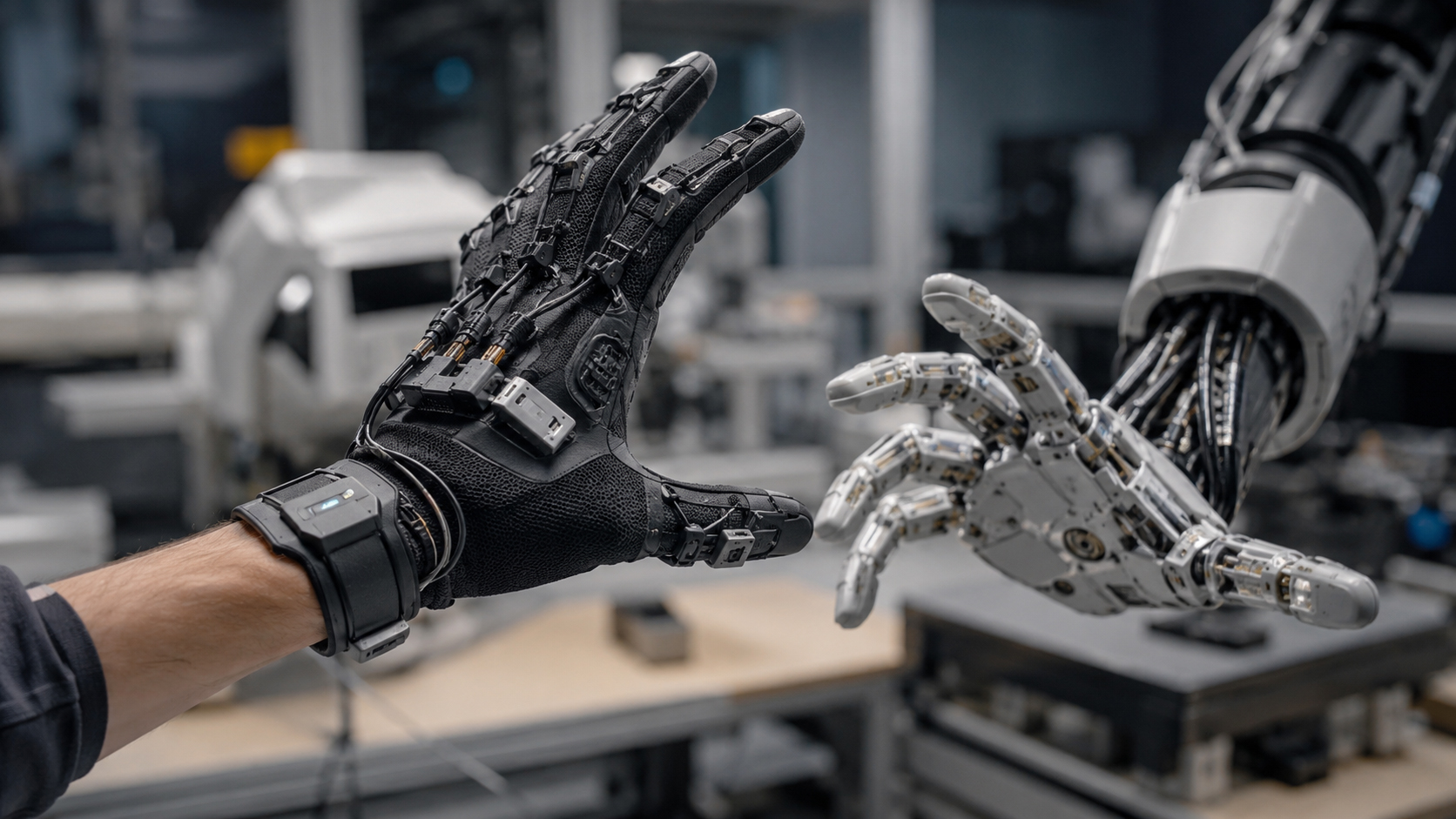
The most important robot story in Japan this week may not be a robot at all. It may be a glove. Diver-X announced ContactGlove3 Pro on June 24, positioning the device as a professional interface for robot teleoperation and work-data collection. The headline specifications are concrete: electromagnetic-field fingertip tracking, native support for ROS 2, C++ and Python SDKs, cross-platform operation on Linux, macOS and Windows, and a starting price of ¥498,000 including tax. For a daily consumer gadget, that would be expensive. For a robotics laboratory trying to collect dexterous human motion, it is suddenly a very practical number.
The hand is the hard part
Industrial robots have been excellent at repeating known motions. They weld, lift, sort, paint and assemble with tireless precision. But the human hand is a different kind of machine. It pinches, slides, twists, feels resistance, adjusts pressure and recovers from small errors without a written manual. A worker can open a stuck cap, align a flexible cable, pick up a soft object, fold a towel, or guide a tool around a small obstruction. Those actions look ordinary because humans do them every day. For robots, they are the frontier.
That is why ContactGlove3 Pro matters. The product is not merely about moving a robot hand from a distance. It is about recording human demonstrations in a form that robot systems can understand. In the language of the new robotics wave, the glove sits at the meeting point of teleoperation, imitation learning and Physical AI.
From VR glove to robot-teaching interface
Diver-X did not appear from nowhere. The company built its reputation in XR and VR gloves, where the challenge was to make digital hands feel more natural. ContactGlove2 already emphasized accurate hand tracking and a more immersive interface for virtual environments. The new ContactGlove3 family continues that lineage, but the Pro model turns the same interface idea toward robotics research and industrial automation.
Japanese specialist coverage notes that the Pro model uses a full-finger structure covering all five fingertips, with measurement coils in each fingertip. That design is meant to capture fine interactions such as fingers touching one another, pinching and combined finger movements. In other words, the glove is aimed at the small details that make hand work difficult to automate.
Why ROS 2 changes the audience
The phrase ROS 2 may look technical, but it is central to the business meaning of the product. ROS, the Robot Operating System ecosystem, is a common language of robotics development. ROS 2 is widely used in modern robot research and increasingly in commercial systems. By supporting ROS 2 along with C++ and Python, ContactGlove3 Pro speaks directly to the engineers who build and test robot behavior.
This matters because data gloves often fail not only because of hardware, but because of integration friction. A glove that produces interesting hand data is useful. A glove that can fit into existing robot pipelines, simulation tools, control code and data-collection workflows is more than a peripheral. It becomes infrastructure.
Physical AI needs demonstrations
Japan’s robotics debate is changing. For decades, the story was hardware: motors, actuators, arms, sensors, factories. Now the story is increasingly data. Foundation models for robots need examples of how bodies act in the real world. Vision-language-action models need to connect what a system sees, what a human intends and what a machine should physically do next. Imitation learning needs demonstrations. Teleoperation needs interfaces precise enough to make those demonstrations worth recording.
That is the larger context around ContactGlove3 Pro. Japan has factories, aging infrastructure, labor shortages, care needs and a culture that has long accepted robots as more than science-fiction villains. But turning that history into a new Physical AI industry requires data from real tasks. A glove can become a way to collect that data.
A Japanese startup at a global inflection point
The timing is interesting. Diver-X also announced a company-name change to Melt Interface Technologies, suggesting a broader ambition around the point of contact between people and machines. The firm’s own English-language corporate messaging says it focuses on the “point of contact” between humans and computers as a place where experiences and productivity can be reshaped. ContactGlove3 Pro makes that philosophy physical.
In global robotics, several research groups are chasing the same problem: how to collect high-quality human manipulation data at scale. Recent academic work has explored devices for dexterous human manipulation transfer and ROS 2-compatible pipelines for learning-based manipulation and teleoperation. Diver-X’s advantage, if it can execute, is that it already understands wearable hand interfaces and now wants to bring that knowledge into the robotics stack.
Why ¥498,000 is important
The price is not a small detail. A starting price of ¥498,000 makes the product expensive compared with consumer VR accessories, but reachable for university laboratories, corporate R&D teams, robotics startups and factory-automation pilots. In robotics, the cost of a single failed integration project can dwarf the price of a peripheral. If the glove shortens data collection, reduces custom engineering, or improves the quality of demonstrations, the business case becomes plausible.
That does not make success automatic. Robot hands are not all the same. Mapping human motion to a five-finger robotic hand is not trivial. Latency, calibration, durability, data cleaning, operator fatigue and task repeatability all matter. A glove can capture a human movement; it cannot by itself guarantee that a robot can perform the task safely, cheaply and repeatedly in a real environment. But it can become one of the missing tools.
Japan’s old robot dream meets the AI era
Japan has loved robots for a long time: factory arms, humanoids, pet robots, service machines and anime companions. Yet the new era may be less glamorous and more consequential. The next important Japanese robot may not bow on stage. It may learn how to pick a part, insert a connector, operate a tool, inspect a shelf or help a human worker from a remote site.
ContactGlove3 Pro belongs to that quieter revolution. It is not the robot. It is the human interface that may help teach the robot. That makes it a good Japan.co.jp story: a small product announcement that points toward a national industrial question. Can Japan turn its long robotics identity into a practical advantage in Physical AI?
The answer will not come from one glove. But the race to teach robots has begun. And in that race, the human hand is still the master teacher.
Sources and references
This article draws on Diver-X/Melt Interface Technologies product materials, PR TIMES, PANORA, Mogura VR, ROS 2 documentation and recent robotics research on teleoperation and imitation-learning data collection. Product details, pricing and release schedules may change.
- PR TIMES: ContactGlove3 Pro announcement, ROS 2 / C++ / Python SDK support, ¥498,000 starting price.
- Diver-X News: company announcements and ContactGlove3 Pro listing.
- PANORA: ContactGlove3 and ContactGlove3 Pro details, full-finger tracking, SDK and platform support.
- Mogura VR: company-name change and robotics positioning.
- ROS 2 documentation: robotics middleware context.