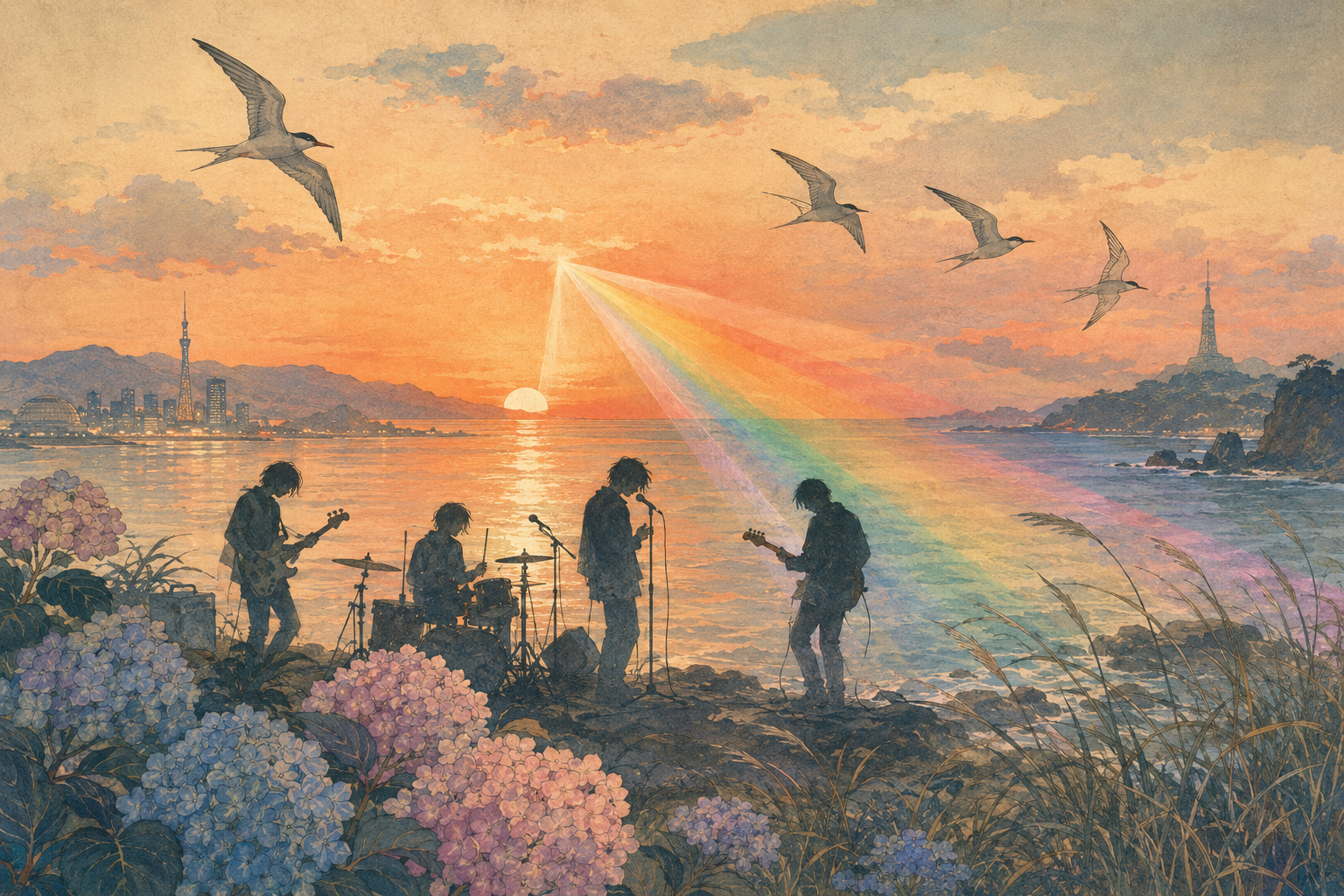
A prism does not invent light. It reveals that white light was never singular. Turn it slightly and an apparently unified beam separates into colors that had traveled together all along.
That is an apt title for Culenasm’s new single. “PRISM,” released Wednesday, takes a single remembered summer and divides it into sensations: sea spray, heat shimmer, orange dusk, a feeling left unspoken and a romance that refuses to fade when the calendar moves on. The release describes it as a summer tune driven by the band’s characteristic transparency, the rush of pop and the density of shoegaze.
The song also arrives as a hinge. Culenasm—Moe on vocals and guitar, Kenjirō on guitar, Makoto on bass, and Shūta on drums—will carry it into a winter solo tour spanning Fukuoka, Tokyo, Taipei and Osaka. For a band founded by university classmates in Fukuoka in 2018, the route is evidence of something larger than one overseas booking. Taiwan has become a recurring room in which the band’s music lives.
What “PRISM” Is Trying to Hold
Vocalist-guitarist Moe says the song places Culenasm’s transparent band sound around the sparkle and sadness of summer. She asks listeners to connect its sea and sunset imagery to their own unforgettable seasonal memory. That statement is promotional testimony, but it identifies the song’s emotional mechanism: the lyric does not need to describe one documented romance if each listener can refract it through a different past.
The title is especially useful for a band that works by layering. In shoegaze, a guitar is rarely heard only as a clean string struck once. Distortion, reverb, delay, modulation and feedback spread the attack into a cloud. Bass and drums give the cloud weight and direction. A vocal may sit inside the texture rather than commanding from above it.
Culenasm’s difference is its insistence that the song remain legible. The official profile calls the band a fusion of shoegaze sound and pop. Early coverage heard feedback noise wrapped around “sugar pop”; later releases added programmed rhythm and a wider palette. “PRISM,” according to the release, pushes the openness and forward motion of summer without abandoning the group’s hazed edges.
That balance is harder than it sounds. Too much atmosphere and the melody dissolves. Too much polish and the guitars become colored decoration around conventional pop. Culenasm’s central craft is to make noise behave like memory: blurry at the perimeter, painfully precise at the center.
A Name Caught Between Day and Night
“Culenasm” romanizes the Japanese word kurenazumu: the lingering interval when the sun has set but darkness has not fully taken the sky. The name is almost a manifesto. This is music interested in transitions rather than stable categories—day into night, sweetness into abrasion, remembered summer into approaching winter.
The four members met at university in Fukuoka and formed the band in May 2018. An early account says Makoto urged Moe not to accept an ordinary path, then invited Kenjirō and Shūta from their music circle. At only their third performance, they passed the audition for Ringo Music Festival. That quick result did not remove the ordinary labor that followed: local shows, circuit festivals, limited releases, videos and drives between cities.
In July 2019 they issued the double-sided first single “Hanabira / Itsuka no Imagoro.” The second mini-album, In Your Fragrance, arrived that December after a venue-only debut release. Early interviews situated their influences unusually widely—from the Jesus and Mary Chain to Hikaru Utada and Bump of Chicken. The combination helps explain why the band’s loudest passages do not reject Japanese pop structure.
The first full album, Hibi wa Kisetsu o Mekutte (“The Days Turn the Seasons”), followed in November 2022 after four mini-albums. Whisper of the Heart came in 2023, and the second full album, a beautiful days, in May 2025. In 2026, “Kokorobi,” “Natsu no Zanzō” and now “PRISM” have returned repeatedly to embers, afterimages and seasonal residue.
| Year | Milestone | What changed |
|---|---|---|
| 2018 | Band forms in Fukuoka | Four university classmates build a local live unit |
| 2019 | First single and In Your Fragrance | Early shoegaze-pop identity reaches national circuit stages |
| 2020 | Taiwan festival and pandemic-era work | Overseas possibility appears as live-house life contracts |
| 2022 | First full album | Four mini-albums consolidate into a longer statement |
| 2024 | Fifth-anniversary tour reaches Taipei | Taiwan becomes a repeat headlining market |
| 2026 | “PRISM” and “Tōka Seisei” | A four-city solo tour treats Taipei as part of the circuit |
Shoegaze, Rebuilt in Japanese Pop
The word “shoegaze” began as a dismissive description in the British music press around the end of the 1980s. Guitarists appeared to stare at the floor because their feet worked rows of effects pedals. Bands such as My Bloody Valentine, Slowdive and Ride replaced the heroic guitar solo with massed texture: volume that could feel less like attack than weather.
Japan did not merely import that template. In the 1990s and 2000s, groups including Coaltar of the Deepers, Luminous Orange and Cruyff in the Bedroom bent dense guitar sound toward metal, electronic music and Japanese melodic writing. Later bands such as Kinoko Teikoku and Yuragi helped a new audience hear shoegaze less as a closed British period and more as an adaptable East Asian language.
Culenasm belongs to that afterlife but resists being trapped by the label. The drums can drive rather than drift. Hooks arrive quickly. Moe’s low, slightly husky vocal stays human inside the effects. The members share songwriting work, allowing different centers of gravity from track to track.
The group’s music also fits the way songs now travel. A listener does not need a record shop specializing in obscure British imports. An algorithm, subtitled video, fan playlist or festival clip can place a Fukuoka band beside Taiwanese dream pop, Korean indie rock and a 1991 classic. Genre becomes a route through platforms as much as a shelf in a store.
Why Fukuoka Matters
Japanese music careers are often narrated as movement toward Tokyo. Fukuoka complicates that map. The city is a major metropolitan market with its own radio, clubs and festival circuit, but it also faces the Asian continent across a relatively narrow sea. Seoul and Busan can feel closer than Tokyo in travel time and imagination; Taipei is a short international flight.
Culenasm keeps the place audible in its language. “Bari yoka,” used in the tour and campaign names, means roughly “very good” in the speech associated with Fukuoka—bari intensifies and yoka means good. It is a small refusal to erase origin as the audience expands.
The venues make the same argument at human scale. LIVE HOUSE OP’s in Fukuoka and Shinsaibashi Pangea in Osaka are standing-room club spaces; Shindaita FEVER is embedded in Tokyo’s independent live circuit. These are not arenas that flatten local difference into a standardized production. Fans can see pedals changed, hear amplifiers push air and watch a band solve the room in real time.
Starting at home on November 12 and ending in Osaka on Christmas Day gives the itinerary an arc. Tokyo is essential, but it is neither origin nor finale. Taipei sits between the domestic dates as a full solo stop rather than a decorative foreign encore.
Taiwan Was Not Added at the Last Minute
Culenasm’s Taiwanese relationship reaches back at least to 2020, when contemporary coverage reported the band appearing as a headliner at the festival “Ishiki Funō Shōtaijo.” The timing was brutal: just as overseas promise appeared, the pandemic closed venues and borders. The band joined the “Make with music” project supporting Fukuoka live houses, a reminder that international careers still depend on small local rooms surviving.
By 2024 the route had reopened. The fifth-anniversary tour began in Fukuoka and ended June 15 at The UU Mouth in Taipei. Taiwanese ticketing material for a December return said the June solo engagement had expanded to two performances and sold out both. The December 14 show moved to The Wall, one of Taipei’s best-known independent-rock rooms.
The band returned again on March 28, 2026 for a three-act Taipei stop with Kūhaku Gokko and Hakubi at SUB Live. Nine months later, “Tōka Seisei” will place Culenasm alone at Billboard Live Taipei, a venue built around seated sightlines, food and drink service, and two compact sets in one day.
That progression matters more than the word “international.” A first overseas appearance can be a subsidized showcase, a festival invitation or a risky experiment. Repeated ticketed returns indicate that promoters have audience data, fans remember the songs and the travel cost can be placed inside a working plan.
2020 Contemporary coverage records a Taiwan festival appearance.
June 15, 2024 Fifth-anniversary tour reaches The UU Mouth in Taipei; ticketing material later describes two sold-out sets.
December 14, 2024 Culenasm returns for a winter solo show at The Wall.
March 28, 2026 Taipei date with Kūhaku Gokko and Hakubi at SUB Live.
December 12, 2026 Two solo sets scheduled at Billboard Live Taipei.
Why the Taiwan–Japan Indie Route Works
Japanese and Taiwanese independent musicians meet in a regional ecosystem that is both physical and digital. Taipei’s live houses, festivals and services such as StreetVoice have built audiences comfortable moving among Mandarin, Taiwanese, Japanese and English-language songs. Taiwan Creative Content Agency’s music platform describes festivals deliberately booking artists from Taiwan, Japan, Korea and Southeast Asia, and cites a pandemic-era remote collaboration between Kaohsiung trio Elephant Gym and Japan’s toe.
Language still matters, but guitar music carries information before translation. Timbre, tempo, dynamics and stage movement reach a listener immediately. Culenasm’s Japanese lyrics can then acquire meaning through fan translation, repeated listening and the emotional specificity of Moe’s delivery.
Taiwan also has its own shoegaze and dream-pop lineage, with bands and promoters who recognize the vocabulary of submerged vocals and layered guitars. That makes Culenasm neither an exotic novelty nor a perfect copy of local music. The band arrives legibly different.
Travel is comparatively manageable, but “near” is not “easy.” Instruments and merchandise cross borders. Promoters coordinate work permissions, tax, settlement and technical riders. A show must be marketed in Traditional Chinese, tickets priced in New Taiwan dollars, and travel delays absorbed. A four-member band may carry fewer buffers than a major-label arena act.
Inside Billboard Live Taipei
The December 12 venue changes how the music will be received. Billboard Live Taipei is on the seventh floor at 12 Songshou Road in Xinyi District. Its official listing schedules doors at 3:00 p.m. for a 4:00 p.m. first set, then doors at 6:00 p.m. for a 7:00 p.m. second set.
The seating categories, table service and two-show format move Culenasm away from the crush of a conventional basement live house. Detail may become more audible: the grain of Moe’s voice, the point where a clean guitar begins to saturate, the bass beneath a wash of reverb. But the room may also test whether music built for collective volume can retain danger while an audience is seated.
Two sets create another artistic problem. They can repeat one carefully timed program, vary songs for returning fans or reshape intensity for afternoon and evening. The official event page confirms the times and sales system but does not publish separate set lists. Any claim that the shows will differ would be speculation.
- November 12, Fukuoka: LIVE HOUSE OP’s.
- November 20, Tokyo: Shindaita FEVER.
- December 12, Taipei: Billboard Live Taipei, first set at 4:00 p.m. and second set at 7:00 p.m.
- December 25, Osaka: Shinsaibashi Pangea.
Summer as a Campaign, Not Just a Song
“PRISM” sits inside the “culenasm BARIYOKA SUMMER CAMPAIGN 2026,” running through August 31. The plan includes summer merchandise, member vacation vlogs and an official streaming playlist. The deadline deliberately connects with one of the band’s signature songs, “8月31日” (“August 31”).
This is contemporary independent music economics in miniature. Streaming makes the recording universally available but rarely makes one song sufficient as a business. Merchandise, video, membership, tickets and recurring audience attention surround the track. The song is the emotional center; the campaign builds reasons to remain near it.
There is a risk in converting every season into content. Nostalgia can become a calendar asset, and intimacy can become inventory. Culenasm’s defense is specificity: Fukuoka dialect, local scenery such as Kashii Bay in earlier work, the exact date of an older song and the member-made visual art that accompanied “Kokorobi.” A memory feels less manufactured when it retains where and when it happened.
“Tōka Seisei”: Green Through Winter and Summer
The tour’s Japanese subtitle, 冬夏青青, is read tōka seisei. The four-character phrase evokes evergreen trees that remain green in winter and summer and, by extension, a conviction that does not alter with circumstance. The band’s announcement renders the promise personally: it will travel to meet listeners with an unchanged belief.
The name creates a deliberate seasonal knot. “PRISM” is saturated with summer, yet the winter tour begins in November. One of Culenasm’s enduring subjects is precisely this inability of seasons to obey the calendar. Summer survives as an afterimage; a small inner fire persists in stagnant heat; a sunset lingers after the sun has gone.
The band itself is now testing evergreen endurance. Eight years is long enough for university classmates to encounter jobs, rent, health, relationships, industry disappointment and the unequal labor of touring. “Unchanging conviction” cannot mean repeating the 2019 sound forever. A living band stays itself by changing its methods without losing the reason it began.
What This Tour Will Measure
The important numbers will not be social impressions alone. Did listeners save and return to “PRISM” after the summer campaign ended? Can the band fill two Taipei sets? Do Taiwanese fans buy tickets earlier with each return? Does the December performance lead to another independent booking rather than a one-off prestige date?
There are artistic measures too. A studio shoegaze mix can stack tracks until sound becomes architecture. Four people onstage must rebuild that architecture with finite hands, pedals and breath. A good performance does not reproduce the file perfectly; it reveals which parts of the recording were load-bearing.
The tour will also test whether the Japan–Taiwan route can become routine without becoming generic. Repetition is the goal of a sustainable circuit, but every city must still feel addressed. A Fukuoka greeting in Taipei, a local-language message, a changed set or a remembered earlier room can turn logistics back into relationship.
The Light After the Song Ends
Culenasm chose its name for a sky that refuses to become night immediately. “PRISM” is about a summer that refuses to end when summer ends. “Tōka Seisei” invokes leaves that refuse to lose their color. Across all three images, persistence is not loud triumph. It is something remaining after conditions say it should be gone.
That may explain why the band’s combination of shoegaze and pop travels. Pop provides the shape a listener can carry away. Noise makes the shape feel weathered, as if the memory had passed through distance before arriving. The Japanese words may not be immediately understood in Taipei, but longing does not wait for a glossary.
On December 12, a Fukuoka song about orange summer evening will sound twice inside a Taipei winter. The calendar will say the season is over. The amplifiers, if Culenasm’s wager holds, will split that old light open again.
Reporting notes and principal sources
Release descriptions and artist comments are attributed to the band and distributor. Tour dates and Taipei set times were cross-checked against the band, ticketing coverage and the venue. Historical attendance claims are presented as promoter statements; no independent audit was identified.
- The Orchard Japan / Culenasm: “PRISM,” summer campaign and tour announcement
- Culenasm: official news and schedule
- Culenasm: official profile and member roles
- Culenasm: official discography
- Billboard Live Taipei: December 12 venue, set times and ticket rules
- SPICE: 2024 fifth-anniversary tour and first announced Taipei stop
- KKTIX / SlowGush: December 2024 Taipei return and two-show sellout claim
- Hakubi: March 2026 Taipei three-band show
- Fanplus Music: 2019 early-career interview and influences
- Culenasm: first full-album announcement and early release chronology
- block.fm: “Make with music” live-house support project
- Taiwan Beats / TAICCA: Taiwan’s regional festival networks
- World Literature Today: history of Japanese shoegaze and its East Asian revival