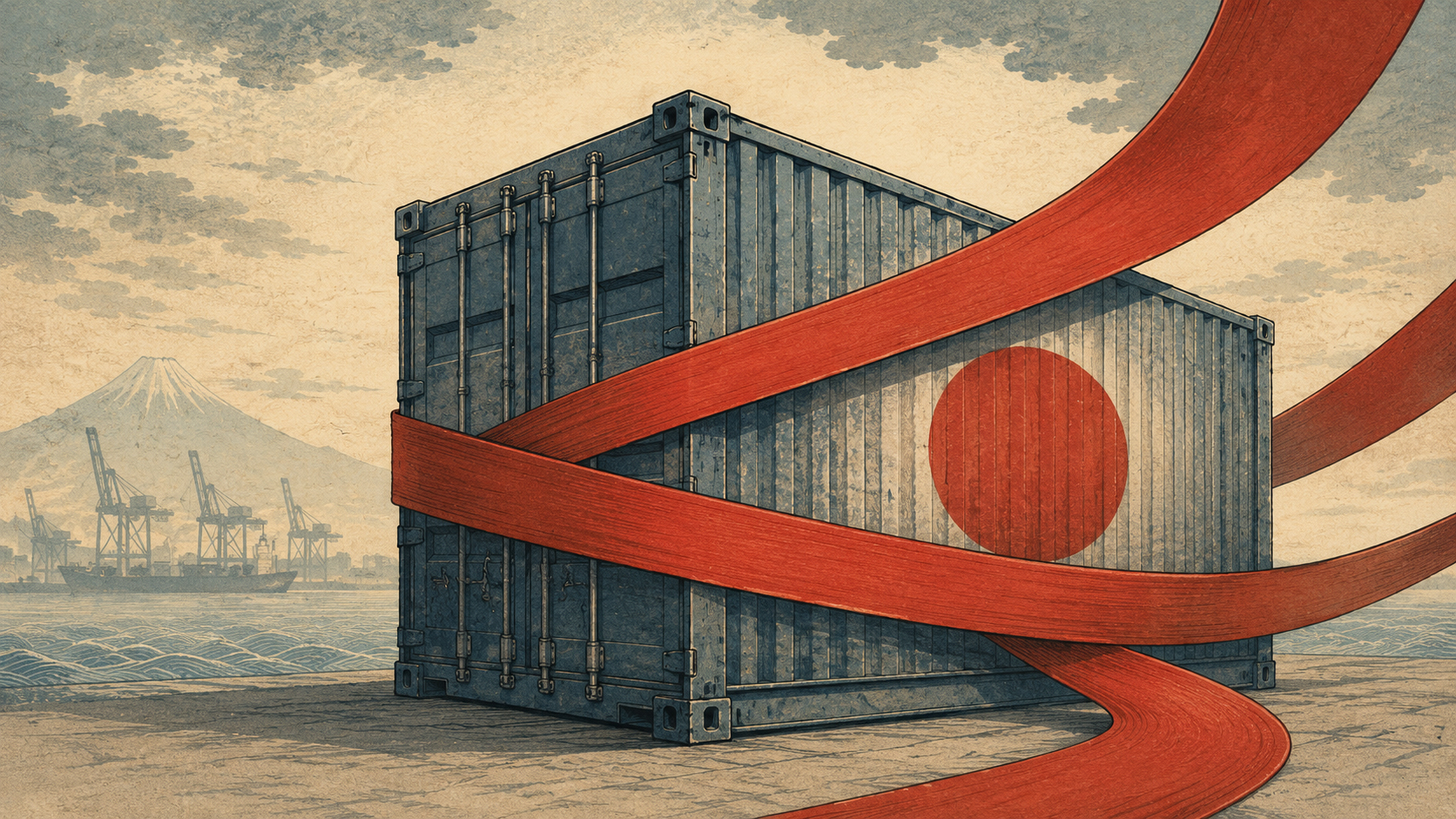
China’s decision to target 40 Japanese entities with new export-control measures is not just another trade story. It is a signal that the politics of East Asia now travels through cargo manifests, machine tools, rare earths, drone components, chip equipment, software systems, and the quiet compliance work of procurement departments. Diplomacy once moved mainly through summits and communiqués. In 2026, it also moves through end-user certificates.
On June 29, China’s Ministry of Commerce added 20 Japanese entities to its export-control list for dual-use items and placed another 20 on a watch list. The total is 40. Beijing said the measures were necessary to protect national security, fulfill nonproliferation obligations, and curb what it called Japan’s remilitarization and “new militarism.” Tokyo objected sharply.
The number matters, but the structure matters more. One group faces a severe restriction on receiving Chinese dual-use goods. The other group falls into a stricter review channel: exporters must submit risk assessments, provide written commitments against military use, and accept closer end-user and end-use scrutiny. Beijing has built a two-tier gate: one door nearly closed, another door watched by guards.
The pressure is in the architecture
Under China’s explanation, exporters dealing with watch-listed entities cannot rely on ordinary general-license treatment or simplified registration. They must seek individual licenses, file risk assessments, and provide commitments that the items will not enhance Japan’s military capabilities. Applications involving military users, military purposes, or end uses that could strengthen Japanese military capacity will not be approved.
That is a heavy signal to business. The burden does not fall only on the Japanese entities. It also falls on Chinese exporters, intermediaries, suppliers, and compliance officers. Export controls punish the target, but they also warn everyone around the target: this relationship is politically risky.
Why Japan, and why now?
China’s formal argument is security and nonproliferation. The listed institutions and companies sit near defense research, aerospace, shipbuilding, drones, industrial systems, information technology, or other technologies that can serve both civilian and military purposes. Chinese state media framed the move more sharply, describing it as a warning against Japanese “neo-militarist” expansion.
The larger background is Taiwan. Japan’s security debate has shifted. Defense spending has risen. Counterstrike capabilities have entered official policy. Missile deployments in the southwest islands have become more prominent. Defense ties with the United States and other partners have deepened. Japanese leaders have increasingly linked Taiwan contingencies to Japan’s own security.
From Beijing’s view, Japan appears to be moving away from postwar restraint and toward a front-line role in a U.S.-aligned containment architecture. From Tokyo’s view, the logic is reversed: China’s military buildup, coast guard activity, pressure around Taiwan, and willingness to use economic leverage are what have forced Japan to harden. The new list is that mutual suspicion translated into trade administration.
Export controls are an old tool with a new reach
Export controls are not new. During the Cold War, the United States and its allies developed systems to prevent sensitive machinery, materials, encryption, aviation parts, and missile-related technology from reaching the Soviet bloc. Wars are not shaped only by weapons. They are shaped by the machines and materials that make weapons possible.
What is different now is the breadth. Semiconductors, AI, quantum technology, drones, batteries, satellites, telecom equipment, rare earths, precision measurement, chemicals, and advanced manufacturing all sit in the dual-use zone. That phrase — dual-use — has become one of the central words of our time because it joins industrial policy to national security.
The United States has tightened advanced semiconductor controls on China. China has leverage in rare earths, gallium, germanium, graphite, batteries, and vast manufacturing networks. Japan stands in the middle: a U.S. ally, a precision-manufacturing power, and an economy deeply connected to China’s market and supply chains. Japanese companies live on the fault line of the new economic-security era.
From 1972 to 2026: the long arc of Japan-China commerce
The irony is hard to miss. After the normalization of diplomatic relations in 1972, Japanese companies became central to China’s modernization. Manufacturing, electronics, machinery, automobiles, chemicals, power generation, ports, urban infrastructure: Japanese capital and know-how helped build parts of China’s industrial rise.
From the 1980s through the 2000s, China became the workshop of the world, and Japanese companies placed factories, suppliers, customers, and managers inside that workshop. Politics could freeze while containers kept moving. Even when the two governments argued over history, islands, textbooks, Taiwan, or war memory, factories kept running.
By 2026, that older bargain is under strain. Interdependence no longer guarantees calm. It also creates leverage. China knows where Japanese industry depends on Chinese materials, components, and processing capacity. Japan knows where China depends on Japanese precision, quality, and industrial trust. They need each other, and that is exactly why they can hurt each other.
This is not just about weapons makers
The most important feature of the list is that it does not touch only narrow arms makers. Reporting has identified names or categories linked to Mitsubishi, Kawasaki Heavy Industries, Fujitsu, Komatsu, Mitsui E&S, drone firms, and defense or research institutions. Shipbuilding, aerospace, IT systems, construction machinery, port systems, unmanned systems, and nuclear-adjacent supply chains all sit inside the dual-use universe.
Construction machinery builds roads, ports, and tunnels; it can also build bases, runways, and hardened infrastructure. Drones inspect bridges and farms; they can also scout battlefields. Port machinery powers trade; in wartime, ports become logistics nodes. The border between civilian and military capability is not gone, but it has become thinner.
The real risk for companies
For Japanese firms, the risk is not only that a certain Chinese input may become harder to obtain. The larger risk is uncertainty. Which goods are covered? Which transactions will be approved? Which customer might be listed next? Which legal regime should a multinational follow first: Chinese, Japanese, U.S., European, or all of them at once?
Long supply chains make this harder. A company can be outside the list and still face questions about final users, final use, affiliated customers, military-adjacent research, or re-export. A small component can become politically sensitive because of where it ends up. A software update can become an export-control problem because of who receives it.
This is no longer just a problem for national champions. Mid-sized component makers, machine-tool distributors, drone startups, university labs, maritime suppliers, and software companies may all find themselves pulled into the same compliance web. The quiet work of documentation is becoming a strategic function.
Japan’s options: protest, diversify, explain
Japan’s first response is diplomatic protest. That is necessary, but it is not enough. The harder task is resilience: diversifying suppliers, building inventories where sensible, identifying alternative materials, moving critical production into Japan or trusted partner countries, and helping companies navigate export-control compliance.
Japan is also tightening its own economic-security system. It is protecting critical technologies, reviewing foreign investment more closely, supporting strategic supply chains, and linking cyber, research, and industrial policy. Tokyo can object to China’s methods, but it cannot pretend that economics and security remain separate. Japan is institutionalizing the same broad idea: economic flows can create strategic risk.
The test for Japan is not anger. It is predictability. Japan needs rules that companies can understand, allies can coordinate with, and even adversaries can recognize as lawful and transparent. Economic security rewards disciplined institutions more than loud rhetoric.
Japan.co.jp view
China’s move suggests that Japan-China relations are shifting from the old phrase “cold politics, hot economics” toward something colder and more brittle. Trade will not stop tomorrow. China remains a vast market for Japan; Japan remains a critical source of technology, capital, and quality for China. But the old assumption that commerce could float above politics is breaking.
The list is the symbol. To be named or not named can affect procurement, sales, share prices, research partnerships, and long-term investment plans. Companies used to hope that business could keep the relationship alive even when politics soured. Now business itself has become one of the arenas of political pressure.
Japan’s answer should be neither panic nor provocation. It should be quiet strength: better supply chains, cleaner rules, more domestic resilience, stronger trusted partnerships, and greater transparency. If China applies pressure through lists, Japan should answer through institutions. This story is not only about 40 entities. It is a preview of the world Japanese companies will have to live in.
Reader’s guide
| Question | Answer |
|---|---|
| What happened? | China added 20 Japanese entities to an export-control list and another 20 to a watch list. |
| What goods are involved? | Dual-use goods and technologies: potentially including rare earths, machinery, electronics, drones, semiconductor-related inputs, and other sensitive items. |
| Why does it matter? | The measure raises licensing, risk-assessment, end-use, and compliance costs for trade involving sensitive Japanese entities. |
| What is the background? | Taiwan, Japan’s defense buildup, the U.S.-Japan alliance, and China’s economic-security strategy all overlap. |
| Japan.co.jp view | This is a symbol of the security-ization of Japan-China trade. Companies must now read geopolitics as part of daily business. |
Sources and references
This article draws on China’s Ministry of Commerce, Associated Press, Reuters, Al Jazeera, Global Times, Japan Times, and February 2026 export-control analyses. Target lists, licensing treatment, and enforcement practice can change.
- MOFCOM: export control and watch-list remarks on Japanese entities.
- Associated Press: China imposes export controls on 40 Japanese entities.
- Reuters: China places Japanese entities on dual-use export control list.
- Al Jazeera: China’s explanation and regional context.
- Global Times: Chinese state-media framing and February comparison.