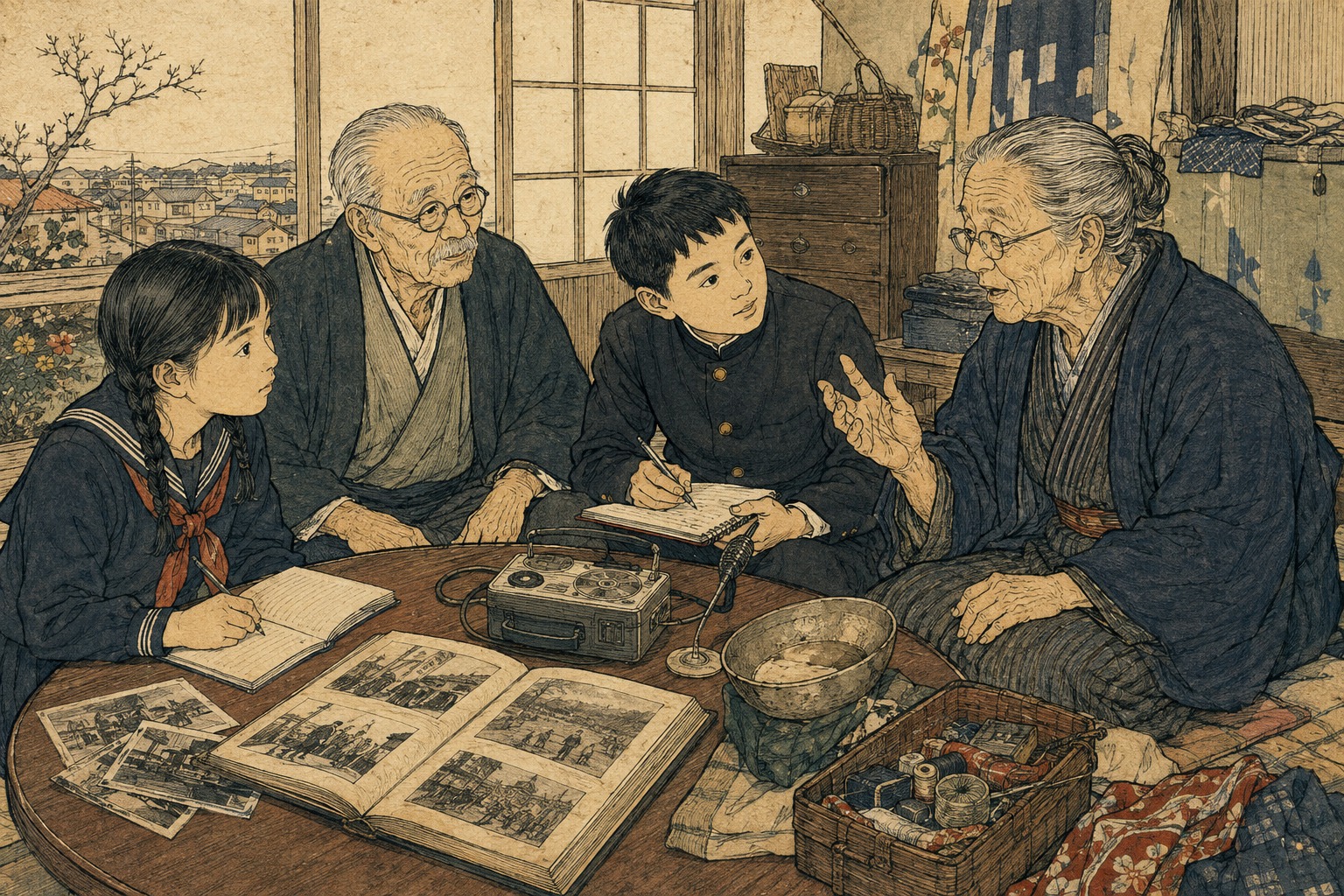
Open the album and an unfamiliar young woman appears. She stands straight in clothes the child has never seen. “Who is that?” the child asks. The 90-year-old grandmother across the table laughs. “That’s me.” In that moment, the stranger in the photograph and the relative in the room join into one line of time.
A good interview does not have to begin with the enormous question, “Was the war frightening?” It can start with a house, breakfast, a walk to school or the first thing bought with a paycheck. Ordinary detail gives the narrator a door into memory at her own pace. War may enter. It may not. The speaker—not the assignment title—should decide.
In the summer of 2026, Yumephoto asked children to find “the oldest person still able to speak whose life is connected to your own.” They interview a grandparent, great-grandparent or another senior close to them, then shape the life into an essay or a panel of photographs and words. The fifth contest closes on September 3. Its proposal is simple: before buying something for Respect for the Aged Day, make time to receive a life.
One hour of conversation before the essay
The rules are straightforward. Children from first grade through the third year of junior high may enter nationwide. There are essay and panel divisions, and entry is free. One grand-prize winner in each division receives ¥30,000 worth of value and the book People of Meiji; two excellence winners in each receive ¥10,000 worth and the book, and three honorable mentions in each receive ¥5,000 worth and the book. Every participant receives a participation award. The official site lists June 1 as the opening date, September 3 as the deadline, September 16 for results and September 21 as Respect for the Aged Day.
The heart of the work is not the finished page. The organizer’s sample questions move through childhood, wartime, work, greatest happiness and advice for the next generation. Looking at an album together does more than trigger recall. It lets a child ask who, where and why, and gives an elder visual points along a century of life.
Yumephoto describes an earlier entrant who interviewed a 98-year-old great-grandmother about wartime food and fear; the woman died about a month later. It also tells of a second-grade girl who had begun avoiding a great-grandfather with dementia. She assembled a panel around the school satchel he bought and corn he grew, and wanted to visit again. These are organizer-published accounts, not scientific proof of an educational effect. They do convey one truth: the period in which a person can speak does not follow a school calendar.
How an album company came to ask for lives
Founded in Osaka in 1998, Yumephoto primarily makes nursery and graduation albums, along with commemorative histories, autobiographical books and time capsules. The contest grew from president Sayuri Hayashi’s interviews with 31 people born in the Meiji era, conducted around Japan from 2002 through 2005. The work was published in 2018 as People of Meiji.
One interviewee was Ryuhei Kuruma, a 100-year-old lawyer who had survived Soviet detention in Siberia. Hayashi said she was astonished that his family barely knew the life he had lived. After his death, a grandchild found the interview online and relatives circulated a printout at his funeral. The organizer locates the project’s origin there: before reading the biographies of famous people, listen once to the senior whose life is closest to yours.
The contest began in 2022. In 2025 the company launched People of Taisho, another nationwide interview project. Even someone born in Meiji’s final year, 1912, would be 113 or 114 in 2026. A person born in Taisho’s last year, 1926, is 99 or 100. The names of eras have become deadlines for documentation.
1947 A senior-honoring event in Nomadani Village, Hyogo, becomes a starting point for the later national movement
1951 The Central Social Welfare Council proposes a national “Day for Older People” movement and a week of activities
1966 Respect for the Aged Day becomes a national holiday
1998 Yumephoto is established in Osaka
2002–2005 Hayashi interviews Meiji-born people around Japan
2003 The holiday moves from September 15 to the third Monday in September
2012 Hiroshima begins training A-bomb Legacy Successors
2018 The lives of 31 people appear in People of Meiji
2022 First children’s essay and panel contest; Hiroshima also begins training family successors
2025 Yumephoto starts its nationwide People of Taisho interviews
2026 Fifth contest, 81 years after the war; deadline September 3, holiday September 21
Turning Respect for the Aged Day from giving into receiving
The holiday has its own postwar history. According to Japan’s Cabinet Office, an event held in Nomadani Village, Taka District, Hyogo Prefecture, in 1947 helped inspire a prefectural campaign in 1950 and a national movement in 1951. A “Day for Older People” evolved into Respect for the Aged Day, made a national holiday in 1966.
Its statutory purpose is to respect older people who have devoted many years to society and celebrate longevity. The date moved to the third Monday in September in 2003; in 2026 it falls on September 21. September 15 remains “Older People’s Day” under the welfare law, with September 15–21 designated Older People’s Week.
The contest changes the direction of respect. A child does not only give; the child receives time, words and the meanings inside photographs. Celebrating longevity becomes an effort to learn what happened within those years, not simply applaud their number. This is a prize-based private initiative, not a government program, but it adds a practical verb—listen—to the holiday’s ideal.
The arithmetic of the final direct witnesses
“Eighty-one years after the war” is not only commemorative language. A person who was 18 in August 1945 is 98 or 99 in 2026, depending on the birthday. A nine-year-old schoolchild is 89 or 90; even a five-year-old is 85 or 86. Adults who served in combat are not the only direct witnesses. People who remember air raids, evacuation, repatriation, colonial rule, militarized schools, a parent’s departure, rationing and surrender through children’s eyes are now deep into old age.
Longer lives extended the time available for testimony. The Ministry of Health, Labour and Welfare counted 99,763 centenarians in September 2025, up from 153 when the Elderly Welfare Act was enacted in 1963. Women numbered 87,784, about 88 percent. If “war testimony” is centered only on male combat, it loses immense histories of the home front, labor mobilization, bombing, parenthood, bereavement and postwar scarcity lived by women.
But a large population does not mean unlimited opportunity. Illness, hearing, speech, cognition, fatigue, distance and family relationships all affect whether a conversation can happen. Sometimes relatives open a drawer of letters and service records only after the person who could explain them has died. “Someday” is the most dangerous date in memory preservation.
Testimony is not a recorded timeline
Oral history is valuable not because a narrator plays the past back like a camera. Memory selects, connects and changes meaning through later experience. It records not only what happened, but what an event has come to mean. A date may be one year off while the question of why one image remained for 80 years is still historically important.
When a child creates an essay, scattered speech is arranged, shortened and titled. Editing can remove hesitation, correction and silence, turning a life into a clean lesson. “It was hard, but we persevered” and “peace matters” are understandable conclusions; they can also flatten contradictions a narrator carried for decades.
Keep the underlying record. With permission, that may be audio; without it, notes that follow the questions and answers closely. Include interview date, location, participants, writing from the backs of photographs and unfamiliar words. Treat the essay as an interpreted work and the notes or recording as source testimony. Cross-check dates, place names, units, schools and institutions against letters, photographs, public records, municipal histories and archives such as the Showakan. Distinguish “the narrator recalls” from “records confirm.”
| Layer of record | What to preserve | What it can show |
|---|---|---|
| Testimony | Permitted audio, near-verbatim notes, silences, uncertainty and the narrator’s language | How experience is told and understood in the present |
| Family materials | Photographs, letters, diaries, notices, address books and objects | Clues to people, place, dates and relationships |
| External sources | Newspapers, public documents, local and school histories, research and maps | Context linking one life with contemporary institutions and events |
| Child’s work | Chosen scenes, structure, response and questions | How the next generation received and interpreted the testimony |
Silence is part of the answer
Family does not automatically make war easier to discuss. An elder may not want to worry relatives, relive pain, be misunderstood, or expose military service, victimization, harmful acts, discrimination, poverty, illness, death or ancestry. Decades of silence can have many reasons. A child’s assignment and deadline do not confer a right to break it.
Before the interview, explain why it is happening, whether sound or photographs will be taken, whether the work will leave the family, and whether winning could lead to online or media publication. Use language both the child and elder understand. Any question may be skipped. The interview may stop. The narrator and guardian should review the work before it is shared. When dementia complicates consent, family proxy permission should not override the person’s facial expression, refusal or fatigue.
If painful memory appears, do not pursue detail as if intensity proves success. Offer choices: continue, pause or stop for the day. Tears are not a performance metric. The interviewer’s responsibility is not to extract a confession; it is to create a space in which the speaker retains control of the boundary.
Do not frame an entire century only with war
In the summer of the 81st anniversary, wartime questions will move forward. They should; time is short. But a 90-year life did not end in 1945. It also contains improvised postwar housing, black markets, reopened schools, first jobs, rapid economic growth, mine closures, pollution, migration, farm mechanization, appliances, marriage and divorce, caregiving, earthquakes, births, favorite songs and food.
Nor should an interview imply that “all Japanese people” had one wartime experience. City and countryside, Okinawa, Hiroshima and Nagasaki, former colonies, emigrant communities, repatriates, ethnic Koreans in Japan, soldiers and civilians, gender and class produced very different histories. A family testimony is history from one position. Japan’s suffering must also be studied alongside sources about the empire’s domination and military violence elsewhere.
One narrator cannot be forced to tell somebody else’s history. A child can, however, research who stood beyond a grandparent’s field of view. Family history should be an entrance into broader history, not a miniature national myth. Testimony then does not replace a textbook; it returns questions to it.
With dementia, do not search only for “correct” memory
The organizer’s story of a great-grandfather with dementia and his great-grandchild shows both possibility and caution. Even when names and dates are difficult, a photograph’s color, a song, food, the feel of work or affection for a child can open conversation. Remote memory may remain when recent memory is fragile.
But a photograph does not necessarily “bring memory back,” and conversation does not cure dementia. Reminiscence research suggests possible relational and psychological benefits, while Japanese reviews also emphasize weak evidence and limits in study quality. A family interview is not treatment. Do not turn failure to remember into a test. Listen to repeated stories without correction and stop when the person is tired.
Value is not measured only in facts recovered. A great-grandfather who has forgotten a name and a great-grandchild whose name was forgotten may still look at one photograph together. That time may reconnect them. It is equally important not to promise the same beautiful ending to every family. A relationship that does not improve, or a conversation that cannot happen, is not failure.
Making a child a small oral historian
A family does not need to reproduce professional fieldwork. A few principles change the conversation. The Smithsonian Institution Archives recommends preparing an outline, beginning with easy questions such as name and birthplace, and asking open prompts: tell me, describe, what do you remember? Avoid leading questions, ask one thing at a time, leave silence unfilled and allow the narrator to travel into subjects the outline did not anticipate.
A child needs no specialist vocabulary. “What was outside the edge of this photograph?” “Do you remember a smell?” “Who was with you?” “How did you feel?” “What were you doing when you were my age?” The child’s present age becomes a measure that makes generational difference concrete. Hearing that school was unavailable during the war can put today’s classroom in a different light.
- Explain: State the assignment, entry, recording, photographs and possible audience; obtain agreement.
- Prepare: Bring three to five photographs, a simple family tree, a timeline and broad question topics.
- Begin easily: Start with name, birthplace, home, play, food and school.
- Ask openly: Prefer “tell me,” “what was it like?” and “what happened next?” over yes or no.
- Do not lead: Do not place the answer inside a question such as “You were terrified, weren’t you?”
- One at a time: Wait through silence and do not rush to pull a digression back.
- Protect boundaries: Repeat the right to decline, pause or end.
- Mark uncertainty: Separate firm dates, estimates, hearsay and facts to research.
- Review together: Let the narrator and guardian see the work before submission or sharing.
- Keep two layers: Preserve the permitted source record separately from the edited essay or panel.
What not to place on a public panel
Families have memories suitable for public use and memories that should remain at home. Names, dates of birth, addresses, schools, employers, medical history, dementia, military records, faces and kinship can identify a person in combination. Third parties appearing in a story have privacy too. An old photograph is not automatically free to publish.
One solution is a complete family version and a reduced public version. Limit location to municipality, include school or unit names only when necessary, remove another person’s illness or household circumstances, and omit faces the narrator does not want shown. Adults should explain that online publication travels further than a classroom display, can be copied and is difficult to retrieve.
The official 2026 material confirmed by the reporting cutoff gives eligibility, schedule, divisions and prizes. Guardians should check the current entry terms directly for copyright, secondary use, publication approval, return of work and data retention. An outside listing for the 2024 contest said works could be reused on the site or social media after contact, but an earlier year’s terms must not be assumed to govern 2026.
The light and shadow of making listening a contest
A prize can motivate, and a deadline converts “someday” into a date. A school or class can use the project to teach interviewing, editing and presentation. Showing the finished panel to the narrator makes the act of being heard visible.
Competition can also substitute polish for listening. A household with many photographs, computer access and adults able to edit has an advantage in producing an attractive entry. Some children have no fluent grandparent, live far away, have a complicated family or have already lost their elders. A life without a dramatic war episode is not less worthy.
The organizer says its dream is not simply a larger contest, but a culture in which children spend an hour listening on Respect for the Aged Day. Preserving that ideal requires valuing the conversation that is never entered, the unfinished notes and the unanswered question. Each division has one grand prize. Family history has no second place.
Connecting family memory to public history
Japan has professional repositories for personal testimony. The national Showakan focuses on daily life from wartime through reconstruction, preserving and making available filmed recollections of school, bombing, rations, family and repatriation. Hiroshima has spent two years training each A-bomb Legacy Successor since 2012. Beginning in FY2022 it also began training Family Legacy Successors who inherit testimony from a related survivor. Institutions are moving from direct experience toward transmission through record and study.
A child’s family interview cannot replace those programs. Without durable formats, catalogs, permission, long-term storage and source criticism, a phone recording disappears during an upgrade and names on a panel become intelligible only to one household. But the contest can create the first question. It can put a date on the back of a photograph, connect a voice with a name and lead a family to a local archive or school collection.
For durable preservation, put narrator, date and location in filenames; keep audio on more than one medium; copy information from photograph backs into a text file. Decide with the narrator who may hear it and whether it can become public later. A testimony that cannot be published can still have great family value. The value of a record and the size of its audience are not the same.
The child who listens enters history too
An interview is not a one-way transfer from past to present. A child who hears “I could not go to school” may reconsider school. A child asks a grandfather why he remained a firefighter and receives the answer, “Because it helped people.” The organizer reports one case in which a child who was absent from school returned, and another in which a child formed an ambition. Those are organizer-provided anecdotes, not promised outcomes. They still show that a questioner may not be the same person after the answer.
The elder is not merely handing over a finished life. A grandchild’s question can make the narrator arrange an experience for the first time, remember someone, or preserve a silence. Oral history does not only excavate the past. It creates a record in the present relationship between two people.
The voices that directly knew the summer of 1945 will eventually survive only as recordings and words. Transmission does not end when the last witness dies. Responsibility then moves to the listener: which words to preserve, what to verify, and what uncertainty to carry forward honestly.
Changing “next time” into today
Family history does not sleep only at distant monuments. It is inside a tin in a cabinet, writing behind a photograph, an old New Year card, a uniform in a closet, or the familiar story everyone stopped listening to. Because it looks ordinary, preservation is postponed. Then the last person who can explain an object is gone.
The contest’s strongest invention is not the essay, panel or prize. It is the phrase “the oldest person connected to you.” It moves the center of evidence away from a famous historical figure and toward a person called by name inside a family. Even someone who never entered a major event lived the time in which society changed.
Listening is not ownership. A memory given in conversation is not raw material the child may use without limit; it is entrusted by the narrator. Check fact, protect silence, decide the audience and study histories from positions outside the family. That labor is part of receiving a life.
The September 3 deadline is close. But no contest entry is required to ask a question. Sit down with one photograph and say, “Tell me about this day.” Eighty-one years after the war, documentation begins not with professional equipment but with that sentence.
- Yumephoto announcement, fifth Respect for the Aged Day Children’s Essay & Panel Contest (August 12, 2026; purpose, eligibility, divisions, deadline, prizes and accounts of prior entrants)
- Official Respect for the Aged Day Children’s Essay & Panel Contest site (2026 schedule, divisions and participation guidance)
- Yumephoto announcement for the fourth contest (2025; annual history since 2022 and family interviews as living history education)
- Yumephoto, People of Meiji (interviews with 31 Meiji-born people and 2018 publication)
- Yumephoto, People of Taisho project (2025; 2002–2005 interview history and new nationwide documentation)
- Cabinet Office, history of Older People’s Day and Week (Nomadani in 1947, nationwide movement in 1951 and national holiday in 1966)
- Cabinet Office, Respect for the Aged Day and 2026 national holiday calendar (purpose and September 21 date)
- Ministry of Health, Labour and Welfare, FY2025 centenarians (99,763 total, 87,784 women and comparison with 1963)
- Showakan audiovisual and oral-history room and testimony catalog (records of wartime and postwar daily life)
- Hiroshima City, training A-bomb Legacy and Family Legacy Successors (programs begun in 2012 and FY2022)
- Smithsonian Institution Archives, “How to Do Oral History” (preparation, open questions, avoiding leading prompts, silence, breaks and narrator-led speech)
- Sachiko Hitomi, oral history through the “Children of War” project (2018; childhood wartime experience and historical use of oral sources)
- Hideharu Konno, sharing war experiences (2018; declining witness generation, trauma and transmission)
- Yukiko Kurokawa, evidence and clinical knowledge in reminiscence (2021; possible value and research limitations)
- Tsiloni et al., systematic review of intergenerational learning (2024; psychosocial effects for school-age children and older adults)
Editor’s note: This article cross-checked organizer materials, government statistics and institutional history, war-testimony archives, and research on oral history and intergenerational exchange available by August 12, 2026 at 9:18 a.m. JST. Japan.co.jp did not independently interview Yumephoto, entrants, families represented in earlier works, judges, Showakan, Hiroshima City or researchers. We attribute reported changes in children and family reactions to the organizer and do not treat them as general or therapeutic effects. The 99,763 centenarian count is the latest published figure from September 2025, not a 2026 count. Ages between 1945 and 2026 vary by one year with birthdays. Guardians should read the current 2026 entry terms for reuse, publication, return and retention; we do not apply older terms automatically. We do not treat family testimony as verified fact, a complete national history or a substitute for broader sources, and we prioritize the narrator’s rights to consent, refuse, pause and remain private.