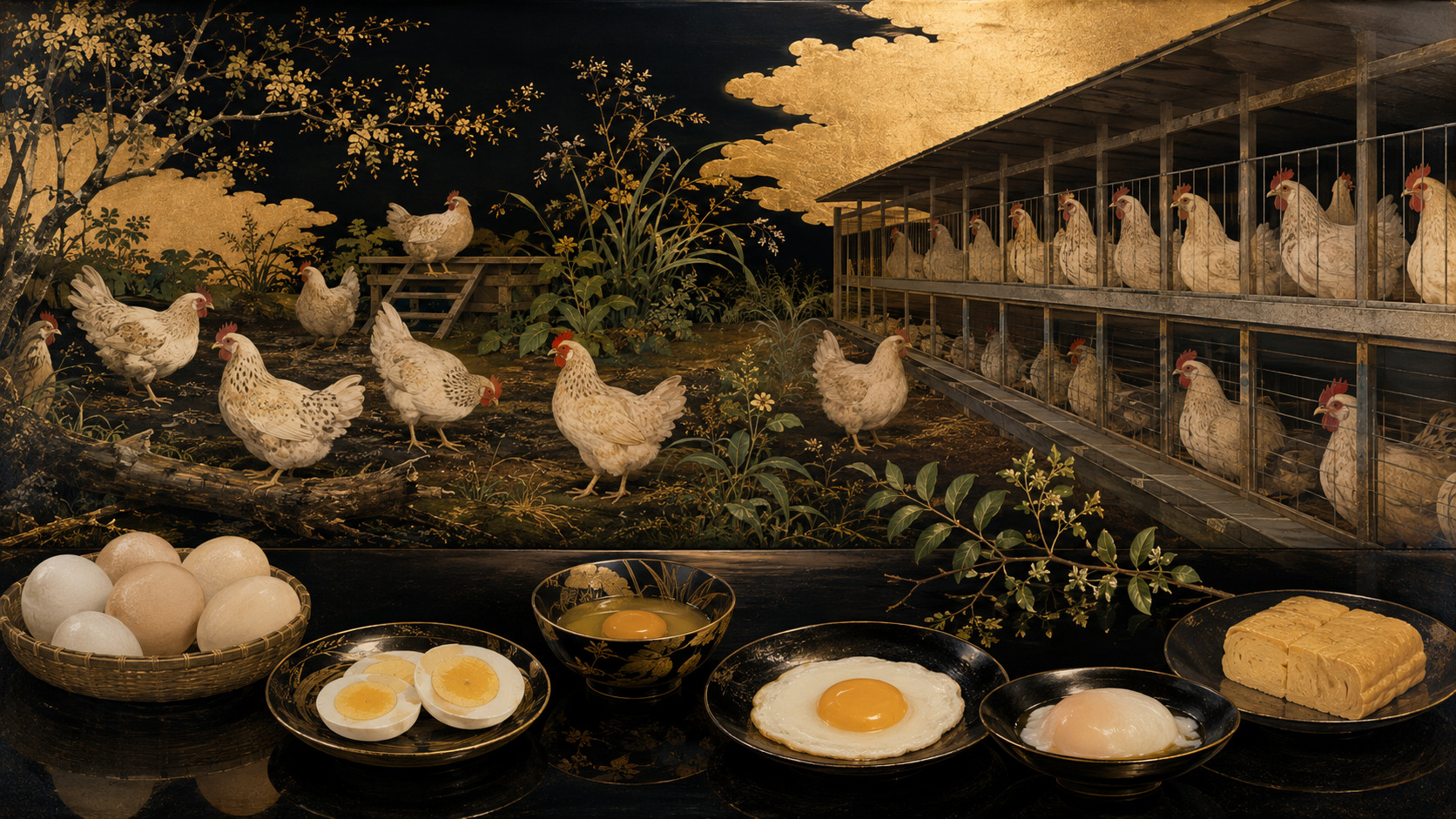
In one dish, the signal felt creamy. In another, it tasted savory. Japanese researchers made custard pudding and chawanmushi from eggs laid under two housing systems, served them under blind codes, and asked 107 people what they sensed. Cage eggs leaned toward creaminess in pudding. Cage-free eggs gave the savory steamed custard a stronger association with umami, smoothness and a jiggly texture.
That kitchen result was the end of a much longer trail. Over five years, scientists at Tokyo University of Agriculture and Technology and four partner universities repeated a controlled housing comparison four times. The hens ate the same feed and lived in the same climate-controlled room. Their ability to move and perform behaviors differed. So did their metabolism, the molecules deposited into their eggs, and the way those eggs registered after cooking.
The paper, published August 27 in npj Science of Food, offers unusual evidence that a hen's physical environment can shape flavor independently of feed composition. Its message is more interesting—and more limited—than a cage-free marketing slogan. The two systems produced different sensory profiles. The study did not crown one egg best.
A room designed to remove the obvious answer
Egg comparisons are notoriously tangled. A free-range hen may eat grass, seeds and insects that a caged hen never encounters. Feed changes yolk color, fatty acids and flavor, making it difficult to tell whether a result came from diet or freedom of movement. This team removed that explanation by placing both systems in the same windowless, environmentally controlled room.
The hens were initially raised in cages, then randomly assigned at 17 weeks. Each experimental cage group had 15 birds, housed five to a cage at 755 square centimeters per hen. Each cage-free group had 12 birds in a 4.6-by-2.5-meter floor enclosure—0.95 square meter per hen—with wood shavings, a nest box and two wooden perches.
Temperature was held at 23 degrees Celsius, plus or minus one degree. The light cycle was 14 hours on and 10 hours off. Both groups had unrestricted access to the same water and a standardized diet. A trial ran for an average of 37 weeks. Three replications used the brown-egg Momiji line; one used the white-egg Julia Lite line.
Feed intake and egg production did not differ significantly between the systems. Behavior did. Direct observation recorded more comfort behaviors and movement in the cage-free birds, including stretching, wing flapping and other activities that the enclosure allowed. Small telemetry tags measured movement in the later replications.
Why this design matters
- It isolates housing: feed, room, temperature, light and water were controlled.
- It repeats the test: four trials over five years reduce the risk that one flock created the entire pattern.
- It includes two layer lines: most trials used brown layers, one used white layers.
- It remains experimental: a 12- or 15-hen group is not a commercial house with thousands of birds.
The tasting table was two experiments, not one
The consumer test used brown eggs from two of the four replications. Eggs were refrigerated for less than a week, then prepared in standardized batches as pudding and chawanmushi, a savory Japanese steamed egg custard. Ingredient ratios, heat treatment and serving conditions were held constant. Random three-digit codes concealed the housing system.
Participants scored liking on an eight-point scale and used a 24-term check-all-that-apply list to describe aroma, flavor and texture. Umami, smoothness and a jiggly structure clustered around cage-free chawanmushi. Creaminess clustered around pudding made with cage eggs. Cage-free pudding was also associated with richness. Positive terms were not owned by one system; cooking redistributed them.
A separate analytical panel prevented the consumer results from being treated as a single impressionistic vote. Twelve trained assessors at the Japan Food Research Laboratories examined pooled raw yolk. Cage yolks tended to score higher for creaminess, bitterness and astringency. Cage-free yolks tended to score higher for saltiness—but not for raw-yolk umami.
That last detail is essential. The strongest umami distinction appeared in cooked chawanmushi, where egg white, heat and dashi interact. It was not a simple property that trained tasters consistently detected by placing raw yolk on the tongue.
| Evidence | Cage eggs | Cage-free eggs | Do not conclude |
|---|---|---|---|
| Cooked dishes | Creaminess associated with pudding | Umami, smoothness and jiggle associated with chawanmushi | That either system wins in every recipe |
| Trained raw-yolk panel | Creaminess, bitterness and astringency trended higher | Saltiness trended higher | That cooked umami was already obvious in raw yolk |
| Yolk chemistry | More long-chain fatty acids and several bitterness-linked bile-acid metabolites | A different metabolic profile | That composition alone proves a health advantage |
| White chemistry | — | More glutamate, aspartate, glycine, alanine, serine and threonine | That sweetness-linked amino acids guarantee perceived sweetness |
From steps taken to molecules laid down
The researchers used capillary electrophoresis and liquid chromatography coupled with time-of-flight mass spectrometry to map egg chemistry. They detected 563 metabolites. Of these, 107 differed in yolk—64 higher in cage eggs and 43 higher in cage-free eggs. Forty-nine differed in white—14 higher in cage eggs and 35 higher in cage-free eggs.
Several cage-yolk differences fit the sensory result. Oleic, palmitic, arachidonic and linoleic acids were consistently higher. Long-chain fatty acids can contribute a coating, creamy mouthfeel and carry flavor through food. The cage yolks also contained more hypoxanthine and several secondary bile-acid-related compounds connected with bitterness, including taurochenodeoxycholic and tauroursodeoxycholic acids.
In cage-free whites, glutamate and aspartate—amino acids associated with umami—were higher. Glycine, alanine, serine and threonine, often described as sweet-tasting or roundness-enhancing, also increased. Yet the panel did not identify a clean, independent sweetness effect. Those molecules may have contributed to richness or smoothness, or remained below perceptual thresholds in the recipes.
The team then looked upstream, sequencing liver RNA from five hens per system in one replication. Among the altered biological pathways, primary bile-acid synthesis produced the strongest enrichment. Together, the behavior, blood, egg and liver data support a chain: restricted activity changes lipid and bile-acid metabolism, while greater movement alters amino-acid metabolism; those shifts change the material sent into yolk and white.
Support is not the same as complete causal proof. The authors propose that lower inosine in cage-free eggs might preserve more inosine monophosphate, which can amplify glutamate's umami. They did not directly measure that cooking-stage mechanism. It remains a testable explanation, not a demonstrated final step.
How egg science arrived at housing
For decades, scientists and producers have changed eggs by changing feed. Carotenoids deepen yolk color. Particular fats shift fatty-acid composition. Vitamins and minerals can be enriched through the ration. In that history, the hen often appears as a converter: nutrients go in, a modified egg comes out.
Housing studies complicated the picture but often carried a confounder. Birds with outdoor access could consume vegetation and invertebrates unavailable indoors. Differences attributed to the system might still have been diet differences. The new Japanese work is significant because it treats physical environment as an input of its own and connects sensory science with metabolomics and transcriptomics.
Japanese animal-welfare policy developed along a parallel track. Ministry of Agriculture documents show that a welfare-oriented layer-hen management guide was compiled in March 2009 after work in fiscal 2008. In July 2023, MAFF issued its current technical guidance for laying hens, reflecting standards from the World Organisation for Animal Health, known as WOAH.
The guidance distinguishes conventional battery cages from enriched cages equipped with resources such as perches and nest boxes. It defines floor housing as a system in which hens can move freely on a floor or the ground. Importantly, it says good welfare can be achieved through different housing systems and puts responsibility on density, ventilation, hygiene, disease control, injury, behavior and management skill—not the label alone.
That prevents a simplistic welfare reading. Cage-free systems allow more locomotion, perching, nesting and comfort behavior, but commercial flocks must manage feather pecking, litter, parasites, air quality and injuries. Cages separate birds from manure and can simplify observation, while restricting movement and behavioral choice. The five-year study measured one path through that larger system: housing to activity, activity to metabolism, metabolism to flavor.
What an egg carton cannot promise
The experiment makes a strong causal comparison within its room. It does not predict every carton in a supermarket. Commercial eggs vary by genetic line, hen age, diet, flock size, stocking density, freshness, cold chain and farm management. A brand's cage-free egg and another brand's cage egg may differ in several of those dimensions at once.
Nor does the study establish nutritional superiority. A statistically higher concentration of a fatty acid or amino acid is not evidence that eating one egg changes human health. Food safety, shell strength, shelf life, environmental footprint and the economics of conversion were outside the experiment.
Even taste resists a ranking. Bitterness-linked metabolites in cage yolks did not make cage products universally disliked. Creaminess can be desirable in custard. More umami-related amino acids in cage-free whites mattered most when heat and savory ingredients made them perceptible. The practical idea is not “buy this egg.” It is that eggs with documented composition could eventually be matched to particular uses.
Japan.co.jp fact check: five claims the paper does not prove
- Cage-free eggs taste better to everyone.
- Either system produces safer, healthier or longer-lasting eggs.
- The measured effect will be the same on large commercial farms.
- Higher sweetness-associated amino acids create clearly perceptible sweetness.
- A retail premium is justified by flavor alone.
The next test belongs on farms and in kitchens
The authors acknowledge that the metabolomics and transcriptomics sample sizes were relatively small and that large-scale farm studies are needed. Selectively increasing candidate metabolites would help confirm which molecules actually generate the sensory changes. The pathway is coherent, but not every link has been manipulated and reproduced.
Replication should now cross farm sizes, seasons, genetic lines, ages and diets. The cooking work can move beyond pudding and chawanmushi to tamagoyaki, dashi-maki, sponge cake, noodles and raw-egg dishes. A useful commercial study would also measure welfare outcomes, mortality, disease, labor, energy use and price alongside flavor.
The deepest contribution of the paper is a new question. An egg is not only a record of what the hen ate. It may also carry a molecular trace of how much she moved and which behaviors her environment allowed. Whether a diner can taste that trace depends on what happens next: whisking, seasoning, heating—and the dish placed on the table.
Sources and documents
- Shimura, N.N. et al., “Housing environments link egg taste through metabolic alterations in laying hens”, npj Science of Food, August 27, 2026 (peer-reviewed paper; principal source for design, sensory results, metabolomics, transcriptomics and limitations)
- Tokyo University of Agriculture and Technology: “Discovery that how chickens are raised changes the taste of eggs”, August 31, 2026 (Japanese; official names, affiliations, summary and funding)
- MAFF Livestock Industry Bureau: Technical Guidelines for the Management of Laying Hens, July 26, 2023 (Japanese PDF; official definitions and management guidance for cage and floor systems)
- Ministry of Agriculture, Forestry and Fisheries: Animal welfare policy and guidance (Japanese; WOAH definition, current guidance and implementation material)
- MAFF: Progress under the fiscal 2008 poultry policy action plan (Japanese PDF; history of Japan's first welfare-oriented layer-hen management guidance)
- Agriculture, Forestry and Fisheries Research Council: Development of welfare-conscious management technologies for chickens and pigs (Japanese PDF; background on housing-system benefits and constraints)
Reporting was checked against material available by 9:30 PM JST on September 1, 2026. Japanese names, titles, affiliations and technical terminology were verified in Japanese primary sources and the original paper. The university's interpretations are attributed to the research group. Measured sensory results are distinguished from flavors inferred from metabolites, and claims about nutrition, safety and commercial-farm generalizability are excluded from the finding.
Image rights: © 2026 Japan.co.jp. This AI-assisted editorial illustration may not be republished or reused without prior written permission. For licensing, use the contact page.