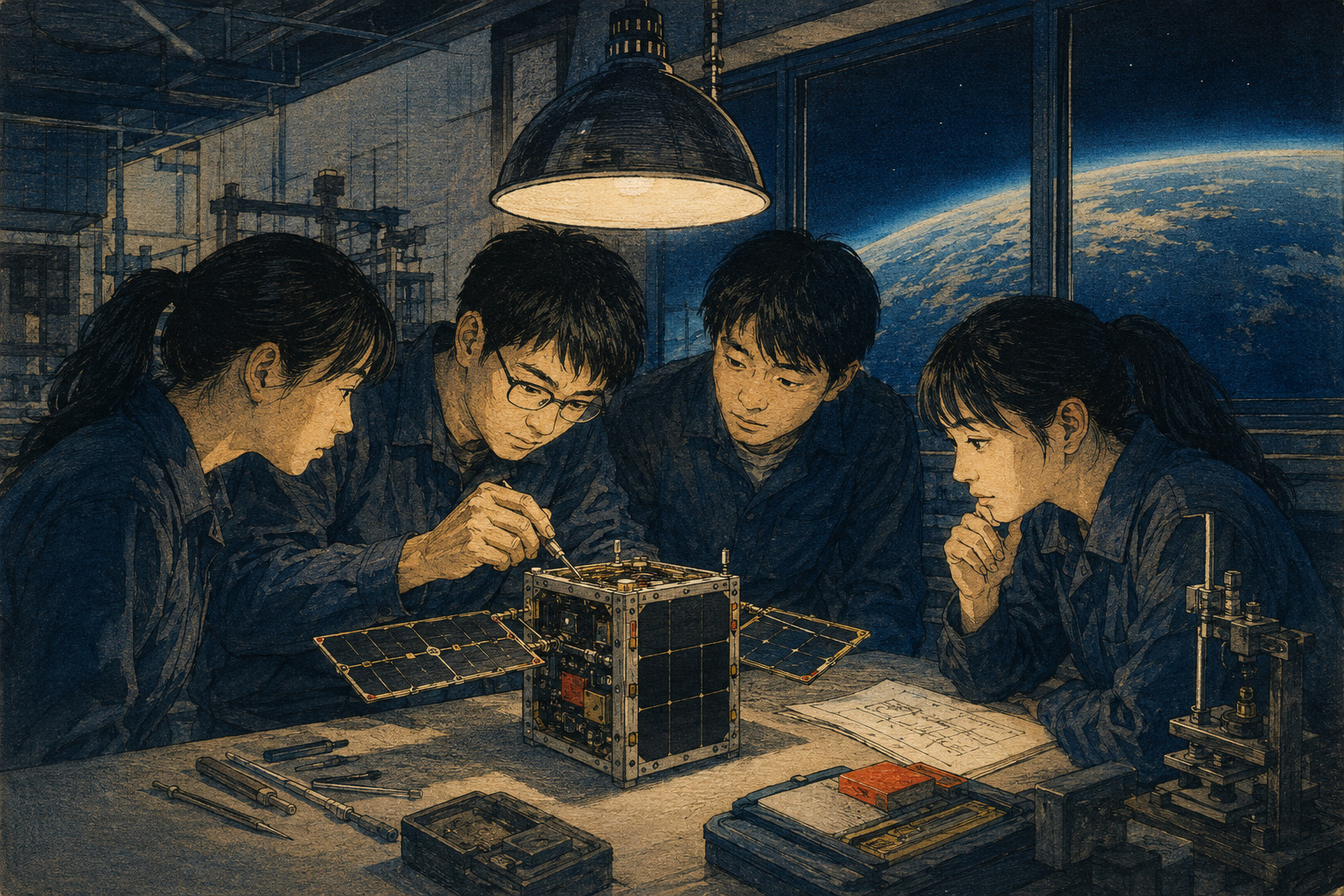
The spacecraft is now beyond ordinary repair. On August 26, 2026, Chiba Institute of Technology handed MOMIJI to the Japan Aerospace Exploration Agency. The undergraduates who had assembled it, tested it and handled launch paperwork could no longer reach for a soldering iron or change one more line of code whenever a problem appeared. From that point, their machine had to live with its decisions.
That handover—not a launch—was the event confirmed by the university’s Planetary Exploration Research Center, or PERC, the next day. Its current plan calls for a Falcon 9 launch in December 2026 or later, with Northrop Grumman’s 25th Cygnus cargo mission carrying the satellite to the International Space Station. MOMIJI would be stored aboard the station and released into orbit later through the Japanese Experiment Module, Kibo. None of those later steps had happened when this article was prepared.
MOMIJI is the fifth spacecraft in Chiba Tech’s GARDENs Advanced Engineer Development Program. That phrase needs two qualifications. Fifth refers to the educational program’s development sequence, not to every satellite in the university’s history. And the vehicle is student-built, but it is not a classroom model: launch safety, spectrum use, orbital operation and hardware qualification impose real institutional and legal consequences.
A photograph is a systems test in disguise
Why define success with one photograph? Because an image that can be viewed on the ground is the visible end of an invisible chain. The spacecraft must generate and distribute power. Its onboard computer must wake, accept or schedule a command, control a camera and place the output in storage. The communications system must turn that file into packets and transmit during brief passes over a ground station. Ground software must recognize those packets, check or repair errors, order the pieces and reconstruct the image.
If the result is incomplete, operators have to diagnose a machine they cannot touch. A dark frame could mean the lens saw night, pointing was wrong, the sensor failed, a command was malformed or data were lost after an otherwise successful exposure. A clean image therefore demonstrates more than a camera. It is evidence that power, command and data handling, storage, radio, operations and ground processing worked as an integrated system.
PERC describes two minimum-success conditions for MOMIJI: confirmation that the satellite’s basic functions operate in space, and reconstruction on Earth of one image taken by the satellite. The university has not published the camera resolution, compression format, radio data rate, likely number of passes per image or formal acceptance criteria. The end-to-end interpretation follows from ordinary spacecraft architecture; it should not be mistaken for a disclosed MOMIJI technical specification.
Twice the volume, more than twice the negotiation
A CubeSat’s fundamental unit is a cube roughly 10 centimeters on each side. The 2U MOMIJI joins two such volumes into a 10-by-10-by-20-centimeter form. The extra room makes a broader mission set possible, but volume is not capability by itself. Each payload must claim power, data storage, processor time, thermal margin, radio time and physical interfaces. Added equipment changes mass distribution and test obligations. A larger box creates a larger argument over resources.
MOMIJI’s published portfolio is unusually crowded for an education satellite. Four imaging tasks include a “space trip” scene featuring Chibany, the university mascot designed by Chiharu Sakazaki; photographing remaining snow in Tohoku with the stated aim of contributing to pollen-dispersal prediction; demonstrating an Earth-pointing imaging mode in response to desertification in Greece; and imaging terrestrial vegetation with a Bhutanese team. The spacecraft also proposes an image-downlink service for overseas users.
These are mission intentions, not demonstrated services. No public document specifies the camera’s spectral bands or ground sampling distance, the location and timing of a Greek target, the method that would connect snow imagery to a pollen forecast, or how overseas users would request and receive images. A responsible account cannot infer scientific performance from the mission name.
The distinction matters in small-satellite reporting. “Photographed a target,” “produced a georeferenced measurement,” “improved a forecast” and “operated a repeatable service” are four different accomplishments. MOMIJI can be educationally successful even if an ambitious application proves impractical, provided the team publishes what the hardware and operations actually achieved.
Bhutan is a participant, not a decorative flag
Students from the College of Science and Technology of the Royal University of Bhutan are participating in MOMIJI. PERC identifies two joint activities: vegetation imaging, and observation of the ozone layer combined with estimation of the satellite’s altitude and attitude. The public release does not explain the ozone sensor, retrieval method, estimator or accuracy target, so those elements remain goals rather than independently assessable experiments.
The institutional path began before the satellite. On September 30, 2024, Chiba Tech and Bhutan’s Government Technology Agency signed a memorandum of understanding in Paro covering cooperation and academic exchange in space science and technology. A university briefing said the framework envisioned Bhutan-made experimental equipment flying aboard a Chiba Tech student satellite and joint experiments. That followed a broader three-party cooperation agreement made in December 2023 among the university, GovTech and Druk Holding and Investments.
This is part of a wider change in access to orbit. A country does not need its own launch vehicle to train spacecraft engineers or operate an experiment. Standardized satellite form factors, cargo flights to the ISS and Kibo’s deployment mechanism allow hardware to be developed in one country, integrated through a partner and operated by teams in several places. JAXA and the United Nations Office for Outer Space Affairs have used the same basic infrastructure for KiboCUBE, a capacity-building program serving countries developing their first satellites.
Participation, however, should be measured in engineering authority rather than ceremony. Which hardware, software and analysis tasks belong to the Bhutanese students? Who sets observing priorities? Who owns and can publish the data? What ground segment will CST operate? Chiba Tech’s public material does not yet answer those questions. They are appropriate tests of the collaboration after deployment—not reasons to discount it before launch.
An experimental solar cell with a long family history
MOMIJI will carry a new satellite CIGS solar cell in a joint experiment with Idemitsu Kosan. CIGS is a thin-film compound semiconductor made principally from copper, indium, gallium and selenium. Idemitsu presents low mass, high radiation tolerance and light-assisted recovery from radiation damage as advantages for spacecraft. Those are the manufacturer’s technical claims, supported on its site by test and flight references; MOMIJI has not yet added evidence to them.
Nor is CIGS new to space. Idemitsu traces its work to 1993 and lists tests on Japan’s MDS-1 technology demonstrator in 2002. The University of Tokyo’s 1U XI-V, launched in 2005, carried CIGS as one of its new technology demonstrations. More recently, Chiba Tech’s fourth GARDENs vehicle, BOTAN, carried an Idemitsu CIGS experiment and completed its initial mission after deployment in October 2025.
MOMIJI therefore represents iteration, not a first-ever appearance. PERC calls the device a “new” satellite cell, but has not disclosed its dimensions, electrical architecture, comparison device, telemetry, success threshold or improvement over BOTAN. Those missing details limit what can be concluded. A cell can survive launch, produce current, retain output over time or outperform an alternative; each is a different level of validation.
The same caution applies to three experiments associated with laboratories in Chiba Tech’s Department of Space and Semiconductor Engineering: a new diode demonstration, an on-orbit temperature-data interpolation demonstration, and a remote-ground-station activity. The university has not named the three laboratories in its release or described the methods. Listing those omissions is more accurate than inventing a technical story from short labels.
What a satellite has to do with Reeves’s muntjac
The most unexpected MOMIJI application involves kyōn, Reeves’s muntjac, an introduced deer that has spread in Chiba Prefecture. PERC says a remote APRS ground station will be used to help determine the animals’ population. That wording does not mean the satellite’s camera will count deer from orbit. The public description instead points to remotely collected ground data being passed through or used with an APRS communications path; the sensing and estimation method has not been published.
APRS stands for Automatic Packet Reporting System. It is an amateur-radio digital protocol for distributing real-time information such as positions, status, messages, weather and objects. Its creator’s official technical site emphasizes that it is a shared tactical information system, not simply a vehicle tracker. Satellites have long served as APRS relays.
MOMIJI also proposes a new “APRS chatbot” mode intended to attract interest in radio technology. That mission sits naturally in GARDENs: every earlier vehicle included an APRS service or communications demonstration, and the university says signals from the series can be received with antennas simple enough for schoolchildren to build. Yet public participation remains governed by amateur-radio rules. No MOMIJI frequency, callsign or license had been announced at publication. The four previous spacecraft received Japanese amateur-station licenses equivalent to artificial-satellite stations after deployment.
Terminology required an editorial correction. The MOMIJI release expands APRS as “Automatic Position Reporting System.” The protocol creator and the heading on Chiba Tech’s own YOMOGI material use “Automatic Packet Reporting System,” the accepted name used here. Position is one important APRS data type, but not the expansion of the acronym.
A production line for experience
GARDENs began in April 2021 with an industrial argument: Japan needed more engineers able to build and operate reliable spacecraft, not only people able to propose novel missions. Chiba Tech opened the program across faculties and departments and planned a continuous series—up to nine satellites over ten years through fiscal 2030—so that test records, operational knowledge and design improvements could move from one student cohort to the next.
The team name evokes a garden in which young leaves grow into strong plants; every spacecraft receives a plant name. Students experience design, manufacture, testing and operations. MOMIJI’s cohort began fabrication in November 2024 when its members were in their first or second undergraduate year. At handover they were third- and fourth-year students. PERC says they also handled required applications and launch tests, work that often disappears from the romantic image of building hardware.
The first four GARDENs spacecraft were 1U machines. Their project numbers do not match deployment order because launch opportunities move independently of development. KASHIWA, project No. 2, was the first released from the ISS in April 2024. SAKURA followed in August, YOMOGI—project No. 1—in December, and BOTAN in October 2025. Chiba Tech reports successful operations and initial missions for all four.
| Project | Spacecraft | Size | Delivered to JAXA | ISS deployment | Published initial result |
|---|---|---|---|---|---|
| No. 1 | YOMOGI | 1U | June 5, 2024 | December 9, 2024 | Initial mission completed two days later |
| No. 2 | KASHIWA | 1U | November 27, 2023 | April 11, 2024 | Completion announced June 3, 2024 |
| No. 3 | SAKURA | 1U | April 17, 2024 | August 29, 2024 | Initial mission completed two days later |
| No. 4 | BOTAN | 1U | February 28, 2025 | October 10, 2025 | Initial mission completed on first operations day |
| No. 5 | MOMIJI | 2U | August 26, 2026 | Not scheduled publicly | Not launched; no result |
That record shows why the common one-image target is valuable. A repeated success criterion makes generations comparable. It also reveals differences: YOMOGI and SAKURA announced initial success within two days of release, BOTAN on its first operating day, while KASHIWA’s announcement came about seven weeks after deployment. “Success” is not always instant, and a delayed result may contain more useful engineering education than an effortless first pass.
MOMIJI’s name carries three ideas, according to PERC: the maple leaf as a broad hand grasping results from many functions; a wish that the spacecraft remain memorable until it completes its orbital life; and an international bond resembling the maple’s recognition as a Japanese landscape symbol. Naming cannot improve a link budget. It can, however, give successive cohorts a language for inheritance—and GARDENs is fundamentally a project about inherited practice.
Not Chiba Tech’s fifth satellite
Calling MOMIJI the university’s fifth satellite would erase a longer institutional history. PERC and Tohoku University developed S-CUBE, a 3U satellite intended to observe meteors with visible and ultraviolet instruments. Japanese astronaut Kimiya Yui released it from Kibo on September 17, 2015. Chiba Tech established stable command and telemetry links after first reception two days later, operated the spacecraft for more than a year, and recorded its atmospheric re-entry on November 23, 2016. PERC also cites experience from Chiba Tech’s earlier Whale Ecology Observation Satellite, WEOS.
The broader CubeSat story began in 1999, when California Polytechnic State University and Stanford University developed the standard as an educational and exploration platform. A 1U unit measures 10 by 10 by 10 centimeters; modular sizes such as 2U, 3U and 6U followed. Standard dimensions allowed spacecraft developers, deployer makers and launch providers to design against a shared physical interface.
Japanese universities were at the beginning of the flight era. The University of Tokyo’s Intelligent Space Systems Laboratory says XI-IV, launched from Russia on June 30, 2003, achieved the world’s first successful CubeSat launch and operation. The claim reflects a historically close race among the first CubeSats, but there is no dispute about XI-IV’s place in the inaugural group. Its successor XI-V carried a CIGS experiment in 2005, connecting MOMIJI’s new hardware to a lineage more than two decades old.
Japan then helped turn the ISS into a small-satellite gateway. JAXA’s J-SSOD deployer released its first satellites from Kibo in October 2012. CubeSats can ride inside a pressurized cargo vehicle, be transferred through the Japanese module’s airlock and be released by robotic equipment without a spacewalk. That route has supported university research, commercial missions and countries building first-generation space capability.
1999 The CubeSat standard is developed in California.
June 2003 The University of Tokyo’s XI-IV flies in the first successful CubeSat generation.
October 2012 JAXA begins J-SSOD deployments from Kibo.
September 2015 Chiba Tech and Tohoku University’s S-CUBE is released from the ISS.
April 2021 Chiba Tech begins the GARDENs training program.
2024–25 Four 1U GARDENs vehicles are deployed.
August 26, 2026 The first 2U GARDENs vehicle is handed to JAXA.
December 2026 or later The Falcon 9 launch is planned; timing remains provisional.
The launch headline will arrive too early
Space reporting compresses a chain of events into one verb. A university “launches a satellite,” although a rocket company launches a cargo vehicle, the cargo docks with a space station, astronauts or ground controllers transfer hardware, a deployer later releases it, and only then does the university attempt contact. MOMIJI’s present plan contains every one of those dependencies.
Schedule movement is normal. BOTAN was announced for a summer 2025 launch before Chiba Tech revised the target to autumn; it ultimately launched in September and was deployed in October. MOMIJI’s December-or-later date should be checked again before publication and again before any headline declaring a winter flight.
After release, the team will receive only radio evidence. A satellite in low Earth orbit passes over a ground station for minutes at a time. Temperature cycles, radiation, vacuum and an uncertain attitude complicate the first days. If no beacon appears, engineers must separate a failed spacecraft from an unheard spacecraft, a mistimed pass, an antenna problem or an incorrect orbital estimate. If the beacon is healthy, commissioning still proceeds cautiously so that one power-hungry experiment does not endanger the bus.
MOMIJI’s many missions will compete for finite energy and contact time. The sequence should favor survival and diagnosis: establish telemetry, confirm power and thermal conditions, validate commanding, attempt the minimum image, then allocate opportunities to observations, APRS and component experiments. PERC has not published that detailed operations plan, so this is the logic by which the mission ought to be evaluated, not a claim about its command schedule.
- Safe release: confirmation that J-SSOD placed MOMIJI into orbit.
- First reception: a beacon or telemetry acquired and identified.
- Commissioning: power, computer, radio and thermal state shown healthy.
- Image reconstruction: one complete orbital image rebuilt on Earth.
- Joint work: Bhutanese observation and analysis roles carried out.
- Measured demonstrations: comparative data for CIGS, diode and temperature work.
- Open lessons: methods, criteria, imagery and failures documented for the next cohort.
The product is not the box
Japan’s Cabinet Office released an official Space Skill Standard in 2026 that maps work across strategy, project planning, systems and subsystem design, assembly, integration and testing, quality and safety, operations, communications and data use. That map explains why a university satellite matters even when a larger commercial spacecraft could collect a better image. The educational product is the person who has crossed interfaces and seen how a requirement becomes a test, a license, an operating constraint and a decision under uncertainty.
PERC lists Mengu Cho, a principal staff scientist and professor in Chiba Tech’s Department of Space and Semiconductor Engineering, as the program contact. His work has focused on lean satellites, reliability and international standardization. In that context, the repeated GARDENs bus and success test are more than shortcuts. They turn individual student experience into organizational memory.
MOMIJI may reach orbit with every experiment intact. It may return a partial image, silence one payload to preserve power, miss a target or wait weeks for an operational breakthrough. A serious assessment should resist both publicity reflexes: treating handover as success and treating any incomplete stretch goal as total failure.
The defining moment will be quiet. During one pass, packets will arrive at a ground station in pieces. Operators will sort and combine them. A file will open. If a recognizable image appears, its subject may be snow, vegetation, the sea or darkness. The deeper picture will be of a system made whole: two years of design arguments, applications, tests, international coordination and patient radio work compressed into one recoverable frame.
- Chiba Institute of Technology PERC — MOMIJI release, August 27, 2026
- Chiba Institute of Technology PERC — GARDENs program and official spacecraft record
- Chiba Institute of Technology — Space-science MoU with Bhutan GovTech
- Chiba Institute of Technology — Detailed briefing on the Bhutan cooperation framework
- Idemitsu Kosan — Space CIGS solar-cell technology and flight history
- Official APRS technical site — Automatic Packet Reporting System
- Chiba Institute of Technology PERC — S-CUBE meteor-observation satellite
- JAXA — Official list of small satellites deployed through Kibo J-SSOD
- University of Tokyo ISSL — XI-IV, XI-V and other mission records
- NASA — History and dimensions of SmallSats and CubeSats
- Cabinet Office of Japan — Fiscal 2025 Space Skill Standard manual