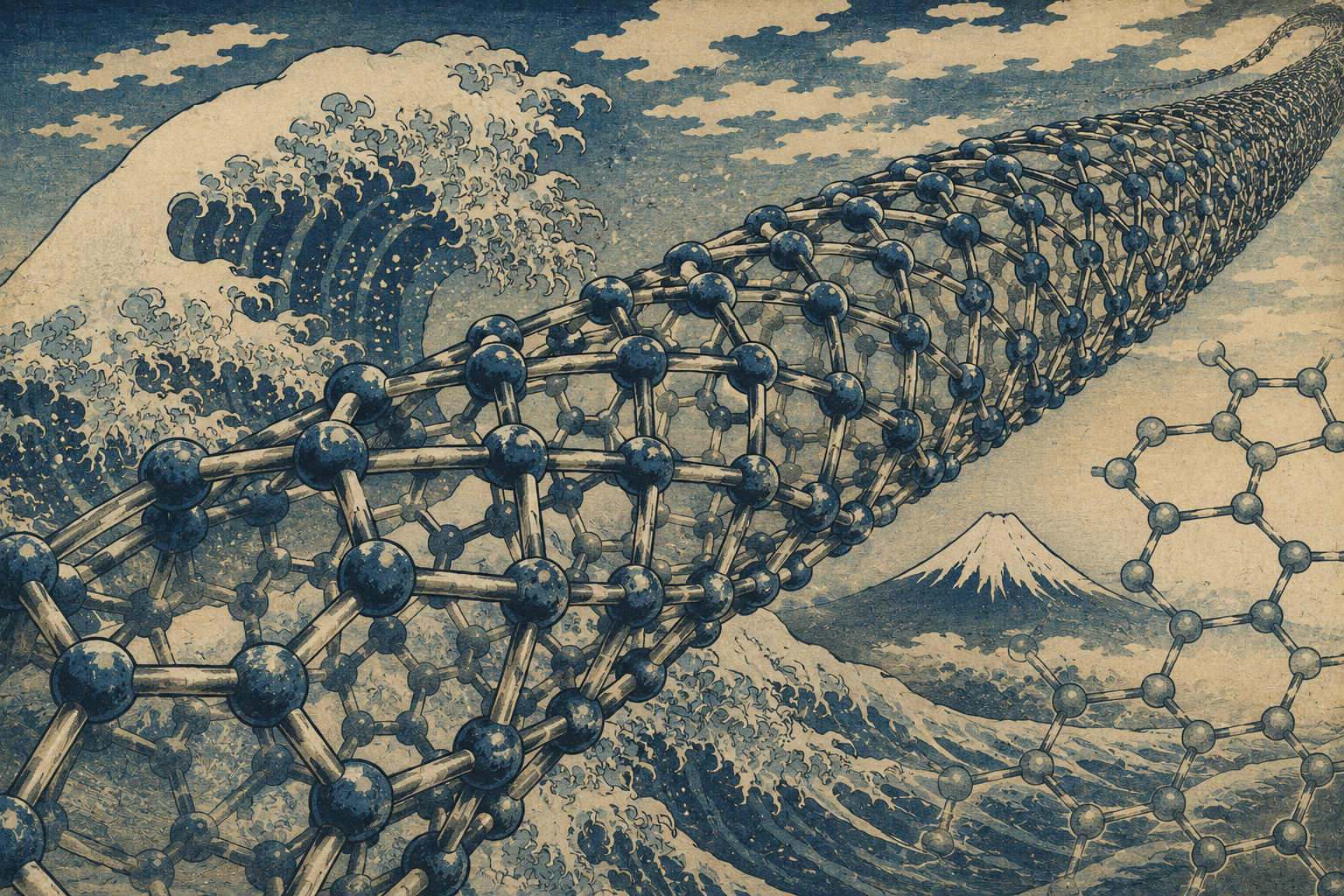
A carbon nanotube does not grow from a motionless mold. Its catalyst can swell. The furnace temperature can climb and fall. The chemical environment can change as the particle travels through a reactor. Yet the tube emerging from that unsettled interface may keep an identity assigned at the instant of its birth.
That is the central finding of a University of Tokyo study published September 1 in Nature Communications. Assistant Professor Keigo Otsuka, Ryuji Fujiwara—then a master’s student—and Shigeo Maruyama, then a professor, reconstructed the growth histories of individual single-walled carbon nanotubes. Their method turned each tube into its own experimental record: carbon-isotope patterns marked when successive segments formed, while Raman spectroscopy revealed how fast the tube grew and whether its structure changed.
The catalyst did change. After the researchers heated and cooled the furnace, growth rates displayed hysteresis: at the same temperature, some tubes grew as much as roughly twice as fast on the way down as they had on the way up. The most consistent interpretation was irreversible catalyst coarsening. But the tube often declined to follow the catalyst’s changing geometry. Its diameter and chirality—the helical arrangement of carbon atoms that helps determine whether it behaves as a metal or semiconductor—remained fixed over hundreds of micrometers.
The identity problem inside a one-dimensional crystal
A single-walled carbon nanotube can be pictured as a one-atom-thick graphene sheet rolled into a cylinder only a few nanometers across. That familiar description conceals the manufacturing problem. A sheet can be rolled along different directions. Each wrapping geometry is represented by a pair of integers, (n,m), and is known as a chirality.
Chirality is not decorative geometry. In 1992, Noriaki Hamada, Shin-ichi Sawada and Atsushi Oshiyama calculated that graphitic microtubules could vary from metallic to semiconducting depending on diameter and the helical arrangement of their carbon hexagons. For electronics, that difference is decisive. A metallic nanotube where a semiconducting switch is required can provide an unwanted current path. In optical devices, structure determines absorption and emission energies.
This is why a production line cannot be judged only by kilograms, meters or average diameter. It must deliver the right electronic identities. The long-running quality-quantity trade-off in nanotube synthesis is therefore unusually severe: increasing output is of limited value if the output contains a broad population of incompatible structures.
A fossil record written during growth
The experimental obstacle is temporal. A catalyst particle is only nanometers across, sits at a hot reactive interface and changes while the nanotube extends. A conventional image taken after growth shows the survivor, not the sequence of states that produced it.
Otsuka and colleagues approached the problem from the opposite direction. Instead of watching the catalyst continuously, they wrote time into the nanotube. Aligned tubes were grown from lithographically patterned iron catalysts on r-cut quartz using alcohol chemical vapor deposition. Ethanol supplied carbon. During a programmed heating-and-cooling cycle, the team introduced ten-second pulses of ethanol enriched in the heavier isotope carbon-13.
Three carbon-13 fractions—33%, 67% and 100%—served as the symbols 0, 1 and a delimiter. The resulting three-bit codes were inserted every 30 seconds. Because heavier carbon shifts vibrational frequencies, Raman mapping after growth could locate each code along a tube. The distance between neighboring labels revealed how far the tube had grown during a particular 30-second interval.
The same spectral survey carried structural information. Radial breathing modes reflect tube diameter, while G-mode lineshapes help distinguish metallic and semiconducting tubes. By combining the time labels with those signatures, the researchers could place growth kinetics and structural identity on the same longitudinal map.
Growth rate then became an indirect probe of catalyst evolution. Within the framework used in the study, a larger catalyst surface supports a higher carbon incorporation rate. An irreversible change in speed after the temperature returned to a previous value could therefore expose an irreversible change in the catalyst even when the catalyst itself had not been continuously imaged beside that individual tube.
The furnace returned; the kinetics did not
The temperature program rose from 800°C to 873°C and then fell back to 800°C. A purely temperature-controlled process would trace the same kinetic path in both directions. The measured tubes did not. Their growth rates and survival probabilities depended on where they had already been.
At a given temperature during cooling, some nanotubes elongated up to about twice as fast as they had during heating. Atomic-force microscopy of separate catalyst samples and kinetic modeling supported an Ostwald-ripening picture: at elevated temperature, material migrates from smaller iron particles toward larger ones. Once coarsened, a catalyst does not automatically shrink when the furnace cools. The same temperature can therefore meet a different particle.
Speed carried a cost. Higher temperatures increased elongation rates but also increased the frequency of growth termination. The paper found lower survival probability during cooling than during heating at the same temperature. Many nanotubes stopped growing before the carbon feed ended.
The two clocks behind final length
- Elongation rate: how quickly the tube extends while its catalyst remains active.
- Growth lifetime: how long the active interface survives before growth terminates.
- Residence time: in a continuous reactor, how long the catalyst-tube system remains inside a useful reaction zone.
A hotter zone may make the first clock run faster while stopping the second sooner. Final length is the integrated result, not a simple thermometer reading. This matters for reactor design because a condition optimized for instantaneous speed may reduce total useful material.
Kinetics adapted; atomic identity largely did not
The structural result was striking precisely because the kinetic result was so dynamic. Tube #3 retained its chirality while its growth rate increased by about 3.5 times over a temperature rise of only around 30°C. Metallic tube #6 preserved its spectral identity as it grew from the maximum temperature down to about 800°C. In both cases, the catalyst environment was changing enough to alter speed substantially.
Across the full dataset, 139 of 158 analyzed nanotubes—88%—retained their chiral indices over the entire measured length. Researchers recorded 24 (n,m) transitions across a total inspected length of 9.39 millimeters. That is 2.6 transitions per millimeter, or one event per 391 micrometers.
The numbers establish robustness, not perfection. Tube #7 showed an abrupt local change in its Raman signatures, indicating a structural transition. The authors also cautioned that shifts in Raman resonance conditions can be missed, potentially causing preservation to be modestly overestimated. Some classifications rely on G-mode continuity when a clear radial breathing mode is unavailable.
| Evidence | What it supports | What it does not prove |
|---|---|---|
| Up to roughly twofold rate difference at the same temperature | Growth kinetics retain a history consistent with irreversible catalyst evolution | Continuous direct imaging of the catalyst paired with every individual tube |
| 139 of 158 tubes classified as chirality-preserved | Structural identity is highly robust under the tested dynamic conditions | Perfect preservation across all chiralities, lengths and process windows |
| Longitudinal Raman continuity | Diameter, electronic type and chiral indices remain consistent over measured segments | Atom-by-atom microscopy along hundreds of micrometers |
| Molecular dynamics with an enlarging iron catalyst | A physically plausible mechanism for preserving chirality during coarsening | A full quantitative reproduction of an industrial FCCVD reactor |
Why a changing edge may still reject a wrong turn
Changing chirality along a nanotube requires the hexagonal carbon network to incorporate non-hexagonal rings, commonly pentagons and heptagons. Those defects alter how the lattice closes around the cylinder. The simulations added iron atoms to an expanding catalyst while feeding carbon to predefined (8,7), (13,0) and (10,5) tubes. In each modeled case, growth accelerated as the catalyst grew, but chirality remained fixed.
The proposed explanation lies at the tube-catalyst interface. Transient non-hexagonal arrangements can make subsequent reactions less favorable and may be removed before they become permanently incorporated into the wall. The interface can reconfigure without necessarily memorializing each fluctuation as a lasting defect.
The paper draws a conceptual analogy to proofreading during DNA replication: rapid one-dimensional extension can maintain fidelity when incorrect intermediates are rejected before irreversible incorporation. It is an analogy, not a claim that nanotube growth uses a biological proofreading system.
The mechanism still needs boundaries. The authors call for systematic simulations across more diameters, carbon-supply rates and temperatures. Structural memory may be robust within the tested window without being unlimited.
The main experiment was not an industrial production line
The study is motivated by floating-catalyst chemical vapor deposition, or FCCVD. In that process, catalyst particles travel with precursor gases through a heated tube. They encounter changing temperatures and chemical compositions, collide, coarsen and continuously generate nanotube material. FCCVD is attractive because it is scalable and compatible with continuous collection.
But the isotope-resolved experiment did not follow a freely flying catalyst through a commercial-scale reactor. It used substrate-supported iron catalysts on quartz and imposed selected dynamic variables associated with FCCVD in a controlled setting. This choice made individual tubes accessible to detailed post-growth mapping.
The researchers added complementary FCCVD experiments. Raman maps of sparsely deposited FCCVD-derived tubes showed continuity along individual tubes, while ensemble measurements at four furnace temperatures between 800°C and 950°C showed only minor diameter variation; the average remained below 1.2 nanometers even at 950°C. Those results are consistent with nucleation-set structure, but they do not provide the same 30-second, single-tube growth histories inside the floating-catalyst reactor.
A reactor with separate places for birth and growth
The industrial opportunity comes from decoupling two jobs that have often been forced into one set of conditions. If chirality is established primarily at nucleation and remains stable during elongation, a reactor could be designed so that the first zone selects structure and later zones optimize output.
Near the inlet, temperature gradients and precursor concentration could confine nucleation to a narrow region, limiting the range of catalyst sizes sampled at birth. Once a tube’s diameter and chirality are set, a downstream elongation zone could use a different carbon-activity and temperature profile to maximize useful length without disturbing that identity.
This is a mechanistic design principle, not a completed manufacturing process. The study did not produce a continuous stream of one semiconductor chirality at commercial yield. It did not demonstrate wafer-scale placement, transistor fabrication, process cost or production reliability. Nor did it prove that every floating-catalyst chemistry will share the same degree of memory.
Five gates between this result and a semiconductor line
- Nucleation selectivity: reliably create the intended (n,m) population.
- Elongation yield: preserve identity while balancing speed, lifetime and reactor residence time.
- Material purity: suppress or remove metallic tubes, unwanted chiralities, defects and catalyst residue.
- Placement and contact: align tubes at useful density and connect them with low-resistance electrodes.
- Manufacturing control: repeat the distribution and device yield across large areas, tools and lots at acceptable cost.
From discovery to control: a 35-year arc
1991: Sumio Iijima reports needle-like, multi-shell graphitic tubes produced by arc discharge, accelerating the modern carbon-nanotube field.
1992: Noriaki Hamada, Shin-ichi Sawada and Atsushi Oshiyama predict metallic or semiconducting behavior based on diameter and helical arrangement.
1993: Iijima and Toshinari Ichihashi report abundant single-shell nanotubes about one nanometer in diameter.
2002: Shigeo Maruyama and colleagues introduce low-temperature synthesis of high-purity single-walled nanotubes using alcohol as the carbon source.
2013: Researchers demonstrate a functional computer built entirely from carbon-nanotube transistors.
2018: Otsuka and colleagues publish digital isotope coding for tracing the growth of individual single-walled nanotubes.
2019: A 16-bit microprocessor using more than 14,000 carbon-nanotube transistors is reported.
2026: Isotope-coded histories show that chirality is usually preserved even as catalyst state and growth kinetics evolve.
The arc of the field has moved from finding tubes to specifying them. Device demonstrations have established that nanotube transistors can compute. The manufacturing challenge is to stop treating the desired tubes as rare members to be found, sorted or worked around and instead produce them as a controlled population.
Not a shortcut to a carbon chip, but a better map
Carbon nanotubes remain attractive for electronics because a very narrow semiconducting channel can carry current efficiently, and for photonics because selected chiralities can interact with light at useful wavelengths. Research has progressed from individual devices to computers and processors. Yet chirality control is only one part of a manufacturing stack that also includes alignment, density, contamination, contacts, defect control and integration with existing fabrication.
This study removes one particular fear: that any catalyst evolution during long growth must force the nanotube to continuously change its structure. Instead, it elevates the importance of the birth event. It also warns against reading causality from a static post-growth image. A catalyst measured after growth may no longer have the size it had when the tube’s diameter was selected.
The result is therefore not a product announcement. It is a rearrangement of the process logic. Set identity first. Optimize kinetics afterward. If that division survives in practical continuous reactors, it could loosen a constraint that has tied structural uniformity to low output.
The experiments that now matter
The next scientific task is to map the failure boundary: which diameters, chiralities, temperatures and carbon activities overwhelm structural memory? Directly correlating catalyst evolution with the same growing tube would further test the indirect growth-rate proxy. Repeating time-resolved measurements under a wider range of dynamic chemistries would show how general the phenomenon is.
The next engineering task is more demanding. Researchers must build and compare reactors with deliberately separated nucleation and elongation zones, then measure the resulting chirality distribution, usable yield, length distribution and energy or material productivity. For device relevance, the output must also be judged by electronic purity, defects, alignment, contacts and circuit yield—not only by Raman spectra and total mass.
The catalyst changes. The furnace changes. Growth speed changes. The nanotube, more often than not, keeps the first twist it was given. The industrial question is no longer whether that memory exists. It is whether a production line can learn to use it.
Sources and documentation
- The University of Tokyo Graduate School of Engineering, “Carbon Nanotubes Remember Their Structure as They Grow” (September 1, 2026)
- Otsuka K., Fujiwara R., Maruyama S., “Isotope-labeled growth histories reveal persistent chirality in individual carbon nanotubes despite catalyst evolution,” Nature Communications 17, 8898 (2026)
- Otsuka K. et al., “Digital Isotope Coding to Trace the Growth Process of Individual Single-Walled Carbon Nanotubes,” ACS Nano 12, 3994–4001 (2018)
- Iijima S., “Helical microtubules of graphitic carbon,” Nature 354, 56–58 (1991)
- Hamada N., Sawada S., Oshiyama A., “New one-dimensional conductors: Graphitic microtubules,” Physical Review Letters 68, 1579–1581 (1992)
- Iijima S., Ichihashi T., “Single-shell carbon nanotubes of 1-nm diameter,” Nature 363, 603–605 (1993)
- Maruyama S. et al., “Low-temperature synthesis of high-purity single-walled carbon nanotubes from alcohol,” Chemical Physics Letters 360, 229–234 (2002)
- Shulaker M. M. et al., “Carbon nanotube computer,” Nature 501, 526–530 (2013)
- Hills G. et al., “Modern microprocessor built from complementary carbon nanotube transistors,” Nature 572, 595–602 (2019)
- The University of Tokyo and RIKEN, Japanese primary-source release used to verify the readings of Keigo Otsuka and Shigeo Maruyama (2022)
The English edition was written independently rather than translated from the Japanese article. “Structural memory” refers to persistence of nucleation-set diameter and chirality, not electronic information storage. The article reports the underlying paper’s full figures—139 of 158 tubes, 24 transitions across 9.39 mm—and does not describe preservation as universal. The time-resolved isotope experiment used substrate-supported iron catalysts on quartz; it did not track individual freely floating catalysts through an industrial FCCVD line.
Image rights: © 2026 Japan.co.jp. This AI-assisted editorial illustration may not be republished or reused without permission. For licensing, use the contact page.