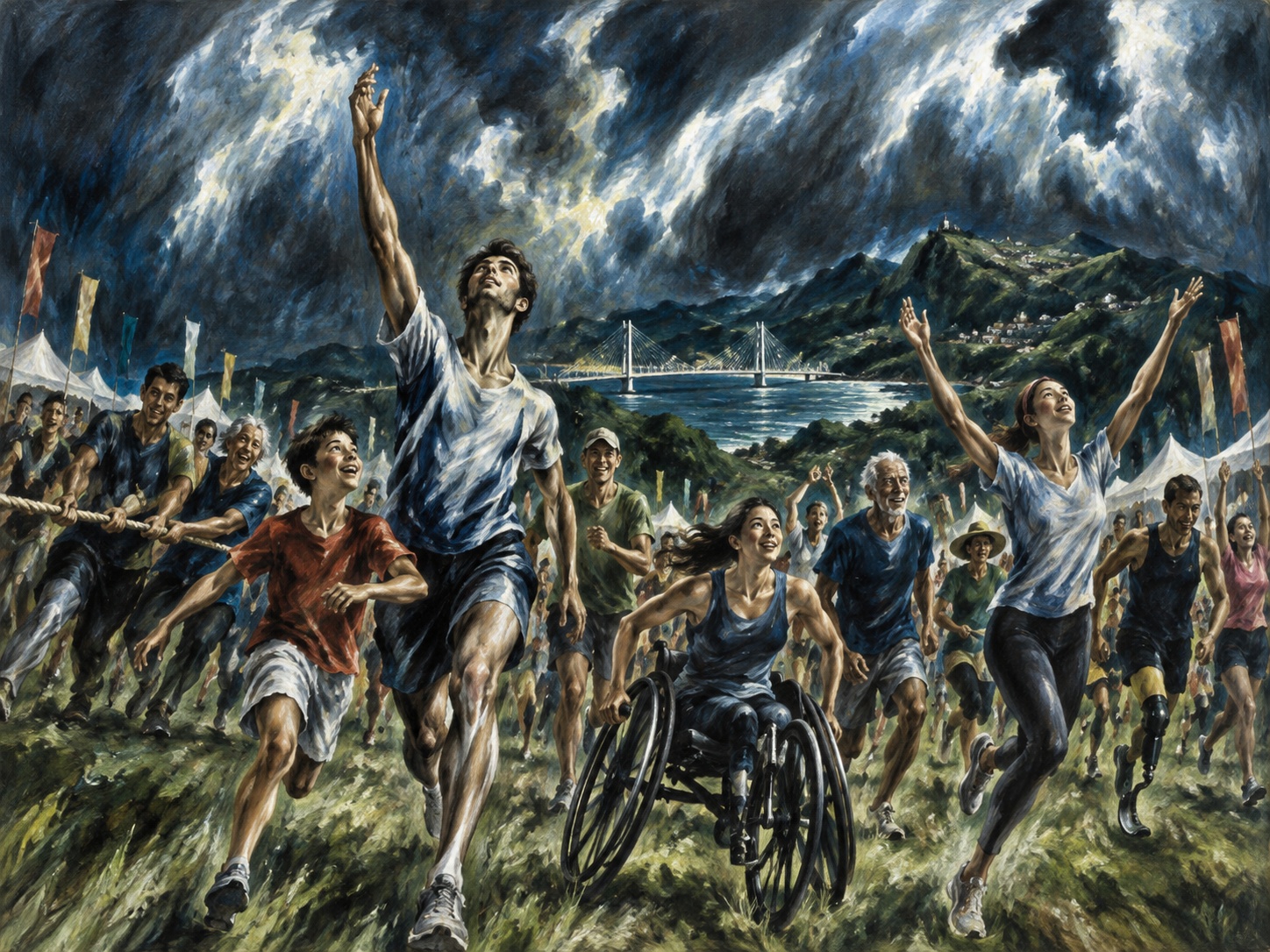
Japan’s school sports day has never been only about identifying the fastest athlete. The runners matter, but so do the children rolling an enormous ball, the team throwing beanbags into a basket, the grandparents watching from the edge and the classmates whose job is to cheer.
That mixture of competition and collective participation is what an Awaji Island event has been trying to scale far beyond the schoolyard.
Pasona Group announced on September 14 that UNDOKAI WORLD CUP 2026 will run from October 30 through November 1. The event began on Awaji Island in 2016 and enters its 11th year. Organizers describe it as a sports festival open regardless of age, gender, nationality or disability, with roughly 20 undokai-style activities planned alongside regional mascots, disaster-preparedness exhibits, food and traditional-culture programs.[1]
The current official website lists Awaji Island Akashi Kaikyo National Government Park as the venue for October 30-November 1 and says participation in the sports events is free, with park admission charged separately.[2] The Sept. 14 press release, however, separately lists October 30 as “within Awaji City” and October 31-November 1 at the national park. Because the public materials differ, travelers should verify the final venue information before the event.
About 20 activities are planned, but only the first five are currently detailed
The September announcement says roughly 20 sports-day activities are planned. For prize-eligible events, the proposed awards are deliberately local: a year’s supply of Awaji beef for first place, rice for second and Awaji onions for third.[1]
The official competition page currently lists only its first announced set: ball toss, water carrying, giant-ball rolling, a 20-meter sprint and a work-themed relay. Ball toss, water carrying and giant-ball rolling are “battle” events with preliminary rounds and finals; the sprint and work relay are classified as lower-pressure attraction events.[3]
The site divides entrants into a kids division for elementary-school age and younger and a general division for junior-high age and above.
There is also a procedural discrepancy. The official competition page now says there is no advance entry and registration will take place at the venue, while the Sept. 14 press release says advance entry began Sept. 11.[1][3] Japan.co.jp therefore advises participants to rely on the latest official website immediately before attending.
| Item | Published information as of Sept. 14 |
|---|---|
| Dates | October 30-November 1, 2026 |
| Venue | Current official site lists Awaji Island Akashi Kaikyo National Government Park; the Sept. 14 release differs for Oct. 30, so final confirmation is advisable |
| Participation fee | Sports-event participation free; park admission separate |
| Activities | About 20 planned; first published set includes ball toss, water carrying, giant-ball rolling, 20m sprint and work relay |
| Inclusion goal | Organizer states participation regardless of age, gender, nationality or disability |
| Other programs | Regional mascots, disaster-preparedness area, food, stage content and traditional sparkler-making activities |
“Regardless of disability” is a stated goal, not yet a complete accessibility specification
The 2026 announcement explicitly says the festival is intended for participants regardless of age, gender, nationality or disability. Similar language appeared in organizer materials for the 2023, 2024 and 2025 editions, making inclusion a recurring part of the event’s recent identity rather than a one-year slogan.[1][4][5][6]
But the currently published competition information does not yet explain adaptive rules for wheelchair users, blind or low-vision participants, deaf participants, people with intellectual disabilities or other specific needs. The event regulations cover general health, safety and participant conduct but do not publish sport-by-sport accommodation standards.[7]
The national park itself provides wheelchair and stroller loans at its gates and identifies accessible parking spaces.[8]
Physical access to the venue and equitable participation in a competition are different issues. Japan.co.jp therefore treats disability inclusion as the organizer’s stated design objective, not as proof that every event is already universally accessible in the same format.
Japan’s national data show why low-barrier opportunities matter
Japan’s Sports Agency reported in March 2026 that 51.7% of adults aged 20 or older participated in sport at least once a week. Among adults with disabilities, the comparable rate was 35.0%. For people with disabilities aged 7-19, it was 38.3%.[9][10]
The agency identifies that gap as a policy problem and calls for environments in which people can participate regardless of disability. Its Sport in Life strategy similarly tries to move sport from a specialist activity into ordinary daily living.[9][11]
A festival built around short, familiar activities can serve a different function from a formal league. A participant does not need years of technical training before becoming part of the event.
Undokai itself is a Meiji-era reinvention
The exact “first” Japanese sports day depends on definition. Materials catalogued through the National Diet Library’s Collaborative Reference Database include one account of a sports event involving French and Japanese engineers at the Yokosuka Iron Works in 1868. A more widely cited institutional origin is the March 21, 1874 “kyoto yugi-kai” competitive sports gathering at the Imperial Japanese Naval Academy in Tsukiji, Tokyo, organized with guidance from a British instructor.[12]
From there, Western-style athletics spread through institutions including Sapporo Agricultural College and Tokyo Imperial University and eventually became embedded in school physical education during the Meiji period.[12]
Japan’s undokai did not remain a conventional track meet. Events such as tug-of-war, giant-ball rolling, three-legged races, obstacle races and ball toss introduced teamwork, chance, humor and group identity. Those qualities help explain why the format can still be adapted for people who would never enter a formal athletics meet.
In 2016, Awaji turned the sports day into a “World Cup”
UNDOKAI WORLD CUP began in 2016. The first organizer announcement linked the idea to two Japanese concerns: an aging society that needed more opportunities for lifelong physical activity, and communities that used sports days as recurring social events. It repackaged familiar school and corporate activities as an international festival on Awaji Island.[13]
The original concepts were regional revitalization, health and the promotion of traditional culture. Those remain the official three pillars today.[2]
By 2018, more than 200 companies were involved as sponsors and organizers were promoting participation spanning elementary-school children to people in their 90s. The 2019 announcement said the previous edition had attracted more than 50,000 visitors and included participants and volunteers from 24 countries and regions.[14]
Materials issued for the 2022 restart reported that the 2019 edition involved more than 200 companies, participants from 45 countries and regions and 69,000 cumulative visits.[15]
The pandemic broke the annual rhythm; 2022 brought a three-year return
The 2022 organizer materials described 2019 as the previous edition. A Tokyo Metropolitan Government sports-company profile later described 2022 as a return after the prior year’s cancellation and as the first event in three years.[15][16]
The 2022 event was formally described as the fifth edition and ran for four days. Awaji City’s official newsletter reported about 75,000 cumulative visits.[17]
The restart had a particular social context. Pasona’s announcement pointed to reduced physical activity, disrupted routines and the loss of face-to-face community opportunities during the pandemic.[15]
An undokai built around being physically present with other people suddenly carried a different meaning.
Attendance has not moved upward in a straight line
Large festivals often tell their history as a growth chart. UNDOKAI WORLD CUP’s published numbers are more complicated.
Organizer and local-government materials report about 69,000 cumulative visits in 2019, roughly 75,000 in 2022 and about 70,000 in 2023. Awaji City’s official newsletter reported 40,000 cumulative visits for the 2025 edition.[15][17][18][19]
Event length, weather, accompanying attractions and counting practices can differ from year to year, and no official explanation for the lower 2025 number has been published. It would therefore be misleading either to label the event as declining from one number or to describe its attendance as continuously increasing.
The organizer also calls the event “one of Japan’s largest sports days.” That is an organizer description, not a third-party national ranking based on standardized attendance data.
By 2026, the sports festival is part of a wider “well-being week”
UNDOKAI WORLD CUP is now embedded in Awaji Well-being Week, a wider Pasona program that combines sports with food, entrepreneurship and health-oriented events. The 2026 concept describes a society in which people, nature and technology coexist and uses sport as one element in a broader well-being agenda.[20]
The sports-day festival itself emphasizes physical, mental and social well-being — “body, mind and bonds.”[1]
That overlaps with Japan’s national Sport in Life agenda. The Sports Agency wants sport to be something people experience as part of ordinary life rather than an activity reserved for trained competitors or organized clubs.[11][21]
Working-age adults and women still participate less
The Sports Agency’s 2026 national survey found that 55.0% of adult men participated in sport at least once a week, compared with 48.8% of women. The gap was the largest recorded in that survey series. Participation and total weekly exercise time were especially low among adults in their 20s through 50s — people balancing work and child-rearing — with working-age women particularly low in weekly minutes.[10]
UNDOKAI WORLD CUP allows corporate and organizational entries as well as individuals. In theory, a company sports-day format can draw in people who would not independently join a gym, running club or league.
The harder question is whether one festive day changes the following month. If the event claims a health benefit, long-term behavior matters more than the number of steps recorded on the island.
Awaji’s festival is also a regional-development project
Pasona has consistently positioned UNDOKAI WORLD CUP as part of its regional-revitalization work. After launching the event in 2016, the company expanded tourism, food, cultural, education and employment-related operations on Awaji Island and announced a partial transfer of headquarters functions to the island in 2020.[22]
Awaji City itself has made corporate attraction and visitor growth part of local strategy. Its mayoral policy statement credits the arrival of Pasona’s headquarters functions with employment creation, population inflow, municipal tax revenue and local economic activity.[23]
The sports festival’s prizes make that connection visible: Awaji beef, rice and Awaji onions. The mascot festival similarly turns the sports venue into a regional-promotion marketplace for communities around Japan.[1]
Why put disaster preparedness next to ball toss?
The 2026 event will include a disaster-preparedness area in cooperation with the Japan Ground Self-Defense Force, showing equipment and supplies used during emergencies. Organizers say the purpose is to help visitors think about preparedness and appropriate action during disasters.[1]
Ball toss and disaster equipment may seem unrelated. Community festivals, however, have a practical advantage: people are already gathered. Public-safety information can reach families who would never attend a stand-alone preparedness seminar.
Awaji Island also carries the memory of the 1995 Great Hanshin-Awaji Earthquake. At the 2024 event, a local 300-meter, 530-kilogram tug-of-war rope associated with recovery commemorations was revived for the first time in 15 years.[24]
In that sense, an undokai can carry community memory as well as physical activity.
Can inclusion and competition coexist?
UNDOKAI WORLD CUP still has finals, rankings and major prizes. It is not purely noncompetitive recreation.
That is part of the appeal. Giant-ball rolling and ball toss do not depend as narrowly on elite speed or strength as a 100-meter race. Teamwork, coordination and chance create more ways to contribute.
But the more seriously an event ranks competitors, the more carefully it has to define fairness and adaptation. Equal rules do not always produce equal access. Some participants may need modified equipment, assistance, alternative starts or separate classifications.
Japan’s Sports Agency has long noted that disability-sport participation can depend on trained instructors, specialized equipment, accessible transport and personal assistance.[25]
If UNDOKAI WORLD CUP wants its “regardless of disability” language to become a distinctive strength, the next step is operational: publish how specific events are adapted for specific needs.
Free entry does not mean zero barriers
The organizer says sports participation is free, but park admission is separate. Participants also pay their own travel costs. The event rules encourage public transport and warn that parking is limited.[2][7]
That matters for an event using the language of universal participation. Awaji Island has no railway. Most off-island visitors arrive by highway bus or car.
Accessibility is therefore not only about whether a person can physically perform a ball toss. Cost, travel time, vehicle access and the availability of assistance also shape who can realistically participate.
In year 11, measure the mix rather than only the crowd
Japan.co.jp’s analysis is that the event’s own goals are poorly served by attendance alone.
- Participant diversity: who actually competes across age, gender, nationality and disability?
- Adaptive access: how many events publish modified rules, equipment or assistance for different disabilities?
- Retention: do first-time participants return or become more physically active afterward?
- Regional impact: how much spending reaches island accommodation, food, transport and local products?
- Corporate follow-through: does a company sports day lead to recurring workplace activity?
- Safety: can participation scale without serious incidents?
The national participation gap for people with disabilities gives the organizer’s inclusion claim real policy relevance. Publishing actual participant composition and accommodations would make the event’s social effect more measurable.
Undokai has always been a system for being together
Modern Japanese sports days spread during the Meiji period with physical education, but they changed meaning repeatedly: military-style group training, school ritual, community gathering, family event.
UNDOKAI WORLD CUP pushes the format in another direction. It removes the school as the common identity and tries to mix children, older adults, companies, foreign participants and people with disabilities in one place. It then adds food, disaster education, regional mascots and local culture.
Calling it only a sports tournament therefore misses part of the design. It is also a festival, tourism event, corporate gathering and regional-development project.
That hybrid model creates responsibilities as well as opportunities. A bigger crowd means more pressure on transport, safety and accessibility. The word “everyone” becomes harder to justify as participation scales.
The real finish line is a wider starting line
Sports news usually ends with the winner. UNDOKAI WORLD CUP asks an earlier question.
Did somebody who normally avoids sport step onto the field at all?
A participant does not have to become the fastest runner. Rolling a giant ball with a stranger, carrying water with a teammate or throwing beanbags into a basket can be enough to change the feeling from “sport is something other people do” to “I was part of it.”
UNDOKAI WORLD CUP began on Awaji Island in 2016 and reaches its 11th year in 2026. Its significance will depend less on whether it can call itself the world’s biggest sports day than on the range of people it can genuinely place on the same starting line.
Japan’s undokai has spent more than 150 years changing shape. The Awaji experiment asks whether its next form can be an entry point into an inclusive sporting society.
Sources & Reference Material
- Pasona Group, UNDOKAI WORLD CUP 2026 announcement, Sept. 14, 2026
- UNDOKAI WORLD CUP 2026 official website
- UNDOKAI WORLD CUP 2026 official competition page
- Pasona Group, UNDOKAI WORLD CUP 2023
- Pasona Group, UNDOKAI WORLD CUP 2024
- Pasona Group, UNDOKAI WORLD CUP 2025
- UNDOKAI WORLD CUP 2026 event regulations
- Awaji Island Akashi Kaikyo National Government Park access map — wheelchair loans and accessible parking
- Japan Sports Agency, FY2025 survey on sport participation by people with disabilities, March 11, 2026
- Japan Sports Agency, FY2025 national sports participation survey, March 11, 2026
- Japan Sports Agency, creating sports opportunities for diverse participants — Third Basic Plan for Sport
- National Diet Library Collaborative Reference Database, origins of Japanese undokai
- Pasona Group, first UNDOKAI World Cup announcement, Sept. 26, 2016
- Pasona Group, UNDOKAI WORLD CUP 2019
- Pasona Group, UNDOKAI WORLD CUP 2022
- Tokyo Sports Promotion Company site, Pasona Group sports and UNDOKAI WORLD CUP
- Awaji City newsletter, December 2022 — about 75,000 visits to UNDOKAI WORLD CUP 2022
- Pasona Group, 2023 release citing 2022 attendance
- Awaji City newsletter, December 2025 — 40,000 visits to UNDOKAI WORLD CUP 2025
- Pasona Group, AWAJI WELL-BEING WEEK 2026
- Japan Sports Agency, health promotion through sport — Third Basic Plan for Sport
- Pasona Group, regional revitalization timeline and Awaji operations
- Awaji City, FY2025 mayoral policy statement on corporate attraction and local economic activity
- Kiss PRESS, 2024 UNDOKAI WORLD CUP and revival of Tsuna community tug-of-war
- Japan Sports Agency, promotion of disability sports in local communities
Sources checked through September 14, 2026. The current official website and the Sept. 14 press release differ on the Oct. 30 venue, and they also differ on entry procedure: the competition page says no advance entry and on-site registration, while the release says advance entry began Sept. 11. Only the first five activities are currently detailed on the competition page; the roughly 20-event total is the organizer's announced plan. The phrase 'regardless of age, gender, nationality or disability' is the organizer's inclusion objective. Public materials do not yet provide disability-specific competition rules, accommodation standards or assistance procedures, so Japan.co.jp does not describe every event as already fully universally accessible. Attendance figures are organizer/local-government cumulative counts, not independently audited totals. Analysis is by Japan.co.jp.