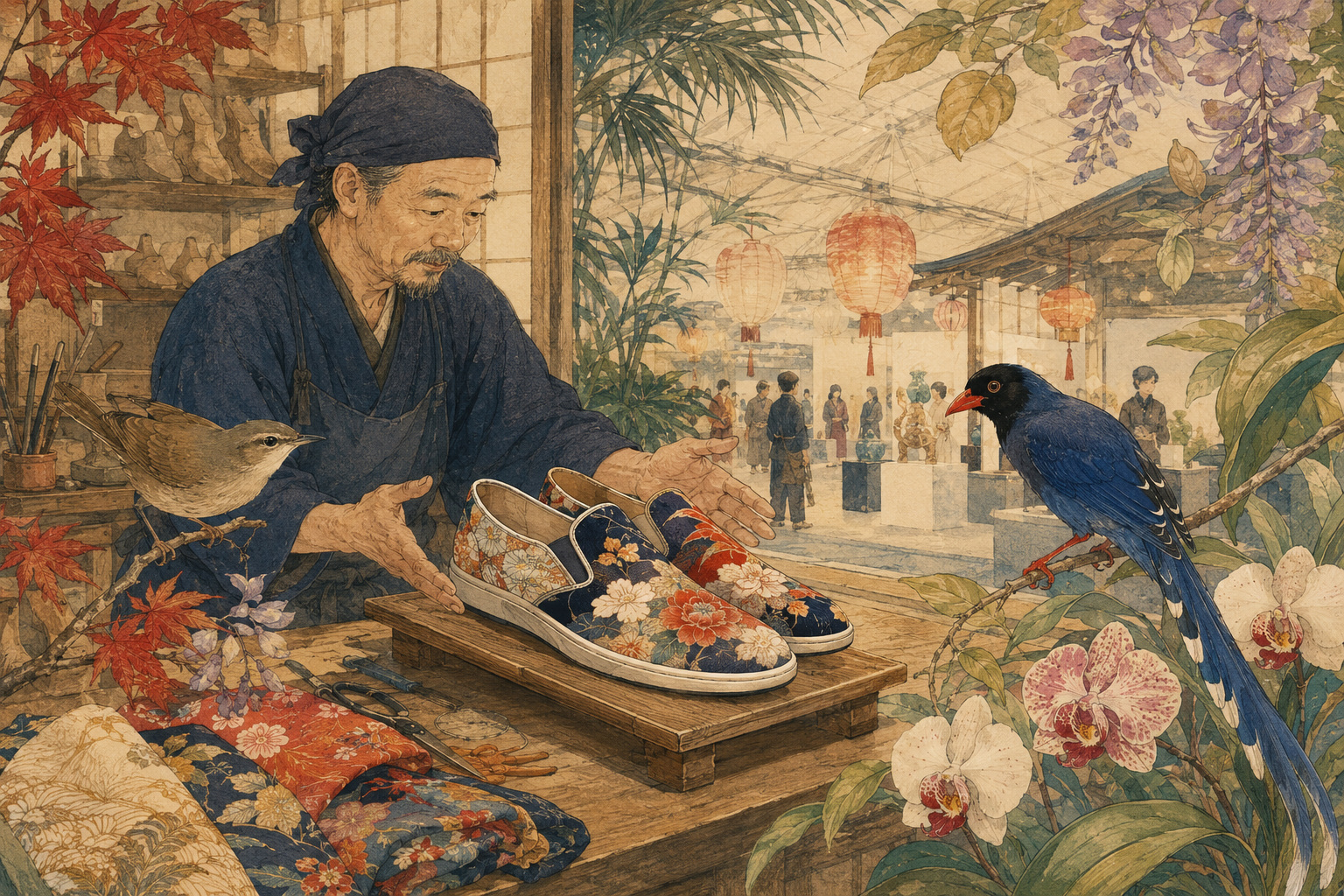
Before a kimono becomes a shoe, someone must make an irreversible choice. The garment is spread flat. A paper pattern passes over cranes, chrysanthemums, waves or geometric crests. Move the pattern a few centimeters and the finished pair tells a different story. Then the blade descends.
For a preservationist, cutting old silk can look like destruction. For the family that has kept an unworn kimono in a chest for decades, it may be rescue. For a shoemaker, it is the beginning of a series of practical questions: Is the fabric strong enough? Where should the motif land? How can delicate woven silk survive flexing, weather and friction? How should it be joined to leather?
Those questions have traveled from Imado, on the northern edge of Asakusa, to Taipei. AXT—a small Tokyo footwear manufacturer led by Noriko Onozaki—is presenting its signature HeWhoMe.Tokyo sneakers at Creative Expo Taiwan. The company says it combines vintage kimono textiles with leather and a hand-lasting method preserved by Asakusa craftsmen.
The exhibition opened Thursday at Taipei Nangang Exhibition Center. The first two days are for buyers and other professionals; from Saturday through Wednesday, the public can enter and purchase. AXT is appearing as a past success case of the Tokyo Metropolitan Government’s Buy TOKYO support program, an effort to help Tokyo-made brands build domestic and overseas markets.
The Other Asakusa
To most visitors, Asakusa means Sensō-ji, Kaminarimon’s enormous lantern and Nakamise’s stream of sweets and souvenirs. Walk north toward Imado and Higashi-Asakusa, however, and a second city appears: leather merchants, heel and sole suppliers, pattern cutters, sample rooms, repairers, small factories and wholesalers.
This geography is a production technology. A shoe company does not need to own every process when a specialist a few streets away can skive leather to an exact thickness or solve a difficult upper. Knowledge moves through repeated orders, corrections and relationships. The cluster allows a small brand to assemble expertise beyond its payroll.
Tokyo’s official tourism site says around 100 shoe factories remain in Asakusa, alongside leather and materials shops. Taitō Ward supports leather-related startups at the Asakusa Monozukuri Kobo and preserves industrial records at the Leather Industry Museum. The annual A-ROUND event opens ordinarily private workshops and has drawn 15,000–20,000 people per edition, according to the ward’s industry vision.
AXT’s address in Imado places it inside this less photographed Asakusa. The company’s own site says production takes place in its Asakusa factory and that “made in ASAKUSA” or “made in TOKYO” can be printed for clients. The label is not nostalgic decoration; it identifies an operating supply network.
How the Shoe Capital Was Built
Japan’s modern leather-shoe story begins with the Meiji state’s desire to equip soldiers and officials in Western dress. In 1870, industrialist Katsuzō Nishimura established Isekatsu Shoemaking in Tsukiji and produced what industry histories describe as the country’s first domestically made Western leather shoes.
The industry soon moved east. Nishimura shifted tanning to Mukōjima in 1871. In 1872, Naoki Dan relocated shoemaking to Hashiba in Asakusa. Those decisions linked leather processing, footwear assembly, river transport and working-class eastern Tokyo. The district’s earlier leather trades and the difficult social history of people assigned to animal-related work also form part of that foundation—an inheritance often erased from polished craft narratives.
War and state demand expanded production. After 1945, Asakusa factories supplied a population adopting Western shoes for school, office and daily life. Young people arriving through Ueno Station from northeastern Japan joined the workshops. By 1970, suppliers gathered for the first Tokyo Leather Fair in the newly built metropolitan trade center in Taitō.
Globalization later reversed the wind. An industry timeline records that leather-shoe imports reached about ¥124 billion in 2013 and exceeded the value of domestic shipments for the first time. Volume moved abroad; Asakusa’s comparative advantage narrowed toward sampling, small lots, fit, speed, specialist construction and brand story.
1870 Katsuzō Nishimura establishes Isekatsu Shoemaking in Tsukiji.
1871–1872 Tanning moves to Mukōjima and Naoki Dan relocates shoemaking to Hashiba, Asakusa.
1902 Nihon Seika, an ancestor of today’s Regal Corporation, is established.
Post-1945 Mass adoption of Western footwear expands the eastern Tokyo cluster.
1970 The first Tokyo Leather Fair is held in Taitō.
2013 Imported leather-shoe value overtakes domestic shipment value.
August 2026 HeWhoMe.Tokyo takes Asakusa kimono sneakers to Taipei.
From Robe to Upper
A kimono is unusually suited to reuse because its original construction is designed around straight, minimally wasteful cloth panels. When seams are unpicked, much of the fabric returns to long rectangular lengths. Historically, garments were remade, resized, handed down, turned into children’s clothing or repurposed as household textiles.
But a shoe asks different things of cloth than a robe. A kimono hangs and drapes; an upper bends thousands of times, rubs against the foot and meets the street. Vintage silk may be weakened by light, humidity, perspiration, storage stains or invisible fiber damage. Selection and reinforcement are therefore as important as visual design.
The brand says its shoes use Japanese pure-silk kimono and that each pair becomes unique because motif placement changes when pattern pieces are cut. Its online collections include names such as Miyabi, Rin, Iki, Ai, Akane and motifs including snow rings, tortoiseshell and kodemari flowers.
Upcycling changes the value equation. A garment that is difficult to sell or wear in its original form can become the visual center of a luxury sneaker. Yet the transformation consumes the source. Responsible makers must distinguish damaged or surplus fabric from museum-worthy textiles, document provenance where possible and obtain clear consent when working with a family garment.
What “Hand-Lasted” Actually Means
The press release calls the technique tezuri, literally hand-lasting. “Fishing by hand” is an easy mistranslation; no hook is involved. Lasting is the operation that gives a shoe its three-dimensional form.
After the kimono and leather parts are cut and sewn into an upper, the craftsperson places that upper over a foot-shaped last. The material is pulled progressively around the toe, sides and heel, shaped without distorting the motif, and secured to the insole. Tension must be balanced: too loose and the shoe wrinkles or lacks support; too tight and seams twist, material strains or fit changes.
AXT’s related Tokyo Kimono Shoes process lists cutting, leather skiving, sewing, lasting, bonding the upper to the outsole, inspection and finishing. Skiving is crucial because leather varies naturally in thickness; uneven joins can create pressure or visible bulk. The finished shoe is thus neither simply a kimono wrapped around a sneaker nor an entirely hand-sewn bespoke shoe.
The manufacturer describes the result as a fit that remembers the foot and follows its movement. That is promotional language, not an independent clinical finding. Hand-lasting can give a skilled maker precise control over shape and tension, but comfort also depends on the last, size range, insole, sole geometry, weight and the wearer’s foot.
| Stage | Craft problem | Why it matters |
|---|---|---|
| Motif placement | Choose which part of the kimono appears on each panel | Determines visual balance and makes pairs non-identical |
| Leather skiving | Reduce varying leather thickness evenly | Prevents bulky seams and pressure points |
| Sewing | Join delicate textile, reinforcement and leather | Controls strength and alignment |
| Hand-lasting | Pull the upper around the last with balanced tension | Creates shape, fit and clean lines |
| Bonding and finish | Attach outsole, inspect and adjust | Determines durability and final quality |
Why Old Kimono Need a New Life
The postwar shift to Western clothing moved kimono from everyday dress toward ceremonies, formal occasions and specialized enthusiasm. A Ministry of Economy, Trade and Industry presentation says sales have continued to decline; weddings, school ceremonies and coming-of-age events—the remaining major occasions—are themselves changing as population falls and customs simplify.
METI has cited a market of roughly ¥1.8 trillion around 1980 versus about ¥200 billion in recent years. Exact estimates vary by scope, but the direction is unmistakable. Fewer bolts woven and garments sold mean fewer orders for dyers, weavers, stencil cutters, embroiderers, finishers and retailers in a deeply divided production system.
At the household level, decline leaves material stranded. Formal kimono may carry great purchase price and family meaning but little resale value. Sizes, dressing knowledge, maintenance cost and limited occasions make inheritance difficult. Chests preserve extraordinary textile work that no one plans to wear.
Upcycling offers one exit from that impasse. It does not revive the full kimono economy: cutting an existing robe creates no new order for the original weaver. But it can teach a new buyer to recognize weave, motif and silk quality, create income from dormant cloth and keep skilled cutting and sewing in use.
Upcycling Is Not a Free Environmental Pass
“Sustainable sneaker” is an attractive phrase, but environmental performance belongs to the whole product. Reusing kimono fabric avoids discarding that portion and reduces demand for a new decorative upper textile. The rest of the shoe still matters: leather origin and tanning, reinforcement, adhesives, synthetic components, outsole material, packaging, air freight, durability and end-of-life separation.
A composite shoe can be difficult to recycle because cloth, leather, foam, rubber and glue are designed not to come apart during wear. A handmade product that lasts and can be repaired may perform better over time than a disposable fashion shoe, but that requires evidence about repair services, replacement soles, care, manufacturing waste and years of use.
The maker’s announcement does not provide a lifecycle assessment, carbon figure, recycled-content percentage for the whole shoe or production volume. It is therefore more precise to say the brand upcycles vintage kimono in its uppers than to conclude that every pair is environmentally superior.
- How are kimono sourced, screened and documented?
- What share of the complete shoe is reclaimed, renewable or recyclable?
- Which leather, tanning chemistry, adhesives and sole materials are used?
- Can the shoe be resoled, repaired and returned?
- What happens to silk offcuts and pairs that fail quality control?
- Are cultural motifs explained accurately and family textiles used with consent?
Taipei as Market and Mirror
Taiwan is more than a convenient first Asian sales destination. Japanese travel, food, craft and design have strong visibility there, while Taiwanese buyers are sophisticated interpreters of Japanese culture rather than passive recipients. They can recognize whether a product offers technique and thought or merely places a familiar motif on merchandise.
Creative Expo Taiwan is designed for that test. Organized by Taiwan’s Ministry of Culture, its commercial exhibition combines creative brands and intellectual-property licensing. The 2025 edition reported 650,000 visits, 650 international brands, more than 930 booths, nearly 180 overseas buyers and more than 1,400 business meetings. Transaction value reached NT$1.35 billion.
The 2026 brand show runs seven days in Nangang Exhibition Center, with two protected trade days before public opening. That split lets AXT attempt two businesses at once. A distributor or retailer can discuss wholesale, sizing, delivery and exclusivity; a consumer can touch the silk, try the fit and decide whether the story justifies the price.
The company says Taiwan is its third overseas exhibition country, following a fashion show in Saudi Arabia and Maison & Objet in France. Those appearances build visibility; they do not by themselves establish recurring exports. The Taipei measure will be orders, partners, repeat customers and the operational ability to handle returns and sizing across borders.
The Buy TOKYO Bet
AXT’s place in the Tokyo booth reflects a public policy wager: a metropolitan craft cluster can export not only objects but an identity. Buy TOKYO supports products rooted in the city as businesses seek wider markets. Selecting HeWhoMe.Tokyo as a past success case suggests the program sees the brand as evidence that a small maker can translate local production into an international proposition.
That translation has several layers. “Asakusa” signals craft and old Tokyo. “Kimono” supplies material and cultural recognition. “Upcycling” speaks to contemporary environmental concern. “Sneaker” makes the object legible in everyday global fashion. The combination is commercially powerful because each term helps explain the others.
It also carries a risk. If foreign demand values only the visual exoticism of kimono, the shoe becomes a souvenir at luxury price. The defense is specificity: explain the fabric, name the motif, show the lasting process, disclose the source and let the maker—not a vague image of Japan—occupy the center of the story.
A Pattern Must Cross a Seam
The most difficult part of turning heritage into product is not placing old material on a new shape. It is deciding what must remain recognizable and what must change. A kimono cannot perform as a shoe without being cut, reinforced and joined to modern components. A shoe cannot carry the textile honestly if the process erases its origin.
The same tension faces Asakusa. Its factories survive not by repeating 1950s volume production but by using accumulated skill for smaller, stranger and more demanding work. An upcycled silk sneaker is exactly that kind of object: too variable for frictionless mass production, valuable because human judgment remains visible.
Taipei will test whether that visibility travels. Buyers will see color and pattern first. The lasting, skiving, district history and careful choice of cloth must arrive through explanation and through the feel of the product itself.
A kimono stored in a chest preserves memory by remaining unchanged. A shoe preserves differently: by entering motion, collecting creases and touching a new city. Neither path is automatically more respectful. But in HeWhoMe.Tokyo’s wager, tradition survives by accepting the cut—and walking.
Reporting notes and principal sources
Event schedule and brand claims come from AXT’s release and official sites. No independent lifecycle assessment or comparative comfort study was identified; sustainability and fit language is qualified accordingly.
- HeWhoMe.Tokyo / AXT: Creative Expo Taiwan announcement
- HeWhoMe.Tokyo: collections, materials and brand statements
- AXT: Asakusa production and company services
- Tokyo Kimono Shoes: manufacturing sequence and craftsmanship
- Creative Expo Taiwan: official 2026 dates, venue and admission schedule
- Taiwan Ministry of Culture: 2025 attendance and business results
- GO TOKYO: Asakusa shoe cluster and factory count
- Tokyo Leather Fair: 150-year industry chronology
- Taitō Ward: industry vision and leather-craft ecosystem
- METI: current state of the kimono industry
- METI Journal: long-term kimono-market contraction