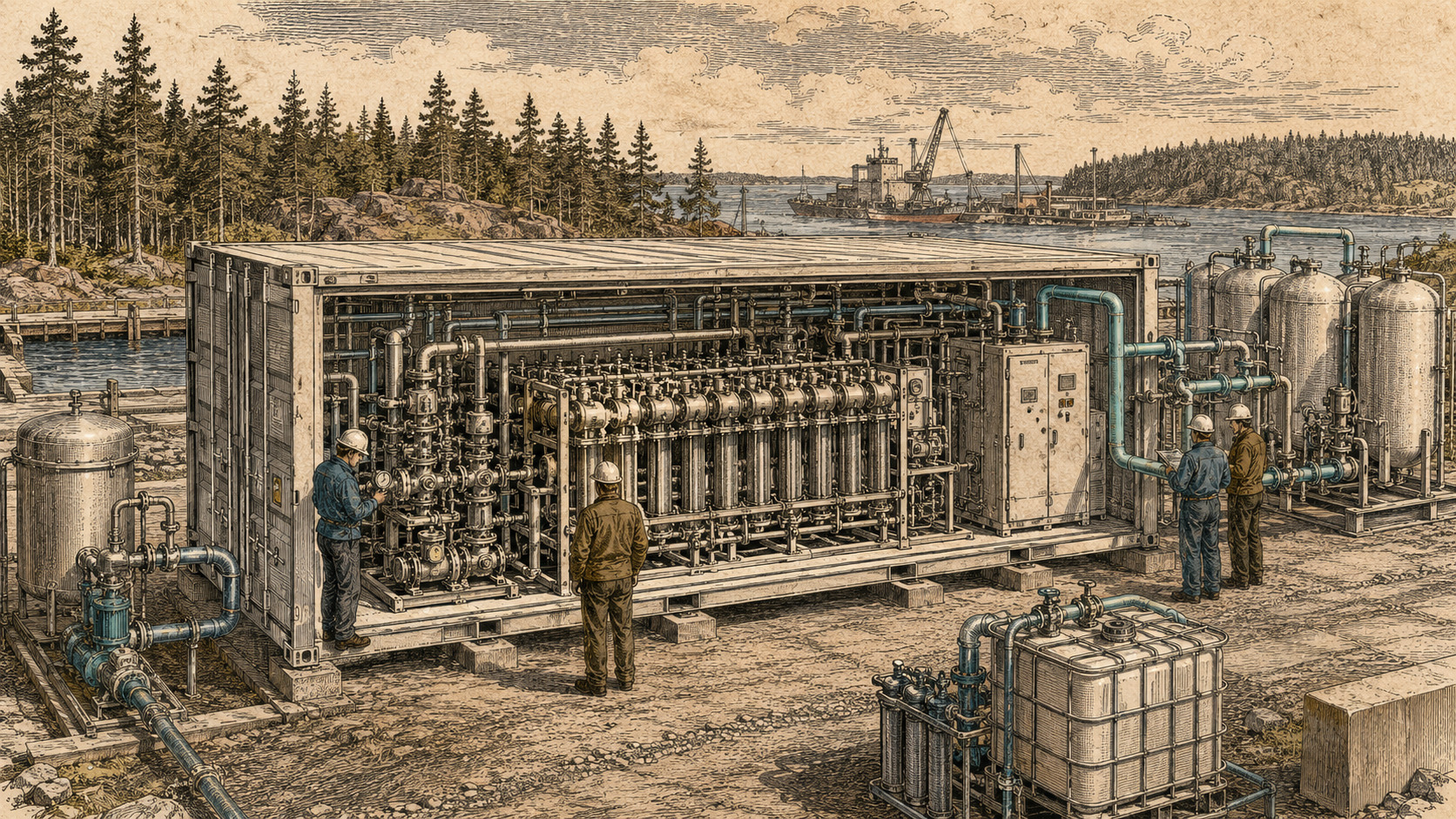
Two clocks are running at the hydrogen station in Jyväskylä, a city of lakes and forests in Central Finland. The first has already started. Fuel-cell buses and a limited number of cars and taxis have been using the station in pilot service, supplied by hydrogen carried roughly 270 kilometers from P2X Solutions' plant in Harjavalta. The second clock belongs to a container being installed next door. When Asahi Kasei's equipment enters steady operation, water and electricity will begin replacing trucked fuel with production at the point of demand.
The box is called Aqualyzer-C³. It is a pressurized alkaline-water electrolysis system rated in the 1 MW class, with planned full-load output of about 400 kilograms of hydrogen a day. Asahi Kasei expresses the flow another way: enough hydrogen in an hour to refill approximately three fuel-cell passenger cars. That is large by the standards of a vehicle demonstration and tiny beside the appetite of an ammonia plant or steelworks. Its position between those scales is what makes it revealing.
The hydrogen industry has become adept at announcing enormous future projects. Execution is harder. The International Energy Agency says more than half of potential electrolyzer capacity is now expected to miss its original operating date. A market does not learn only from gigawatt ambitions; it learns by permitting one megawatt, connecting it, surviving winter, maintaining purity and finding a buyer every day. Jyväskylä's container is small beside the global pipeline, but large as a unit of commercial learning.
It did not merely make a plant smaller—it made the plant a product
Industrial plants are normally designed around their sites. Electrolyzer stacks, pumps, piping, power conversion, controls, water treatment, gas separation and safety systems are assembled and commissioned in place. That can deliver economies of scale, but it demands custom engineering and a long construction schedule. For an organization making its first hydrogen, the entry barrier is formidable.
Aqualyzer-C³ packages the equipment needed for hydrogen production inside containers. More assembly and testing can happen in a factory, less must happen outdoors, and additional units can be connected as demand grows. Asahi Kasei positions the 1-to-7.5 MW line as an entry model for new users and distributed plants beside facilities such as hydrogen stations. The container is not primarily a symbol of smallness. It is a symbol of repeatability.
Setting down a box does not mean a vehicle can refuel that afternoon. The system still needs high-quality water, electricity, cooling, ventilation, a safe perimeter and site utilities. Downstream come purification and drying, compression to the required pressure, storage and dispensing. Containerization standardizes the heart of the production plant; it does not magically compress an entire hydrogen station into one shipping unit.
What happens inside the box
Electrolysis uses electricity to split water into hydrogen and oxygen. In a liquid alkaline electrolyzer, an alkaline solution—typically potassium or sodium hydroxide—acts as the electrolyte. Hydroxide ions move between the electrodes; hydrogen forms at the cathode and oxygen at the anode. The principle is old, and commercial liquid-alkaline equipment has a long industrial record.
Mature does not mean simple. Wind and solar output change. An electrolyzer must raise and lower load, sometimes stop and restart, while protecting gas purity and pressure and limiting deterioration of electrodes and separators. Operating only during the cheapest hours can reduce the electricity bill per kilogram, but it also leaves expensive equipment idle. Running nearly all the time spreads capital cost over more product but can force the operator to buy expensive power. That tradeoff governs the economics of renewable hydrogen.
If a 1 MW unit consumed full nameplate power for 24 hours, it would use 24 MWh. Divide that by 400 kilograms and the rough result is 60 kWh per kilogram. This is only arithmetic from rounded public specifications—not a disclosed Aqualyzer-C³ efficiency. “1 MW class” is approximate, and Asahi Kasei has not published the auxiliary load, operating factor or measurement boundary for this project. For context, the U.S. Department of Energy lists 55 kWh/kg as the 2022 system status for liquid alkaline electrolysis. Values cannot be compared honestly until compression, auxiliaries and boundaries match.
| Stage | Function | Often-hidden challenge |
|---|---|---|
| Power conversion | Turns grid alternating current into current the stack can use | Electricity price, grid connection, renewable variability |
| Water treatment | Supplies sufficiently pure water | Water quality, freezing and local resources |
| Alkaline electrolysis | Separates water into hydrogen and oxygen | Electrode life, starts and stops, gas purity |
| Purification, compression, storage | Prepares hydrogen for its end use | Additional power, safety and capital cost |
| Dispensing and demand | Sells fuel to buses, trucks and cars | Utilization, fleet size and dependable purchase contracts |
The story began in 1923, a century before “green hydrogen” became a slogan
Asahi Kasei's hydrogen history nearly overlaps its corporate history. Founder Shitagau Noguchi built a fertilizer complex in Nobeoka, Miyazaki Prefecture, supported by hydroelectric stations on the Gokase River system. In 1923, the enterprise used electricity to split water and fed the hydrogen into Japan's first synthetic-ammonia production using the Casale process. The combination would now be described as renewable hydrogen, long before anyone marketed the color green.
It would be too neat to draw a straight technical line from that plant to today's Aqualyzer. The essential bridge was chlor-alkali electrolysis. In 1975, Asahi Kasei commercialized an ion-exchange-membrane process that electrolyzes brine into chlorine, caustic soda and hydrogen. It displaced older process materials such as mercury and asbestos and reduced energy use.
By the end of 2024, the technology had been adopted by more than 160 plants in over 30 countries. The company supplies not just membranes, but electrodes, cells, controls, operating support and long-term knowledge. The deepest asset exported by Aqualyzer is therefore not one sheet of membrane or one steel stack. It is the operating culture required to manage electricity, corrosive liquid and delicate electrochemistry for years, stop safely, and start again without shortening the plant's life.
How a 10 MW Fukushima stack was folded into a 1 MW box
Asahi Kasei began applying its chlor-alkali experience to dedicated alkaline-water electrolysis development in 2010. In 2018, a 120 kW system at Soma, Fukushima Prefecture, began trial operation with solar power. Rated for 25 normal cubic meters of hydrogen per hour, it tested how a large-electrode design could follow changing renewable input.
The next leap came at the Fukushima Hydrogen Energy Research Field, or FH2R, in Namie. In March 2020, a single 10 MW-class stack began supplying hydrogen, with rated output of 1,200 normal cubic meters an hour. It had to do more than reach a large number once; it had to follow renewable power over years. The long-running program helped earn Asahi Kasei engineers the Electrochemical Society of Japan's 2026 Tanahashi technology prize.
A different scale was tested at Asahi Kasei's Kawasaki Works beginning in March 2024. Four 0.8 MW modules run in parallel under simulated wind and solar fluctuations, low nighttime supply and maintenance conditions in which one module can be taken down while others continue. The large Aqualyzer concept uses 10 MW building blocks on a path past 100 MW. C³ divides the smaller 1-to-7.5 MW market into containerized increments. Asahi Kasei is trying to commercialize both a great single engine room and a fleet of small boxes.
1923 Hydroelectricity in Nobeoka makes electrolytic hydrogen for synthetic ammonia.
1975 Asahi Kasei commercializes its ion-exchange-membrane chlor-alkali process.
2010 Dedicated alkaline-water electrolyzer development begins using chlor-alkali know-how.
2018 A 120 kW system in Soma begins testing with photovoltaic power.
March 2020 The 10 MW-class single stack at FH2R starts hydrogen supply.
March 2024 The four-module, 3.2 MW Kawasaki pilot starts operation.
September 2024 Asahi Kasei and Italy's De Nora form a containerized-system collaboration.
July 2025 Jyväskylä becomes Asahi Kasei's first order after commercialization.
March 2026 Installation begins, with production planned around July and steady operation by year-end.
This is not a purely Japanese export
Aqualyzer-C³ can fairly be described as a Japanese technology export, but the more accurate story is a Japanese-Italian collaboration being commercialized in Northern Europe. In September 2024, Asahi Kasei signed a memorandum with De Nora, the Italian electrode and electrolysis specialist, covering development, evaluation and sales of small pressurized alkaline systems. De Nora brought expertise in electrode catalysts and compact pressurized electrolyzers. Asahi Kasei brought chlor-alkali customers, system integration, monitoring, operating knowledge and after-sales support.
The buyer is an ecosystem rather than a solitary company. Central Finland Mobility Foundation, or Cefmof, was created in 2024 by the City of Jyväskylä, TOYOTA GAZOO Racing World Rally Team and Toyota Mobility Foundation. Its wholly owned subsidiary, Cefmof Hydrogen, operates the station and related infrastructure. Bus operator Koiviston Auto, manufacturer CaetanoBus, regional transport organization Linkki and hydrogen producer P2X Solutions connect vehicles to fuel.
That cross-border division of labor is not a dilution of the achievement. Hydrogen needs less mythology about one company inventing everything and more evidence that someone can build the stack, commission it in a Finnish winter, maintain it locally and sell its output to a bus that must leave every morning.
Why Finland, and why Jyväskylä?
The first answer is electricity. Statistics Finland says 95% of domestic power production in 2024 was fossil-free when renewables and nuclear are combined. Renewables supplied 57%, and wind alone produced one-quarter. Because the carbon intensity of electrolytic hydrogen follows its power input, a grid with abundant low-carbon generation offers a favorable starting point.
A favorable national average does not automatically make every kilogram “renewable hydrogen” under European rules. The operator must show which electricity it contracted, when that power was generated and how it meets guarantees-of-origin and RFNBO requirements. Asahi Kasei's Japanese release uses “clean hydrogen” as an umbrella for green and other hydrogen from low-carbon energy. This article does not infer a certification category from the equipment alone.
The second answer is cold. A Jyväskylä winter tests freezing risk in water lines, electrolyte and balance-of-plant temperature control, startup, storage and fuel-cell vehicle performance at the same time. A failure that can hide in laboratory data is exposed when transit service depends on the system. For Asahi Kasei, Finland is both a customer and a reference site for other cold markets in the Nordic region, Canada and northern North America.
The third answer is that the city created demand first. Five fuel-cell buses are assigned to a two-year pilot, and the station also serves lighter vehicles. Buses travel predictable routes and return to a common base, creating a more regular customer than scattered private cars. Jyväskylä began learning vehicle and dispensing operations with hydrogen delivered from Harjavalta; onsite electrolysis is the next layer. It is an attempt to solve hydrogen's chicken-and-egg problem as a sequence rather than all at once.
- Demand: five fuel-cell buses, plus taxis and passenger vehicles in real operation.
- Initial supply: green hydrogen delivered from P2X Solutions' Harjavalta plant.
- Local production: a 1 MW-class Aqualyzer-C³ beside the station.
- Operation: day-to-day responsibility moves from a foundation to Cefmof Hydrogen.
- Expansion: additional containerized units can follow if demand earns them.
Is 400 kilograms a day large or small?
Four hundred kilograms of hydrogen contains roughly 13.3 MWh of chemical energy on a lower-heating-value basis. That can support many passenger-car fills, but a bus or heavy truck consumes tens of kilograms at a time. Supplying five buses daily while serving lighter vehicles can turn the 1 MW unit from a demonstration into a small commercial plant.
Heavy industry lives on another scale. At continuous full production, 400 kilograms a day is about 146 tonnes a year. Steel, ammonia and refining projects require orders of magnitude more. C³ will not decarbonize a steelworks from one container. Its purpose is to begin near demand, reduce transport, collect operating data and add another standardized unit when customers materialize.
The price of hydrogen is set outside the box
An excellent electrolyzer cannot make cheap hydrogen from expensive electricity. At a rough consumption of 60 kWh/kg, a change of only five euro cents per kilowatt-hour moves electricity cost by €3 for every kilogram of hydrogen. Capital recovery, maintenance, water, compression, storage, dispensing and certification come on top. Vehicle operators must also absorb any premium over diesel or battery buses.
This is why electrolyzer manufacturing sits between exuberant capacity announcements and severe financial pressure. The IEA says global installed water-electrolysis capacity reached 2 GW in 2024 and added more than 1 GW through July 2025. China accounted for 65% of installed and final-investment-decision capacity and nearly 60% of manufacturing capacity. Outside China, falling revenue, losses, acquisitions and bankruptcies point toward consolidation, while project schedules continue to slip.
Asahi Kasei must therefore avoid competing only for the cheapest stack. Its case rests on long operating life, one-stop supply of membranes, electrodes, cells and controls, predictive monitoring, field support and an expansion path that reduces project risk. Jyväskylä will test whether those services are worth more to a first-time operator than the price difference against lower-cost hardware.
Putting water in does not make the output automatically clean
An electrolyzer releases no carbon dioxide at the point of production. A complete environmental account still includes electricity generation, equipment manufacturing, purified water, compression, delivery and storage. The chemical minimum is about nine kilograms of water for one kilogram of hydrogen, but total facility withdrawal can be higher when purification and cooling are included. Oxygen is produced as a co-product; its economic value depends on whether a nearby user exists.
There is also an energy-conversion penalty. Turning electricity into hydrogen and later back into electricity aboard a fuel-cell vehicle loses more energy than charging a battery directly. Whether hydrogen makes sense for a city bus depends on range, refueling time, cold-weather performance, fleet utilization, battery mass and shared infrastructure—not just tailpipe emissions. Jyväskylä already uses electric, biogas and renewable-diesel buses. It is testing hydrogen as one option, not declaring it the universal answer.
When a Japanese technology export becomes real
An export is not complete when a container leaves port. It becomes real when the system starts on a freezing morning, protects hydrogen quality, supports the bus timetable and can obtain parts and skilled help in Finland. Asahi Kasei has promised support from installation through operation and maintenance. For its first commercial electrolyzer order after market launch, that service commitment matters more than the shipment itself.
The Jyväskylä container tests whether Asahi Kasei can move from being the company behind great demonstration plants to the company behind a repeatable product and service. Success will not be measured only by the peak figure of 400 kilograms. It will be measured in winter availability, maintenance hours, electricity per kilogram, product purity, integration with the station—and whether a second box can be installed faster and more cheaply than the first.
In 1923, hydropower in Nobeoka made hydrogen for fertilizer. In 2026, Finnish electricity is scheduled to make hydrogen for mobility. The century between them is not a story of an unchanged chemical reaction. It is the story of turning a process once confined to great industrial works into something that can travel, connect locally and grow in modules. The Aqualyzer-C³ container may be the smallest visible part of this project. Its largest ambition is to export a new way of building the factory itself.
Reporting notes and primary sources
This article uses public information checked through August 10, 2026, 9:00 a.m. JST. Because no later Asahi Kasei release confirming production was found after the March installation announcement, the July start and year-end steady-operation dates are described as plans. The roughly 60 kWh/kg figure is simple arithmetic from rounded nameplate figures, not a disclosed product efficiency. “Clean” and “green” hydrogen are distinguished according to power and certification conditions.
- Asahi Kasei: Installation of Aqualyzer-C³ begins in Finland (March 12, 2026)
- Asahi Kasei: Japanese release with July and year-end timetable
- Asahi Kasei: First commercial order for the 1 MW-class system (July 30, 2025)
- Asahi Kasei and De Nora: 1–7.5 MW containerized-electrolyzer collaboration
- Asahi Kasei: Hydrogen history from 1923 hydropower and ammonia
- Asahi Kasei: 1975 chlor-alkali commercialization and more than 160 plants
- Asahi Kasei and IHI: 120 kW Soma green-hydrogen trial (2018)
- Asahi Kasei: Hydrogen supply starts from the 10 MW-class FH2R stack (2020)
- Asahi Kasei: Four-module Kawasaki pilot starts operation (2024)
- Asahi Kasei: Long-term FH2R operation and the 2026 Tanahashi Prize
- Cefmof: P2X supply and pilot operation at the Jyväskylä station (February 2026)
- City of Jyväskylä: Five-bus, two-year hydrogen pilot
- Toyota Mobility Foundation: Establishment of Cefmof (January 2024)
- Statistics Finland: 95% of 2024 electricity production was fossil-free
- U.S. Department of Energy: Liquid-alkaline efficiency, life and cost guideposts
- International Energy Agency: Global Hydrogen Review 2025