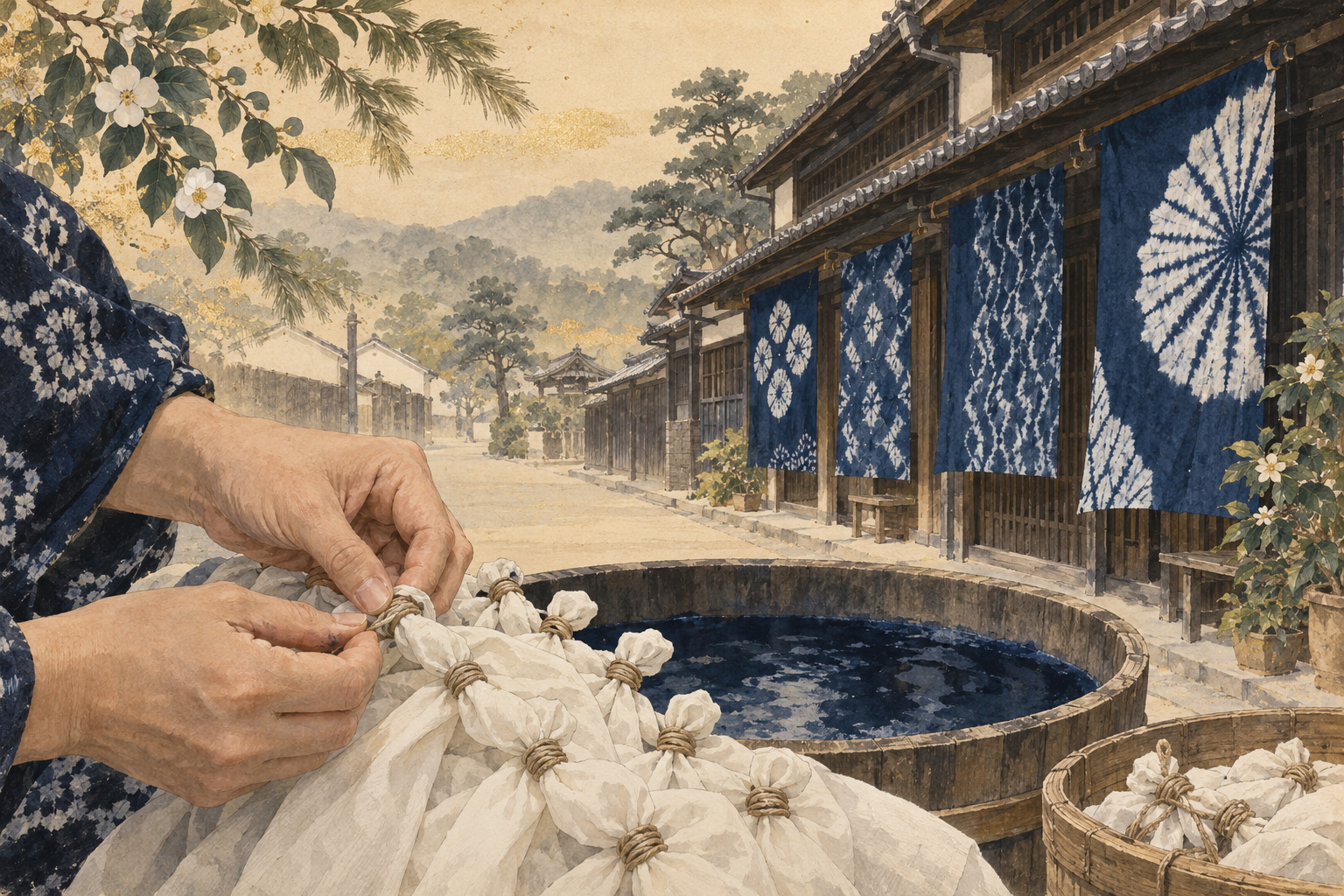
A shibori pattern begins before the cloth reaches the dye. Thread, folds and pressure determine where colour can enter. Removing the bindings reveals the work that preceded the apparently simple surface: areas held back from the dye, beside areas allowed to absorb it. The process described by the Arimatsu-Narumi Shibori Museum makes a useful starting point for understanding this corner of Nagoya. [2]
Arimatsu’s merchant houses offer an inviting view of Japanese craft history. Yet the more revealing subject is the chain of decisions connecting a design to a finished textile. Behind the street’s architectural presence lies a business built around specialist skills, changing customers and the difficult task of making knowledge into a livelihood. Four centuries of continuity have required considerable change.
A business between post towns
Nagoya’s municipal history dates the settlement to 1608, when the Owari domain established it between Narumi and Chiryū on the Tōkaidō. Arimatsu developed through selling shibori to passing travellers; it should not be mistaken for one of the road’s formal post stations. The route supplied customers as well as a way for products to leave the district. [1]
The museum identifies Takeda Shōkurō among the craft’s founders and describes towels and yukata bought as souvenirs under the domain’s protection. Another account links the technique’s arrival to people from Bungo, in present-day Oita, associated with Nagoya Castle’s construction. The national traditional-crafts association presents that explanation as a tradition, rather than an established eyewitness account. [2][3]
The commercial setting matters. A souvenir was both a useful possession and something that connected its buyer to a place. Arimatsu’s history therefore raises a question that remains relevant to craft businesses: how can a distinctive technique find a product and an audience willing to sustain its making?
The merchant and the many hands
Calling shibori “handmade” can obscure how many different hands were involved. The Association for the Promotion of Traditional Craft Industries places the consolidation of the division of labour around the late eighteenth and early nineteenth centuries. Pattern cutting, transferring a design, binding and dyeing became connected specialisms. [3]
A field report published by the association in January 2017 describes Takeda Kahei Shoten coordinating design, orders to specialists and sales. This historical reporting offers a particularly useful view of the merchant’s role: choosing how a design will be realised is itself skilled work. The shopfront represents the endpoint of an organised production process. [4]
For a visitor, that changes the meaning of the finished fabric. Its surface cannot disclose every exchange of materials or every judgement made during production. Asking how a piece was made gives substance to the otherwise vague idea of craftsmanship. It also helps explain why the time spent in a dye bath is only one part of the work a buyer is purchasing.
Reading the pattern
Shibori describes a method of resisting dye; indigo describes a dye. A blue shibori textile is not, by appearance alone, evidence of natural-indigo production. The museum’s explanation allows for dyes suited to different fabrics and uses. Technique, fibre and colour are separate questions worth asking. [2]
| Method | What happens before dyeing |
|---|---|
| Stitched resist | Stitches gather and tighten the cloth. |
| Spider binding | Pleats are gathered and wrapped with thread from their base. |
| Folded resist | Cloth is folded into triangles or squares and secured. |
These are simplified descriptions drawn from the association’s technical account. [3] Their value is to connect a visible pattern with a physical action. Look at where the pale areas repeat, then imagine what had to be folded, gathered or held in place. A textile becomes easier to read when its pattern is understood as the consequence of a sequence.
A street rebuilt, and a trade reinvented
The streetscape is not an untouched survival from 1608. Fire destroyed most of the settlement in 1784. Later, declining road traffic after the Meiji Restoration damaged the industry; new designs, production methods and a turn towards wholesaling helped it recover. Buildings surviving today span the late Edo to early Shōwa periods. National selection as an Important Preservation District for Groups of Traditional Buildings came on July 25, 2016. [1]
Individual buildings make the business history tangible. The Nagoya Convention and Visitors Bureau describes the Hattori residence as a merchant complex with packing and storage areas. Its plastered construction, upper-storey lattice windows and projecting udatsu walls belong to a vocabulary in which appearance and fire protection are closely connected. [7]
It is worth imagining goods being prepared for dispatch when looking at such a frontage. The house was part of an enterprise. Preserving its appearance conserves evidence of that enterprise, but the survival of buildings and the survival of paid craft work are different measures of success. A handsome street cannot, by itself, tell visitors whether its production skills have a secure future.
Finding a way into the craft
Inheritance is one route into a traditional industry, but it is not the only one. The craft collective Rinku’s profile of binding specialist Aya Osuka traces her interest to university study and a visit to the museum. It records her independence in 2017 and the opening of a home and atelier along the old Tōkaidō in 2020, combining product work with dyeing experiences. [5]
That trajectory connects institutions often treated separately: an exhibition, an apprenticeship and a working space within the historic town. Someone who first encountered the craft as a learner became part of its productive life. Her example does not establish a general recovery in employment, but it shows a concrete path by which knowledge can acquire a new practitioner.
The association’s 2017 reporting also described efforts to connect trained newcomers with work. That distinction remains essential to understanding succession: acquiring a technique and earning a living from it are related achievements, not interchangeable ones. [4] The relevant question is not simply whether people admire shibori, but whether enough work reaches those able to make it.
Start with a demonstration
The Arimatsu-Narumi Shibori Museum publishes regular opening hours of 9:30 a.m.–5 p.m., with demonstrations ending at 4:30 p.m. Its usual weekend programme lists reserved folded-resist sekka workshops at 10:30 a.m. and 2 p.m. Check the operating calendar and availability before travelling; the published programme is not confirmation of places on September 13. [6]
A demonstration offers a useful preparation for shopping. Watch how the cloth is handled and how the binding progresses, then look again at the finished pieces. Questions about technique, fibre, washing and intended use can produce a more meaningful exchange than simply seeking the most recognisably traditional pattern.
Arimatsu’s long history is visible in its buildings, but its continuation takes place in such practical relationships. A maker needs another order; a newcomer needs the chance to practise; a buyer needs something worth using. Following those connections gives the old road a contemporary significance. The patterns endure because people keep finding reasons to make them.
- Nagoya City: settlement, fire, commercial revival and preservation
- Arimatsu-Narumi Shibori Museum: history and production
- Association for the Promotion of Traditional Craft Industries: methods and division of labour
- The association: field report on production and succession (displayed publication date January 14, 2017)
- Rinku: profile of binding specialist Aya Osuka
- Arimatsu-Narumi Shibori Museum: hours, demonstrations and weekend workshops
- Nagoya Convention and Visitors Bureau: Arimatsu streetscape and Hattori residence