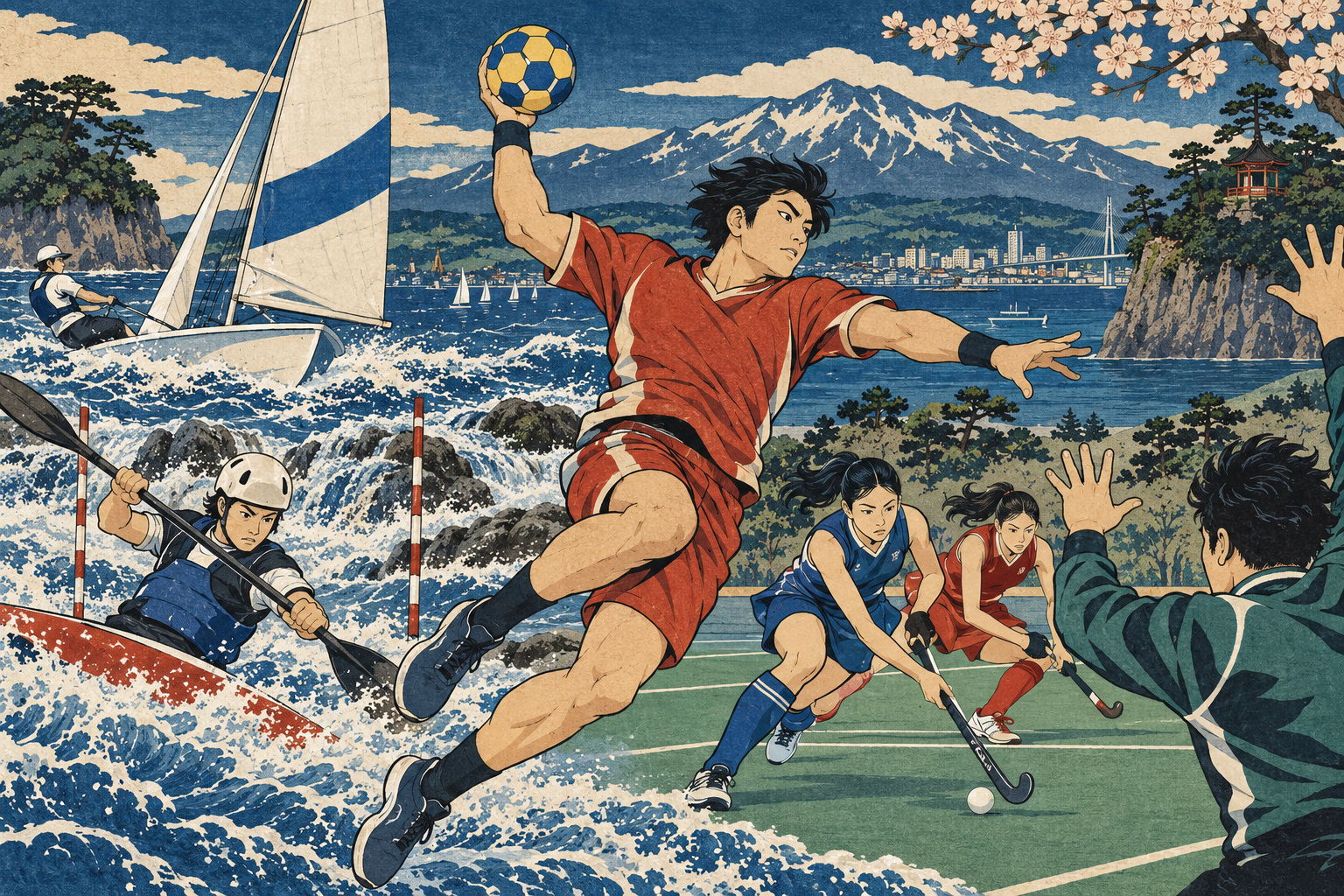
The first advance session of the Aomori Japan Games opened on September 3 and moved into its decisive phase across the prefecture. Sailing and canoe slalom/wildwater completed their programs on September 7. Hockey and handball crowned four category winners by the end of that day, with their remaining finals assigned to September 8.
This is not the end of the festival. The first advance session continues through September 13, a second advance period runs October 2–9, and the main session is October 10–20. The overall opening ceremony does not take place until October 10. These are the first champions of Aomori 2026, not the final resolution of the prefectural points races for the Emperor’s and Empress’s Cups.
| Sport and category | Result confirmed through Sept. 7 | Official mark |
|---|---|---|
| Sailing, youth 420 | Mie won both boys’ and girls’ events | 14 points in each |
| Sailing, youth ILCA 6 | Kanagawa won both events | 9 points in each |
| Canoe, men’s wildwater sprint | Okayama first; Aomori second | 39.30 / 39.43 sec. |
| Field hockey | Gifu won adult men; Fukui and Gifu shared youth women | 2–1 / 0–0 |
| Handball | Hiroshima won adult women; Osaka won youth men | 35–31 / 47–46 |
A decisive stage is not the closing ceremony
The label “finals” can conceal the architecture of the National Sports Festival. Sports with different venue, climate and calendar requirements are distributed across several periods. The September 3–13 session includes aquatics, rowing, gymnastics, sailing and other disciplines. A second advance group follows from October 2. Athletics, ball sports, martial arts and many more occupy the October 10–20 main session.
That arrangement solves logistical problems, but it creates a reporting one: a reader can easily mistake a sport’s last day for the festival’s end. This report examines official results confirmed through September 7. It does not fill the September 8 spaces with live-blog guesses or results copied from pages carrying recycled data from older Games.
Mie and Kanagawa find two different sailing sweeps
Sailing ran from September 4 to 7 at Ominato’s Ohira Marina in Mutsu. A light-air day can include long waits before a start. Positions across a series are converted into points, with lower totals generally better, so resilience across changing wind and water matters as much as a single first finish.
Mie won both two-person youth 420 categories. The prefecture’s boys’ crew of Okada and Yamazumi finished on 14 points; its girls’ pairing, two sailors listed under the Fukushima surname, also recorded 14. The result joined two crews rather than two identical performances: each partnership had to coordinate balance, sail trim, tactics and communication.
Kanagawa swept the one-person youth ILCA 6 events. The official Japanese results list Ikuto Mori of Kanto Gakuin Mutsuura High School and Kurumi Iijima of N High School, each on nine points. Both have developed through Kanagawa’s youth sailing network. Alone in the boat, a sailor owns every adjustment and every error; the pair of titles emerged from two separate decisions repeated across a series.
Thirteen hundredths on the Iwaki River
The men’s canoe wildwater kayak sprint in Nishimeya produced the most compressed podium of these results. Okayama’s Yamane won in 39.30 seconds. Aomori’s Nishizawa was second in 39.43, and Gifu’s Suzumura third in 39.52. Only 0.22 seconds separated first from third.
Nishizawa has trained with the local Shirakami Canoe Club, giving the host prefecture’s silver a relationship to the river deeper than home-crowd symbolism. Local reporting said he and Aomori women’s paddler Sato had won the longer classic races earlier in the program and entered the sprint seeking doubles. The official sprint record shows how narrowly Nishizawa’s second title escaped: less time than a blink, on water that never presents precisely the same line twice.
Yamane’s victory carries another history. He has been a leading Japanese wildwater paddler for years and now also contributes to developing younger athletes. A host-region story and a veteran national competitor met in the same 200-metre run. The format is prefecture against prefecture; the race was also local knowledge against accumulated experience.
A scoreless final produces two champions
Gifu beat Shimane 2–1 in the adult men’s hockey final at Rokkasho on September 7. Gifu scored first, Shimane levelled in the second quarter, and the defending champion found the deciding goal in the fourth. The official competition record describes it as a third consecutive title.
The youth women’s final at Misawa High School followed another logic. Fukui’s Nyu High School and Gifu Kakamino High School completed four quarters at 0–0. The official record declared both teams champions—Fukui retaining the title and Gifu returning to the top after two years.
A shared championship challenges the expectation that a knockout final must manufacture one winner. Nil-nil does not mean that nothing happened. It means two defences, two midfields and two sets of decisions inside the shooting circle preserved equilibrium to the end. Here the competition rule, not a sudden-death spectacle, became part of the story.
Hiroshima changes four goals after halftime
Hiroshima’s Izumi Hiroshima defeated Kagawa Bank 35–31 in the adult women’s handball final. Kagawa led 17–16 at halftime. Hiroshima won the second half 19–14, transforming a one-goal deficit into a four-goal victory.
The parenthetical club names in the official record are important. An adult prefectural side may be a selection, but it may also be built around a company or established club. The surface story is Hiroshima against Kagawa; the underlying contest carries the daily systems of two teams, their workplaces, leagues, coaches and shared repetitions.
The handball field across all four categories comprised 70 teams: 19 adult men’s, 16 adult women’s, 16 youth men’s and 19 youth women’s sides. Most reached Aomori through regional qualifying in a punishing summer. A host can construct the stage; the coordination visible in a final was built elsewhere.
Osaka wins a 93-goal match by one
The youth men’s final was even tighter. Osaka University of Health and Sport Sciences Namisho High School beat Fukui’s Hokuriku High School 47–46. Hokuriku led the first half 22–21; Osaka took the second 26–24. Ninety-three goals ended with the smallest possible margin.
A high total does not make defence irrelevant. Fast breaks, substitutions, goalkeeper choices and exclusions rapidly convert one decision into a shot at the other end. Osaka overturned one goal and protected one. On the same day that Hiroshima changed a women’s final after halftime, school-age players in another arena performed a narrower version of the same act.
The festival’s youth category also complicates the prefecture table. Some entries are intact school teams; others are selections drawing from several schools. A national school power and a locally assembled side can occupy adjacent lines of the same bracket. The result is simultaneously a map of school sport, regional development and prefectural representation.
From the 1977 Asunaro Games to Aomori 2026
Aomori is hosting the main national festival for the first time in 49 years. Its previous edition was the 1977 “Asunaro Kokutai,” the 32nd National Athletic Meet. The prefecture describes 2026 as the first “complete Japan Games” under the new name because both the winter and main festivals are being staged in Aomori.
The current official nickname is Ao no Kirameki Aomori Kokuspo—roughly, the brilliance of blue Aomori. Its slogan, “Soar into the future, riding the winds of Jomon,” connects the prefecture’s sky, sea, lakes and mountains with its dense archaeological inheritance. Those are organizer meanings, not neutral descriptions of competitive outcomes, but they explain why the event is presented as more than a medal table.
The festival began in 1946 in the Keihanshin region amid postwar reconstruction. Since 1961 it has been co-hosted by the Japan Sport Association, the Ministry of Education, Culture, Sports, Science and Technology, and the host prefecture; today it is grounded in the Basic Act on Sport. The long-standing National Athletic Meet name changed to National Sports Festival in 2024, with “Japan Games” adopted in English. The prefectural format and cumulative trophy system continued beneath the new label.
The host story cannot be the only story
Nishizawa missing gold by 0.13 seconds is naturally powerful in Aomori. Yet the full early-session picture also belongs to Yamane from Okayama, the Mie and Kanagawa sailors, the two schools sharing a hockey title, and the Hiroshima and Osaka teams that changed their finals after halftime.
The Games foreground prefectures, and formal points accumulate toward the Emperor’s Cup for the overall standings and the Empress’s Cup for the women’s standings. Athletes’ everyday worlds are less tidy. A company, school, university, club, family, coach and municipality can all sit behind one prefectural abbreviation. Reporting only the host’s celebration turns that network into scenery.
Japan.co.jp’s analysis is that these advance events matter not because they finish before the October spotlight, but because they place radically different definitions of mastery in one official record. Waiting for wind, reading whitewater, preserving a scoreless balance and reversing a one-goal deficit require different bodies and different forms of intelligence. A festival large enough to hold all four should be judged by whether it lets those differences remain visible.
- Results in this edition are limited to official records confirmed through September 7.
- Adult women’s and youth men’s hockey, plus adult men’s and youth women’s handball, had final-day matches on September 8. Their official records require a final pre-publication check.
- A sailing “score” is a points total derived from race finishes, not an elapsed time; lower is generally better.
- The Games’ “adult” and “youth” categories are eligibility terms defined by each competition’s rules, not a perfect match for everyday age labels.
- Aomori organizing committee competition periods and competition requirements, dates and brackets.
- Official sailing records—final youth standings.
- Official canoe wildwater sprint record—men’s times and places.
- Japan Hockey Association Aomori competition site and official Games record—schedule, team composition and finals.
- Japan Handball Association results—brackets, scores and confirmed final positions.
- Aomori’s official festival identity and Japan Sport Association overview—festival history and 2024 renaming.
Editorial method: Competition-body pages and the official record service take priority. Japanese names are not given invented readings. English romanization is used only where corroborating official or established sport records were available; otherwise the independent English edition reports the prefecture, school or surname without reconstructing uncertain phonetics.