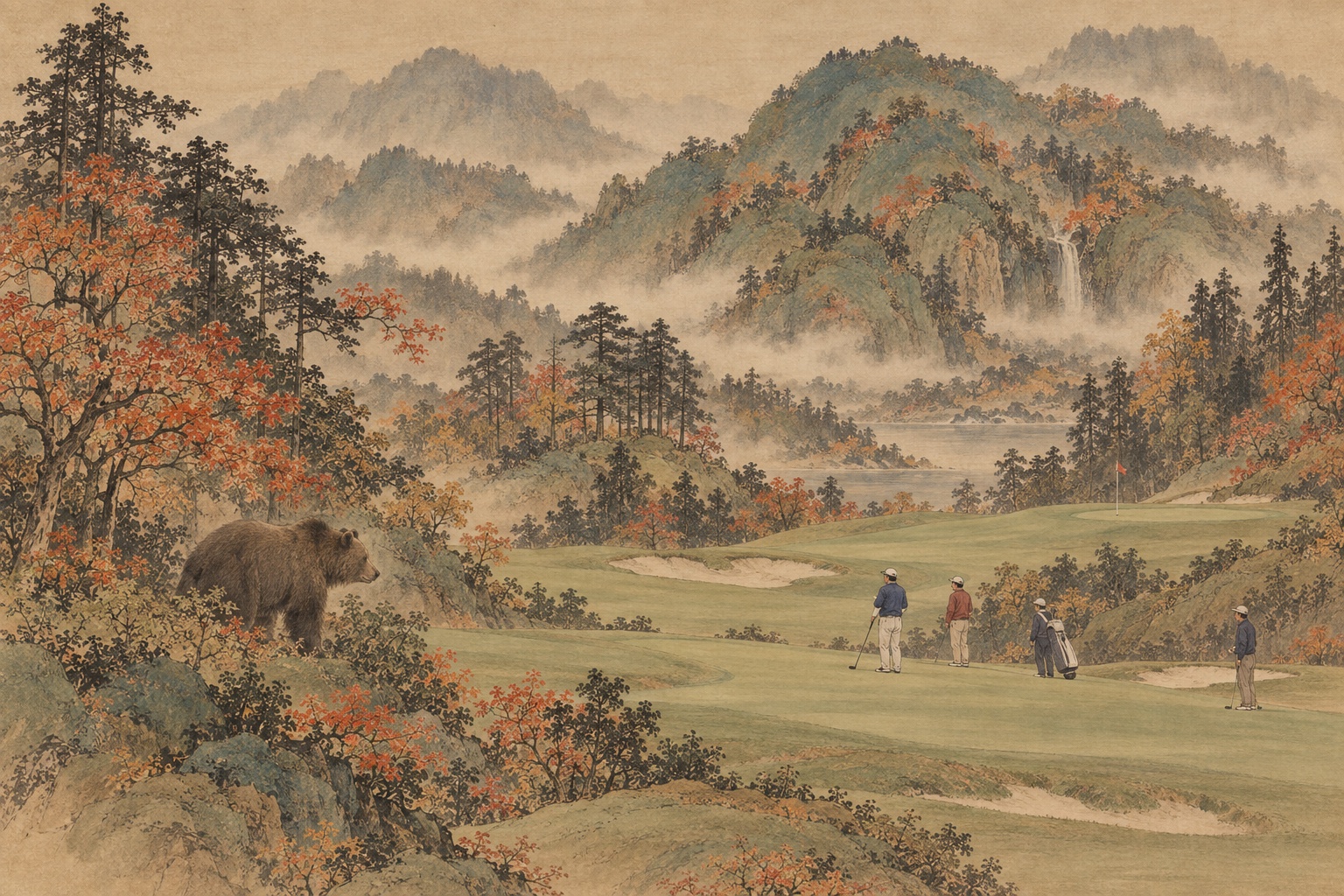
The second round of the junior boys’ golf competition at Japan’s 80th National Sports Festival began on the morning of September 11 at To-O Country Club in Aomori City. Under the normal format, 18 holes that day would be added to the opening round for a 36-hole individual and prefectural team championship. Instead, the decisive event was not a putt or a drive but a bear sighting. The official competition record posted “competition interrupted” at 9:46 a.m. and, at 12:02 p.m., announced that the round was cancelled because the safety of players and coaches could not be secured. The Japan Golf Association confirmed that the first-day results would become final.[1] [2]
That made Amuro Yoshiyuki of Hiroshima, who had shot 67 on September 10, the individual champion. Hiroshima also won the team title at 207, built from Yoshiyuki’s 67, Ryoma Nakagami’s 69 and Rory Yoshiyuki’s 71. A leaderboard that had been intended as the halfway point of a two-day competition became the championship table.[3] [4]
From the seventh hole to the second
The official record confirms a bear sighting, interruption and cancellation. Local broadcaster ATV supplied more detail from Aomori City and tournament officials: at about 8:10 a.m., staff patrolling near the seventh hole reportedly saw two bears believed to be a parent and cub. A player later saw them near the adjacent second hole. Roughly 230 athletes, team personnel and staff were at the venue; no injuries were reported.[6]
The event was stopped. On a golf course, the absence of another immediate sighting is not proof that the hazard has left. Players are dispersed across a large landscape of fairways, rough, trees and blind areas. Unlike an indoor arena, organizers cannot keep everyone in one controlled competition space while monitoring the entire field.
An Aomori City sports official interviewed by ATV acknowledged the disappointment for athletes and tournament personnel but said the decision to cancel because safety could not be assured was unavoidable. The judgment was not that a bear attack was certain; it was that the organizers could not verify a level of safety high enough to send junior athletes back onto the course.[6]
A championship designed for 36 holes ended after 18
National Sports Festival golf is a prefectural team competition as well as an individual event. The Aomori organizers describe the standard format as 18 holes per day over two days, 36 holes total. In the team championship, the scores of three players from each prefecture are added together. The junior boys were assigned to To-O Country Club; adult men competed at Natsudomari Golf Links and women at Aomori Country Club.[5]
Eighteen-hole and 36-hole competitions are not interchangeable. Golf has large day-to-day variation. Wind, pin positions, putting surfaces and a player’s own swing can change. Yoshiyuki led after day one by two strokes, but seven players were tied for second at 69: Michitoshi Azuma of Saitama, Shizuku Okita of Chiba, Kohaku Takita of Aichi, Yoon Dae-chi of Hyogo, Ryoma Nakagami of Hiroshima, Seiya Hayashida of Fukuoka and Yosei Goya of Okinawa.[3]
The team competition was also open. Hiroshima led at 207, only four strokes ahead of Saitama and Fukuoka at 211. Under normal conditions, a four-shot team margin can disappear quickly over another 18 holes. But there was no fair way to infer what the second round would have produced. Using the last fully completed round for every competitor gave officials a single, common basis for the final classification.
Hiroshima had earned a clear first-day advantage
The shortened format should not obscure the quality of Hiroshima’s opening round. Yoshiyuki went out in 36 and came home in 31 for 67, two strokes clear of a large second-place group. Nakagami added 69 and Rory Yoshiyuki 71. All three Hiroshima players shot 71 or better, producing the only team total below 210.[3] [4]
| Event | Champion | Score | Next position |
|---|---|---|---|
| Individual | Amuro Yoshiyuki, Hiroshima | 67 | Seven players at 69 |
| Team | Hiroshima | 207 | Saitama and Fukuoka, 211 |
Even so, the ending leaves an unavoidable sporting ambiguity. The leader lost the challenge of defending over another round; the chasers lost the chance to come back. Weather-shortened golf tournaments are familiar. A championship curtailed because a wild animal could not be safely cleared from the playing field is something different.
The bear risk was already known across Aomori
The September 11 sighting did not arrive in a prefecture that had regarded bears as a remote possibility. Aomori has had a prefecture-wide Asiatic black bear alert in effect from April 20 through November 30, 2026. One trigger in the prefecture’s warning system is more than 15 sightings over the preceding five days. On April 1, Aomori also launched “Kuma Log Aomori,” mapping sightings and human injuries and distributing information through official messaging channels.[7] [8]
The Hakkoda area was placed under an even stronger special alert from June 29 through July 31. When the special alert ended, the prefecture explicitly kept the general warning in force throughout Aomori. On August 22, a tourist near Lake Towada was bitten on the arm in a separate human-injury incident.[7] [9]
The golf venue was not operating without precautions. ATV reported, citing the city and prefectural golf federation, that fireworks had been set off before competition to deter bears and that staff and caddies carried bear spray. The sighting therefore illustrates a difficult point about wildlife risk: prevention can reduce probability without reducing it to zero.[6]
Golf makes nature part of the playing field — but not every natural hazard is playable
The official Aomori description of golf emphasizes that the sport uses natural terrain and changes constantly with wind, slope, weather and course conditions. Those variations are part of golf.[5]
A bear is not. Lightning can be tracked with weather systems; heavy rain can be forecast; darkness has a known time. A bear can emerge from wooded ground, cross a fairway and disappear into cover. On a junior course, tournament officials are responsible for minors spread across multiple holes.
That raises a modern operational question for outdoor sport: in areas under active wildlife alerts, should bear response be formalized as specifically as lightning suspension? A workable protocol may require pre-round patrols, defined radio procedures, evacuation points, local-government and police contacts, wildlife-response specialists and explicit criteria for resuming competition after a sighting.
Japan’s bear problem is larger than one golf course
Aomori is part of a national trend. Japan’s 2026 Environment White Paper says 238 people suffered bear-related injuries nationwide in fiscal 2025, while sightings, incidents, casualties and deaths all reached record levels. The government designated most bear populations as managed wildlife in 2024, introduced rules enabling emergency shooting under controlled conditions in human living areas in 2025, and adopted a national bear-damage countermeasure roadmap in March 2026.[10]
The Ministry of the Environment now updates prefecture-by-prefecture sighting, injury and capture data. The drivers are multiple: food availability such as nut crops, changing habitat use, attractants near settlements, abandoned land, population management and the shrinking or aging workforce available for wildlife control. No single cause explains every sighting.[10] [11]
Outdoor sporting venues sit directly on that boundary. Golf courses, trail races, campsites, cross-country routes and ski areas can all overlap with habitat while also attracting large numbers of people at predictable times.
Golf’s first National Sports Festival was shortened too — by rain
Golf became an official event of the National Sports Festival in 1999 at the Kumamoto Games. The Japan Golf Association’s history says the change came 37 years after a 1962 proposal to add golf to the national competition. In an historical coincidence, that inaugural official golf tournament was also shortened — because of heavy rain.[12]
So an incomplete scheduled golf championship is not unprecedented. What is unusual is the reason. ATV reported, citing local organizers, that the Aomori cancellation was the first caused by a bear since golf became an official National Sports Festival event in 1999. Japan.co.jp has not independently audited every competition notice across all editions, so this article attributes that “first” to the local report rather than presenting it as a separately verified JGA historical ruling.[6] [12]
From Kokutai to Japan Games, the safety equation is unchanged
The National Sports Festival was renamed the National Sports Games in 2024. Aomori 2026 is the 80th edition. It is Aomori’s first hosting since the 1977 Asunaro Kokutai, and the early-session program alone brought 7,175 athletes and coaches from all 47 prefectures across 13 official sports.[13]
The larger the event, the greater the pressure to keep schedules intact. Teams have traveled across Japan. Accommodation, transportation, live streaming, volunteers and officials are all arranged around fixed times. Yet none of that can outrank a safety decision.
The asymmetry is especially sharp in youth sport. If organizers cancel and the bears never return, the decision can look overcautious. If organizers restart and an attack occurs, the question becomes why juniors were sent back onto a course after a confirmed sighting. Responsible event management has to make decisions under that imbalance.
- Should active bear warnings and recent local sightings be built into sport-specific pre-event risk assessments?
- Can pre-round wildlife patrols be standardized and documented rather than handled informally?
- Do every group, marshal and caddie have a rapid communication and evacuation procedure?
- What objective conditions must be satisfied before play resumes after a sighting?
- Are the roles of tournament officials, local government, police and wildlife-control personnel defined in advance?
- Do competitors know beforehand how incomplete rounds will be treated if safety forces cancellation?
Playing in nature requires knowing when not to play
No one was injured at To-O Country Club. That is the most important outcome. The price was that young golfers did not get the 36-hole championship they had prepared to play. Yoshiyuki and Hiroshima are the official champions, while the unresolved sporting question — what might have happened in round two — will remain.
Sport is never conducted in perfectly equal conditions. Wind changes. Rain arrives. Greens firm or soften. But an event has to draw a line between natural variation that competitors are expected to manage and danger that organizers cannot reasonably ask them to accept. On September 11, Aomori drew that line at bears on the golf course.
Golfers are supposed to return balls to the fairway. Bears are not part of the recovery shot. As outdoor sport increasingly overlaps with areas of active wildlife movement, the quality of an event will depend not only on how well it can start and finish competition, but on whether it knows how to stop.
- Japan Golf Association: junior boys' second round cancelled after bear sighting; first-round scores made final
- Official Aomori National Sports Festival records: competition interrupted at 9:46 and cancelled at 12:02 on Sept. 11
- Official results: junior boys' individual first-round standings — Amuro Yoshiyuki of Hiroshima, 67
- Official results: junior boys' team first-round standings — Hiroshima, 207
- Aomori National Sports Festival: golf format — 18 holes per day for two days, three-player team total
- ATV Aomori Television: two bears sighted, roughly 230 people at venue, fireworks/bear spray precautions, reported first bear-related cancellation since golf became an official event
- Aomori Prefecture: prefecture-wide Asiatic black bear alert through Nov. 30, 2026
- Aomori Prefecture: 2026 bear alert and launch of Kuma Log Aomori sighting map
- Aomori Prefecture: special Hakkoda alert ended July 31 but prefecture-wide warning continued
- Ministry of the Environment: 2026 Environment White Paper — record 238 people injured by bears nationwide in FY2025
- Ministry of the Environment: current bear sighting, injury and capture data
- Japan Golf Association history: golf became an official National Sports Festival event in 1999
- Japan Sport Association: Aomori 2026 National Sports Festival early-session overview
Editorial note: The Japan Golf Association and official Games record confirm a bear sighting, cancellation and use of first-round scores as the final results. Details including two bears, the approximately 8:10 a.m. sighting, a possible parent-cub pair, roughly 230 people at the venue, fireworks/bear spray precautions and the claim that this was the first bear-related cancellation since golf became an official National Sports Festival event come from ATV's reporting based on Aomori City and local golf officials and are attributed accordingly. Player names and scores follow the official Games record.