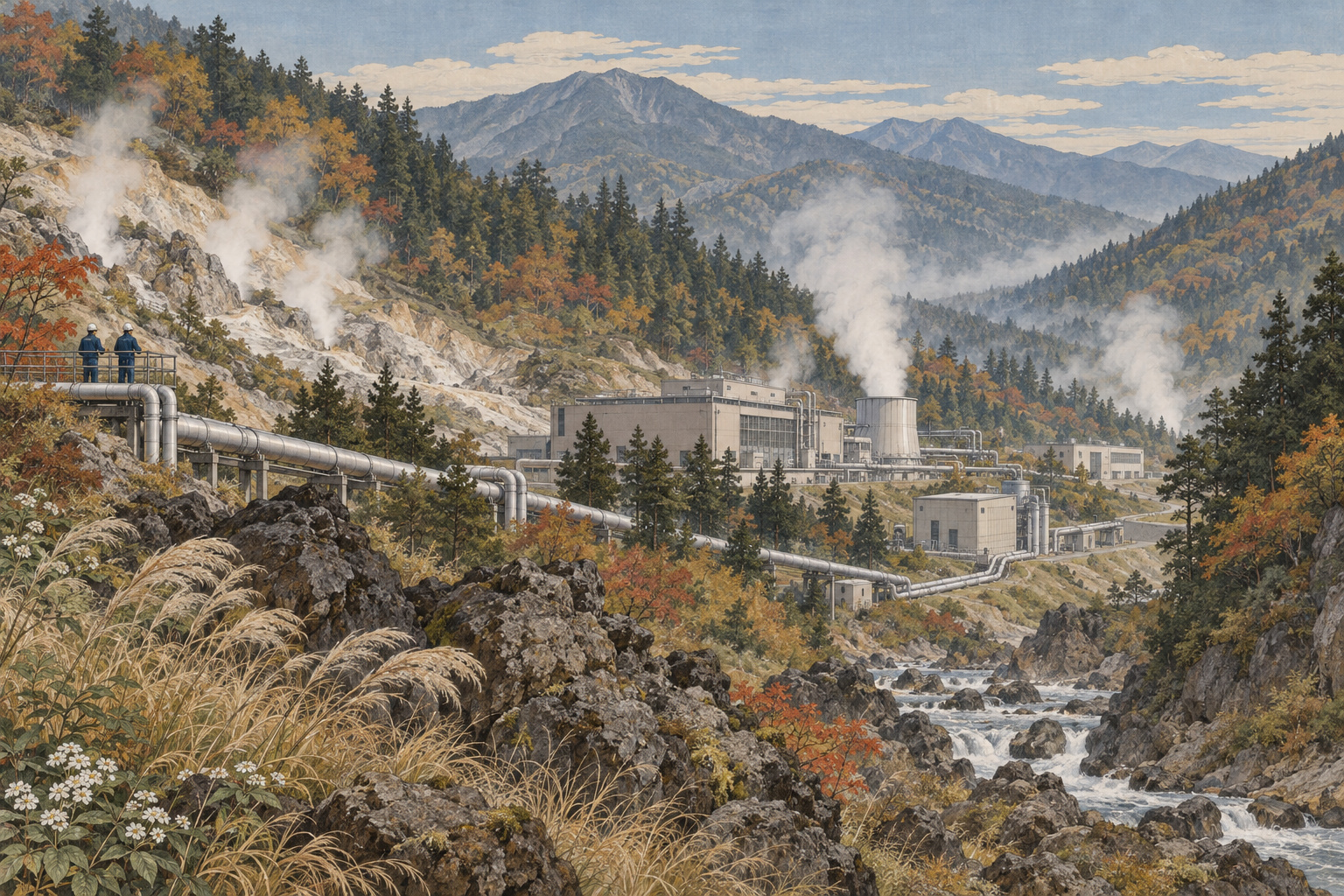
A geothermal power station has two working landscapes. Above ground are pipes, separators, a turbine and cooling equipment. Below ground is a system of hot fluid moving through rock—a resource that must be understood through wells, measurements and models rather than inspected as a single visible machine.
At Wasabizawa in Yuzawa, Akita Prefecture, those landscapes meet in a plant that entered commercial operation on May 20, 2019. Its published capacity is 46,199 kilowatts, or about 46.2 megawatts. The operator, Yuzawa Geothermal, was established by J-POWER, Mitsubishi Materials and Mitsubishi Gas Chemical.[1] The city continues to list it among its operating geothermal stations in information updated in July 2026.[2]
Seven years after the opening, the revealing questions extend beyond the generator: how is heat extracted, what does operation teach engineers about the reservoir, and how does electricity production fit into a place whose hot water already supports other uses?
Getting a second contribution from hot water
Wasabizawa uses a double-flash system. A separator divides fluid from the production wells into steam and hot water. Lowering the pressure of the remaining water releases a second, lower-pressure steam stream. Both streams help drive the turbine and generator.[3]
The second stage recovers energy that remains after the first separation. It does not mean the same steam simply passes through the same process twice. After the turbine, a condenser turns steam back into water; the cooling tower removes heat from the cooling-water circuit. Reinjection wells return used geothermal water underground.[3]
The equipment connects tasks with very different purposes. Production wells bring the resource to the surface. Surface machinery converts part of its energy into electricity. Reinjection provides a route back underground. Describing all three is more informative than treating the visible plume as the explanation of the plant.
Capacity also needs a precise reading. Kilowatts measure power; kilowatt-hours measure energy over time. A nameplate figure does not establish this year’s generation, the amount delivered to the grid or the number of homes actually supplied. Those questions require operating data and clearly stated assumptions.
A project with roots in the 1990s
Yuzawa already had geothermal generation before Wasabizawa: the Uenotai station began commercial operation in 1994.[2] Exploration of the newer resource also reaches back decades. A 2017 paper by researchers involved in the project records NEDO-supported surveys at Wasabizawa in 1993–97 and neighboring Akinomiya in 1996–2000. Joint feasibility work followed in 2008, exploratory drilling in 2009 and a production test in 2010.[4]
The operating company was formed in April 2010.[9] Construction began on May 25, 2015, approximately four years before commercial operation.[1] Counting only that construction period would leave out much of the work needed to establish whether the underground resource could support the proposed plant.
That distinction helps explain the pace of geothermal development. Evidence of underground heat is a starting point. A power project also needs a workable understanding of fluid supply, recovery, reinjection and behavior over time. Decisions about the surface plant depend on answers obtained below it.
At the 2019 opening, the partners described Wasabizawa as Japan’s first new large geothermal station exceeding 10,000 kilowatts in 23 years.[1] The size threshold matters: the statement was not a claim that all geothermal development, including smaller projects, had stopped for that period.
Reliable power requires continuing observation
J-POWER describes geothermal energy as a domestic renewable resource capable of stable generation throughout the year, with limited dependence on weather.[10] That gives it a different operating profile from resources that depend directly on sunshine or wind. It does not remove the need for maintenance or reservoir management.
A 2025 conference paper by AIST and J-POWER researchers provides a useful account of the work after startup. Using well information and geophysical observations, including gravity and natural electrical-potential measurements, the team refined a model of the Wasabizawa reservoir. Agreement with many observations improved, but discrepancies remained.[5]
This is what it means to learn from operation. A model is a reasoned representation of the subsurface, not a complete photograph of it. New measurements can reveal where its assumptions need revision. The practical value lies partly in making the remaining uncertainty visible.
Reinjection belongs in that same discussion. Returning water is an important part of the process, but its presence alone cannot prove that every underground condition is restored. Where fluid moves, how it exchanges heat and how conditions evolve are questions to investigate. Renewable energy still requires a plan for using a particular resource over time.
Hot springs make the local question concrete
For Yuzawa, underground heat has meanings beyond electricity. The operator’s account places the plant in a city with hot-spring areas including Akinomiya, Doroyu and Oyasukyo.[9] At Oyasukyo Daifunto, the city describes steam and hot water emerging through exposed fractures—a striking surface expression of geothermal activity.[8]
Those places help explain why a discussion of resource management cannot end at the plant boundary. Hot-spring water has value to existing businesses and visitors. Understanding a change in that water can be as consequential locally as understanding a change in generating performance.
In its fiscal 2025 monitoring notice, published in June 2026, the operator reports changes in temperature and water characteristics at some of 15 monitored hot-spring and related locations. It reports no major changes at the others. The notice also records a condenser-pit outlet pH outside the planned range in May 2025; the company says there was no external discharge or environmental effect.[6]
These are the operator’s reported findings. They do not, by themselves, establish the cause of the spring changes or justify a blanket conclusion about impacts. The useful follow-up questions concern the magnitude and persistence of changes, the supporting measurements and the explanation given to affected users.
Publishing monitoring results creates a basis for that conversation. A description of how the turbine works answers one set of questions; accessible evidence about the surrounding resource answers another. Both belong in the relationship between an energy project and its host community.
Following a benefit into the city budget
One documented local connection is financial. Yuzawa’s published fiscal 2024 grant information lists ¥11,925,000 associated with Wasabizawa under the power-facility siting promotion program. The named project was refurbishment of the Takamatsu district center and Geosta Yuzawa, a local learning and exhibition facility.[7]
This is a specific public grant allocation, not the plant’s revenue or a corporate donation. Keeping that distinction clear makes the example more useful: it shows an identifiable route from hosting energy infrastructure to a municipal project.
A fuller assessment of local economic value would examine employment, procurement, maintenance work and links with tourism separately. A large generating capacity cannot stand in for all of those measures. Nor should one grant be treated as a complete calculation of community benefits and costs.
A landscape that can teach
The city advertises public visits to Wasabizawa during fiscal 2026. As of the September 18 reporting cutoff, its next listed date is October 21; application conditions and availability should be checked with the organizer.[2] A visit offers an opportunity to connect an abstract energy source with equipment and operational questions.
Seeing natural steam at Oyasukyo and learning about the plant can also reveal different aspects of the same city. It would be a mistake, however, to assume that every visible hot-water feature follows the same underground flow path as the production wells. A regional abundance of heat does not eliminate local geological differences.
Wasabizawa’s broader significance is in the continuing work that links these scales: decades of exploration, a functioning power station, reservoir research and public environmental reporting. The lasting achievement will be measured in how well electricity production can coexist with the other ways Yuzawa depends on its land and water.
Sources and references
- Yuzawa Geothermal and partners: commercial operation announcement, May 20, 2019
- Yuzawa City: operating and planned power stations, updated July 31, 2026
- Yuzawa Geothermal: Wasabizawa equipment and double-flash process
- Nakanishi et al.: numerical simulation of the Wasabizawa–Akinomiya field, GRC Transactions 41 (2017)
- Kano et al.: improvement of the Wasabizawa reservoir model, Stanford Geothermal Workshop (2025)
- Yuzawa Geothermal: fiscal 2025 environmental monitoring, published June 30, 2026; attached notice inspected
- Yuzawa City: power-facility host-community grants, updated March 4, 2026
- Yuzawa City: Oyasukyo Daifunto, updated September 14, 2026
- Yuzawa Geothermal: company origins and the local geothermal setting
- J-POWER: geothermal generation business