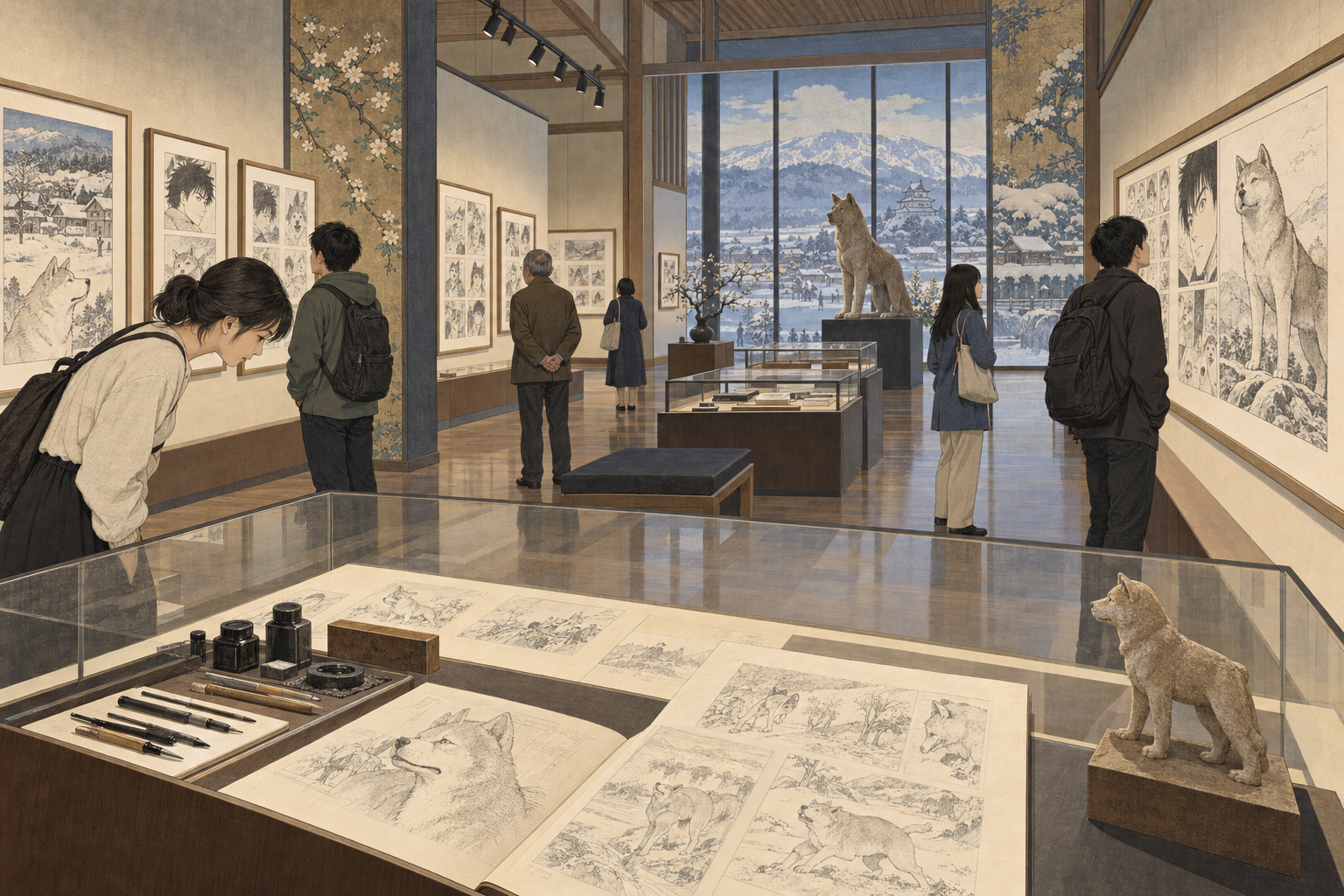
An anniversary exhibition asks readers to look back. Yoshihiro Takahashi’s forthcoming show in Yokote adds a more personal question: which works does the artist himself want to place before them? The Yokote Masuda Manga Museum has announced an exhibition of original art drawn from a new, author-selected anthology, marking his 55-year career.[1]
For readers who associate Takahashi with the Ginga series, that premise offers a route into a wider body of work. For the museum, it also brings two responsibilities together: introducing an artist to an audience and caring for the material through which his work was made.
A selection shaped by its maker
The official Japanese title is 画業55周年 高橋よしひろ自薦原画展. The accompanying anthology names three works—『枯滝の十文』『シオンの疾風』『ロンリーロン』—alongside an interview and 55 questions for the artist.[1]
An artist’s selection changes the reader’s starting point. Instead of following an assumed hierarchy of best-known titles, visitors can approach the chosen stories on their own terms. A familiar work may look different after many years; an unfamiliar one can reveal a different way of organizing a scene, introducing a character or holding attention.
Self-selection should not, however, be treated as a ready-made explanation of the artist’s intentions. The useful distinction is between what Takahashi says about a work and what a reader finds in it. Reading the anthology alongside the exhibition can make that distinction productive: the artist supplies one perspective, while the visitor brings a separate history of reading.
An Akita career with readers far beyond Japan
Takahashi was born in Higashinaruse, Akita, in 1953. A biography published by Japan’s embassy in Finland identifies his debut work as Shitamachi Benkei and dates Shiroi Senshi Yamato to 1976 and Ginga—Nagareboshi Gin— to 1983. He became the museum’s second honorary director in April 2021.[2]
The same embassy announced a Helsinki exhibition in 2022 and described the Ginga series’ popularity in the Nordic countries.[2] That connection helps explain why a museum in Akita can matter to readers who have never visited the prefecture. An artist’s place of origin and the geography of his readership need not coincide.
For Yokote, the opportunity is more substantial than attaching a famous name to a destination. A regional institution can give dispersed readers a place to encounter the surviving evidence of an artist’s work. Local identity becomes a point of connection, with the museum serving people whose first attachment is to a story rather than a place.
What publication cannot preserve by itself
A successful manga can survive in repeated editions and on screens. Its original working material presents a different problem. Keeping a story available does not automatically ensure that the paper used to produce it will remain accessible to future study.
The museum opened on October 21, 1995, and reopened after redevelopment on May 1, 2019. In a message dated that reopening day, its first honorary director, Takao Yaguchi, raised concerns about the deterioration and dispersal of original manga artwork and the difficulty of leaving its care solely to artists and their families.[3]
That argument shifts attention from individual affection to institutional responsibility. A reader can treasure a book; an archive has to sustain the conditions under which material remains identifiable and usable. Admiration may motivate preservation, but it cannot perform the continuing work of preservation on its own.
Original pages also invite a different pace of looking. In a book, the urge to find out what happens next may pull the eye past the construction of a page. In an exhibition, a visitor can pause over the relationship between a large panel and several smaller ones, or consider how areas of black and empty space distribute attention. These are questions to bring to the artwork, rather than claims about particular pages in the forthcoming display.
Making the archive visible
The museum’s Manga no Kura exhibition area makes storage part of the visitor experience. Its glass-fronted repository has round-the-clock temperature and humidity management. Visitors can also see archival work through glass: recording original pages, digitizing them and using neutral-pH paper materials in their storage. Touchscreens allow close examination of high-resolution images.[4]
Seen together, these facilities suggest a practical relationship between physical and digital care. The original remains an object to preserve; the image provides another way to inspect it. Digitization can extend opportunities for close looking without making the physical page irrelevant.
There is a public argument in displaying this work. A visitor who sees only finished exhibitions may never encounter the labor that makes them possible. Showing part of the archive asks the audience to recognize that cultural continuity involves repeated, patient tasks as well as memorable openings.
It also invites a useful question of any anniversary: what will remain available at the next one? The answer depends on more than the reputation of the artist. It depends on whether records, materials and knowledge can be carried forward together.
Planning a visit
The exhibition is scheduled for September 19–November 8, 2026, in the first-floor special exhibition room, with an October 20 closure. Hours are 10 a.m.–6 p.m., last admission 5:30 p.m. Adult exhibition admission is ¥1,000; the dedicated announcement lists student rates and other conditions.[1] The permanent exhibition is free.[6]
A signing is separately scheduled for October 11. Participation requires the designated event ticket and the self-selected anthology; ordinary exhibition admission does not secure a signing place. Check the event’s own instructions before making arrangements.[5]
Allowing time for the permanent preservation displays would give the visit a second dimension. The temporary exhibition presents choices made by an artist looking across his career. The archive raises the question of how those choices—and the wider body of work around them—can remain available to people who have yet to discover him.
That is the longer perspective behind this celebration in Akita. A career anniversary recalls the years already spent making manga. A museum can help ensure that the years still to come contain opportunities to read it, examine it and find something new.
Sources and references
- Museum: official exhibition announcement, updated September 10, 2026
- Embassy of Japan in Finland: Takahashi exhibition announcement and biography, October 17, 2022
- Museum: institutional history and founding honorary director Takao Yaguchi’s message
- Museum: Manga no Kura storage, archiving and display facilities
- Museum: October 11 signing event requirements
- Yokote Masuda Manga Museum: official visitor information