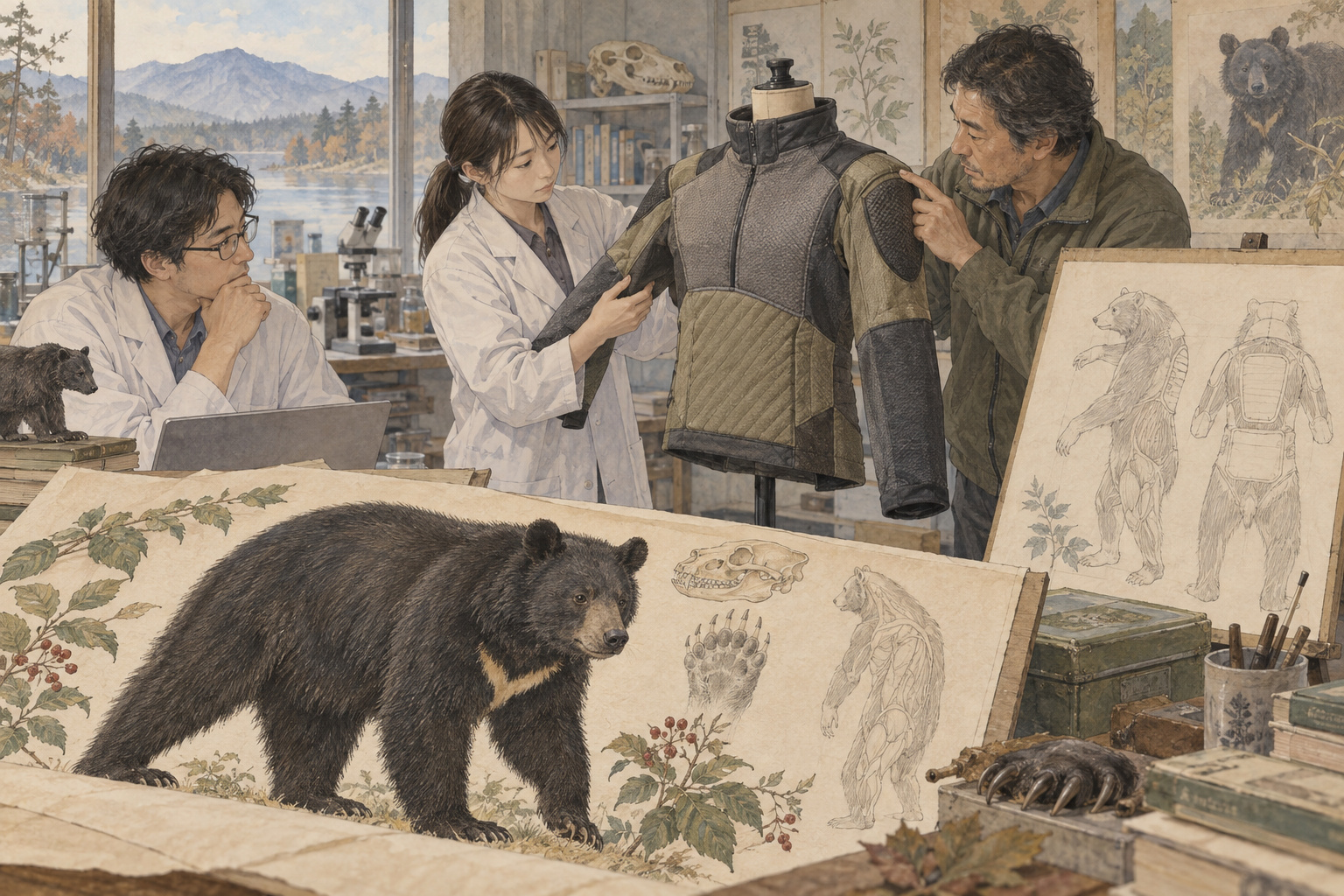
What can an emergency department contribute before a patient reaches its doors? Akita University is pursuing an answer through research on wearable protection and public education aimed at reducing the severity of injuries caused by bears.
On September 1, the university announced a crowdfunding campaign for its クマ外傷重症化軽減プロジェクト, a project to lessen serious bear-related trauma. The university’s regional disaster-prevention and mitigation unit set a ¥5 million fundraising target, with support sought through October 30.[1]
The project should be understood as a development effort. A proposed protective item, a laboratory result and evidence that an item reduces injuries in practice are different stages of knowledge. The initiative’s importance lies in the question it is trying to answer, rather than a claim that a proven solution is already available.
From clinical experience to a design problem
The project team says Akita University Hospital’s advanced emergency and critical-care center has treated more than 150 bear-trauma cases over roughly 30 years. That experience gives the initiative a longer history than its current fundraising campaign.[3]
The university identifies local company 廣瀬産業株式会社 as its development partner. Its release describes plans for protectors, clothing and accessories that combine everyday wearability with the aim of reducing injuries from claws and teeth. Items pictured in the release are identified as prototypes under development.[2]
The connection between medicine and engineering is practical. Clinical records can help identify where protection is needed. They cannot, by themselves, show which material, shape or fastening will provide it. Turning the pattern of injuries into a useful product requires a further chain of testing.
Reading the underlying study carefully
A 2024 paper in Acute Medicine & Surgery examined records of 20 patients treated for bear-related trauma at Akita University Hospital in 2023. Eighteen had facial injuries; 15 were injured in areas classified as human habitat. This was a retrospective observational study, not a trial of protective equipment. Its small, single-hospital sample limits generalization.[4]
That distinction changes how the findings should be used. The study describes patients who reached a particular hospital. It does not calculate the probability that any Akita resident will be attacked, or the protection a future garment would provide. The findings help frame a research question; they do not establish the answer.
For design, the question becomes whether an item covers the vulnerable area in actual use. Does it remain in position when a person turns or bends? What happens at edges and openings? Those are analytical questions arising from the protection objective, not reported results of the university’s prototype tests.
The recent history: count people and incidents separately
The Environment Ministry’s provisional table dated September 9 records 62 incidents involving 70 people in Akita in fiscal 2023, followed by 10 incidents involving 11 people in fiscal 2024. Fiscal 2025 brought 59 incidents involving 67 people, including four deaths. Japanese fiscal years run from April through March.[5]
This sequence shows why one quieter year cannot establish that the problem has ended. It also cautions against portraying every year as equally severe. Preparedness has to persist through changes in the recorded toll.
The prefectural statistics and the hospital research serve different purposes. One describes the scale of reported harm across an area; the other examines injuries in a clinical group. Keeping their time periods and populations separate is essential to an accurate account of why the research matters.
Protection people can actually wear
Strength is an obvious consideration for protective equipment, but it is not the only one. An item intended for daily life also needs to be evaluated for fit, visibility, freedom of movement and the burden of wearing it. These are considerations for judging the development work, not specifications or demonstrated capabilities announced by the project.
A design that fits one adult may sit differently on a child. Agricultural work and a walk to school involve different movements. Coverage shown on a stationary model may change when the wearer looks down or reaches for something. The practical question is how the equipment behaves throughout its intended use.
Performance claims also need precise boundaries. A test of resistance to cutting does not automatically establish resistance to every puncture or impact. Readers should eventually be able to understand what was tested, what comparison was used, and what the result does—and does not—support.
Successful development would therefore require more than an encouraging demonstration. Clear reporting of test conditions, results and limitations would help prospective users understand the protection offered. Wearability and protective performance need to be considered together.
Education reaches beyond the laboratory
In July, the university announced a bear-themed stamp-rally activity for an August 3 summer program in Yokote. The planned audience was approximately 20 participating children in the first four years of elementary school. That was the announced scale, not a verified attendance count.[6]
The project team subsequently reported holding a quiz-based children’s event in August. It also describes plans to communicate protective postures through illustrations, videos and participatory activities. Its crowdfunding campaign uses an all-or-nothing arrangement: the organizer receives the pledged funds only if the target is reached by the deadline.[3]
Delivering an event and demonstrating learning are different achievements. A useful evaluation would ask whether participants retain the guidance, understand when it applies and can connect it with decisions made by families and schools. Attendance and the number of materials distributed cannot answer all those questions.
Children’s education also has to sit within adult responsibility. Decisions about travel to school, supervision and whether an activity should proceed cannot be transferred to a child simply by supplying equipment or a lesson. Public education is most useful when it supports a wider system of precaution.
Avoiding encounters remains fundamental
The university’s own campus precautions illustrate that wider approach. Its published notice describes improving waste-storage areas, cutting vegetation, sharing sighting information and restricting activities when necessary. It advises travelers to check recent sightings and use routes with good visibility.[7]
This context matters when reporting protective-equipment research. Development of a wearable item does not make it appropriate to approach a bear or to disregard an alert. Teaching a protective posture likewise should not be presented as a guarantee of safety in every encounter.
The Environment Ministry’s public-information page links to school-age learning materials, guidance for parents and prefectural sighting information. It identifies Kumadas as the Akita information destination. These official channels provide a place to check changing local conditions alongside instructions from local authorities.[8]
What meaningful progress would look like
The project joins questions that are sometimes treated separately: what injuries clinicians see, what protection engineers can develop, and what people can learn and use in daily life. Its value will depend on how well those questions are connected.
A research milestone might be a reproducible test result. A practical milestone might be equipment that its intended users can wear comfortably and correctly. An educational milestone might be retained knowledge that supports sound decisions. None should be substituted automatically for evidence of reduced injury severity.
Nor should the seriousness of the problem be used to overstate a prototype’s promise. The public interest is served by reporting both progress and the limits of what has been established. That gives residents and potential supporters a clearer understanding of what remains to be learned.
Akita’s initiative begins with knowledge accumulated through treating people after harm has occurred. Its ambition is to make that experience useful earlier. The lasting measure of success would be protection that helps preserve people’s lives and their ability to return to ordinary activities—not simply a product launch or a completed fundraising campaign.
Sources and references
- Akita University: project announcement, September 1, 2026
- Akita University: full release on equipment development and education
- University project team: research and fundraising account on READYFOR
- Tsuchida et al.: Characteristics of black bear-related trauma (2024; full paper)
- Environment Ministry: provisional bear-injury statistics, September 9, 2026
- Akita University: announcement of the Yokote children’s disaster-education event
- Akita University: bear precautions on and around campus
- Environment Ministry: public guidance and prefectural sighting-information links