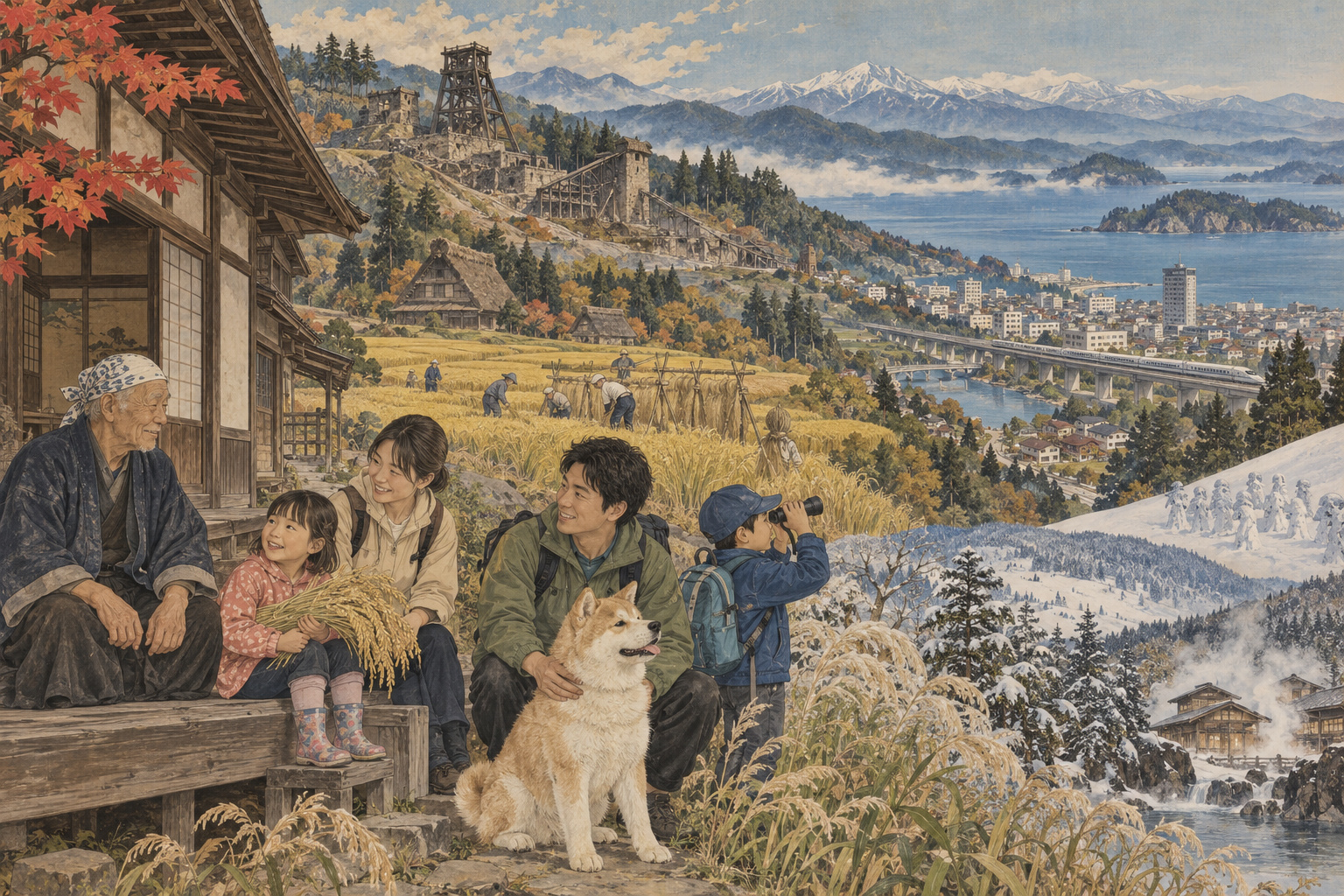
Akita’s past can be read in very different places: a Jomon stone circle, an ancient administrative compound, a former mining town and farmland created from a lake. Each records a way people organized work, settlement and exchange. Together they offer a richer introduction to the prefecture than population decline alone.
The demographic pressure is nevertheless substantial. Akita’s official estimate for August 1, 2026, was 863,586 residents.[11] Understanding what that means requires two kinds of attention: to the history that shaped the region’s communities, and to the definitions behind the numbers now used to describe them.
Settlement before the prefecture
At Oyu in Kazuno, two stone circles form the center of a ritual site dated to approximately 2000–1500 BCE. Archaeological remains include buildings, burials and objects associated with ceremonies. The official heritage account places this activity within a landscape of rivers and deciduous forest that supplied food and other resources.[1]
The site establishes an essential starting point. Organized communal life here long predates the modern prefecture, its rice fields and its administrative boundaries. Archaeology allows questions about how people used their environment and gathered together; it does not justify treating today’s residents as a single, unchanging population stretching back through every period.
Another layer emerged with the expansion of the early Japanese state. According to Akita’s municipal museum, the Dewa stockade was moved to Takashimizu in 733 and later became known as Akita Castle. It served administrative and military purposes in territory inhabited by people described in historical accounts as Emishi. The museum also interprets it as an important point of northern trade and contact with the Asian mainland.[2]
This ancient center should be distinguished from the much later Kubota Castle. Its history includes the extension of state control as well as exchange. Akita’s position on a northern frontier involved relationships across territory and water, not simply distance from a capital.
The domain and the making of modern Akita
The Satake family moved from Hitachi to Akita and Senboku in 1602 and established its base at Kubota Castle. The prefecture’s historical overview identifies new farmland, forestry and mines such as Innai and Ani among the domain’s major developments. It also records the destruction associated with the 1868 Boshin War, when the domain supported the new government.[3]
The modern prefecture took shape through the abolition of domains and administrative consolidation in 1871. Its territory brought together areas with different earlier affiliations.[3] A history of the Satake domain is consequently an important strand in Akita’s story, rather than a complete substitute for the history of the whole prefecture.
Across these changes, resources mattered through the systems built around them. Productive land required water management and labor. Forest and mineral products required techniques, transport and markets. The capacity to turn a resource into a livelihood depended on people and institutions as much as on what lay in the ground.
Mining built more than mines
Kosaka illustrates that relationship. DOWA’s corporate history dates its origins to the acquisition of the government-owned Kosaka mine in 1884. It describes a crisis in silver production followed by the development of techniques to process complex sulfide ore, or kuroko, and a shift toward copper. The company also records investment in railways, water supply, housing, schools and medical facilities.[4]
Such infrastructure connected industrial work to the ordinary requirements of a town. A mine supported households and services as well as production. Conversely, a change in the industry could alter the conditions under which those households planned their futures.
Kosaka’s present smelting business demonstrates a further transformation. The operator says it recovers metals including gold, silver, copper and lead from materials such as discarded appliances. A furnace suited to recycling feedstocks began operating in 2008.[5] Knowledge developed for ore processing has become part of the work of recovering resources from used products.
That is a significant example of industrial adaptation. Its demographic consequences still need to be measured separately. Technical continuity does not by itself establish how many people will find lasting employment, where their families will live or whether population decline will slow.
A farming community built through migration
The agricultural landscape also contains deliberate, modern reconstruction. Work on the Hachirogata reclamation project began in 1957; Ogata village was established in 1964. The local agricultural cooperative dates cultivation by the first settlers to 1968.[6]
Settlers were recruited and selected from across Japan and received training in cultivation, machinery and farm management. JA Ogata’s account records origins extending from Hokkaido to Kyushu and Okinawa.[7] The project created a farming community through the movement of people and the acquisition of skills.
This history gives current discussion of migration a useful perspective. New arrivals have helped make Akita’s communities before. Successful settlement involves more than reaching a destination: people need the means to work, a place to live and relationships through which everyday life becomes possible.
The comparison has limits. A nationally organized postwar reclamation project operated under conditions very different from those facing a household considering a move today. It offers questions about the foundations of settlement, rather than a ready-made policy to repeat.
Reading the population record
Akita’s long annual population series reached its maximum at 1,349,936 in 1956. The trajectory subsequently included a recovery during the 1970s before sustained decline resumed in 1982.[8] The history is therefore more varied than a continuous fall from one peak.
| Reference date | Population | Basis |
|---|---|---|
| October 1, 1956 | 1,349,936 | Prefectural historical series [8] |
| October 1, 2020 | 959,502 | Final census count [11] |
| October 1, 2025 | 882,100 | Preliminary census count [9] |
| October 1, 2025 | 878,798 | Estimate based on the 2020 census [11] |
| August 1, 2026 | 863,586 | Estimate on the same basis [11] |
The preliminary 2025 census figure was 77,402 below the 2020 count, a decline of approximately 8.1 percent.[9] The monthly estimates follow a different procedure: they start with the final 2020 census and add or subtract subsequent registered population changes. Foreign residents are included.[10]
The two figures for October 2025 demonstrate why these distinctions matter. The gap between them is not a count of people who moved away. Comparing an estimate with a newly enumerated census can mix differences in statistical measurement with changes in population. A reliable account identifies the series before calculating a trend.
Two components of decline
For August 2025 through July 2026, the prefecture recorded 3,104 births and 16,346 deaths. It also recorded 11,176 arrivals and 15,222 departures across the prefectural boundary. Natural decrease was therefore 13,242, while net outward migration was 4,046. Together they produced a loss of 17,288 people.[11]
Natural decrease accounted for about 77 percent of that loss. This calculation has a practical implication: even if arrivals and departures balanced, the population would still have fallen over this period because deaths exceeded births.
The components nevertheless interact over longer periods. Movement by younger adults affects the subsequent age structure of a community. Birth totals also depend on the number of people in the relevant generations; they cannot be read simply as a measure of individual willingness to have children.
This is why migration and family policy should be assessed through several outcomes. More arrivals, better conditions for raising children and improved access to services can each matter, even when the total population does not immediately begin to rise.
What an older population requires
In the prefecture’s October 1, 2025 estimates, people aged 65 or older accounted for 40.1 percent of residents, while children younger than 15 accounted for 8.6 percent.[8] These are age categories. They are not measures of dependence, disability or employment status.
Older residents can be workers, caregivers, business owners and organizers of community life. At the same time, planning for medical care, long-term care, shopping and transport must take changing needs seriously. Recognizing contribution and providing support are compatible responsibilities.
A prefectural average cannot determine where every service should go. Distance between homes, access to a vehicle and the presence of family members affect how a person experiences the same nominal provision. The policy question concerns whether people can actually reach what they need.
Why people move—and what the survey can tell us
The prefecture’s fiscal 2025 migration-reasons survey, released in July 2026, examines work, education, family and housing circumstances. Participation was voluntary: responses covered 30.9 percent of outward movers. When a family moved together, the principal mover’s reason was assigned to accompanying family members in the tabulation.[12]
That makes the survey useful evidence about recorded circumstances, with clear limits. It does not capture every person’s motivations, and a family member’s tabulated reason should not automatically be interpreted as an independently expressed preference.
A move for university or employment also need not settle a person’s lifelong relationship with Akita. The conditions for returning may arise later. For someone arriving without previous ties, building a life may depend on whether a partner can find suitable work, children can settle into school and local information is accessible.
Foreign residents belong in this discussion as residents with their own plans and needs. Counting them in population statistics should be accompanied by attention to whether they can understand procedures, obtain services and participate in local life.
The next chapter is about how people can live
The subjects of this Akita edition—research, business succession, resource recovery, transport, sport and cultural preservation—approach related questions from different directions. Who will carry work forward? What makes it possible to stay? How can a newcomer become part of a community?
History offers examples of considerable change: new settlements, new administrative boundaries, industrial techniques finding different uses and farming communities created through migration. It does not guarantee another period of population growth.
What it does provide is a basis for examining choices. Akita needs opportunities that people can build a future around, alongside workable services for those who live there now. The strength of that future will be measured in the lives those arrangements make possible, as well as in the population total.
Sources and references
- Jomon World Heritage Office: Oyu Stone Circles
- Akita Castle Ruins History Museum: the ancient administrative center
- Akita Prefecture: 2026 statistical handbook, historical overview (PDF)
- DOWA Holdings: corporate history
- Kosaka Smelting & Refining: company history and operations
- JA Ogata: the village’s formation
- JA Ogata: settlement and farming
- Akita Prefecture: 2025 annual population-flow report (PDF)
- Akita Prefecture: preliminary 2025 census population results, May 29, 2026
- Akita Prefecture: August 1, 2026 monthly estimate and methodological notes
- Akita Prefecture: August 1, 2026 population bulletin, pages 1–2 (PDF)
- Akita Prefecture: fiscal 2025 survey of reasons for migration, published July 31, 2026 (PDF)