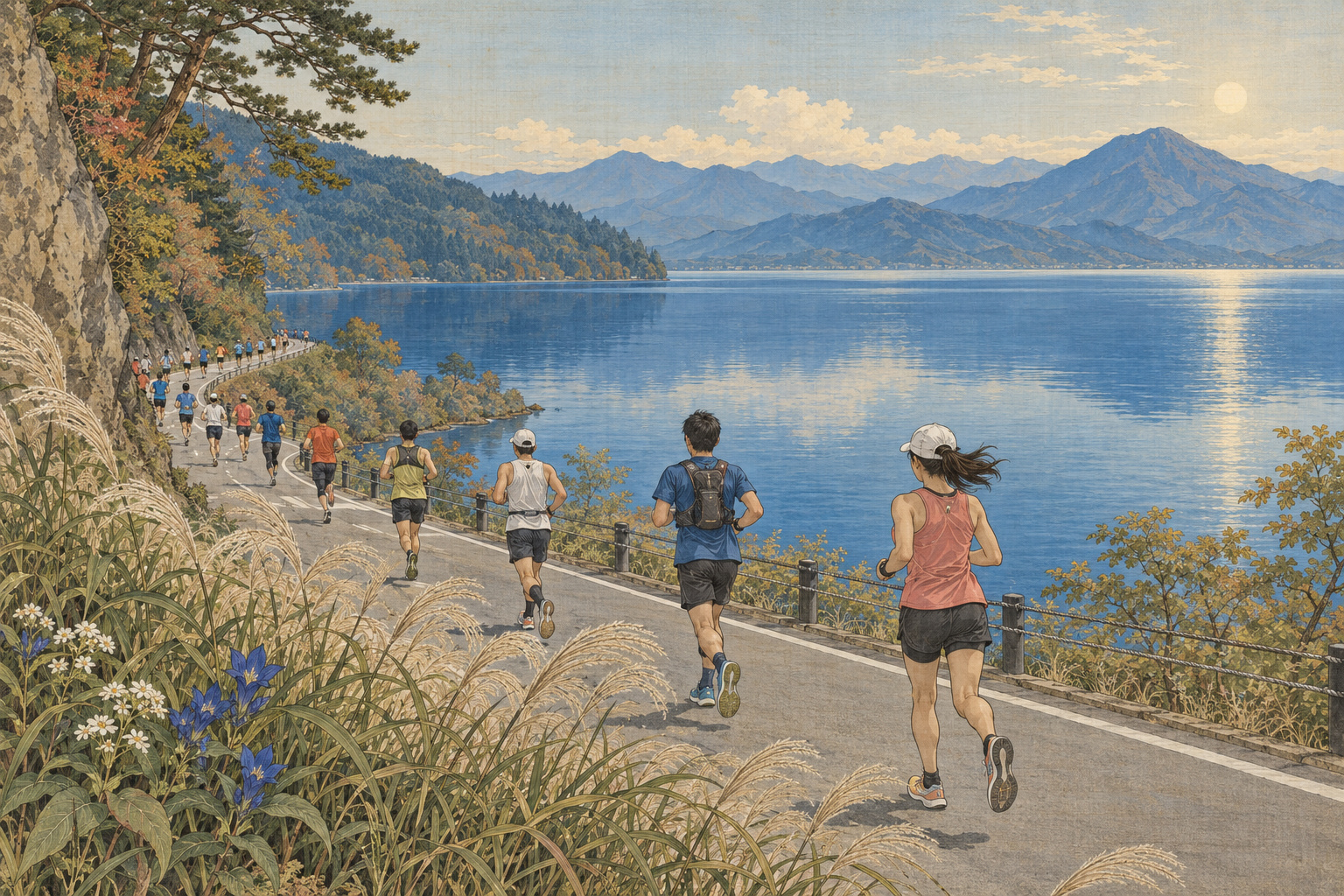
A road around a lake can turn a landscape into a measurable ambition. At Lake Tazawa, runners can choose a full marathon, a 20-kilometer circuit, a shorter individual race or a paired event. The 39th Lake Tazawa Marathon is scheduled for September 20 in Semboku, Akita—a day when personal goals depend on a community’s ability to welcome, direct and support its visitors.[1][2]
At the September 18 reporting cutoff, the published starts are 8:30 a.m. for the marathon and 9 a.m. for the 20km, 10km and 3km pair events, all Japan time.[2] Several recent organizer notices deserve attention alongside the race itself, including a correction to printed cutoff times and clarification of the station shuttle.
One lake, different journeys
The official map shows why entrants need to look beyond the event’s name. The marathon includes an inland section as well as the lakeside route; it is not simply two laps of the shore. The 20km race circles the lake. The 10km starts on the western side, away from the main event area, while the pair race uses an out-and-back course.[3]
The full marathon and 20km are listed as certified courses.[2] The latter should not be described as a half-marathon, whose standard distance is 21.0975km. That distinction matters for anyone comparing a finishing time with a previous race.
The organizers describe Tazawa as a demanding course.[4] A calm-looking stretch of water is no guide to how effortless the road will feel. The attraction lies partly in that contrast: a setting worth looking at, and a sporting task that still requires attention. A participant’s experience will depend on the chosen distance as much as on the destination.
Forty years after the first start
According to the organizing committee, the event began in 1986 as Akita Prefecture’s first full-marathon competition. Its published total for 2025 is 3,003 participants. That is a previous-year figure, not a forecast or confirmed field for 2026. The committee also identifies promoting Semboku and increasing exchanges with visitors as purposes of the race.[4]
Those aims help explain the enduring appeal of a regional road race. Running creates a reason to visit at a particular time and to experience a place at ground level. A participant may need an overnight stay, an early journey to the start and arrangements for companions who are watching rather than racing. The resulting encounter with the community extends beyond the measured course.
It also asks something of the host. Roads must accommodate a temporary sporting event, residents must navigate altered access, and people must be available to handle the practical work. The value of the weekend therefore cannot be judged only by the number of entries. Whether the event remains workable for its hosts is part of its long-term success.
The labor behind hospitality
The event’s published organization brings together the race committee, Semboku City, athletics bodies and other partners. A local traffic-safety association and the city’s traffic guidance corps are listed among the operational collaborators.[12] What appears to a runner as one organized occasion is the combined work of people with different responsibilities.
The race regulations also provide for recognizing individuals and groups who contribute, including volunteers and roadside supporters.[2] That broadens the meaning of participation. A finish time is the most visible record of the day, but it does not capture every contribution needed to produce it.
Hospitality here is practical. Clear directions, accurate information and a manageable journey home can matter as much as a welcome at the start. Runners help sustain that effort when they read revised instructions and follow arrangements on the ground. A visitor’s preparation is one way of respecting the people making the event possible.
The correction runners should read
On September 7, the committee announced that the participant guide enclosed with race numbers contained incorrect cutoff times and directed entrants to the website for the correct information.[5] For the full marathon, the current limits are:[2]
| Point | Clock time | Elapsed time |
|---|---|---|
| 22km | 11:30 | 3 hours |
| 32km | 13:00 | 4½ hours |
| Finish | 14:30 | 6 hours |
Transport also requires care. A September 18 notice explains that the shuttle scheduled to leave Tazawako Station at 7:30 a.m. serves participants arriving on trains reaching the station by that time, among others. No race shuttle is assigned to meet the train arriving at 7:41 a.m.[6] Reaching the station is therefore not the same as having a connection to the start.
The organizers additionally announced on September 15 that temporary parking area No. 3 would not be used because rain had left it muddy.[7] These updates demonstrate why an old printout should not be the sole source of race-day information.
An outdoor event, with decisions still to make
In a September 17 statement, the committee said it was monitoring Typhoon No. 25 but planned normal operation, based on its expectation that the venue would avoid major effects.[8] This is the organizer’s dated assessment, not a guarantee of race-day conditions. Participants should check subsequent announcements before traveling.
A separate September 4 notice said the organizers had drawn up procedures for bear appearances and asked runners to cooperate by carrying bells or similar items. The request is voluntary, rather than a condition of entry.[9] The notice is another reminder that this course passes through a natural environment, with responsibilities different from those of a controlled stadium.
The lake is more than a backdrop
Semboku City gives Lake Tazawa’s maximum depth as 423.4 meters, the deepest in Japan, and its circumference as approximately 20km.[10] Yet the lake’s history is not only geological or scenic.
A municipal account describes the disappearance of its native kunimasu fish after acidic water from the Tamagawa River was introduced in 1940. Kunimasu were found in Lake Saiko, Yamanashi, in 2010. The lakeside Kunimasu Museum, opened in 2017, presents that history along with changes in the environment and the lives of people around the water.[11]
That history complicates the idea of an untouched landscape. The water runners see has been shaped by human decisions, and its future remains a subject of care. Learning something about that past gives a sporting visit another dimension: the destination becomes a place with a history beyond the race route.
Connections beyond the finish
There is also an outward-facing element to the event. Semboku says it plans to send two local participants from the full-marathon or 20km fields to the Kaohsiung Fubon Marathon, with which Lake Tazawa has a memorandum on friendly exchange.[1] A race that brings visitors into the city can also offer residents a chance to encounter another running community.
Even the immediate hours after finishing require coordination. The organizer’s September 16 shower and hot-spring notice explains, for example, that users of the advertised Lake Resort bathing arrangement should use regular buses or other transport for their onward journey.[13] The finish line does not end the visitor’s need for clear information.
Some runners will arrive seeking a faster time, others simply hoping to complete their chosen distance. Volunteers and supporters will have different tasks. The event brings those purposes together for a day beside the same lake. Its lasting achievement may be measured partly in whether visitors and hosts want to repeat the encounter.
Sources and references
- Semboku City: 39th Lake Tazawa Marathon
- Organizing committee: race information and regulations
- Organizing committee: course maps and elevation profiles
- Organizing committee: history, aims and 2025 participation
- September 7: correction to printed cutoff times
- September 18: clarification of the 7:30 station shuttle
- September 15: temporary parking changes
- September 17: organizer’s Typhoon No. 25 statement
- September 4: bear-response arrangements and voluntary bell request
- Semboku City: Lake Tazawa overview
- Semboku City: Kunimasu Museum feature, 2022
- Official race website: organizers and operational partners
- September 16: shower and hot-spring arrangements