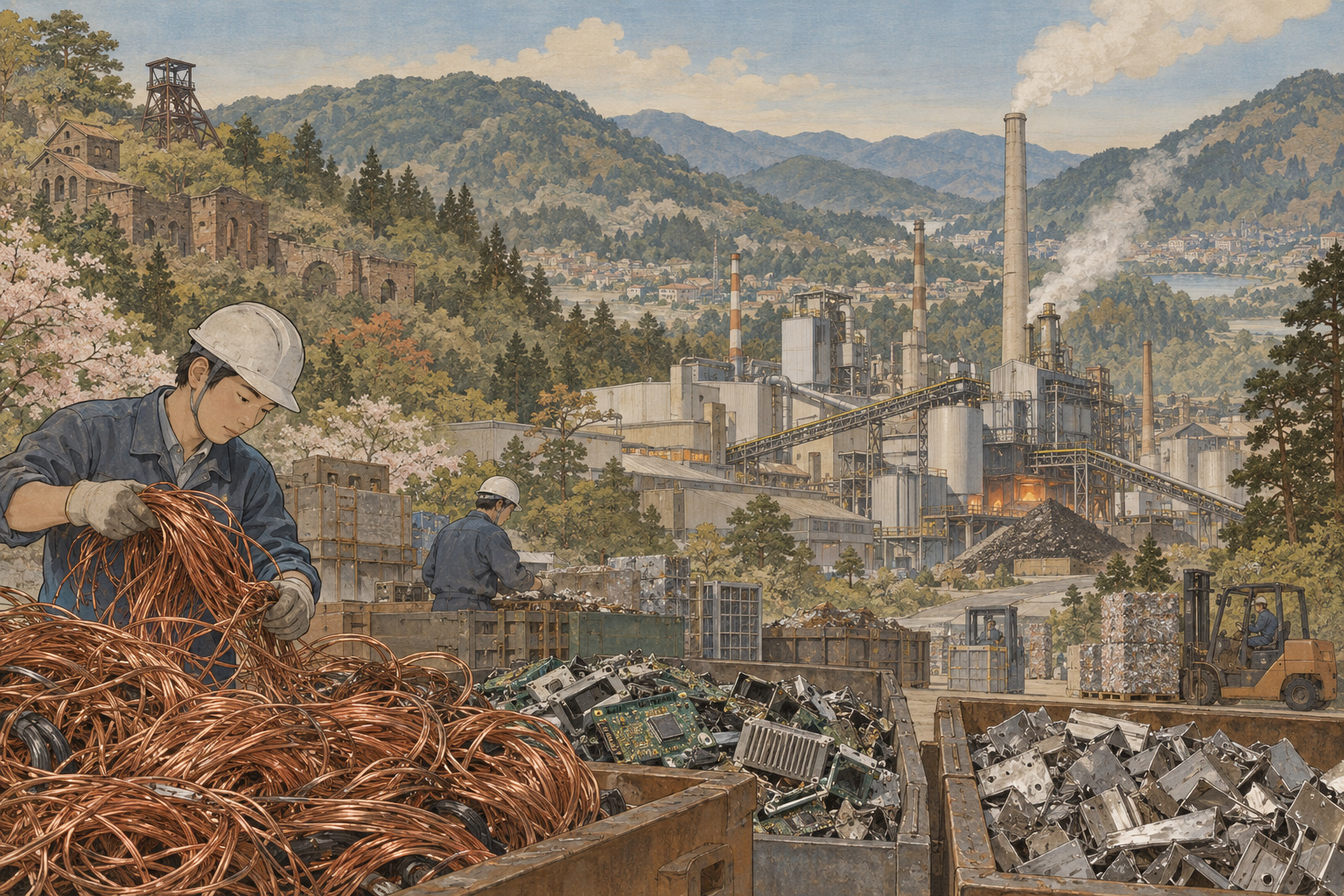
An old circuit board is a difficult kind of resource. Its useful metals are distributed through a manufactured object designed to perform a task, not to make their eventual separation easy. In Kosaka, northeastern Akita Prefecture, that challenge meets an industrial tradition built around another troublesome mixture: the complex ores beneath a mining town.
Kosaka Smelting & Refining says it recovers and makes products from roughly 20 kinds of valuable metals. Parent company DOWA identifies used computer boards and by-products from zinc smelting among the plant’s principal feedstocks. The connection between the mine and modern recycling is therefore practical: expertise in dealing with mixed materials has acquired a new field of use.[1][2]
A silver business learned to work with copper
DOWA traces its beginnings to Fujita-gumi’s acquisition of the government-owned Kosaka mine in 1884. Its corporate history describes a subsequent crisis as silver ore depleted and silver prices fell. Developing a way to process the complex sulfide ore beneath the silver deposits helped establish a new future in copper.[3]
The Japanese term is kuroko, or black ore. DOWA describes it as rich in valuable metals but also burdened by impurities that made processing difficult. The lesson was not merely that metals existed underground; it was that industrial value depended on being able to separate and recover them.[2]
Kosaka’s own chronology dates the start of its black-ore self-smelting operation to 1902.[1] That early process should not be casually equated with today’s furnaces. The continuity is in the development of metallurgical knowledge, while equipment and operating methods have changed.
Modern electronic scrap is not the same material as black ore. Yet both reward the ability to understand a complicated input and produce useful outputs. A mining heritage can remain economically relevant even when the material arriving at a plant has been manufactured, used and discarded elsewhere.
The town records both prosperity and damage
Kosaka’s preserved buildings make the former mining economy visible. The town dates its elaborate mining office to 1905 and the Korakukan theater, built for mine employees and their families, to 1910. These were parts of a community organized around industry, not simply decorative monuments to a successful company.[4]
The municipal museum also records a harder history: smoke damage stripped vegetation from land around the mine, followed by restoration through planting black locust trees. Its account prevents a comfortable reading of the past as uninterrupted industrial progress.[5]
That history does not establish the performance of present-day operations. It does explain why resource recovery and environmental management must be considered together. Calling a material recycled answers one question about its origin; it does not, by itself, tell us what energy was consumed or how emissions and residual materials were handled.
The urban mine extends beyond old phones
The plant’s published examples of feedstocks include computer and telecommunications boards, mobile phones and semiconductor materials. They also include residues from other smelters and metal concentrates recovered from incineration ash. The resource stream is broader than household electronics alone.[6]
“Urban mining” is a useful description of recovering value from materials already brought into society. It can also make the operation sound easier than it is. A phone in a drawer is not yet a suitable industrial feedstock. Someone must collect it, move it into an appropriate processing route and determine how its materials should be handled.
The presence of gold does not automatically make every item profitable to recover. Collection, transport and processing have costs, and different loads contain different mixtures. The relevant unit of business is a reliable flow of material with understood characteristics, rather than the most striking metal hidden inside one device.
Why a network matters as much as a furnace
DOWA describes separate activities for dismantling and sorting used equipment, recovering materials and conducting metal recycling. Its explanation of complex recycling emphasizes both multiple smelters and the analysis and evaluation of incoming feedstock.[7][8]
| Stage | What it contributes |
|---|---|
| Collection | Connects discarded equipment with an appropriate treatment route. Collected weight is not the same as recovered metal. |
| Dismantling and sorting | Separates materials for further processing. Different fractions can follow different routes. |
| Analysis and metallurgy | Establishes the character of the feed and recovers metals through suitable treatment and refining. |
| Manufacturing use | Returns recovered material to productive use, subject to the quality needed by its next user. |
Kosaka has a TSL furnace designed to handle recycling feedstocks. It forms part of a larger system: DOWA’s service descriptions distinguish high-temperature, or pyrometallurgical, treatment at Kosaka from solution-based, or hydrometallurgical, treatment at other sites.[1][9]
This is not a claim that every device follows an identical sequence, nor that a single furnace recovers everything it contains. Matching a material to a process is central to the business. A 2007 technical report by DOWA personnel in the Journal of MMIJ already described recycling built on complex-sulfide processing alongside stronger precious-metal hydrometallurgy and the ability to handle lower-grade materials.[10]
The implication is that knowledge accumulates across connected operations. The most visible installation may be the furnace, but the usefulness of that installation depends on the material arriving at it and the treatment available afterward.
What comes back into use?
Kosaka’s product descriptions connect recovered copper with wire, tin with solder, and gold and silver with electronic materials. Recycling here means producing materials that can serve industrial purposes again, rather than preserving the original shape of the discarded object.[6]
Care is needed with the headline metal count. The company’s “roughly 20” description is not a promise to recover that many metals from every phone. DOWA’s wider statement that it can recover more than 20 metals refers to a network of facilities. Neither number is, on its own, a recovery rate.[1][8]
A meaningful comparison would ask how much of a given metal entered a defined process, how much emerged as a usable product and what other outputs resulted. Counting the names of metals tells readers about breadth of capability; measuring material flows tells them something different about performance.
Japan’s collection system is part of the story
Japan’s small-appliance recycling law took effect in April 2013. Its formal Japanese title is 使用済小型電子機器等の再資源化の促進に関する法律. The Environment Ministry describes a framework using certification of recycling business plans to promote proper treatment and effective resource use.[11][12]
The ministry’s outline connects consumers, collection, intermediate treatment, metal smelting and manufacturing. That is an important corrective to viewing recycling as something achieved only inside a sophisticated plant. Equipment must reach the system, and recovered material must find a productive use at the other end.[12]
For households, the practical starting point is the collection guidance of their municipality or an appropriate recycler. This article is not an invitation to deliver equipment directly to the Kosaka plant. Different product categories can have different routes; Japan’s separate large-appliance framework should not be collapsed into the small-device scheme.[7][11]
Resource security without a claim of self-sufficiency
DOWA says it gathers electronic scrap globally.[8] Kosaka is consequently part of an international materials business, not a closed loop supplied exclusively by Akita residents.
The strategic value is straightforward as an inference: possessing recovery expertise gives Japan another way to obtain usable materials after their first life in a product. But domestic processing capability and domestic feedstock availability are different things. Neither guarantees that recycled supply can meet all demand.
Collection rates, material quality, operating costs and manufacturing requirements still matter. Recycling can contribute to resource circulation without making primary mining disappear. It can also create value in an established industrial town without insulating that town from commercial pressures.
The inheritance is a working capability
There is no new September production announcement behind this feature, and the sources reviewed do not establish a plant-specific 2026 recovery rate or carbon saving. The story is the durable connection between Kosaka’s past and its present industrial role.
That connection should be judged with the same seriousness given to any manufacturing business: consistent output, credible material accounting, skilled operation and environmental controls. An appealing circular-economy label cannot substitute for those questions.
Kosaka’s old mining office preserves one kind of inheritance. The ability to make useful materials from difficult mixtures preserves another. In that second inheritance, the town’s history continues as a task performed in the present: finding the next use for metals whose previous job has ended.
Sources and references
- Kosaka Smelting & Refining: profile and chronology
- DOWA Holdings: metals and mining operations
- DOWA Holdings: corporate history
- Kosaka Town: Meiji Hyakunen Street and industrial heritage
- Kosaka municipal museum: permanent exhibition, including smoke damage
- Kosaka Smelting & Refining: feedstocks and products
- DOWA Eco-System: resource recycling services
- DOWA Eco-System: complex recycling and smelting
- DOWA Eco-System: E-scrap treatment processes and facilities
- DOWA-authored technical report, Journal of MMIJ 123(12), 758–762 (2007); abstract consulted
- Environment Ministry: small-appliance recycling law overview
- Environment Ministry: law outline and system flow (PDF)