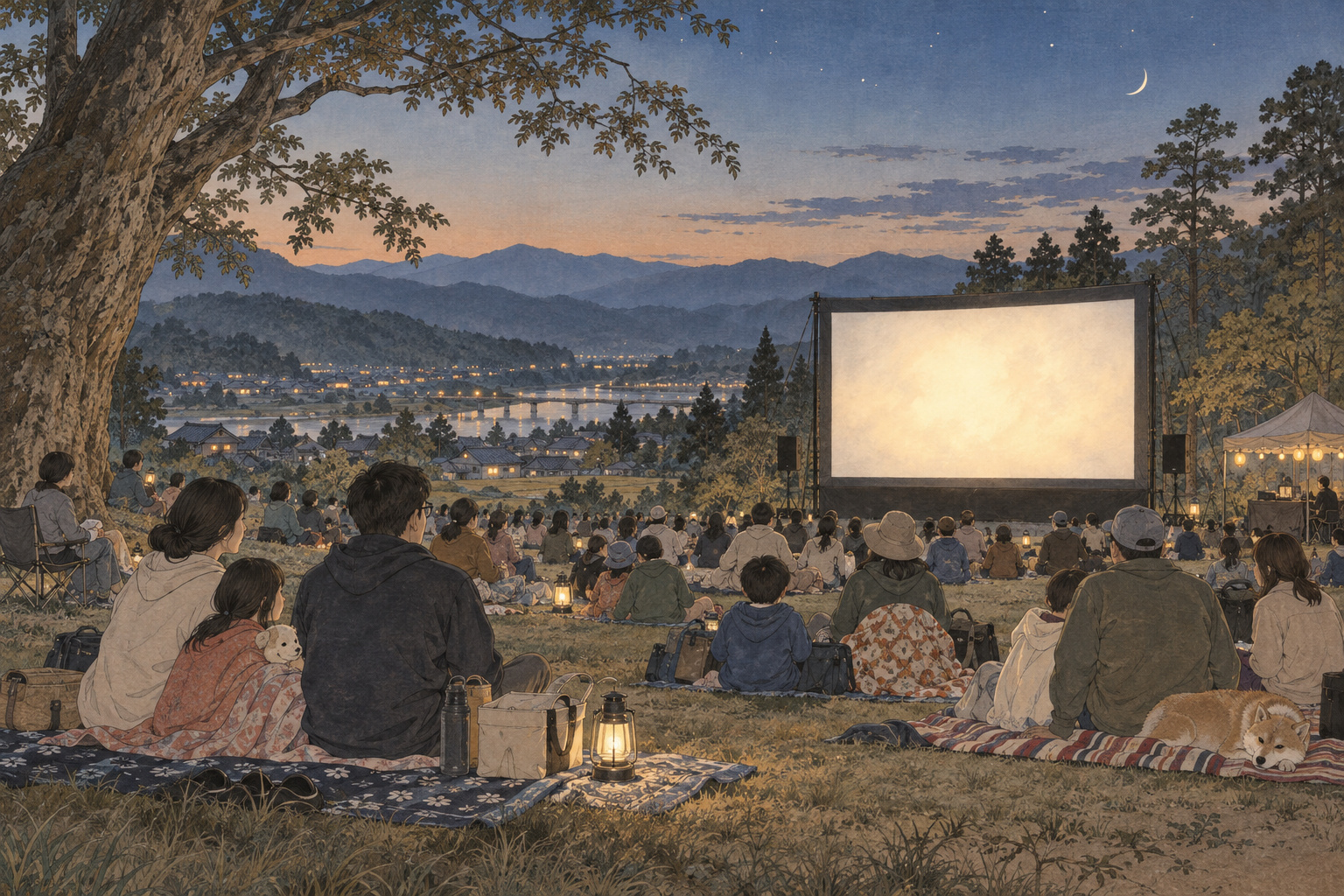
A public park acquires a different meaning when people come back after dark to watch a film. In Ikawa, Akita Prefecture, the announced September 19 program for Ikawa Starlight Cinema brings that possibility to the campsite at Nihonkokkaen. Food stalls, music and two films turn an outdoor screening into a reason to spend time together.[1][2]
The event belongs to a place with a longer history of gathering. The park began with commemorative cherry-tree planting in 1972; the cinema program comes from a region where a small independent exhibitor is also making films and finding audiences for them.[3][6] Together, those histories help explain what a one-day cultural event can offer a town.
An afternoon that leads into cinema
Ikawa’s September 15 announcement sets out a gradual transition from daytime activity to evening viewing: food trucks and stalls from noon, a DJ performance at 2:30 p.m., music from 4 p.m., a short film at 6 p.m. and Summer Wars at 7 p.m., with the program ending at 9 p.m.[1] These are the published plans as of the September 18 reporting cutoff.
That structure gives people several reasons to arrive. A visitor interested in food need not begin as a film enthusiast; someone coming for the feature has an opportunity to encounter a local work beforehand. The overlapping interests matter. A community occasion can make room for people who would not all choose the same concert, meeting or screening on its own.
Sharing a site does not automatically create friendship. What the program can supply is a common reference: a song heard, a film watched, something to mention when two people next meet. Its social potential lies as much in the time around the screening as in the screening itself.
A cherry-tree legacy, used in another season
According to the town’s account, planting at Nihonkokkaen began in April 1972 as a commemorative project associated with Emperor Showa and the empress’s European visit, Akita Prefecture’s centenary and the construction of a consolidated Ikawa elementary-school building. About 2,000 cherry trees representing 200 varieties were gathered from across Japan and planted over two years.[3]
The town dates a further phase of development to 1989, when facilities including lawns, tennis courts and a rose garden began to be added.[3] The park’s history is therefore also a history of expanding uses. A place introduced through its flowers became a setting for spending time, recreation and, through events such as this one, cultural activity.
An autumn screening extends that idea into the evening. The trees need not be in blossom for the place to matter. For someone who already knows the park, returning for a film could add another memory to a familiar landscape. For a first-time visitor, the film might be the reason the park enters their life at all.
Why these two films make an interesting pair
Summer Wars, released in 2009, was directed by Mamoru Hosoda, with a screenplay by Satoko Okudera. It connects a crisis in the virtual world OZ with the actions of an extended family in Nagano.[4] Its setting should not be mistaken for Akita simply because it appears in an Akita event.
The relationship between digital connections and people acting together gives the film a useful resonance here. Viewers would be watching a story about networks while forming, however briefly, a physical audience. That does not establish why the organizers selected it; it is one way to read the relationship between the film and the occasion.
A familiar title can also bring different generations into the same viewing experience. Someone encountering it for the first time may notice something different from a person returning to it years later. They do not have to agree about the film to acquire a subject they can discuss.
The earlier slot is assigned to Outcrop’s independently made documentary 沼山からの贈りもの. Its own description follows three men working to revive Numayama daikon, connecting the radish with Akita’s smoked-pickle food culture and changes in agriculture.[2][5] The feature’s imagined family and the short’s local agricultural work offer distinct scales of storytelling.
The short gives an everyday food a history of effort. Behind something served at a table are seeds, cultivation and people deciding what is worth carrying forward. Placing that story before a nationally known animation offers it an audience beyond those already interested in the crop or the filmmakers.
The work of bringing a film to people
Outcrop’s account of its development provides another relevant history. The company began as a film-production business in 2020 and started its miniature cinema the following year. Its Akita City venue has roughly 16 seats and generally selects one film a month.[6]
The operator describes showing its own short works before films and offering an optional discussion after the final screening of a day.[6] That is a practice at the cinema, not an announced discussion session at the Ikawa event. It nevertheless points to an approach in which exhibiting a film includes helping people encounter it and giving them room to respond.
Small-scale exhibition requires choices that remain important outdoors: which works belong together, how people hear about them and what makes the visit worthwhile. Technical equipment provides a screen and sound. Programming supplies a relationship between the films; the setting supplies a relationship between the audience and the place.
For a local filmmaker, those relationships can matter as much as the size of the screen. A film about regional life needs routes to viewers. A community event can be one such route, putting a local subject beside a title that attracts people for other reasons.
Culture within the pressures of a smaller town
Ikawa adopted its third comprehensive strategy in July 2026, covering fiscal 2026 through 2030. In announcing it, the town described continuing population decline and concern about a shrinking local economy.[7] That is the wider policy setting, rather than evidence that the cinema event is a specific measure under the plan.
A single evening cannot reverse demographic change. Nor does a pleasant experience prove an increase in spending, civic participation or future migration. Cultural activity has a more immediate claim: residents should have occasions to enjoy where they live and opportunities to encounter something beyond their usual routine.
Attendance is one way to examine an event, but it leaves other questions unanswered. Did new people feel able to join? Could a person attend alone without feeling out of place? Could families stay comfortably? Was the work of organizing it manageable enough to repeat? Those questions connect the visitor’s experience with the conditions that make a local event sustainable.
The important outcome may be ordinary rather than spectacular: another reason to use the park, another film remembered, another conversation made possible. Such benefits need careful observation before they are claimed as results. They are nonetheless reasonable ambitions for a modest cultural gathering.
The practical side of a shared evening
The published arrangements include a rainy-day move to Ikawa’s municipal gymnasium, with the venue to be announced through social media and other channels on the morning of the event. Folding chairs and picnic sheets may be brought. Pitching a tent requires a separate paid application to the relevant facility.[2][8]
That distinction between a film visit and campsite use matters. So does a workable alternative to the outdoor setting. The appeal of watching beneath the sky depends on less romantic details: somewhere suitable to sit, clear information about changes and a manageable journey home.
Nihonkokkaen began as a landscape planted for remembrance. Using it for cinema adds another form of shared memory—one made through stories, music and time spent in the same place. The promise of Ikawa’s program is that people can come for a film and leave with a richer connection to the town around it.
Sources and references
- Ikawa Town: official event announcement, September 15, 2026
- Outcrop Cinema: event program and wet-weather arrangements
- Ikawa Town: Nihonkokkaen park history and development
- Studio Chizu: Summer Wars, story and credits
- Outcrop Cinema: Numayama kara no Okurimono, film description
- Outcrop Cinema: history and screening practices
- Ikawa Town: third comprehensive strategy, August 3, 2026
- Ikawa Town: Nihonkokkaen campsite information