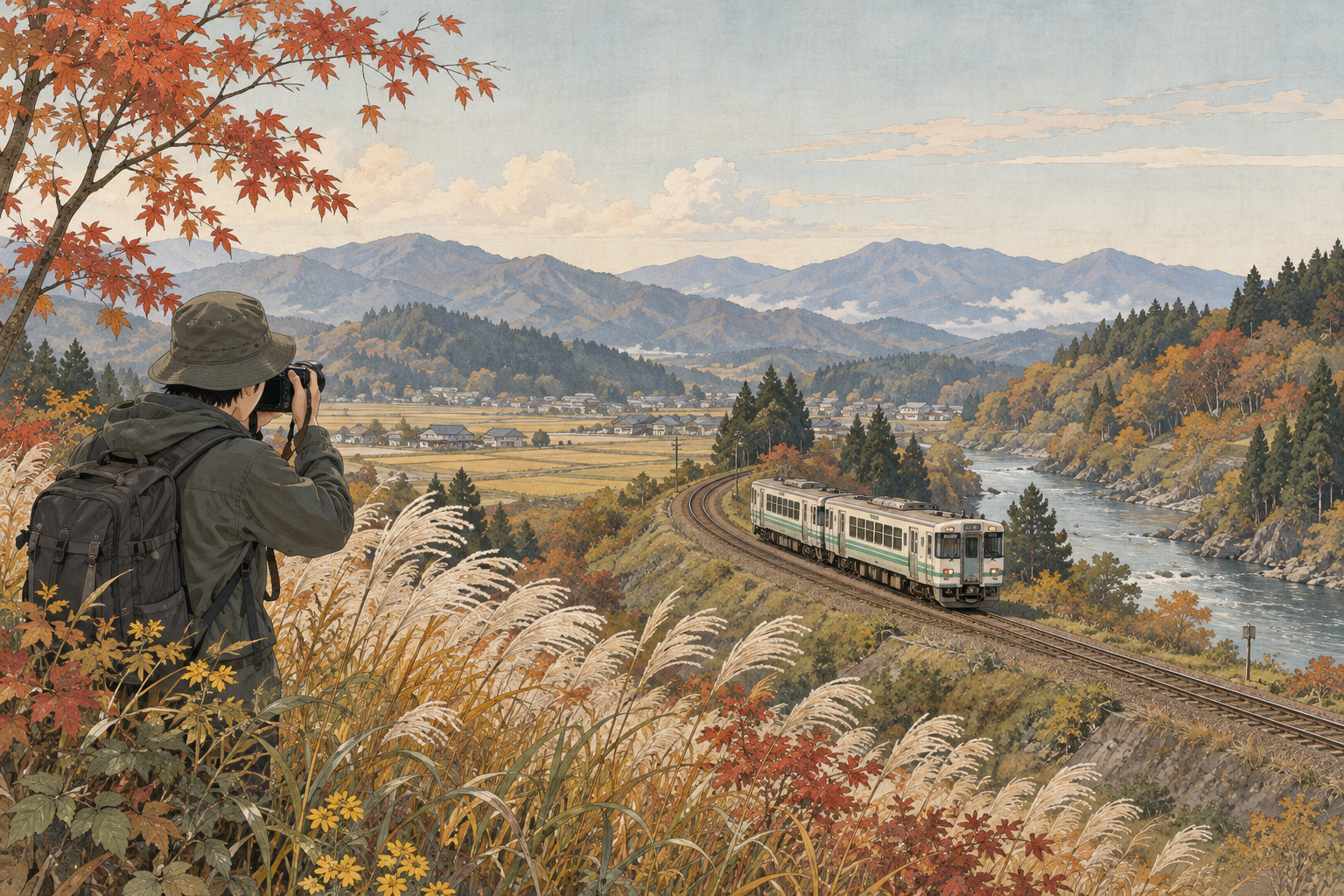
The most consequential photograph in a new Hanawa Line campaign may be the one of a ticket. Alongside a picture completing a local mission, entrants must provide evidence that they rode the train. The design connects an attractive image of northern Akita with an actual journey into its communities.
“Hanawa Line Photo Mission 2026” is advertised for September 19, 2026 through January 31, 2027. The announcement lists prizes including a ¥30,000 accommodation coupon for participating lodging in Kazuno and products from the railway’s wider corridor.[1] This report examines the published plans and rules available by September 18.
For Akita, the opportunity is concentrated in Ōdate and Kazuno: turning a railway trip into reasons to stop, look, eat and learn. The campaign also raises a larger question for regional railways—how can occasional visitors become a useful addition to the people who depend on trains in ordinary life?
A route wider than this prefecture edition
The promotion covers five cities: Ōdate and Kazuno in Akita, and Hachimantai, Takizawa and Morioka in Iwate. It is organized by the Hanawa Line promotion council, with cooperation from IGR Iwate Galaxy Railway.[2]
The campaign geography should not be mistaken for the boundaries of a single operator’s line. The JR Hanawa Line runs between Ōdate and Kōma. The approach from Morioka involves the IGR corridor, whose map includes Morioka, Takizawa and Kōma.[8][9] Travelers should check the route and ticket validity rather than assuming that every place in the campaign lies on JR tracks.
For the communities, however, the wider geography makes sense. A visitor to Akita may arrive from Iwate, and a journey can cross an administrative boundary without becoming two separate holidays. The five-city structure makes room for that movement while giving travelers specific reasons to spend time on the Akita side.
What the camera is asked to notice
Akita missions include photographing the Hachikō statue at Akita Inu no Sato, festival floats at Kazuno’s roadside station, and finding the performance stage at Dainichido.[2] The subjects direct attention beyond trains to the places and practices that give the communities their character.
At Kazuno Antler, the festival exhibition hall displays the floats of Hanawa Bayashi. The facility explains that ten neighborhoods participate in the festival, held each August 19 and 20. Its float tradition became part of UNESCO’s inscription of Japan’s Yama, Hoko, Yatai float festivals in 2016.[6]
An autumn visit offers a different encounter from the August festival itself. A display can give time to notice decoration and the names of the neighborhoods involved. A photograph then becomes a prompt for a question: who maintains this object, and how does a community prepare to use it?
Dainichido Bugaku has another rhythm. The Akita Folk Performing Arts Archives, working with its preservation society, identifies four communities that transmit the dances and describes the January 2 observance at Dainichido. It is UNESCO intangible cultural heritage.[7] Finding the stage during a mission does not mean a performance will be taking place that day.
That distinction matters to the quality of a visit. A venue is more than a backdrop, and its annual calendar is part of what there is to learn. The campaign can introduce a place whose fuller story gives a traveler a reason to return.
A railway assembled from two directions
The council’s chronology records the opening of the Akita Railway between Ōdate and Ōgita on July 1, 1914. On the Iwate side, Kōma–Tairadate opened in 1922. The connection was completed on October 17, 1931, and the government acquired the Akita Railway on June 1, 1934.[3]
What now appears on a map as one route therefore emerged from lines advancing from different sides. October 2026 will mark 95 years since the 1931 connection. It is a useful anniversary for understanding the corridor, though the September edition precedes the anniversary itself.
The same chronology records the end of freight business in 1984, the transition to JR East in 1987 and the renaming of Rikuchū-Hanawa Station as Kazuno-Hanawa in 1995.[3] These milestones show that the relationship between railway and community has changed over time; preservation of a useful connection does not mean its functions have always stayed the same.
A station name can be an entry into that history. For a visitor, learning an earlier name or the sequence of openings can turn a stop on an itinerary into a place with a past. That is a richer role for photography than collecting scenery alone.
Tourism alongside everyday transport
In its fiscal 2025 policy, the promotion council identifies population decline, fewer students and car use among the pressures on ridership. It presents the railway as both everyday transport and a means of reaching visitor destinations.[4] The photo campaign belongs within that dual purpose.
The council’s May 2025 meeting papers document earlier efforts to build visits around rail use. A July 2024 overnight tour through Kazuno and Kosaka had 28 participants; a September day trip involving peach picking and other activities had 24. Participants traveled by Hanawa Line to the meeting station.[5]
Those counts are records of earlier activities, not evidence of the 2026 campaign’s effect. They do show a continuing approach: make the rail journey part of something people already want to do, whether that is an overnight stay, food or cultural discovery.
Visitor demand and residents’ transport needs overlap without being identical. A leisure traveler may have flexibility that a student or someone attending an appointment does not. Attracting a weekend passenger is useful, but evaluating the line’s wider role also requires attention to timing, connections and access to stations.
Planning a mission as a journey
A workable outing starts with the return journey as well as the destination. Check train times, the route from the station, opening days and how much time remains for a meal or a visit. A short distance on a map is not a substitute for checking the actual walking route or onward transport.
The official rules allow multiple missions but only one entry per person for each mission. The same proof-of-travel photograph may be reused for different missions undertaken on the same day.[2] There is room to focus on one community rather than treat the entire corridor as a checklist.
Photography also means sharing space. Keep station circulation clear, respect restricted areas and ask permission where identifiable people are central to a picture. Review the organizer’s image and editing conditions before submitting.[2] An enjoyable campaign should fit around the community’s daily activities.
The prizes are allocated by lottery; the Takizawa commerce association’s notice lists 27 winners in total.[10] This is a different proposition from a judged competition for the most accomplished railway photograph. Its central invitation is participation through travel and completed missions.
What success would look like
Entry totals alone will not answer whether the campaign brought more people onto trains. One person can complete several missions. It will therefore be useful to distinguish photographs, individual participants and journeys, and to ask whether entrants were new riders or returned later.
Stops at local businesses and cultural facilities would provide another perspective: did the train become part of a satisfying visit to the community? These are questions for evaluation, not outcomes established before the campaign’s advertised opening.
The strongest souvenir may ultimately be an unfinished itinerary—a place noticed from the train, a tradition first encountered in an exhibition, or another season someone wants to see. For Ōdate and Kazuno, a photograph that creates a reason for the next journey could carry value beyond the prize draw.
Sources and references
- Kazuno Antler: September 2026 campaign announcement
- Hanawa Line promotion council: official campaign, missions and entry rules
- Hanawa Line promotion council: railway history and chronology
- Hanawa Line promotion council: fiscal 2025 policy and membership
- Hanawa Line promotion council: May 29, 2025 general meeting papers
- Kazuno Antler: festival exhibition hall
- Akita Folk Performing Arts Archives: Dainichido Bugaku, with preservation society cooperation
- Hanawa Line promotion council: station names
- IGR Iwate Galaxy Railway: route map and timetable information
- Takizawa commerce association: campaign notice, September 14, 2026