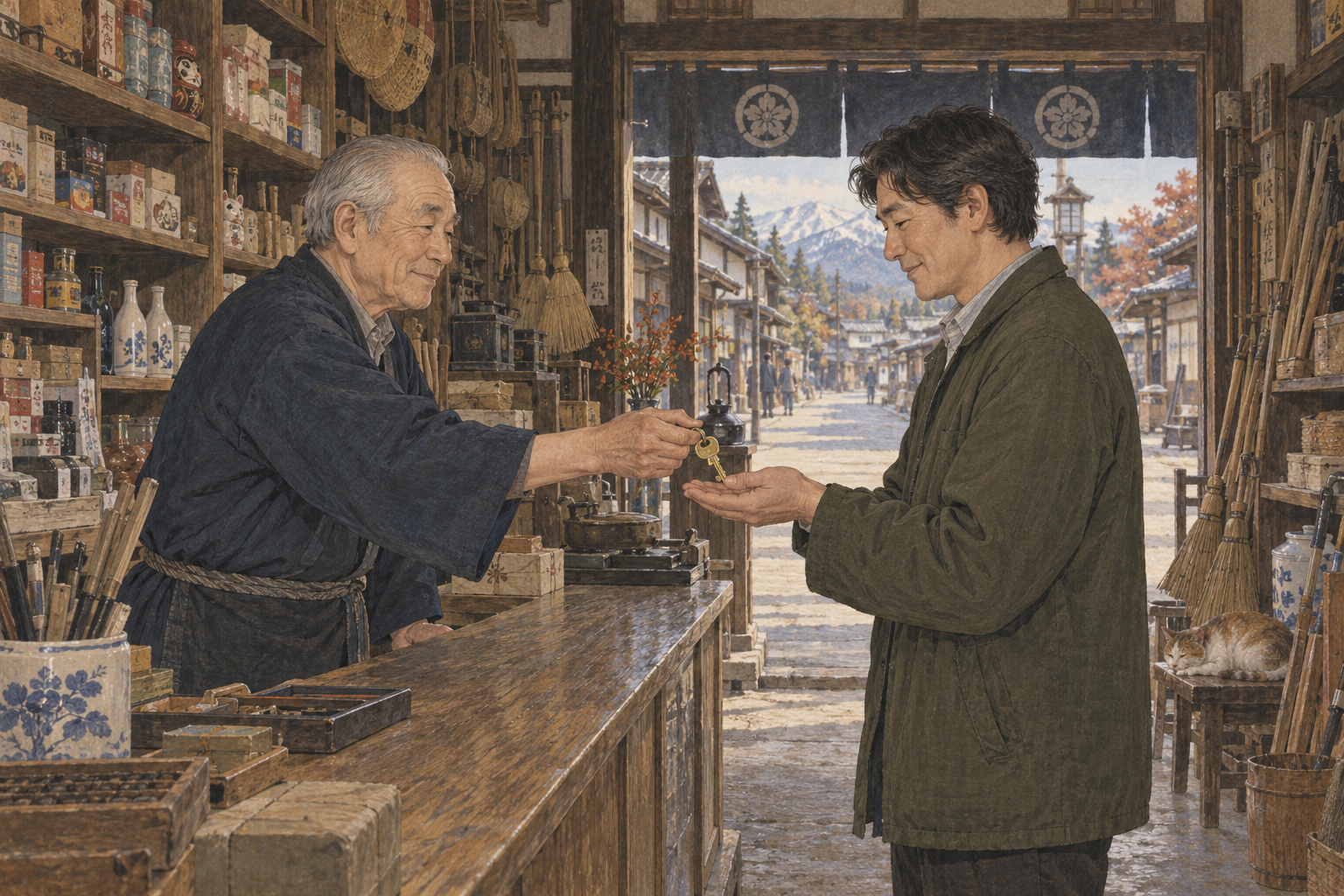
A business can change hands on a particular day. Learning how to keep it useful to a neighborhood takes longer. For Akita, that distinction sits at the heart of business succession: finding a new owner matters, but so does transferring the knowledge, relationships and practical capacity that allow a local enterprise to keep working.
A new food-business initiative gives the question an unusually public starting point. Akita’s federation of local societies of commerce and industry asked people which restaurants and dishes they wanted preserved. Its July 2026 exercise received 463 responses identifying 315 businesses. Those names are community nominations, not a list of businesses for sale. The organizer expressly asks readers not to contact the nominated establishments directly.[1]
The distinction matters. Affection for a restaurant is evidence that someone values it; it is not evidence that its owner wants to leave, that a purchase is possible, or that the business can support a successor.
A new route into an existing business
The initiative, formally named 次世代につなぐ味と技!カケハシプロジェクト, began recruiting potential successors on September 14, with an initial deadline of October 14. Its September 9 notice invites interest from inside and outside Akita, including people considering food-business startups and existing operators looking to expand or enter the sector. Applicants do not have to select a particular shop first.[2]
For a would-be entrepreneur, this presents a different question from where to open a new business: is there an existing operation whose next chapter they could write? The answer needs more than enthusiasm. A successor must understand what customers value, which parts of the operation can change, and whether the income can sustain the work.
Akita City frames succession support around preventing the loss of employment and skills as business owners age. It works with the 秋田県事業承継・引継ぎ支援センター, the prefecture’s business-succession and transfer support center, which the city describes as operated by the Akita Chamber of Commerce and Industry under a national-government commission.[3]
The longer history behind the search
Japan’s succession debate has developed against a prolonged aging of business leadership. The Organization for Small & Medium Enterprises and Regional Innovation, JAPAN (SMRJ), drawing on the 2025 SME White Paper, describes the peak in owners’ age distribution shifting from the early fifties in 2000 to the late sixties in 2023. This is historical national enterprise data, not an Akita census or a count of firms now seeking buyers.[5]
The local center identifies three broad routes: transfer to relatives, to employees or company officers, and to an outside successor through a third-party transaction. A family without an heir willing to run the business therefore still has alternatives to examine.[4]
These routes raise different human questions. A relative may know the family history without wanting the job. An experienced employee may understand production without wishing to become an owner. An outsider may bring useful ideas while needing time to understand customers and staff. None of these possibilities establishes which route is best for an individual company. They explain why succession is a process of consent and preparation, rather than simply choosing a name.
A soup shop’s documented handover
SMRJ’s published case study of SOUPHOLIC, a soup specialist near Akita’s municipal market, records a concrete transition. Established in 2014, the business was offered for transfer in 2023 because its owner wanted to concentrate on another shop. A former public servant connected through the successor talent bank completed the takeover in April 2024, following roughly six months of instruction in recipes and operations. The Yorozu business-support service also helped address management challenges.[6]
The sequence is instructive. It involved both learning a trade and assessing a business, and the departing owner’s reason was not simply retirement. The account is a retrospective published by a support organization; it does not establish the shop’s current financial performance or the success rate of Akita’s wider succession efforts.
More broadly, a recipe book is only one possible part of a handover. A new operator might also need to learn how to judge ingredients, organize preparation and maintain consistency. In a repair or manufacturing business, equivalent questions would concern diagnosis, quality checks and the knowledge needed when something goes wrong. These are illustrative questions, not additional claims about SOUPHOLIC.
What matching can—and cannot—do
Akita’s successor talent bank connects aspiring entrepreneurs, including people considering a move to the prefecture, with owners lacking successors. It checks applicants’ intentions through an interview before formal registration. Its published process moves from a search for compatible parties to mutually desired meetings and negotiations. Registration does not guarantee a match; the center warns that a suitable introduction may take a long time or never materialize.[7]
That limit is useful to understand. A matching service cannot make two different plans compatible by itself. One owner may want the name and location retained; a prospective successor may need a smaller operation or a different schedule. Identifying such differences early is part of understanding whether the business has a workable future.
The center’s wider services include planning, matching and access to specialists. Its planning guidance calls for examining strengths, weaknesses and the financial outlook after succession. Consultation is free, while some expert-dispatch services can involve charges. Free public consultation should not be read as a promise that an entire transfer carries no costs.[8]
For an operator, the central commercial question remains concrete: can the enterprise cover supplies, wages, utilities and the owner’s living needs, while leaving room for maintenance and renewal? A familiar sign above the door cannot answer that question. Nor can nostalgia substitute for a realistic understanding of the workload.
Preserving employment means understanding the work
Keeping a business name alive and preserving local employment are related goals, but they are not identical. A transferred enterprise may change its hours, staffing or services. An assessment of what succession preserves should therefore look beyond the completion of a transaction.
Consider the knowledge carried by employees. Someone may understand a machine’s recurring fault, remember a customer’s requirements or know how to teach a task safely. These examples show why the working organization matters alongside ownership. If continuity is the goal, a successor needs to understand who holds that knowledge and how it can be shared.
Continuity also needs room for change. Reorganizing tasks or revising opening hours may make an operation more manageable. The question is which changes support a durable business while maintaining the service people depend on. This is an analytical way to judge succession, not a claim that every transfer protects every position or preserves every practice.
Training is another part of the local response. The center has announced a successor-development course scheduled for September 26 and October 10, 2026. Its published application deadline was September 18, before this edition’s publication date. The course illustrates support for management capability; it is not presented here as an open enrollment opportunity.[9]
A neighborhood service needs a viable next chapter
The community value of a business can extend beyond what appears in its sales. Losing a nearby place to eat or a repair service could create extra travel and inconvenience, especially for people with fewer alternatives. These are reasons to investigate a business’s local role, rather than assume that another provider will automatically replace it.
They are not reasons to expect a successor to carry an unsustainable workload. A credible handover has to connect what residents hope to retain with what an owner and employees can actually deliver. Asking what people value is a beginning; examining the operation and allowing necessary changes is the work that follows.
For Akita, a meaningful measure of succession would follow businesses beyond signing day: whether services continue, whether skilled employees remain, and whether a new generation learns to do the work. The aim is not simply another completed transaction. It is a business with enough strength to keep serving its neighborhood.
Where to begin: General succession inquiries go to the Akita support center on 018-883-3551. For Kakehashi recruitment, consult the federation’s official project page; the recruitment notice lists 018-863-8493 for inquiries.[3][2]
Sources and references
- Akita federation of societies of commerce and industry: Kakehashi project and survey
- Akita succession support center: September 9, 2026 recruitment notice
- Akita City: business-succession support
- Akita center: succession routes and preparation
- SMRJ: business succession (survey dates and populations differ)
- SMRJ: the SOUPHOLIC succession case
- Akita center: successor talent bank
- Akita center: support services
- Akita center: successor training program