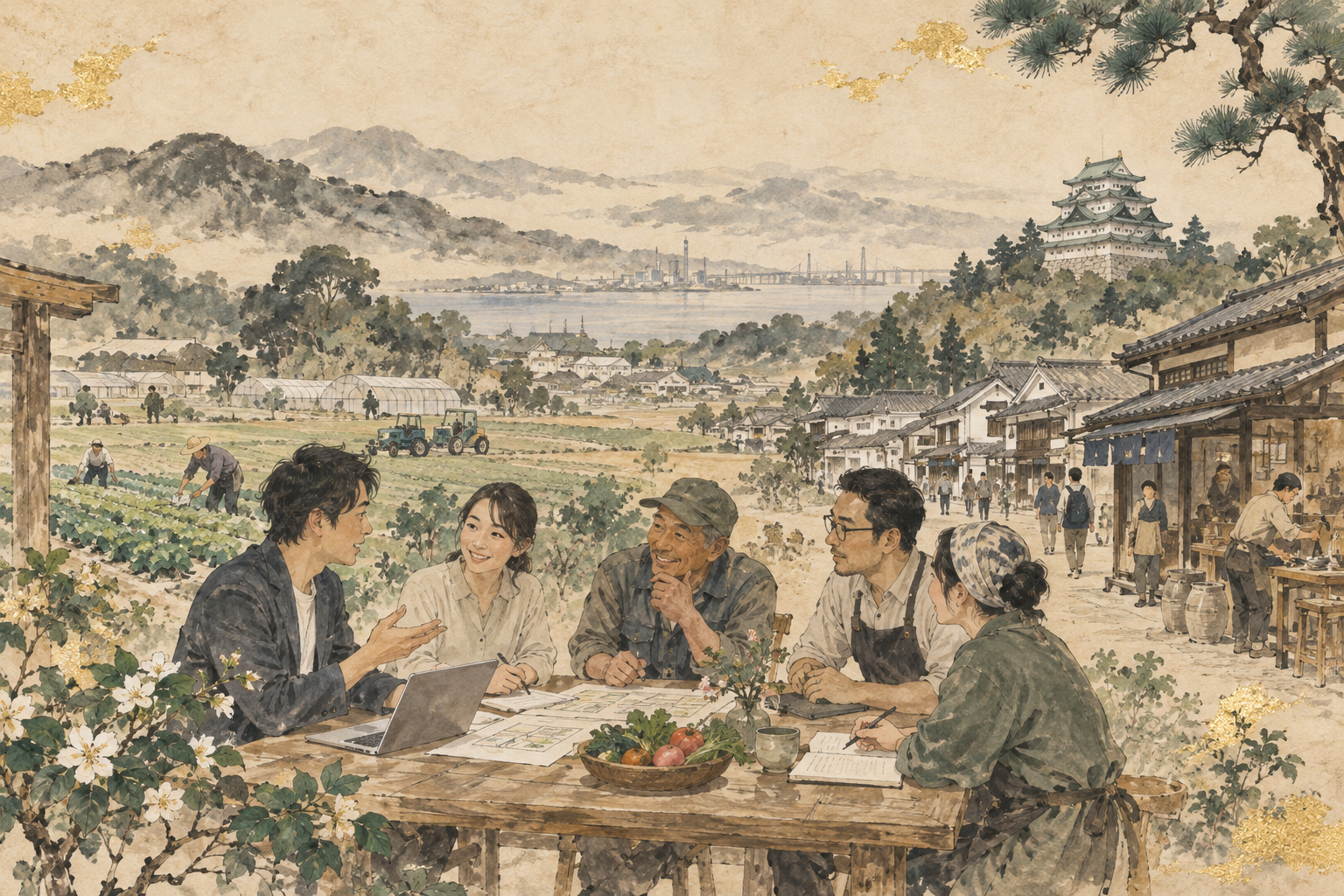
A startup centre can bring founders into the same building. Turning those encounters into useful businesses in other towns takes a different kind of work: finding the person who understands a problem, the organisation that can host a trial and the customer prepared to keep paying when the trial ends.
That is the challenge behind Aichi Prefecture’s latest regional startup recruitment. Applications opened on September 10 for the Connect course of the AICHI CO-CREATION STARTUP PROGRAM 2026, which brings startups together with local authorities and support organisations. Its significance lies in the relationship it seeks to build between Aichi’s central startup infrastructure and the places where new products might actually be used.[1]
The announcement is an invitation to develop projects. It cannot yet tell us whether those projects will produce lasting businesses. But it offers a useful test of regional startup policy: can a concentration of entrepreneurial activity in Nagoya become a practical resource for communities elsewhere in the prefecture?
A manufacturing economy that has changed before
Aichi’s industrial history gives that question particular weight. The region’s established businesses are potential sources of skills, customers and practical knowledge. Treating them simply as the old economy would miss how new industries can emerge from capabilities already in place.
Toyota’s own historical account records that Kiichiro Toyoda established an automobile department inside Toyoda Automatic Loom Works in 1933. Toyota Motor Co. was established in 1937; a factory followed in 1938 in Koromo, now Toyota City in Aichi. The move from textile machinery into cars is a reminder that the industrial landscape familiar today was itself made through consequential changes in direction.[4]
That history is not a forecast for Connect. A collaboration programme does not recreate the conditions that produced Toyota, and a useful local service need not become a global manufacturer to matter. The relevant lesson is narrower: existing industry can provide a starting point for new activity, rather than simply a structure that innovation must displace.
Aichi’s revised 2026 startup strategy places industrial adaptation near the centre of its argument. It points to structural change in the automotive sector and the advance of digital technologies, including AI. The policy question is therefore about renewing an economically important manufacturing region as well as encouraging founders.[5]
From a central hub to a regional network
The prefecture adopted its first Aichi-Startup strategy in October 2018. STATION Ai, its central startup support hub, opened in October 2024, and the strategy was revised in March 2026. In a June 23 announcement, the prefecture reported approximately 720 startup members and around 370 partner companies and institutions, including universities, at STATION Ai. Those are dated membership figures, not a census of startups based in Aichi.[3]
A hub makes the policy visible. Membership numbers can show that people and organisations are joining its community. They do not, by themselves, establish whether a business outside Nagoya has improved its operations or whether residents elsewhere have gained a service they can sustain.
The prefecture’s regional approach links STATION Ai with designated partner hubs elsewhere in Aichi. Within that approach, the co-creation programme brings local networks into contact with startup proposals and supports the testing of business assumptions. The regional participants are meant to contribute knowledge and connections, rather than serve merely as locations on a map.[2]
In practical terms, a central meeting place and dispersed project sites can complement each other. Founders can encounter potential collaborators at the hub, then discover at the proposed place of use whether their assumptions survive ordinary working conditions. The important movement is between those two settings.
Connect starts with the capacity to collaborate
The programme has two courses. Connect focuses chiefly on organisations undertaking startup collaboration for the first time, helping them acquire experience through learning and practice. Create assumes participation by multiple organisations working towards a business rooted in their area. The distinction, set out in the prefecture’s July recruitment announcement for Create, concerns the readiness of the regional partnership.[2]
It is easy to misread a course for first-time collaborators as a course for first-time founders. Connect requires applicants to bring an existing service or product. It aims to put something testable on one side of the table and a regional organisation willing to work through a problem on the other.[1]
Both sides have learning to do. A local organisation may need to explain who can authorise a trial and who will operate it. A founder may need to distinguish an enthusiastic introduction from an actual customer commitment. Agreeing on the scope of an experiment, the staff time it needs and the evidence it should produce is substantive work.
What the partner list tells us
The Connect announcement lists 35 regional partner organisations: 18 municipalities, nine chambers or societies of commerce and industry, three financial institutions and five other bodies. Municipal participants include Ichinomiya, Komaki, Shinshiro, Tahara and Minamichita. The six themes cover agriculture, forestry and fisheries; local industries; tourism and commerce; community development; sustainability; and well-being.[1]
The breadth matters because access to a place is not the same as access to its working life. A municipal office, a business association, a university and a welfare organisation can encounter different aspects of the same problem. Bringing several kinds of institution into the programme creates possibilities for introductions that a startup could struggle to make alone.
It does not make every partner a buyer, lender or technical adviser for every project. Those roles must be established. Nor does a list of 35 organisations mean 35 municipalities or 35 confirmed commercial opportunities. The list describes potential relationships; the project work has to give them substance.
A broad problem needs a precise question
Regional development language can conceal the decisions that determine whether a product is useful. “Digital transformation” does not say which task takes too long. “Well-being” does not identify who is underserved. “Sustainability” does not establish what will be measured or compared.
The separate Create course offers examples of how the prefecture frames more specific challenges. Its published themes include making small-business workflows visible and diagnosable in the Inuyama area, supporting new business through successors to existing enterprises in Okazaki, and regional branding and sales-channel development in Higashi-Mikawa. These are Create recruitment themes, not Connect selections or completed results.[2]
Specificity changes the conversation. A proposal to reduce administrative work needs the account of the person doing that work, not only the approval of a manager. A proposal to expand sales needs a way to distinguish attention from orders. The most valuable early meeting may be the one that narrows the problem enough to make a modest trial meaningful.
Consider a hypothetical booking service. Faster processing would be encouraging, but the assessment should also ask whether staff have acquired a new data-entry task and whether users can complete a reservation without extra assistance. For an environmental proposal, comparisons should account for the amount of activity being measured. These are editorial examples of evaluation questions, not announced Connect projects.
The difficult distance between a trial and a business
A trial can work and still fail to become a continuing service. The beneficiary may not control a budget. The organisation paying may not employ the people who must operate the system. A founder may be able to support a demonstration personally but unable to provide that level of attention indefinitely.
That makes it useful to distinguish the user, the beneficiary and the payer. Sometimes they are the same person; sometimes they sit in different institutions. A credible project needs an account of how those interests will stay aligned after the initial collaboration.
There is a second tension for the startup. Local adaptation can make a product valuable, yet extensive custom work for every partner can make expansion difficult. The business must discover which functions are reusable and which depend on local arrangements. The regional organisation, in turn, has to decide which existing practices it can change.
Progress should consequently be assessed beyond introductions and presentations. Did use continue after the trial? Did the intended burden fall, or move to somebody else? Was there a workable way to cover costs? If a project stopped, what assumption proved wrong? These are analytical benchmarks for judging the programme as it develops, not claims that Aichi has already demonstrated those outcomes.
The application window
Connect applicants must meet the prefecture’s corporate and SME eligibility rules, including a domestic address and incorporation under Japanese law; SMEs deemed to be large enterprises are excluded. They need their own minimum viable product, or MVP, and the capacity to work actively with regional partners and attend the matching session. An MVP is a service or product with the minimum practical functionality needed to deliver value to a user. Participation is free; travel and communication costs remain the participant’s responsibility.[1]
| Stage | Prefectural announcement |
|---|---|
| Applications | September 10–October 19 |
| Selection | Up to approximately 10 startups |
| Notification | Early November, planned |
| Matching session | November 18, 2–5 p.m., STATION Ai |
| Project development | From December, planned |
Source: Aichi Prefecture’s Connect recruitment announcement. Applicants should consult the official notice for full eligibility and application instructions. Selection should not be read as a promise of a purchase order, a grant or commercial success.
The policy’s lasting value will be found in what happens after the introduction: whether a local organisation becomes better at explaining its needs, a company becomes better at responding to them, and a service earns a place in everyday work. That is how a startup programme centred on Nagoya could come to matter well beyond it.
- Aichi Prefecture: Connect startup recruitment, September 10, 2026 (Japanese)
- Aichi Prefecture: Create recruitment, course definitions and area themes, July 22, 2026 (Japanese)
- Aichi Prefecture: FY2025 programme review and STATION Ai membership figures, June 23, 2026 (Japanese)
- Toyota Motor Corporation: The beginnings of Toyota, official historical account (Japanese)
- Aichi Prefecture and Aichi-Startup Promotion Network Council: Aichi-Startup Strategy 2026, introduction and Chapter 1 (Japanese PDF)