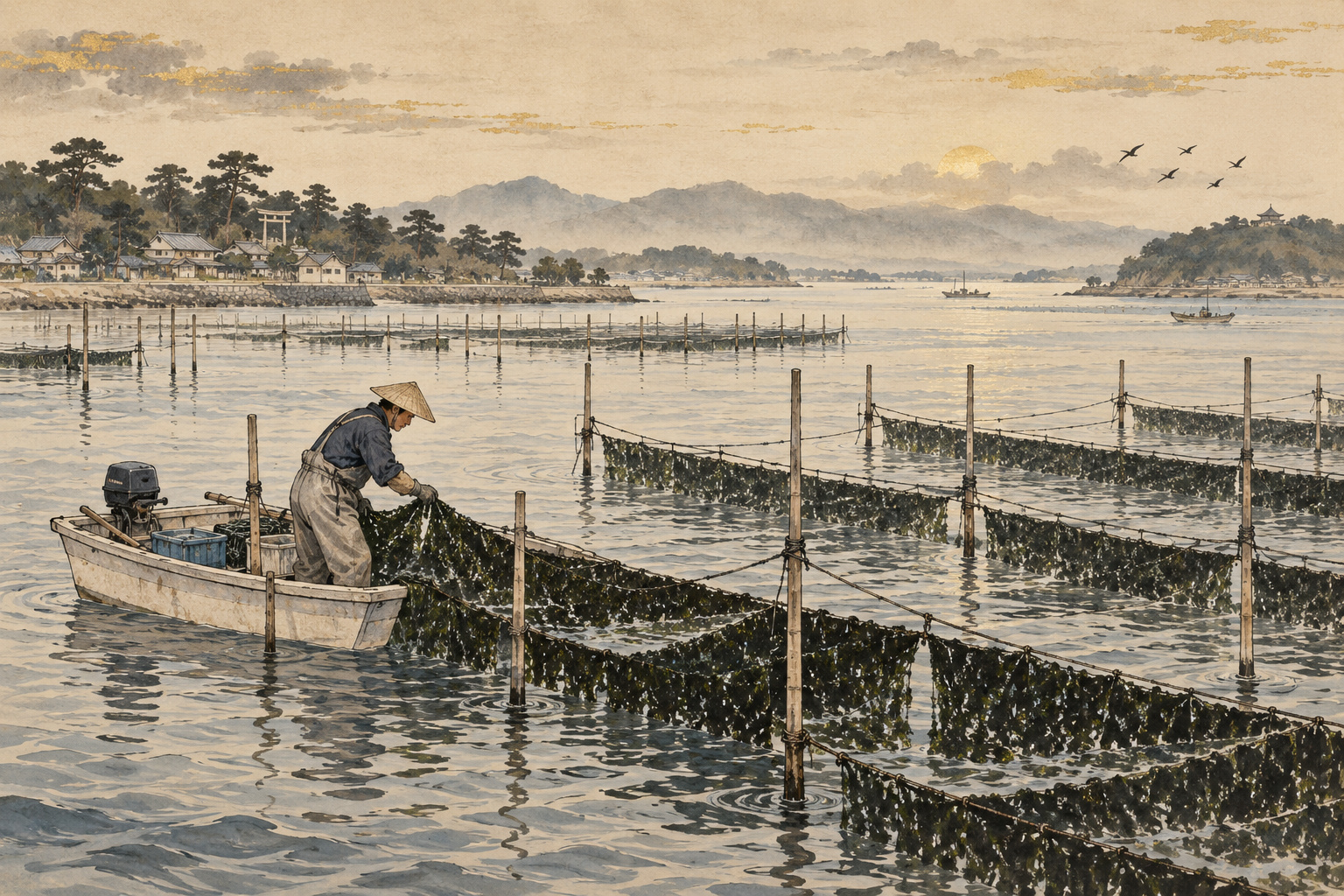
A sheet of nori looks like a finished product: dark, thin and ready to wrap around rice. For the communities that cultivate it in Aichi, it is also the result of decisions made far from the drying equipment. River water, coastal growing conditions, wastewater treatment and the timing of autumn cooling all enter the story before a sheet reaches the table.
On Sunday, September 13, a symposium in Nagoya is scheduled to examine that connection. Organized by Aichi’s committee studying optimal operation of the Nagara River estuary barrage, it focuses on the prefecture’s nori and the benefits of the rivers’ meeting with the sea. Its program brings together fisheries administration, a nori manufacturer and a business working on cultivation challenges.[1]
The subject is practical as well as ecological. Aichi has evidence that adjusting nutrients in treated wastewater can help local growing conditions. It also has growers facing warmer water, animals feeding on the crop and the costs of equipment. Sustaining nori requires connecting those problems without pretending they have a single solution.
An industry that began at a river mouth
A history published by the Aichi Fisheries Research Institute traces the prefecture’s nori cultivation to Maeshiba, now part of Toyohashi, during the Ansei era of 1854–1860. Cultivation spread, and postwar developments—including artificial seed production, floating cultivation and cold-stored nets—helped stabilize and expand output. Port and industrial development also removed shallow tidal-flat growing grounds.[2]
This was never simply a crop supplied by an unchanging coastline. Its history includes technical adaptation and the loss of places where it could be grown. Today’s nutrient debate extends that story: it asks whether decisions about water on land can better support production at sea.
The prefecture’s account of cultivation describes seeded nets supported on fixed structures or floating offshore. Growers manage them according to weather and sea conditions rather than leaving them unattended. A 2012 description places the usual season between autumn and spring; it is useful background, not a timetable for the coming 2026 season.[3]
What the water must provide
Nitrogen and phosphorus are nutrients needed for marine growth. Aichi says wastewater controls have improved water quality in Ise and Mikawa bays, while insufficient nutrients have become a concern for nori and clams. In nori, one visible problem is fading color, known as iro-ochi.[7]
The relationship is more complicated than a choice between clear water and productive water. A 2016 prefectural study examined blooms of the diatom Eucampia zodiacus, a cause of nori discoloration in Mikawa Bay. The behavior of plankton therefore matters alongside the supply of nutrients.[9]
Management has to ask where nutrients travel, when they become available and what happens around the crop. An annual total cannot tell a grower everything about the water reaching a particular net. Equally, adding nutrients without checking the surrounding environment would not constitute a complete conservation strategy.
The river–sea connection is useful precisely because it widens responsibility. A grower can adjust cultivation practices, but cannot independently direct the operation of upstream infrastructure. Fisheries and water management need evidence they can interpret together.
What a 2026 study actually found
A paper published in February 2026 in the Bulletin of the Japanese Society of Fisheries Oceanography examined phosphorus-adjusted wastewater operations near the Isshiki tidal flat in Mikawa Bay. The research covered fiscal 2018–2021 around the Yahagigawa Purification Center. Survey sites nearer the plant had higher nutrient concentrations and better nori color.[6]
That is a promising local finding. It concerns treated wastewater and a defined study area; the publication year is not the year the observations were made. It does not establish that every Ise Bay growing ground would respond identically, or that the intervention produced a particular increase in growers’ income.
A later prefectural experiment adjusted nitrogen and phosphorus at the Yahagigawa and Toyogawa purification centers during fiscal 2022 and 2023. Reporting in 2024, Aichi said nori discoloration appeared to have been reduced. It also said monitoring had not identified the extreme red tides or marked nutrient increases near discharge points that would have triggered suspension.[7]
The distinction between an observed benefit and a universal prescription is essential. A favorable result during a monitored trial is a reason to investigate and manage carefully. It does not remove the need to check other locations, seasons or environmental effects.
A change in policy, with a defined boundary
On March 27, 2026, Aichi announced a change in the environmental classification for a designated part of Mikawa Bay, identified as “Mikawa Bay (Ha).” Its total-nitrogen and total-phosphorus classification moved from II to III, allowing higher environmental-standard values. The prefecture cited local circumstances, scientific knowledge and the needs of nori and clam grounds.[8]
This is a change to an environmental objective for a particular water area. It should not be read as a blanket discharge permission for individual facilities or a rule applying uniformly across Ise Bay. Nor does changing a classification ensure nutrients will arrive where growers need them.
The next practical question is how a revised objective translates into operations and measurable outcomes. A useful assessment would connect water conditions with crop quality, production costs and environmental monitoring, rather than treating any one number as proof of success.
Warmer autumns and a crop that needs protecting
Nutrients are only part of the constraint. The prefecture’s research institute describes delayed autumn cooling as a cause of later cultivation starts. High water temperatures can also deform the nori blade or cause it to detach after cultivation has begun.[4]
Aichi’s response has a history of its own. In 2013, the prefecture and its federation of fisheries cooperatives announced the development of Ayuchi Kurohomare, a nori variety selected for resistance to high-temperature damage and dark color. The initiative shows that adaptation was already an industry concern more than a decade ago.[5]
Breeding and nutrient management address different pressures. A variety better able to tolerate warm water does not eliminate the need for suitable growing conditions. Conversely, improved nutrient supply does not remove temperature stress. A realistic strategy has to work on both.
There is also the problem of keeping the crop from being eaten. A prefectural research report published in 2024 described interviews with 77 nori businesses conducted in fiscal 2022, examining protective measures against grazing by fish and ducks. Growers use measures such as exclusion netting around cultivation structures.[10]
That work belongs in the same discussion as water quality. Successfully growing nori is not the end of the job if the harvest still has to be defended. Additional equipment and handling are part of the effort required to deliver a marketable crop.
Keeping a coastal livelihood viable
The Nishio district’s fisheries revitalization plan for fiscal 2023–2027 describes a declining number of nori operations. It identifies more productive, energy-efficient drying equipment as a priority and records shared use of freezer capacity for nori nets. These are concrete responses to the costs of continuing the business.[11]
They also show why ecological recovery and community renewal should be considered together. Better water conditions matter, but so does the ability to process and store the crop at a manageable cost. A plan can preserve infrastructure or improve efficiency without yet demonstrating a reversal in the number of growers.
Information is another shared resource. The prefectural institute’s Ai-FISH guide explains how growers can use water-temperature observations, chlorophyll information and forecasts of red tides and nutrient conditions. The guide describes hourly buoy observations in the two bays; it does not turn those observations into a guarantee for every cultivation site.[12]
Sunday’s symposium is scheduled for 1:30–4:40 p.m. in Nagoya, with a livestream also announced. Its value will lie in connecting the experiences of those working the coast with the institutions that manage water.[1]
The future of Aichi’s nori will be judged in several places: in the condition of the bays, in the quality of the harvest and in whether people can continue making a living from it. The sheet around an onigiri is the familiar endpoint. The responsibilities that sustain it reach much farther inland.
- Aichi Prefecture: Ise Bay symposium scheduled for September 13, 2026
- Nakao Inokawa: The Development of Nori Cultivation, Aichi Fisheries Research Institute Research Report 21, pp. 22–42 (2016, PDF)
- Aichi Prefecture: cultivation and cooperative sales background, December 7, 2012
- Aichi Fisheries Research Institute: nori seed development and warm-water effects, January 10, 2023
- Aichi Prefecture: development of Ayuchi Kurohomare, November 28, 2013
- Tsuge et al.: Effects of a phosphorus-increasing pilot operation at a sewage treatment plant on the color tone of nori and autumn-winter mortality of Manila clam population in Mikawa Bay, Japan; 90(1), pp. 22–34 (2026), DOI: 10.34423/jsfo.90.1_22
- Aichi Prefecture: results of the fiscal 2022–2023 nutrient-management experiment, July 23, 2024
- Aichi Prefecture: revision of the environmental classification for Mikawa Bay (Ha), March 27, 2026
- Shibata and Nakashima: prediction of Eucampia zodiacus blooms associated with nori bleaching in Mikawa Bay (2016, PDF)
- Nakajima and Narita: protection against grazing at Aichi nori farms; fiscal 2022 interviews, published 2024 (PDF)
- Nishio District Fisheries Revitalization Committee: second-phase plan, fiscal 2023–2027, hosted by the Fisheries Agency (PDF)
- Aichi Fisheries Research Institute, Ai-FISH: guide to ocean-condition information for nori cultivation