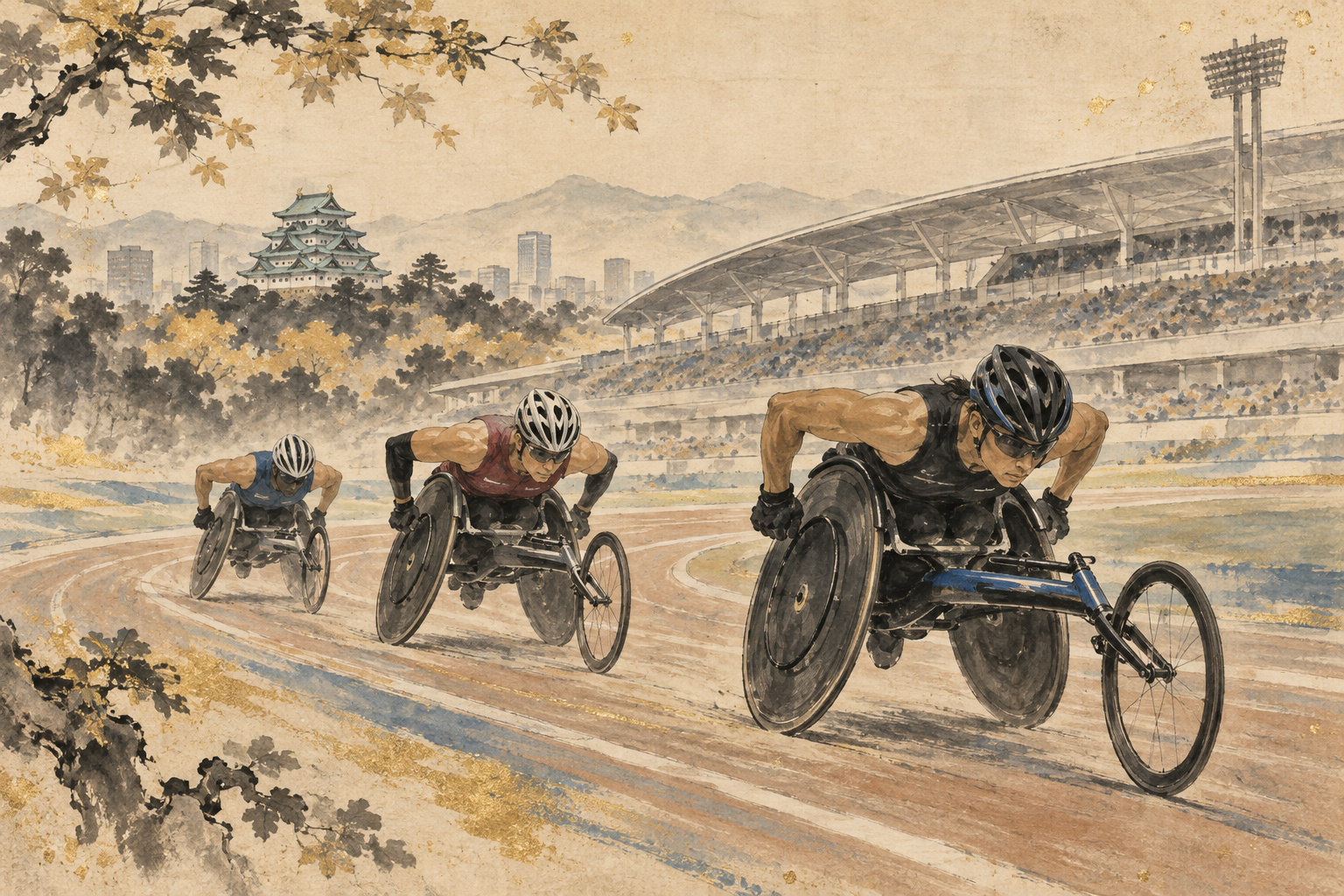
Aichi’s sporting autumn has another opening date beyond September’s Asian Games. On October 18, the Asian Para Games will begin a seven-day edition running through October 24. From this Sunday, September 13, the opening ceremony is exactly five weeks away. The Japanese Paralympic Committee’s July program lists 18 sports and 502 events—a substantial competition with its own athletes, formats and history. [1]
For a host community, this offers two closely connected experiences. There is the sporting contest: a ball placed precisely, a tactical position won, a race decided. There is also the work that allows athletes and spectators to take part. October will bring both into focus, across familiar municipal facilities as well as major arenas.
A first Japanese edition with Japanese roots
This will be Japan’s first Asian Para Games, but the regional movement has a much older Japanese connection. Its predecessor, FESPIC, began in Oita and Beppu in 1975. Bringing sporting opportunities and wider social participation to people with disabilities across the Far East and South Pacific was an important part of its purpose. Kobe hosted a later edition in 1989. [2]
Physician Yutaka Nakamura was a central figure in that development. The museum operated by Japan Sun Industries, Taiyo-no-Ie, recounts his study of sports-based rehabilitation in Britain, his role as Japan’s delegation leader at Tokyo’s 1964 Paralympics, and his establishment of Taiyo-no-Ie in 1965. His work connected sport with employment and participation in community life. It helps explain why the history cannot be contained within stadium results alone. [3]
FESPIC ran for nine editions through 2006. Following institutional integration, the Asian Para Games began in Guangzhou in 2010, followed by Incheon in 2014, Jakarta in 2018 and Hangzhou in 2023. Aichi–Nagoya is the fifth edition. “First in Japan” refers to this Games series, not to the first international Para sporting competition held in the country. [2]
The competition reaches into local Aichi
Nagoya’s municipal guide lists 19 venues overall, including 10 city venues staging 10 sports. Mizuho Park Athletics Stadium is the main venue and the setting for Para athletics. Aichi International Arena will host wheelchair basketball, while Higashiyama Park Tennis Center will stage wheelchair tennis. Choosing a sport will also mean choosing a particular part of the city. [4]
Beyond Nagoya, the map takes in Ichinomiya for Para badminton, Toyohashi for goalball, Toyota for Para table tennis, Kariya for wheelchair rugby, and Okazaki for Para archery and sitting volleyball. The host name should not, however, be mistaken for a prefectural boundary: Para cycling uses Izu Velodrome and the Cycle Sports Center’s five-kilometre circuit in Shizuoka Prefecture. [5]
| Sport | Venue |
|---|---|
| Para badminton | Ichinomiya City General Gymnasium |
| Goalball | Toyohashi City General Gymnasium |
| Para table tennis | Sky Hall Toyota |
| Wheelchair rugby | Wing Arena Kariya |
| Sitting volleyball | Okazaki Chuo Sogo Park General Gymnasium |
A familiar local sports hall can make international competition feel less remote. It also creates a useful comparison between exceptional-event arrangements and everyday use. How do people enter, find their seats and obtain information? What works well enough to retain when the tournament equipment has gone?
A Japanese team taking shape in stages
The JPC’s third announcement, dated August 21, brings the athlete roster to 267. With 15 competition partners, 124 sport-federation staff and 22 headquarters staff, the announced delegation totals 428 people. Those categories matter: the delegation total is not an athlete count, and the July first announcement no longer represents the full published roster. [6]
The consolidated list includes wheelchair tennis player Tokito Oda, 小田凱人, of Tokai Rika, and athletics representative Kakeru Ishida, 石田駆, of Toyota Motor Corporation. Their listed municipalities are Nagoya and Nagakute respectively. The roster identifies these as current residences. Their connections through daily life and sporting organizations provide a concrete starting point for Aichi spectators following the Japanese team. [7]
A familiar name can bring someone through the door. Following the event itself requires another step: learning the competitive format, watching opponents and noticing the decisions that change a result. The most durable local sporting interest would allow both kinds of attention to grow together.
Classification helps explain what is being contested
The difference between 18 sports and hundreds of events is partly explained by classification. The JPC describes a system that determines eligibility and groups athletes according to how impairment affects the fundamental movements needed in a sport. Its purpose is to reduce the influence of impairment on results so that trained skill, power, endurance and tactics can shape competition. [8]
A sport class is not a ranking of a person’s overall ability or daily life. Procedures are specific to the sport. For a spectator, checking the class alongside the event name helps explain why apparently similar races or contests can be held separately. Comparing performances begins with understanding the competitive framework, rather than assuming that every time or distance belongs on one undifferentiated list.
This is an invitation to greater sporting detail. Clear explanations can make a contest easier to follow without asking spectators to master an entire classification system before enjoying it.
The tactical world around a boccia ball
Boccia offers an accessible example of how a little knowledge changes what an audience sees. The Japan Boccia Association explains the basic objective as bringing red or blue balls close to the white target ball, the jack. Balls can also strike and move other balls. A successful delivery therefore changes not only the score but the possibilities for the next play. [9]
In the BC3 class, athletes unable to make the throw themselves use a ramp and work with a ramp operator, communicating their own decisions. Watching only the equipment would miss the central sporting question: what is the athlete trying to do to the arrangement of balls? [9]
A newcomer can begin by remembering the position before each delivery. Is the player trying to get closer, displace a ball or create another route? That makes a small movement meaningful. The pleasure comes from recognizing a decision and then seeing how precisely it is executed.
Access is a journey, not a label
Aichi Prefecture’s spectator transport guide, updated September 10, recommends public transport and sets out additional services at selected venues. These include free accessible shuttles using universal-design taxis for wheelchair users and others with disabilities, generally by reservation. Availability is venue-specific; the announcement is not a promise of an identical service everywhere. [10]
The guide also distinguishes ceremony access routes from those used during competition and advises passengers who need boarding assistance to check the relevant railway’s arrangements. A useful viewing plan consequently starts with the actual venue and session, then follows the journey through to arrival. [10]
Publishing arrangements is an important preparation, but their practical success remains something to assess in use. Can a visitor find the information beforehand? Does the route remain understandable between station, entrance and seat? Is it clear where to ask for help? These are questions for the whole journey, not simply the presence of an accessible feature at its destination.
What remains after October 24
The Games’ history brings sporting excellence and opportunity into the same frame. Aichi’s longer-term challenge will be to connect the attention surrounding an international event with places to practise, equipment, coaching and understandable information for people who want to begin.
None of that follows automatically from hosting a successful ceremony or winning medals. It takes continued local work. But spectators can make a modest beginning now: put an October session on the calendar, learn one unfamiliar sport and follow a performance closely enough to describe what made it good.
Aichi’s autumn will provide the occasion. Whether that occasion broadens everyday sporting opportunity will remain a question for the region long after the closing ceremony.
- JPC: dates and 18-sport, 502-event program, as of July 2026
- JPC: Asian Para Games and FESPIC history and chronology
- Taiyo Museum: physician Yutaka Nakamura and participation through sport and work
- Nagoya City NAGOS: host-city venues and Games overview
- JPC: sport and venue list
- JPC: third delegation announcement, August 21, 2026
- JPC: consolidated athlete roster and Japanese name readings, August 21, 2026 (PDF)
- JPC: classification, its purpose and sport-specific assessment
- Japan Boccia Association: objectives, classes and ramp use
- Aichi Prefecture: spectator transport and venue access, updated September 10, 2026