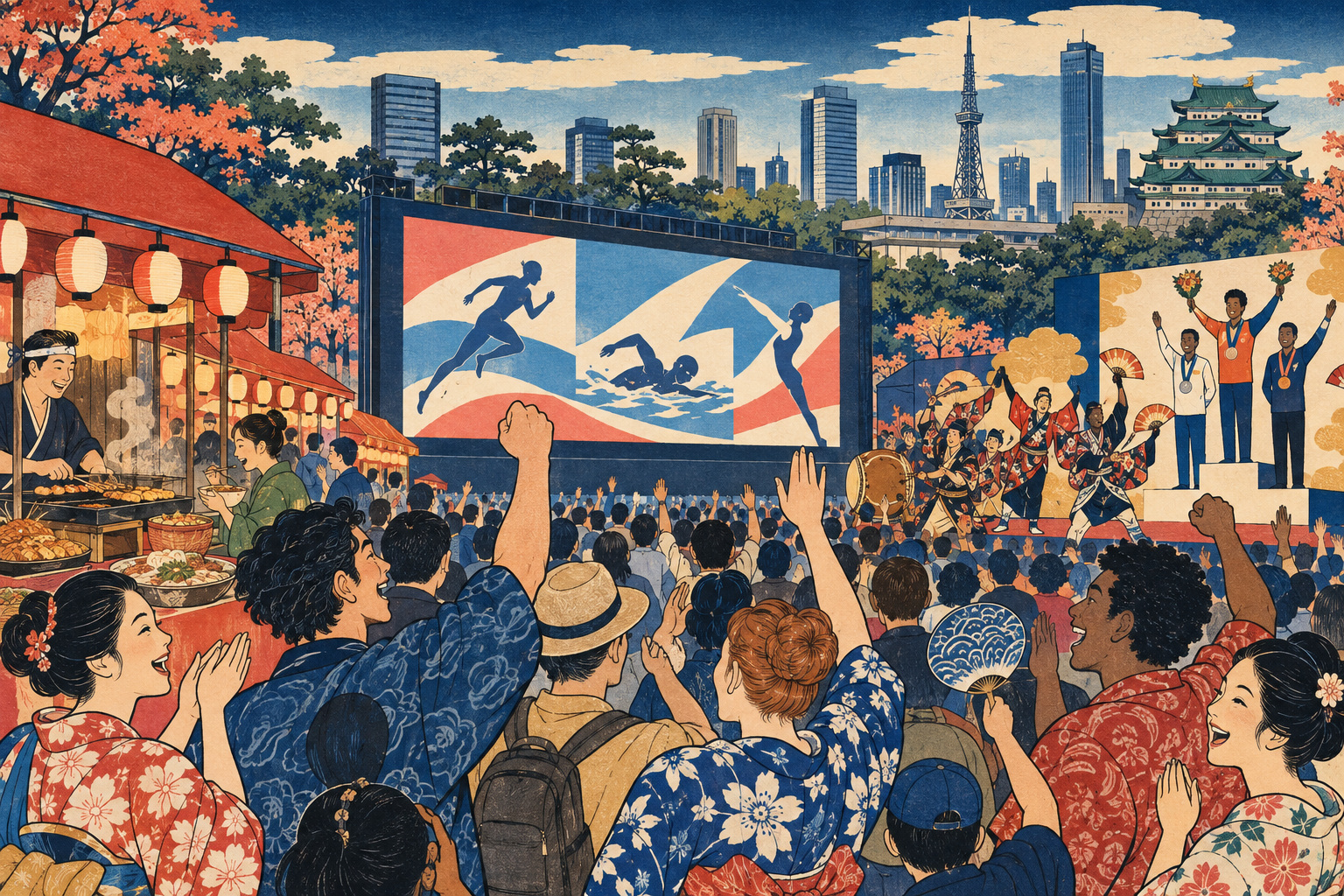
Most spectators will never see every venue at the Aichi-Nagoya Asian Games. The competition is spread across more than 50 sites, while seats, distance and time separate one event from another. For 16 days, organizers intend to answer that fragmentation with a public gathering place in central Nagoya.
ONE ASIA WORLD, the Games’ official Celebration Fan Zone, is scheduled for September 19 through October 4. Its footprint joins Hisaya-odori Park, Oasis 21 and Sakae Hiroba-S. A giant screen, medal celebrations, stage performances, Asian food, participation zones and corporate exhibits are meant to carry the event beyond the ticket gates.
The invitation has limits that matter. Organizers describe the grounds as open whether or not a visitor holds a competition ticket. They also warn that the Hospitality Lounge and some areas or programs may require advance registration or a special ticket. “Open” describes the larger public realm, not guaranteed admission to every seat and activity.
| Zone | What organizers plan |
|---|---|
| CHAMPIONS ROAD & STAGE | Medalist celebrations, athlete appearances and music or cultural performances |
| LIVE SITE | Public viewing on a large screen, entertainment and sport experiences |
| CROSSROADS FESTIVAL | Food, music, cultural programming and interactive company exhibits |
| HOSPITALITY LOUNGE | An official meeting space for Games stakeholders, companies and invited guests |
| PLAYGROUND / PHOTO SPOT / CHAMPIONS WALL | Hands-on activity, visitor photographs and a record of medalists |
A second arena for a scattered Games
A fan zone is easily dismissed as entertainment around the “real” sport. Here it has a more structural purpose. Aichi-Nagoya 2026 spans a wide geography. ONE ASIA WORLD supplies a common address where a diving result, a kabaddi match and a track final can become part of the same public conversation.
The Live Site can give people without a venue seat a shared, real-time experience. The stage can return athletes to a crowd after the controlled rituals of competition. Food and performance can introduce visitors to the societies represented by flags on a results board. None of those functions replaces being present at a final, but together they can make a dispersed mega-event legible.
Attendance alone will not prove that the plan worked. Clear sightlines, multilingual information, crowd management, heat and rain protection, accessible routes and places for families to rest will determine whether the word “public” was meaningful in practice.
After the podium, a walk through the city
The emotional centerpiece is the Medalist Celebration, described as an official Japanese Olympic Committee program. Medalists and other competitors from TEAM JAPAN and participating countries and regions are expected to appear on the Champions Road and stage, with athlete talks and walks built into the timetable.
Organizers explicitly trace the idea to Champions Park, introduced at the Paris 2024 Olympics, and say they are developing it in an Aichi-Nagoya form. That is a statement of ambition, not evidence of an outcome. Nagoya’s test will be whether ceremony can become genuine contact without reducing athletes to a parade or giving only the host team meaningful attention.
The power and limits of a giant screen
The main “Live Site in ONE ASIA WORLD” is at Oasis 21. Aichi Prefecture’s August 28 update gives planned hours of 11 a.m. to 9 p.m. on weekends and holidays, and 4 p.m. to 9 p.m. on weekdays. Public viewing is paired with talk shows, live music, dance, cooking and sport experiences.
Four short-run satellite sites extend the concept beyond Sakae. Kuragaike Park in Toyota and Kariya Highway Oasis operate on September 20 and 21; Expo 2005 Aichi Commemorative Park in Nagakute and the plaza south of Toyohashi Station follow on September 22 and 23. Planned activities vary by site and include trampoline, cycling, equestrian and breaking experiences.
A live site is only as useful as its current schedule. Broadcast rights, competition timing, weather and operations can change what appears on screen. The official timetable itself carries a change warning, so visitors should treat the online day-of schedule—not an early promotional list—as authoritative.
Food can open a door, or flatten a continent
The announced stage roster includes dance and music connected with communities from Indonesia, India, China, Vietnam, Korea and the Philippines. Food stalls and trucks are planned, while cooking demonstrations pair specialist Aya Osada with athletes and dishes identified with Saudi Arabia, India, Korea and Uzbekistan.
This is an approachable way into an enormous region, but there is a journalistic reason to look past the menu board. “Asian culture” can become a decorative category if communities are presented without names, histories or voices. Japan.co.jp’s assessment is that context will matter more than the number of cuisines: who explains a form, who cooks it, and whether visitors can understand something beyond spectacle.
Free space, reserved seats
Aichi Prefecture calls participation in the Live Site free. Yet seats for seven high-profile guest appearances were placed under advance application and lottery rules for safety, and a 72-seat allocation was later created for the Kyoto Tachibana Senior High School band performance. The official Hospitality Lounge has a different purpose and audience from the open park.
There is no contradiction if the boundaries are communicated well. A visitor can enter the public grounds without possessing a competition ticket and still encounter a reserved or restricted program inside them. Signage and mobile information should distinguish open standing areas, lottery seating, registered events and special-ticket spaces at a glance.
From New Delhi in 1951 to Nagoya in 2026
The Asian Games began in postwar New Delhi in 1951. Japan hosted in Tokyo in 1958 and Hiroshima in 1994. Aichi-Nagoya therefore becomes the third Japanese host, 32 years after the Games last took place in the country.
The 20th edition runs from September 19 to October 4. The Japanese Olympic Committee says athletes from 45 countries and regions will compete in 43 sports; it dates the sport count to March 6, 2026, so final pre-Games documentation remains the controlling reference.
The event’s concept, “IMAGINE ONE ASIA,” emphasizes connection. A serious fan zone should not make Asia look culturally uniform in order to fulfill it. Its better possibility is to let different languages, sporting traditions and communities occupy the same civic space without erasing their distinctions.
Why Hisaya-odori Park matters
Hisaya-odori is not an isolated festival compound. It is a long public axis through the commercial center of Nagoya, crossed by commuters, shoppers and tourists. Linking it with Oasis 21 and Sakae Hiroba-S allows the Games to meet people who did not set out that morning to attend a sporting event.
That chance encounter is valuable, but it also gives the project obligations to ordinary city life. Pedestrian flow, nighttime sound, waste, weather response and effects on nearby businesses are part of the fan-zone story. Corporate showcases are among the announced components; the balance between sponsorship and civic ownership will be visible on the ground.
The real score comes after October 4
The easiest image of success will be a full square erupting at a Japanese victory. The more durable result would be quieter: someone follows an unfamiliar sport the next day, a child seeks a local club after trying an activity, or a visitor leaves with curiosity about a culture encountered onstage.
The closing ceremony broadcast and the OAW closing program are scheduled to end the 16-day run on October 4. The stages will disappear. What might remain is operational knowledge for future international events—and a memory that the Asian Games belonged not only to people who bought venue tickets.
Putting a second Games in the city does not mean manufacturing another competition. It means creating a threshold: between broadcast and encounter, medal and person, host city and continent. From September 19, central Nagoya will show whether ONE ASIA WORLD can make that threshold genuinely easy to cross.
- ONE ASIA WORLD is scheduled for September 19–October 4 at Hisaya-odori Park, Oasis 21 and Sakae Hiroba-S.
- The main Live Site plans weekend/holiday hours of 11 a.m.–9 p.m. and weekday hours of 4–9 p.m.; other OAW zones follow daily schedules.
- The broader grounds are designed for visitors with or without competition tickets, but some seating, programs and hospitality spaces can require registration or special admission.
- Performers, broadcast selections, times and food programming remain subject to change. Check the official same-day information.
- Official ONE ASIA WORLD site and its About page—dates, footprint, seven zones, access language and organizers’ stated concept.
- Official event timetable—daily opening and closing, athlete programs and medal celebrations.
- Aichi Prefecture’s August 28 Live Site update—hours, main and satellite sites, performances, food and reservation rules.
- Japanese Olympic Committee Aichi-Nagoya 2026 guide—Games dates, participating countries and regions, sport count and Japanese hosting history.
- JOC list of Asian Games host cities—the historical sequence from New Delhi to Aichi-Nagoya.
Editorial method: Claims about legacy, urban exchange and the Paris model are identified as organizer ambitions or Japan.co.jp analysis. Future performances and operations are not reported as completed facts. Items requiring a final pre-publication check appear in the separate editorial notes.