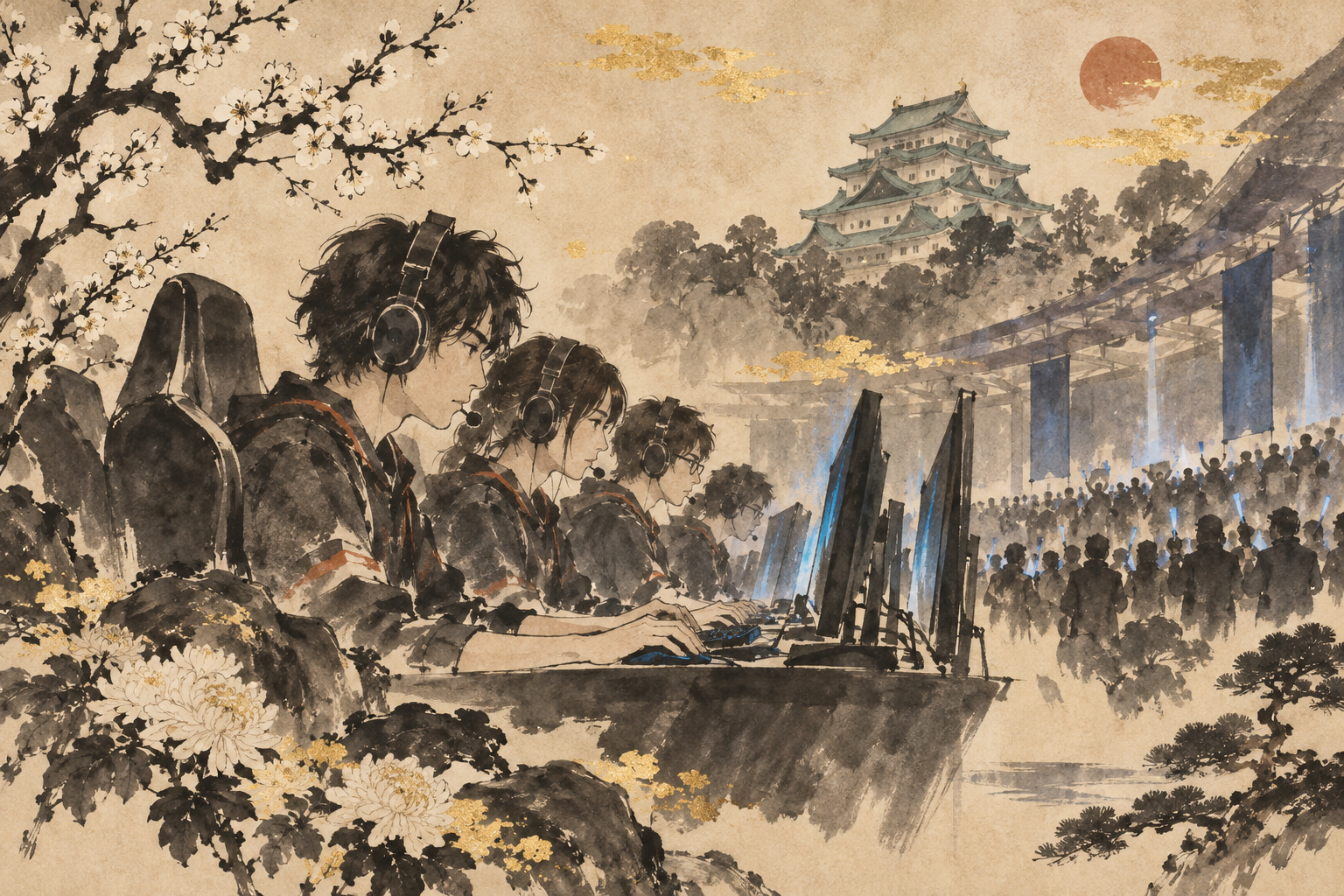
The address matters. The Asian Games’ esports competition will take place in Exhibition Hall D at Aichi Sky Expo in Tokoname, rather than in central Nagoya. From September 23 to October 2, an exhibition space will become the setting for contests whose fields of play exist inside software. For an audience arriving from more familiar sports, the challenge will be learning where to look. [1]
A monitor is not much of an explanation. Neither is the idea that the fastest fingers win. Football, motor racing, fighting games, puzzles and team strategy demand different kinds of attention from a spectator. Aichi’s opportunity is to make those differences intelligible: to turn recognition of a game’s name into an understanding of a competitive performance.
Why 13 games produce 11 medal events
The official program comprises 11 events using 13 titles. The arithmetic reflects a combined fighting-game team event involving Street Fighter 6, TEKKEN 8 and THE KING OF FIGHTERS XV. These are not three separate medal events. The remaining program covers Pokémon UNITE, Honor of Kings, League of Legends, PUBG MOBILE’s Asian Games version, Mobile Legends: Bang Bang, Identity V’s Asian Games version, Naraka: Bladepoint, Gran Turismo 7, eFootball and Puyo Puyo Champions. [2]
Team composition brings another distinction. The fighting event has three players handling its different titles; eFootball combines a PC player and a mobile player in a two-person team. Knowing the consumer game is therefore only a beginning. A spectator also needs to know the event format through which individual performances become a national team’s result. [4]
This is a useful corrective to treating esports as a single activity. A shared electronic medium does not create a shared tactical problem, any more than a shared playing surface makes all ball games equivalent.
A longer history than the novelty suggests
Organized competitive gaming did not begin with its arrival at the Asian Games. The Japan Esports Union’s historical account identifies the arcade fighting-game culture and growth of networked play as important parts of its development. At the multisport level, the 2007 Asian Indoor Games in Macau were an earlier milestone. [5]
At Jakarta–Palembang in 2018, esports appeared as a demonstration competition, and Japan won gold in Winning Eleven. That achievement should not be confused with a medal in the Asian Games’ official medal program. Esports became an official medal sport at Hangzhou, the edition called “2022” that was held in 2023. The Olympic Council of Asia approved its inclusion in Aichi–Nagoya at its July 2023 General Assembly. [6][7]
Those distinctions are more than archival tidiness. They show a progression from an established competition culture, through demonstration status, to a place inside a major national-team tournament. In Aichi, the interesting question is what that place allows spectators to understand—not simply whether a computer game can occupy a sports venue.
Aichi helped select the team before hosting it
The prefecture’s involvement started well before September. On March 21 and 22, Aichi Sky Expo hosted final Japanese selection competitions in the combined fighting event, eFootball, Puyo Puyo and Gran Turismo 7. The venue was already part of the route to national selection, not merely a destination assigned for the autumn. [8]
On July 15, following Japanese Olympic Committee certification, JESU announced 25 players and four coaches for seven events covering nine titles. Japan is consequently not entering every event on the program. That formal announcement also supersedes the earlier language of representative candidates: selection trials and final national-team recognition are different stages. [3]
One local connection is eFootball mobile representative lemon-pop, Yuga Chatani, listed in the announcement with Nagoya NTPOJA. JESU’s profile gives Ishikawa as his birthplace. His Nagoya club affiliation is a connection to the host region, not evidence that he was born in Aichi. It offers a broader way to think about a home team: sporting ties can be built through organizations and careers as well as geography of birth. [3][4]
Esports representatives also attended TEAM JAPAN’s delegation formation ceremony on August 19. For players whose careers are organized around particular games, this brings another layer of identity: participation in a delegation spanning many sports. [9]
Start with the objective, not every flashing detail
For a first-time viewer, trying to decode everything on screen is likely to obscure the contest. A better starting point is the victory condition. What is being scored? What remains on the clock? Which player is creating an opportunity, and which is protecting it?
Pokémon UNITE provides an instructive example. Its publisher describes a five-versus-five contest in which teams compete to score more points within the time limit. It would be misleading to explain it simply as another game about destroying an enemy base. The scoring objective is the anchor from which a newcomer can begin to interpret movement, cooperation and decisions about when to act. [10]
Football and racing titles may offer a bridge through an existing interest in those sports. Fighting games and puzzles invite attention to changes of tempo: when a player commits, waits or turns a disadvantage into an opening. These are viewing approaches rather than substitutes for the competition rules. Familiarity with an ordinary edition also does not establish the rules of a title specifically labelled an “Asian Games Version.”
The institutions behind the screen
The national governing organization has its own recent history. Established in 2018, it changed its Japanese name from 日本eスポーツ連合 to 日本eスポーツ協会 in August 2025, retaining the English name Japan Esports Union and using JESU. It became a JOC associate member in June 2024. [7]
JESU established an anti-doping committee in 2020 and joined the Japan Anti-Doping Agency in 2021. Such institutional arrangements place education and competitive integrity alongside the more visible business of playing matches. They are part of understanding esports as organized competition, rather than assuming that everything relevant happens on a screen. [11]
There is also a distinctive relationship with the owners of the games. JESU’s title announcement describes cooperation with intellectual-property holders. Software is the competitive environment, but it is also a product with a rights holder. That makes the relationship between sporting organizers and publishers relevant to how an event is assembled and explained. It is another reason to distinguish the tournament’s published arrangements from assumptions drawn from everyday play. [2]
Dates to build a viewing plan around
The selected sessions below cover events in which Japan has named representatives. They are drawn from the published schedule and are not a complete listing of every preliminary round. Check the official session information and latest timetable before buying tickets or travelling. [1]
| Date | Event and stage |
|---|---|
| September 23 | Gran Turismo 7: group stage through final; eFootball: semifinals through final |
| September 25–26 | Fighting team event: knockout rounds through semifinals on the 25th; final on the 26th |
| September 26 | Puyo Puyo Champions: knockout rounds through final |
| September 27 | Pokémon UNITE: knockout rounds through final |
| September 29 | PUBG MOBILE, Asian Games version: final |
| September 30 | Identity V, Asian Games version: knockout rounds through final |
For Aichi, the longer-term opportunity is not guaranteed by a full hall or a medal ceremony. It lies in what people can explain afterwards: the purpose of a play they had initially found confusing, the career of a player connected to the region, or the difference between a familiar pastime and a structured international contest.
That kind of sporting literacy can outlast an event. It requires clear commentary, accessible explanations and a willingness to take unfamiliar rules seriously. In Tokoname, the arena will be different. The invitation to the spectator is recognizable: learn enough to see why a difficult performance matters.
- JESU: competition schedule, June 16, 2026
- JESU: confirmed events and titles, updated February 5, 2026
- JESU: formally confirmed Japan roster, July 15, 2026
- JESU: Games hub, formats and player profiles
- JESU: history of esports
- JESU: 2026 inclusion decision and 2018 demonstration history
- JESU: institutional chronology, Hangzhou year and name change
- JESU: Aichi selection finals, March 22, 2026
- JESU: participation in TEAM JAPAN ceremony, August 20, 2026
- The Pokémon Company: official Pokémon UNITE app description
- JESU: anti-doping committee and JADA membership