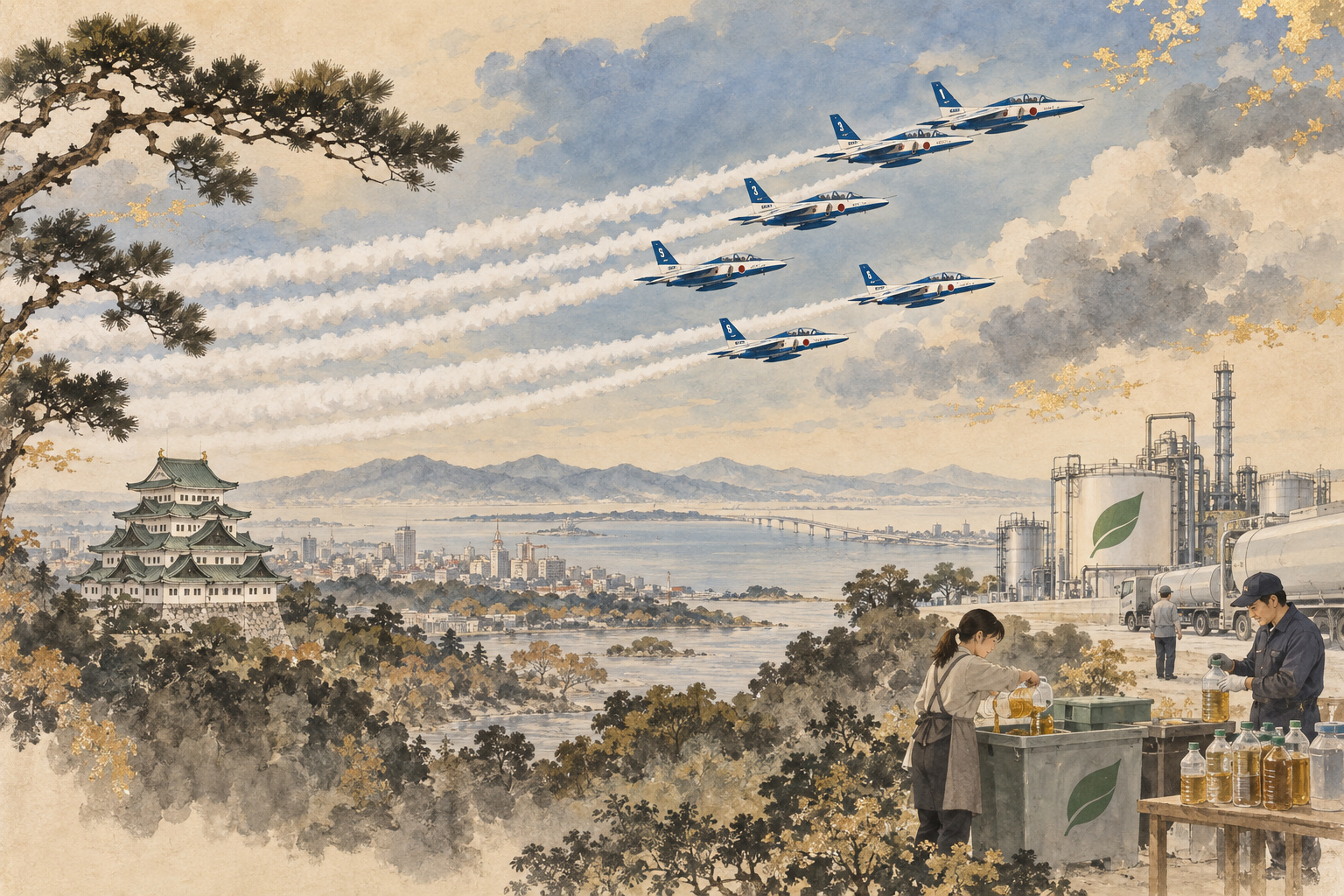
A bottle of used cooking oil and a formation of Blue Impulse aircraft seem to belong to different worlds. Aichi’s latest aviation-fuel initiative connects them through a less visible sequence of collection, processing, shipping and certification. The planned display on September 19 will give that supply chain an unusually public destination.
Aichi Prefecture announced on September 11 that sustainable aviation fuel, or SAF, procured jointly with Nagoya City will form part of the fuel used for the flight commemorating the Aichi-Nagoya Asian and Asian Para Games. The prefecture lists a planned flight window over Aichi of 9:10–9:55 a.m. Japan time on September 19; this is the overall prefectural flight window, not a promise of 45 minutes of aerobatics at one viewing point.[1]
Nagoya’s announcement supplies the local connection: some of the used cooking oil collected by the city has entered the manufacturing process for the domestic SAF being procured.[2] That makes the story more concrete than a general appeal to recycle. It also makes precision important. The announcement does not mean that every aircraft will fly entirely on fuel made from Aichi household oil.
A regional contribution to a domestic supply chain
According to JGC Holdings, the fuel is manufactured by SAFFAIRE SKY ENERGY and supplied through the Cosmo Energy Group. It will leave the manufacturing plant by sea and pass through Chubu Centrair International Airport. The production facility is inside Cosmo Oil’s Sakai refinery in Osaka Prefecture.[3]
Aichi participates through collection, airport logistics and use. The manufacturing geography matters: this particular supply should not be described as a closed loop entirely within Aichi. Nor does the involvement of local collection establish a traceable journey from one family’s bottle to a particular aircraft’s tank.
The supply chain has been taking shape over several years. In March 2025, Japan’s New Energy and Industrial Technology Development Organization, NEDO, announced completion of large-scale demonstration facilities at Sakai. The project linked domestic used-oil procurement, production, quality control and airport supply, with the aim of supplying approximately 30,000 kilolitres of SAF annually.[4] That is a project-scale figure, not the volume allocated to the display.
Centrair had already become a destination for the fuel. JGC and SAFFAIRE SKY ENERGY announced the first supply of their domestic SAF there to a DHL Express cargo flight on May 23, 2025.[5] The September display therefore builds on an airport supply connection that predates the Games.
Cooking oil is the starting material
The aircraft will not be burning filtered kitchen oil. Used cooking oil is a feedstock for industrial conversion. Cosmo identifies the Sakai project with the HEFA route, while also discussing other production technologies to broaden future supply.[14]
The U.S. Department of Energy describes HEFA as processing oils and fats through hydrogen treatment, followed by further molecular rearrangement and cracking to produce suitable fuel components. Approved SAF pathways have specified blending conditions. Neither collecting a litre of used oil nor manufacturing a litre of SAF should be confused with filling an aircraft with a litre of untreated oil.[8]
Behind the appealing kitchen-to-sky story lies ordinary industrial discipline. Feedstocks have to be gathered reliably, transported, processed and controlled for quality. NEDO specifically identifies stable procurement as a challenge and explains that the characteristics of incoming used oils informed the facility’s design.[4]
Making collection a habit
In April 2026, JGC, REVO International and SAFFAIRE SKY ENERGY announced a resource-recovery agreement with Nagoya and Centrair. The company release described the city’s retail collection programme as more than 15 years old and operating at 71 stores at that time.[6] Aviation fuel thus offers a new outlet for an established recovery activity, rather than requiring every part of the system to begin from scratch.
The prefecture formed its locally produced and consumed SAF supply-chain council on August 8, 2025. Its work includes collection arrangements and consideration of certification based on emissions reductions. A February 2026 guidebook addressed household used-oil collection. The broader regional programme also includes a separate project involving a production base in Tahara and traceability systems; it should not be conflated with this shipment of Sakai-produced fuel.[7]
For an initiative intended to last, a spectacular flight can only be an introduction. The practical questions begin after attention moves elsewhere. Will collection remain convenient? Will it produce a dependable feedstock stream? Can the participants maintain the service and explain where the recovered material goes?
These are useful measures of the programme’s durability. A one-day collection total might demonstrate enthusiasm, but an aviation-fuel business needs continuing supply. Public participation becomes economically useful when it is connected to a repeatable operation.
What “lower emissions” actually measures
SAF does not eliminate carbon dioxide from combustion. Its climate case is assessed across a fuel’s lifecycle. ICAO’s methodology considers activities including feedstock collection, processing, transport, fuel production and distribution, and combustion in an aircraft engine. Emissions performance therefore depends on the production pathway and its accounting boundaries.[9]
JGC describes an 84% greenhouse-gas reduction for its used-cooking-oil SAF compared with conventional jet fuel.[10] That is a company account of lifecycle fuel performance. It is not a verified 84% reduction for the September display as a whole. A fuel-level figure cannot simply be assigned to a flight that also uses conventional fuel.
| Established | Not determined by that fact |
|---|---|
| SAF forms part of the display’s fuel provision | The specific blend delivered to each aircraft |
| Local recovered oil contributes to production | The share supplied by an individual household or municipality |
| A domestic manufacturing and supply route is involved | Total display emissions savings or procurement cost |
A quantified assessment would need the amount of SAF used, its relationship to conventional fuel, the allocation of certified environmental attributes and a defined comparison. Those questions do not negate the value of the initiative. They determine what can responsibly be claimed about its scale.
A familiar team carries a different message
Blue Impulse has been associated with major public occasions for decades. The Air Self-Defense Force’s history records its first official display in 1960, the rings drawn for the Tokyo Olympics in 1964 and its appearance at Osaka’s Expo in 1970.[12] Familiarity gives the team an ability to bring a technical subject to an audience that might never follow a fuel-industry announcement.
The present team is the 11th Squadron of the 4th Air Wing at Matsushima Air Base in Miyagi Prefecture. Its T-4 team was established in December 1995.[13] It is visiting Aichi for the occasion, rather than being an Aichi-based unit.
Its connection with domestic SAF also predates this event. Cosmo announced a supply at Kansai International Airport on April 10, 2025, explicitly describing aviation fuel allocated environmental value from domestic SAF through a certified mass-balance approach.[11] That wording is a reminder that physical fuel flows and the assignment of environmental attributes must be read together. The exact arrangements for one supply should not be assumed for another.
The most useful outcome in Aichi would be a public demonstration that leads to a lasting, intelligible system: recovered oil becomes a usable feedstock, certified fuel reaches an airport, and participants can understand both the benefit and its limits. The aircraft provide visibility. The lasting experiment is whether the collection, production and accounting continue to work together after the display is over.
- Aichi Prefecture: SAF provision and the September 19 flight window, September 11, 2026 (Japanese)
- Nagoya City: locally collected oil in the domestic SAF production process, September 11, 2026 (Japanese)
- JGC Holdings and SAFFAIRE SKY ENERGY: supply for the Blue Impulse display, September 11, 2026 (Japanese PDF)
- NEDO: large-scale domestic SAF supply-chain demonstration, March 7, 2025 (Japanese)
- JGC Holdings and SAFFAIRE SKY ENERGY: first domestic SAF supply at Centrair, May 23, 2025 (Japanese PDF)
- JGC and partners: resource-recovery agreement with Nagoya and Centrair, April 30, 2026 (Japanese PDF)
- Aichi Prefecture: regional SAF supply-chain council and project distinctions, updated September 2, 2026 (Japanese)
- U.S. Department of Energy, Alternative Fuels Data Center: Sustainable Aviation Fuel, production pathways and blending conditions
- ICAO: Life Cycle Emissions of Aviation Fuels
- JGC Holdings: Sustainable Aviation Fuel, manufacturing and the company’s lifecycle-emissions claim (Japanese)
- Cosmo Energy Group: Blue Impulse fuel supply and mass-balance allocation, April 10, 2025 (Japanese)
- Japan Air Self-Defense Force: Blue Impulse history (Japanese)
- Japan Air Self-Defense Force: Blue Impulse identity, home base and T-4 team formation (Japanese)
- Cosmo Energy Group: HEFA supply and plans for an alternative feedstock route, February 21, 2025 (Japanese)