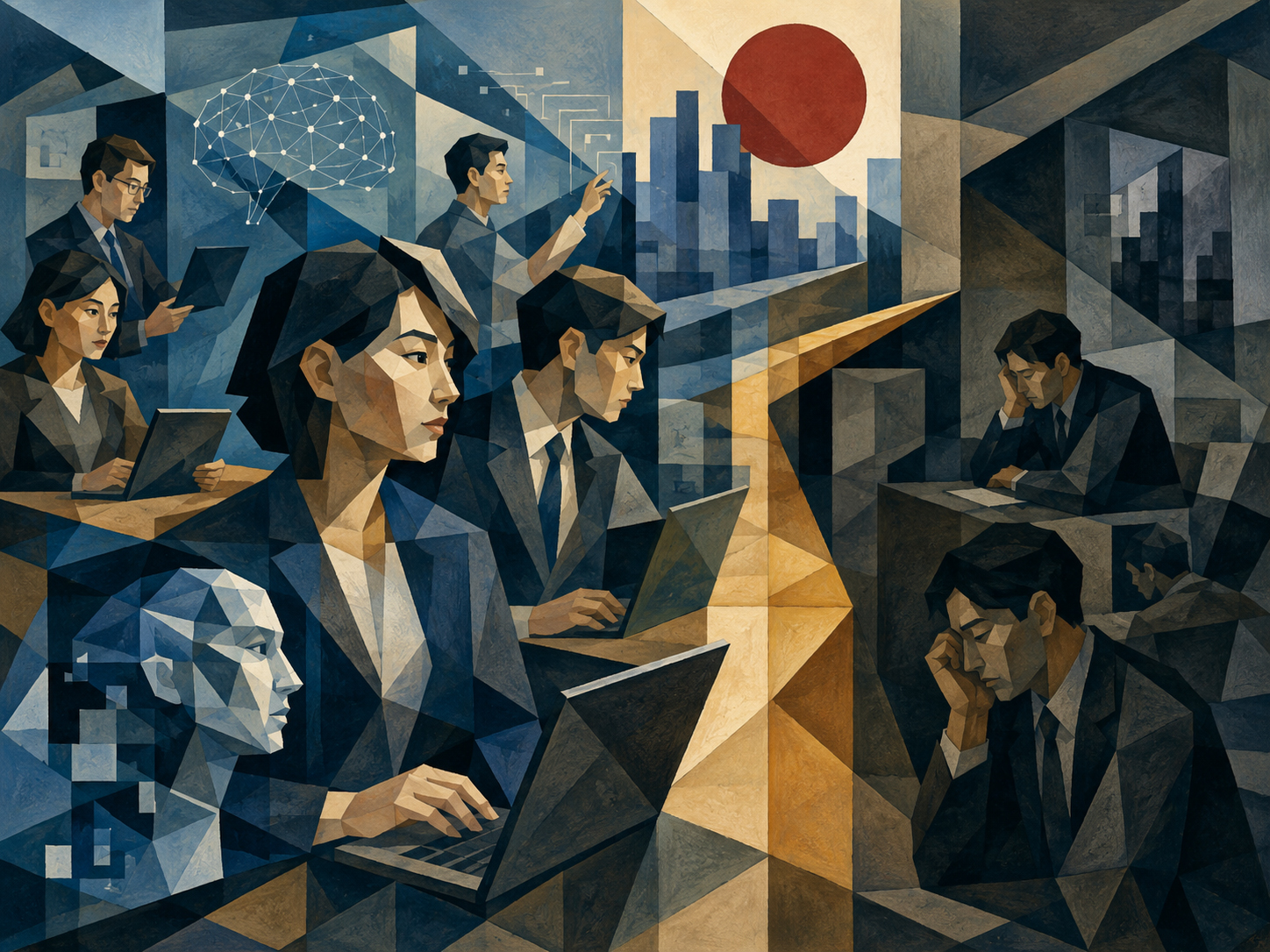
A new divide is opening in Japan’s hiring market. It is not only about university names, seniority, English ability or certificates, though all of those still matter. In 2026, the quieter question is more practical: can a worker use generative AI to research, summarize, code, draft proposals, understand a client’s business, and check the machine’s mistakes? The gap between workers who can use AI and workers who cannot is beginning to shape hiring, placement, promotion, wages and corporate competitiveness.
The Information Services Industry Association of Japan edited, and Impress released, the 2026 edition of the Information Services Industry White Paper under the theme of human-resource problems in the AI era. The central question is blunt: is generative AI a savior for Japan’s IT labor shortage, or a threat that will take jobs?
That question is not only for IT companies. It is a question for Japanese employment itself. Almost every company is becoming an information-services company. Banks, hospitals, factories, hotels, municipalities, publishers and farms now run on customer data, business systems, bookings, logistics, inventory, accounting, advertising, cyber defense and customer support. The AI-skills problem is therefore not a narrow technical story. It is a story about how Japan works.
The white paper’s question: savior or threat?
The book description frames the issue around “the talent required in the AI era.” In a market already suffering from serious labor shortages, AI changes both the quantity and quality of people companies need. The white paper draws on surveys of IT vendors, user companies and individual engineers to analyze that shift.
The important point is that AI is not treated only as a tool for reducing headcount. The deeper message is that the role of information-services firms is changing. Instead of merely building systems to specification, they are being asked to become co-creation partners in business transformation. In other words, AI-era talent is not just the person who can write code. It is the person who can understand a business process, define a problem, embed AI safely and change a client’s work.
Japan’s IT talent problem is older than generative AI
Japan’s AI talent shortage did not appear overnight. Postwar Japanese companies traditionally developed workers through long-term employment, internal training, seniority-based promotion and rotation across departments. That model was powerful for manufacturing quality, shop-floor improvement and teamwork. But it had weaknesses in a software-centered economy: specialist skills were often undervalued, external labor mobility was limited, and the market price for digital talent was hard to see.
Japan’s corporate information systems were long supported by user-company IT departments, systems integrators and multilayered subcontracting chains. This structure could build large, stable systems, but it was less suited to rapid experimentation with business divisions. Cloud, SaaS, smartphones, data analytics, cybersecurity and now generative AI have each exposed the same complaint: not enough people.
Generative AI shakes that structure again. It accelerates research, minutes, slides, basic code, testing, translation and summarization — the kinds of tasks often given to junior workers. At the same time, it raises the value of problem definition, verification, customer understanding, ethics, security and business design. If routine entry-level work is automated away, the ladder for young workers narrows. But young workers who know how to use AI may reach more strategic work faster.
AI skills are not just prompting
The phrase “AI skills” is easy to misunderstand. It does not mean simply writing clever prompts. It includes knowing what AI is good at, where it fails, when it hallucinates, when copyright or personal information becomes an issue, whether internal data can be entered into a tool, and how to verify an output. Judgment is part of the skill.
The OECD’s report on AI and Japan’s labor market treats AI not only as a question of job quantity but also as a question of skills, training, worker consultation and regional differences. Workers in AI-adopting companies do not all benefit in the same way. Occupation, region, education, age, training systems and managerial understanding shape who gains.
For that reason, AI skill is not only an individual responsibility. Companies need safe rules, approved tools, organized business data, training, and a culture in which workers can experiment. A company that simply bans AI will not develop talent. A company that tells everyone to use everything will create risk. AI-era HR is becoming the design of learning environments.
The invisible split in hiring
The hiring divide will not always appear as “must know ChatGPT” in a job posting. It will show up through phrases such as business improvement, data analysis, automation, customer-problem definition, cloud use and productivity improvement with generative AI.
People who can use AI can stretch their roles. Salespeople can prepare proposals faster and research customer industries more deeply. HR staff can improve applicant communication and training design. Accounting teams can create checklists and anomaly-detection workflows. Engineers can use code generation while spending more time on review and architecture. Editors can use comparison and summarization tools while concentrating on judgment and originality.
People without access or training remain at the old speed. That does not mean they lack ability. It may mean their company has not provided tools, rules, training or permission to experiment. The AI divide is therefore a workplace divide before it is an individual divide.
From system contractor to co-creation partner
One of the key words in the white paper is “co-creation partner.” User companies increasingly want more than a vendor that builds a system from a specification. They want a partner that can help design business transformation. This is a major opportunity for Japanese IT firms, but also a painful transition.
In traditional contract development, the client defines requirements and the vendor builds. In the AI era, the client often does not know what is possible. Sales, call centers, factories, logistics, accounting, HR, legal affairs and public relations all have AI use cases, but each also has risks. Which tasks should AI touch? Which decisions must remain human? Which data can be used? Which outputs need audit trails? Those questions require joint discovery.
That is why information-services talent now needs more than technical skill. It needs industry knowledge, facilitation, risk management, data governance, observation of real work and clear writing. The more AI enters the workflow, the more valuable human problem-definition becomes.
The government frame: from Society 5.0 to reskilling
Japan’s government has long placed AI and digital talent inside the broader idea of Society 5.0: a human-centered society that integrates cyberspace and physical space to balance economic development with social problem-solving. Aging, depopulation, health care, disaster response, energy, transportation and public services are all areas where Japan cannot solve its problems without digital tools.
METI has continued discussions on digital skill standards and workforce development for the Society 5.0 era. The target is not only specialist engineers. Executives, managers, sales teams, planners, HR staff and frontline workers must all be able to treat digital tools as part of their own work.
Generative AI changes what reskilling means. It is no longer enough to “increase the IT department.” Every department must learn to redesign its own work with AI. If AI remains a tool for specialists only, the workplace will not change. If it becomes an ungoverned toy for everyone, accidents will occur. The necessary path is role-specific, practical reskilling.
The global labor market is moving the same way
This is not only a Japan story. PwC’s 2026 AI Jobs Barometer says AI is changing the skills employers demand, raising the value of human skills such as judgment, creativity and leadership. The IMF’s 2026 analysis also argues that new IT and AI skills are reshaping wages and hiring while risking deeper labor-market polarization.
Japan, however, has its own pattern. It faces a deep labor shortage, population decline, cautious corporate decision-making and less labor mobility than many Western markets. That means AI-driven change may appear less as sudden mass unemployment and more as the quiet reorganization of tasks. Japan’s AI revolution will happen inside morning meetings, approval documents, spreadsheets, customer visits, emails and minutes.
What companies should do now
Companies should begin by moving beyond the simplistic question of whether AI is allowed or banned. The real issue is which work, which data, which tools and which permissions are appropriate — and how human beings verify the outputs.
Training cannot be a one-time lecture. Companies need small use cases tied to real work, tested by department, with failures shared. AI for sales, accounting, manufacturing, hotels, municipalities and media are all different. A useful system combines company-wide rules with practical local experiments.
Finally, HR evaluation has to change. If AI makes a worker faster, the answer should not be to pile on more low-value tasks. The time created by AI should move toward customer understanding, quality, new business, training, cybersecurity and verification. AI is not only an efficiency tool; it is a way to move human work upstream.
Japan.co.jp view
The phrase “AI skills divide” can sound frightening. But the core story is not only pessimistic. Japan lacks workers. It is aging. Regional companies are short of people. Many small businesses do not have digital specialists. In that context, AI can supplement missing capacity rather than simply replace people.
But tools do not diffuse fairly on their own. People who can use AI may become stronger, while people without access fall behind. Company size, region, occupation, age and employment status may shape who gets the chance. If ignored, AI can raise productivity and inequality at the same time.
Japan needs two things at once: less fear of AI and more seriousness about how it is used. As the 2026 Information Services Industry White Paper suggests, the problem is not “AI or humans.” The problem is what kind of work humans will build with AI. That is the new dividing line in hiring.
Reader and company guide
| Item | How to read it |
|---|---|
| What is happening | Generative AI is changing the skill requirements of Japan’s information-services industry and broader hiring market. |
| The real skill | Not just coding or prompting, but business understanding, AI use, verification, data governance and transformation support. |
| Company challenge | Rules, training, data preparation, HR evaluation and department-specific use cases. |
| Worker challenge | Learning how to make one’s own work faster, deeper and more accurate with AI. |
| Japan.co.jp view | The AI divide is a learning-environment divide. Companies that teach people how to use AI safely will have the advantage. |
Sources and references
This article draws on the Information Services Industry Association of Japan / Impress release for the 2026 white paper, OECD research on AI and Japan’s labor market, METI’s digital workforce policy, the Cabinet Office’s Society 5.0 framework, MHLW employment-policy material, Keidanren’s AI and reskilling recommendations, Reuters reporting on Japanese AI investment, and PwC/IMF analysis of global AI labor-market change.
- PR TIMES / Impress: Information Services Industry White Paper 2026 release.
- Impress Books: title, release details and theme.
- JISA: publication details.
- OECD: Artificial Intelligence and the Labour Market in Japan.
- METI: digitally skilled workforce for Society 5.0.
- Cabinet Office: Society 5.0.
- Keidanren: AI-ready society and reskilling.