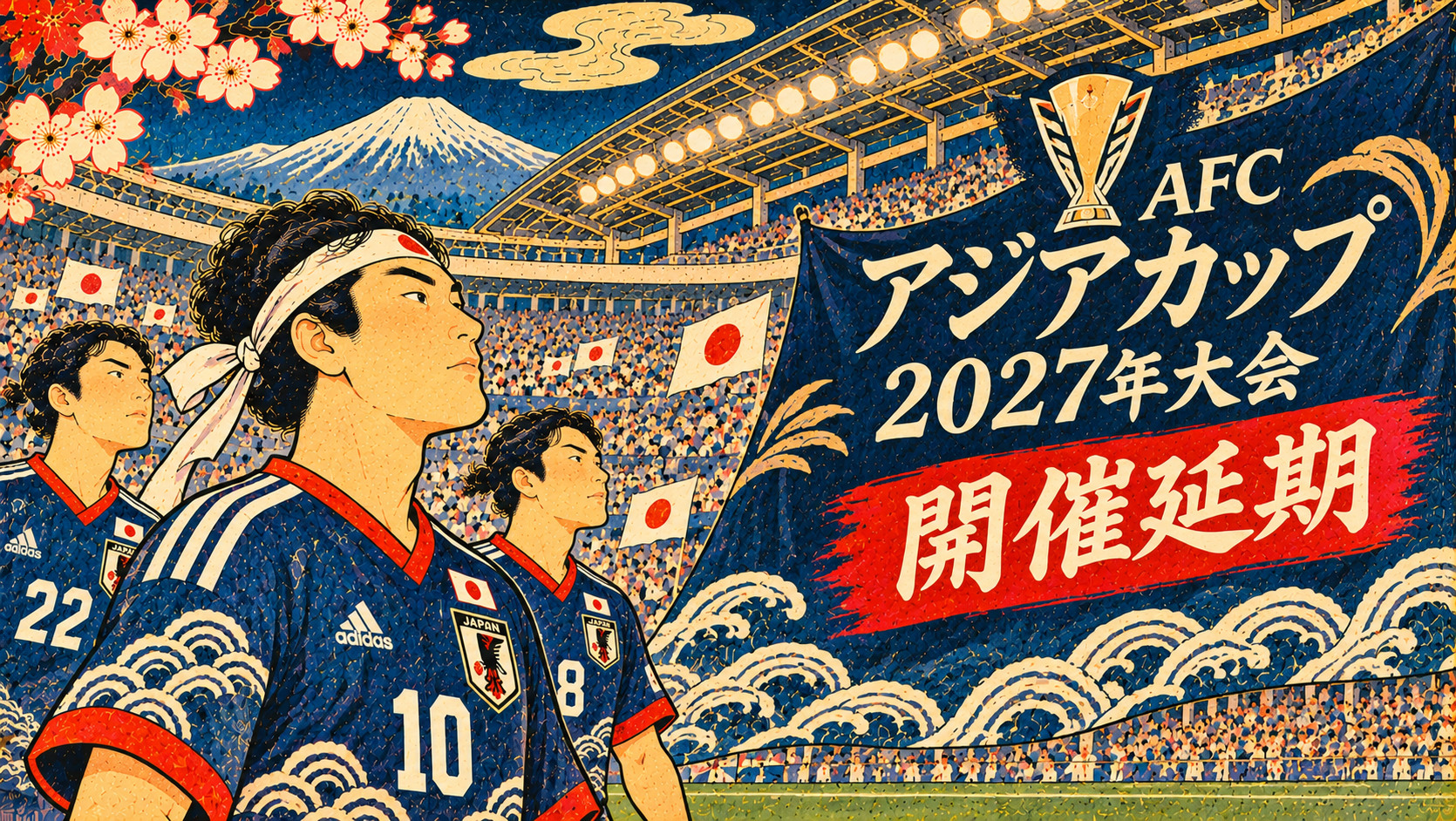
- Eight days after a final schedule, a new calendar
- What the AFC said—and what it did not
- Japan’s football president puts safety first
- Japan’s opponents are known; its new match dates are not
- A particularly consequential moment for the J.League
- A tournament can move; a player’s season does not stand still
- The extra months create both opportunity and risk
- Why the Asian Cup matters to Japan: 1992 to 2011
- The last Asian Cup also outgrew its year label
- Fans, broadcasters and commercial partners also need answers
- The information still missing
- The clock has moved, but preparation cannot wait
Eight days after a final schedule, a new calendar
On October 26, the Asian Football Confederation announced what it called the finalised match schedule for the 2027 Asian Cup in Saudi Arabia. Eight days later, on November 3, that calendar was overtaken by a more fundamental decision: the competition would move almost a year, from January 7–February 5, 2027, to December 23, 2027–January 21, 2028. The name AFC Asian Cup Saudi Arabia 2027 remains, even though the final is now scheduled to fall in 2028.
For Japan, a four-time Asian champion, the headline is not simply a change in dates. It is a reset for preparation, club-player coordination, travel, media operations and the domestic football calendar. The AFC has approved the change through its Asian Cup organising structure, but it says the replacement dates will be presented to FIFA for approval. That distinction matters: a newly announced tournament window is not the same thing as an entirely settled operational schedule.
What the AFC said—and what it did not
The AFC said it consulted the local organising committee and Saudi Arabian Football Federation before changing the tournament window. Its November 3 statement referred to exceptional circumstances associated with developments in the region, including significant logistical complications and disruptions to travel. It did not identify one particular incident as the sole cause or provide a detailed public operational risk assessment.
Organising an international tournament involves much more than the availability of stadiums. It requires predictable transport for teams and supporters, reliable accommodation and medical arrangements, broadcast operations, and the ability to manage a large international event safely. Those are plausible logistical dimensions, not an independently verified list of precise failures in this case. Where the AFC statement remains general, responsible reporting should remain appropriately qualified.
Japan’s football president puts safety first
The Japan Football Association responded on November 3. Its president, Tsuneyasu Miyamoto, expressed respect for the AFC’s decision to prioritise the safety of players, staff, supporters and the media, and said the association would coordinate with relevant parties to give Japan the best possible preparation. The remarks are an official response, not an announcement of a replacement training camp, new matches or a named tournament squad.
That distinction is essential when considering the national team known as Samurai Blue. It has more time before this tournament, but more time is not automatically useful time. Its staff will need meaningful matches, club cooperation and up-to-date information about travel, player eligibility and the revised competition calendar. None of those specifics was laid out in the two governing bodies’ November 3 statements.
Japan’s opponents are known; its new match dates are not
The May 2026 draw placed Japan in Group F with Qatar, Thailand and Indonesia. The JFA published an original sequence of Indonesia, Thailand and then Qatar. The group features the defending Asian champion in Qatar, a reminder that even a nation with four titles can expect difficult competition.
What cannot be carried forward from the old plan are the specific January 2027 kick-off dates and venue allocations. The AFC’s new announcement gives a competition window, not a replacement fixture-by-fixture calendar. Fans considering a trip to Saudi Arabia should not treat the earlier schedule as current. As of the November 3 announcement, they need to await the updated AFC match list before using dates or locations to make firm plans.
A particularly consequential moment for the J.League
The timing intersects with a structural change in Japanese club football. In December 2023 the J.League voted to move to an autumn-to-spring model beginning with the 2026–27 season. Its original transition plan envisioned an August 2026 start, a winter break around December and February, and a season ending in late May 2027. The goal was a new rhythm for the professional game, with substantial consequences for scheduling and player management.
The rescheduled Asian Cup, however, falls in December 2027–January 2028, not during that first 2026–27 winter break. It would be erroneous to assume the early transition plan establishes the exact winter pause for the following 2027–28 season. Club availability and potential scheduling adjustments require a more recent and season-specific decision. That gap is now one of the practical questions confronting Japanese football administrators.
A tournament can move; a player’s season does not stand still
International squads depend on players employed by domestic and overseas clubs. A move of this magnitude changes how those players may approach their conditioning, recovery, transfer decisions and competition calendars. Players who are central to the team in late 2026 may occupy different roles a year later; others may emerge. Injuries, transfers and managerial changes will introduce uncertainties that cannot be forecast responsibly from the announcement alone.
The relationship between the new dates, the FIFA international match calendar and mandatory player-release provisions will require precise regulatory coordination. The AFC has said it will seek FIFA approval. That does not yet establish the outcome of every club-release question, so claims that specific teams will lose particular players on particular domestic matchdays would be premature.
The extra months create both opportunity and risk
A national-team manager may welcome another year to assess opponents and develop combinations, but the postponed tournament also changes the shape of the competitive cycle. There is a temptation to assume that a longer runway benefits a well-resourced team such as Japan. The reality is less simple: time can bring a more mature generation, but it can also bring disrupted chemistry and a very different pool of available players.
Nor should the change be interpreted as evidence that Japan’s coaching staff has already settled a new strategy. The JFA president promised coordination and preparation; he did not disclose a new program. The useful measure will be the quality of matches and training eventually arranged, and the extent to which players arrive physically and tactically ready.
Why the Asian Cup matters to Japan: 1992 to 2011
Established in 1956, the men’s Asian Cup grew into the continent’s defining national-team tournament. Japan’s first title arrived in 1992 on home soil, when Hans Ooft’s side beat Saudi Arabia 1–0 in the Hiroshima final. It was an important landmark just before the J.League opened in 1993, linking an emerging professional football era with a continental success.
Japan added championships in Lebanon in 2000, China in 2004 and Qatar in 2011, producing four titles—the most in the competition’s history, according to the JFA. Those successes shaped expectations, but recent tournaments show how little history guarantees. Japan lost the 2019 final to Qatar and exited the 2023 edition at the quarterfinal stage. The next campaign is a chance to compete for another title, not to collect a trophy already promised by the record books.
The last Asian Cup also outgrew its year label
The most recent edition is itself a lesson in the difference between a competition title and a competition date. The event called the 2023 Asian Cup ultimately took place in Qatar in January and February 2024, after the originally planned Chinese hosting arrangements changed. Qatar won the tournament, and Japan was eliminated in the quarterfinals.
The Saudi Arabia 2027 event now presents a similar naming challenge: a 2027-branded tournament whose final date lies in January 2028. Travel providers, sports databases and news organisations should state the actual dates explicitly rather than assume the tournament label tells the whole story. This is a minor editorial detail with very practical consequences.
Fans, broadcasters and commercial partners also need answers
The October 26 match schedule was specific enough to underpin travel research and programming plans. Its supersession eight days later creates uncertainty for supporters choosing flights and hotels, broadcasters constructing production schedules, and commercial partners planning promotions and hospitality. Some bookings may already have been made, but the public governing-body statements do not quantify those commitments or identify universal refund or compensation terms.
Refund rights depend on individual airlines, lodging contracts, ticket sellers and jurisdictions. It would be irresponsible to imply a blanket compensation policy without documentation. For now, the most useful advice is straightforward: verify any individual reservation conditions with its provider and treat the new AFC fixture list, when released, as the authoritative timetable.
The information still missing
Four decisions will determine how far the postponement changes Japan’s preparation: FIFA’s response to the dates, a new AFC schedule showing exact match times and venues, a detailed JFA national-team programme, and the response of domestic and foreign clubs and leagues to player availability. The published group draw offers a competitive outline, but not the full logistics of a tournament.
An old date can remain visible long after it ceases to be reliable. At the time of this reporting, the JFA tournament landing page still displayed the January 2027 period even while linking to the November 3 change announcement. This report therefore follows the newer dated AFC and JFA statements, not the inherited calendar on the landing page.
The clock has moved, but preparation cannot wait
Japan now faces the unusual prospect of contesting a 2027-branded Asian championship at the turn of 2028. The difference between an administrative announcement and a tournament that can actually proceed is the complex work of coordinating people, travel, regulations and domestic competitions.
Safety, fairness and the needs of players and supporters deserve attention alongside the headline dates. The AFC’s move may ultimately prove prudent, but its practical consequences will be judged by the clarity of the next decisions. Japan’s next Asian Cup is further away than expected. The duty to explain how it will work has already begun.
Dates and their present status
| Original dates | January 7 – February 5, 2027 |
|---|---|
| Revised dates | December 23, 2027 – January 21, 2028 |
| Organiser / host | AFC / Saudi Arabia |
| Approval | AFC has announced dates; FIFA approval to be sought |
| Japan’s group | Group F: Qatar, Thailand, Indonesia |
| Individual fixtures | New kick-off dates not yet published |
Related reporting: Japan’s U-17 squad and its player-development system
Sources and reporting method
Desk research based on AFC, JFA and J.League primary documents. The dated November 3 releases determine the revised window; earlier fixture material is noted only as superseded historical evidence. No independent interviews or unpublished records were used.
- AFC: November 3 official postponement decision
- JFA: Revised dates and comments by president Tsuneyasu Miyamoto
- AFC: Original October 26 fixture announcement (superseded)
- JFA: May 2026 draw, Japan in Group F
- JFA: History of Japan at the Asian Cup
- JFA: Competition background and official FAQ
- J.League: Season transition decision and original winter-break plan
- J.League: Official overview of the season transition
- JFA tournament portal (still displays superseded dates; use with caution)
- AFC: Asian Cup competition news