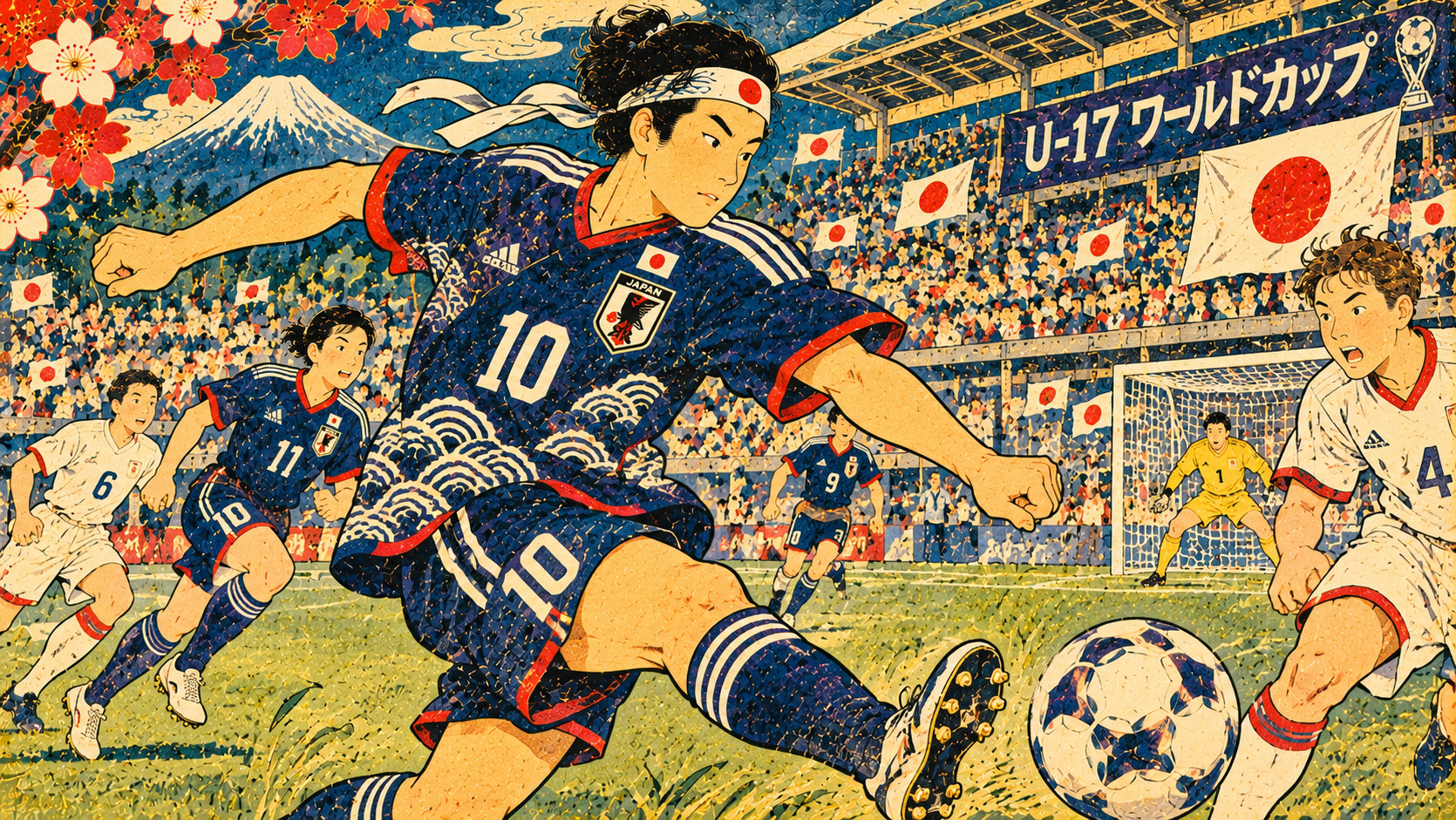
- A World Cup squad is also a map of how Japan makes footballers
- Five names stand out—but not for the reason you might think
- A comeback in Saudi Arabia offers a useful clue
- The roster, in full context
- Group L, three opponents and a larger first hurdle
- The significance of 1993
- High-school football did not disappear
- The tournament is changing too
- What Japan learned on the road this autumn
- The tension between early opportunity and early expectation
- The real test begins after the team photo
A World Cup squad is also a map of how Japan makes footballers
When Japan named its 21 players for the FIFA U-17 World Cup in Qatar on November 2, the official list did more than identify a traveling squad. It traced the overlapping routes by which young Japanese footballers now reach international competition: professional first teams, J.League academies and high-school programs. Each route has a different rhythm of training, education, competition and opportunity. The players will have to combine those experiences into one team.
Shingi Ono, the Japan Football Association’s head coach, takes the group toward a tournament beginning November 19. The announcement is a snapshot, not a forecast of results or a ranking of the players’ future careers. The more interesting question is how a national development system with several pathways prepares teenagers to face unfamiliar opponents under tournament pressure.
Five names stand out—but not for the reason you might think
Five of the 21 are identified in the JFA roster with senior-club names rather than youth-team designations: defender Anthony Udemba Motosuna of Kashima Antlers, defender Chimezie Kai Ezemuokwe of Cerezo Osaka, midfielders Takeshi Wada of Urawa Red Diamonds and Maki Kitahara of Fujieda MYFC, and forward Kakeru Saito of Yokohama FC. That is a verifiable description of club affiliation, not proof that all five have played equivalent minutes at the highest professional level or hold identical contractual terms.
Most of the squad comes through prominent club youth systems—including Kashima, FC Tokyo, Gamba Osaka, Nagoya Grampus and Vissel Kobe—or through schools such as Taisei, Teikyo Nagaoka and Shoshi. The point is not that one pathway has defeated another. Japan has built a football ecosystem in which teenagers can develop through several institutions before arriving at the same international selection process.
A comeback in Saudi Arabia offers a useful clue
The May 2026 AFC U17 Asian Cup match against Qatar shows why Maki Kitahara and Kakeru Saito are worth watching. Japan trailed before Saito equalized in the 51st minute. Kitahara scored in the 70th and 76th minutes, completing a 3–1 comeback according to the official JFA record. Those are concrete match events, unlike predictions about who will become a global star.
Even so, one strong international match does not establish how a player will perform against Colombia, Serbia or Honduras. The tests in Qatar will include compact defending, transitions after losing possession and the ability to read changing patterns at speed. Individual quality matters, but so does the chemistry among players who spend most of the year in different teams.
The roster, in full context
Japan selected three goalkeepers: Koki Takahashi, Kosei Oshita and Rento Kida. Its six listed defenders are Anthony Udemba Motosuna, Chimezie Kai Ezemuokwe, Koki Kurahashi, Riku Hashimoto, Yuzo Takeuchi and Atsuki Sameshima. The ten midfielders are Sosuke Hoshi, Yoshiki Fujimoto, Tafuku Satomi, Sora Iwatsuchi, Takeshi Wada, Maki Kitahara, Riku Nakashima, Kazato Kimura, Arata Okamoto and Ryo Igarashi. The two listed forwards are Kakeru Saito and Eito Takaki. These spellings follow the JFA’s own English announcement.
Official positional categories should not be mistaken for a published starting formation. A midfielder may play wide or operate closer to the goal; an outside defender may be important to attacking build-up. The selection tells us who has been called, not exactly how Ono will deploy them or which roles will persist from one opponent to the next.
Group L, three opponents and a larger first hurdle
Japan drew Colombia, Serbia and Honduras in Group L. The detailed JFA squad release lists matches against Colombia on November 21 at 15:30, Serbia on November 24 at 16:00 and Honduras on November 27 at 16:00, all Qatar local time, at pitches in the Aspire Zone complex. The federation says these arrangements are subject to change. Readers should distinguish the training camp that starts November 11 from the tournament itself, which runs November 19 to December 13.
The 48-team format sends the top two sides in each of 12 groups, plus the eight best third-placed teams, into a round of 32. It rewards performance over a three-game sequence, not just one upset or an inspired first half. One JFA annual schedule page conflicts with the November 2 release about the opener date; this report follows the more detailed dated squad announcement pending further clarification.
The significance of 1993
Japan hosted the U-17 world championship in 1993, the year its J.League began. That overlap matters. Domestic professional football was just beginning to build the geography of club academies, regional talent identification and increasingly specialized coaching that later generations would inherit. The JFA’s tournament history records players such as Naoki Matsuda and Tsuneyasu Miyamoto in the 1993 squad.
The lesson is not that an U-17 appearance guarantees a senior international career. Some teenagers develop early, others later; some encounter injuries or crowded club squads. The deeper story is whether a country gives young players places to continue improving long after a youth tournament ends.
High-school football did not disappear
The rise of club academies did not erase Japanese high-school football. Schools retain competitive traditions, relationships with local communities and opportunities for players to balance sport with education. The three schools represented on this roster underscore that the national team remains open to multiple development environments.
In 2006, the JFA opened its Fukushima academy as a long-term development initiative, describing an ambition to make international standards part of daily experience. Its creation was one institutional answer to a national question: how can elite potential be developed consistently without making every player follow exactly the same route? The 2026 squad is one small way to judge the continuing answer.
The tournament is changing too
Qatar 2026 is the second tournament under the expanded 48-team format, after the first such edition in 2025. More participants mean a broader variety of styles and match situations. The Doha setting also demands attention to recovery, temperature, travel routines and compressed preparation. For a coach, the work extends well beyond choosing a preferred eleven.
It would be a mistake to describe the competition solely as a scouting showcase. The players are teenagers with sporting and educational futures still taking shape. Their performance should be analyzed with the same seriousness as other elite competitions, without turning a good pass or a difficult result into a verdict on an entire career.
What Japan learned on the road this autumn
Japan’s September schedule brought matches against Myanmar (4–2), a Niigata selection (2–0) and New Zealand (4–0) at an international youth tournament in Niigata. The team then beat Ukraine 2–1, lost 1–2 to Austria and defeated France 3–1 at a tournament in Limoges. The JFA also organized an October training camp at J-Village in Fukushima.
These results demonstrate exposure to varied opposition, but they cannot be treated as a simulation of the World Cup. Opponents used different lineups in different settings, and the exact continuity of selection and tactics needs match-by-match examination. The useful questions are about cohesion, tactical adaptation and consistency, not a simplistic tally of wins.
The tension between early opportunity and early expectation
Young players with senior-club affiliations draw attention because an early professional environment may offer different demands and resources. Yet the designation alone cannot tell us the quality of minutes, the player’s wellbeing or the likelihood of a sustained career. Japan’s player-development debate is bigger than the first professional contract.
An international youth tournament can accelerate experience and create exposure, but it should not become a license to invent personality profiles, career ambitions or transfer rumors. The JFA roster provides names, clubs and scheduled matches. The young people behind those entries deserve reporting grounded in observation and confirmed information.
The real test begins after the team photo
Against Colombia, Japan will need to move from the familiar routines of domestic clubs and schools to a shared international plan. Against Serbia and Honduras, further adjustment will be required. The goalkeeper’s distribution, defensive spacing, midfield pressure and movement of the front line may ultimately matter more than which player is already described as professional.
For global readers, Japan’s squad is a window into a country that has worked for decades to make football development a broad institutional project. For Japanese supporters, it is a chance to watch new players without burdening them with predetermined destinies. The most meaningful story on November 5 is not who will be famous in ten years. It is how 21 young people are preparing to compete together now.
The complete 21-player squad
| Position | Players and affiliations |
|---|---|
| GK | Koki Takahashi (Taisei High); Kosei Oshita (Kashima Antlers Youth); Rento Kida (Teikyo Nagaoka High) |
| DF | Anthony Udemba Motosuna (Kashima Antlers); Chimezie Kai Ezemuokwe (Cerezo Osaka); Koki Kurahashi (Kashima Antlers Youth); Riku Hashimoto (FC Tokyo U-18); Yuzo Takeuchi and Atsuki Sameshima (Nagoya Grampus U-18) |
| MF | Sosuke Hoshi (Shoshi High); Yoshiki Fujimoto and Arata Okamoto (Gamba Osaka Youth); Tafuku Satomi (Vissel Kobe U-18); Sora Iwatsuchi (Kashima Antlers Youth); Takeshi Wada (Urawa Red Diamonds); Maki Kitahara (Fujieda MYFC); Riku Nakashima (FC Tokyo U-18); Kazato Kimura (Kawasaki Frontale U-18); Ryo Igarashi (Kashiwa Reysol U-18) |
| FW | Kakeru Saito (Yokohama FC); Eito Takaki (Kashima Antlers Youth) |
Sources and reporting method
This report uses publicly released JFA and FIFA documents available as of November 3, 2026. Official JFA spellings and rosters take precedence. No original player interviews or independent match-film analysis were conducted.
- JFA November 2 squad announcement
- JFA English squad and official spellings
- JFA Group L draw and tournament format
- FIFA Qatar 2026 tournament schedule
- JFA history of Japan at the U-17 World Cup
- JFA 2026 match results and preparatory tournaments
- JFA 2026 U-17 Asian Cup match record against Qatar
- JFA official explanation of its academy system
- JFA 2026 U-17 team profiles
- JFA tournament information and squad profiles