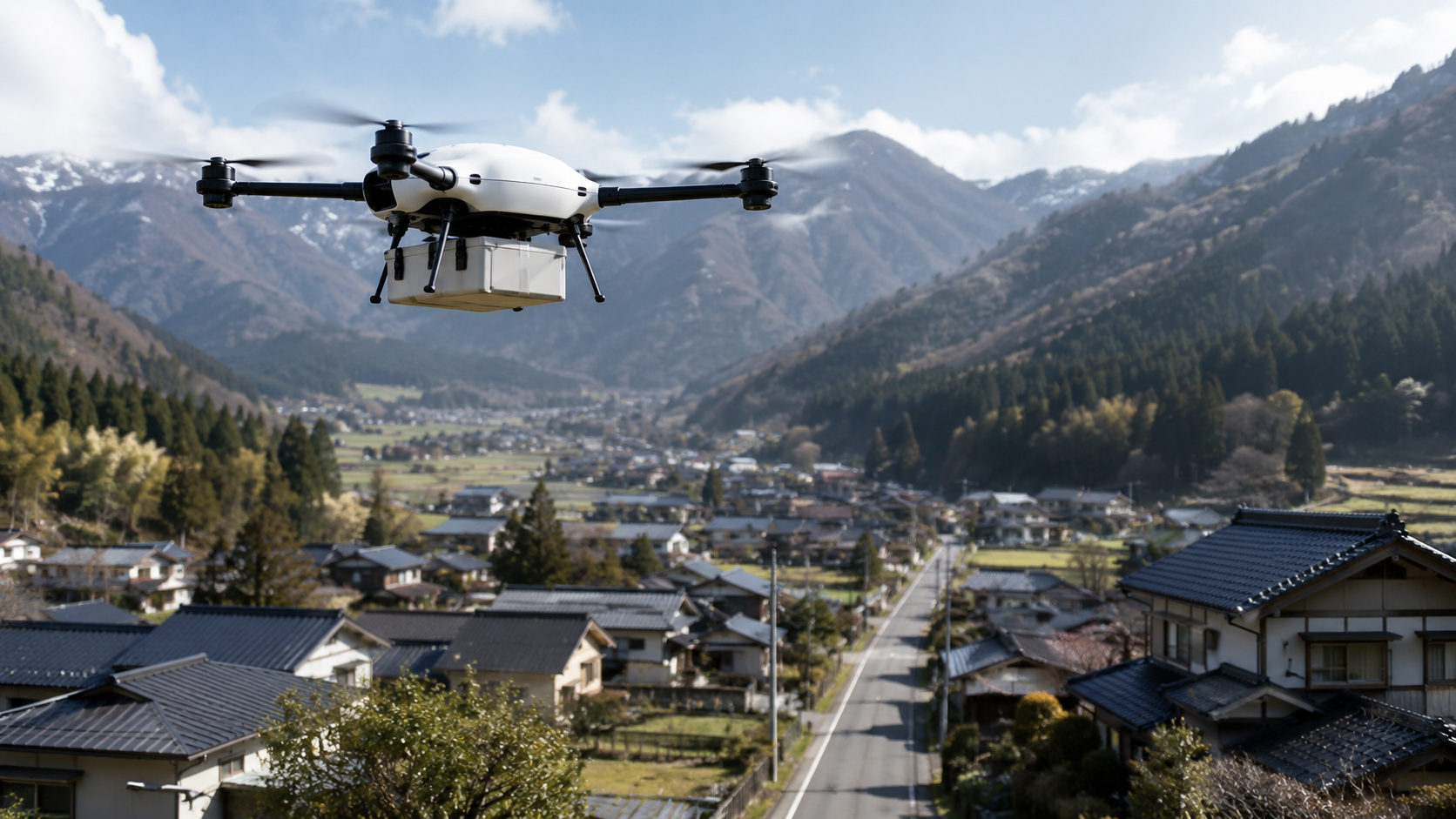
Drone delivery in Japan is not really about pizza. It is about medicine over mountains.
When people hear “drone delivery,” they often imagine a city, a shopping app, and a small package floating toward a balcony. That is the advertising version. Japan’s real drone-delivery story is quieter and more urgent. It lives in mountain villages, on islands, beyond winter passes, in elderly households where shopping requires a car, and in towns where the delivery driver is aging out of the job as quickly as the population is thinning.
That is why Aeronext and its strategic subsidiary NEXT DELIVERY matter. Their story is not simply about a flying machine. It is about the slow breakdown of rural logistics in a country where depopulation is not a theory. It is a daily operating condition.
In June 2026, Aeronext announced that it would unveil a new Japanese-made logistics drone equipped with its proprietary ActiveWing® technology at Japan Drone 2026. The idea is direct: movable auxiliary wings generate lift during flight, giving a multicopter-style aircraft better stability and longer-range potential. Drone delivery has always hit the same wall: range, payload, wind, operating rules, reliability, and economics. ActiveWing® is an attempt to push against the range-and-efficiency part of that wall.
Aeronext is an aircraft-technology company, but it is also trying to build the market
Calling Aeronext a drone maker is not wrong, but it is too small. The company is an IP-driven research and development startup built around aircraft-structure ideas, including its 4D GRAVITY® design approach. At the same time, through NEXT DELIVERY, it is also trying to operate the kind of delivery infrastructure that gives those aircraft a real market.
That combination matters. Many drone companies can show a prototype. Fewer can explain where the depot sits, how the order is received, who manages the flight, who handles bad weather, and how the system works for elderly residents who may not want to live inside a smartphone app. Logistics is never just the vehicle. It is the boring middle layer that makes the vehicle useful.
4D GRAVITY® is Aeronext’s structural-design idea for improving industrial-drone stability, efficiency, and mobility by optimizing aircraft center-of-gravity behavior. ActiveWing® adds another answer to the same practical question: how do you keep the vertical takeoff advantage of a multicopter while gaining some of the flight efficiency associated with wings?
A fixed-wing drone can travel efficiently, but it does not like tiny landing sites. A multicopter can lift off and land almost anywhere, but it pays for that flexibility in battery life. Aeronext’s ActiveWing® concept lives between those two worlds. That is exactly where rural delivery lives too: not glamorous enough for a science-fiction poster, but too difficult for the old delivery model to ignore.
NEXT DELIVERY and SkyHub®: a drone alone is not a logistics system
Japan’s rural-delivery problem cannot be solved by buying a drone and hoping the future arrives. The package has to come from somewhere. Someone has to consolidate it. Someone has to operate the flight. Someone has to handle the no-fly day. Someone has to deal with the resident who needs medicine but does not want to manage a complicated app. The aircraft is the visible part, but the system is the business.
That is where SkyHub® comes in. Developed and deployed by Aeronext and Seino Holdings, SkyHub® is a smart logistics platform that combines existing ground delivery with drone delivery. It treats drones as part of a regional logistics network, not as a magic replacement for the truck, the depot, the clerk, or the local route.
NEXT DELIVERY was established in 2021 in Kosuge Village, Yamanashi Prefecture, as Aeronext’s strategic subsidiary and core drone-delivery operator. That location is not a detail. It tells the story. This is not a Tokyo rooftop stunt. It is a small-village infrastructure experiment.
Aeronext’s group mission speaks of building new social infrastructure for the “100-year life era” and making sure prosperity reaches every corner of society. That could sound like startup poetry. In rural Japan, it is quite literal. If people can live longer but services retreat from their communities, the 100-year life era becomes a logistics problem.
Why Level 3.5 matters more than it sounds
Drone delivery is often delayed less by imagination than by rules. A drone can fly in a laboratory. It can fly in a demo. Commercial service is different. The questions become legal, operational, and social: who is watching, what is below, what happens if the weather turns, where is the route, and who is responsible?
Aeronext and NEXT DELIVERY have pushed forward through actual operations, including Japan’s first Level 3.5 flight approval and flight. That small-sounding regulatory category matters because it can accelerate commercialization by allowing more flexible beyond-visual-line-of-sight operations in appropriate conditions. In drone logistics, regulatory progress is infrastructure progress.
The group’s work around a stable delivery route from Utsunomiya Hospital also points to the most credible early market. Food delivery may be useful. Medical delivery can be essential. Once a route can move meals, it may later move medication, blood samples, or urgent medical supplies. That is the kind of use case that earns trust, because the need is obvious.
The Noto earthquake lesson: normal logistics and emergency logistics should not be separate worlds
The 2024 Noto Peninsula earthquake made Japan’s geography brutally visible again. Roads broke. Communities were isolated. Ground logistics became fragile. Aeronext has pointed to its experience with Japan’s first drone-based medical deliveries to isolated areas during that disaster as part of the reason it is working with governments on a SkyHub® Emergency Package.
The important word here is “phase-free.” A drone logistics system used only for disasters risks becoming an expensive emergency toy: impressive, underused, and poorly integrated into daily life. A system used only for normal shopping may fail when the road disappears. The stronger idea is an infrastructure layer used in ordinary days and available in extraordinary ones.
Japan does not experience disasters as exceptions. Earthquakes, heavy rain, landslides, typhoons, snow, and remote geography are part of the operating environment. If drone delivery is judged only as a convenience service, it looks small. If it is judged as a redundancy layer for rural logistics, the story changes.
The last mile gets heavier as the population gets thinner
In logistics, the last mile is the final stretch from the distribution system to the receiver. In cities, density helps. There are many customers, short distances, multiple deliveries per block, and enough volume to justify routes. Rural Japan is the reverse. Houses are farther apart. Roads bend around mountains. Weather matters. The number of parcels per kilometer can be low. Drivers are harder to hire. The economics get worse precisely where the social need remains high.
This is not just a private-sector profitability problem. The arrival of goods is part of the right to keep living somewhere. Medicine, food, newspapers, welfare supplies, government materials, disaster goods, and daily necessities all depend on logistics. When the delivery network thins, the village thins with it.
SkyHub® is interesting because it does not pretend drones can do everything. It attempts to redesign the regional logistics density by combining depots, ground delivery, drone routes, local operations, and user touchpoints. The drone is only one part of the machine. But without the drone, the difficult mountain crossing may remain the part no one can afford.
The meaning of a Japanese-made logistics drone
Aeronext’s emphasis on a Japanese-made logistics drone fits the larger 2026 drone-industry story. Economic security is no longer a defense-only phrase. It is also about who supplies the aircraft used by municipalities, hospitals, emergency operators, and regional logistics networks. If drones carry medicine, disaster supplies, infrastructure data, or public-service payloads, the origin of the hardware and software matters.
Japan has already been moving away from seeing drones only as imported tools. Domestic players such as ACSL, PRODRONE, Liberaware, Terra Drone, Blue Innovation, and Aeronext are building different layers of the ecosystem: aircraft, operations, inspection, mapping, disaster response, logistics, and airspace management. Aeronext’s contribution is especially interesting because it tries to connect aircraft design to market creation.
Still, “Japanese-made” is not enough. The aircraft has to be reliable, maintainable, cost-effective, insurable, and easy enough for local governments and operators to understand. A domestic drone that cannot survive the operational burden of rural service will not become infrastructure. A domestic drone that can might become something more valuable than a product: a public-service tool.
The hard part: will residents trust the sky?
The obstacle is not only technology. Residents must accept the noise, the routes, the landing points, the prices, the safety assurances, and the privacy implications. A 2026 academic study on Japanese consumer attitudes toward drone delivery found interest in the service, but also highlighted cost and reliability concerns as constraints on adoption. That is common sense. People enjoy the idea of technology. They build their daily lives around trust.
That is why the best early uses may not be ordinary e-commerce. Medical supplies, disaster response, support for shopping-vulnerable residents, scheduled delivery, municipal service, and remote-area logistics are stronger starting points because the necessity is easier to understand. A village does not have to love drones. It has to know that the system works when the road is long, the driver is unavailable, or the bridge is gone.
Over time, the goal is not to make residents say, “Look, a futuristic aircraft.” The goal is for them to say, “The medicine arrived.” That is when a technology becomes part of daily life.
What to watch
| Signal | Why it matters |
|---|---|
| ActiveWing® field performance | The prototype has to prove that longer range, stability, and payload performance matter outside the trade-show floor. |
| SkyHub® deployment | The difference between a demonstration and infrastructure is repeatable local operation. |
| Medical and disaster logistics | These use cases create clearer public value and stronger local-government logic than novelty delivery. |
| Ground-logistics integration | Drones cannot replace trucks, depots, dispatchers, or customer service. They have to plug into them. |
| Resident acceptance | Noise, privacy, safety, price, and trust will decide whether the service becomes normal. |
A small aircraft over the mountains, a big experiment for Japan
The Aeronext and NEXT DELIVERY story is compelling because it begins not with a fantasy city, but with Japan’s real problems. The population is shrinking. Rural areas are aging. Logistics labor is scarce. Disasters happen. Mountains and islands are not going away. A village may look small on a map, but for the people who live there it is the center of the world.
Drone delivery is not a miracle cure. There will be wind, rain, regulations, insurance, maintenance, cost pressure, and skeptical residents. But that is exactly why the Aeronext model is worth watching. It is not only trying to fly a machine. It is trying to redesign how local logistics works.
If drone delivery truly takes root in Japan, people may stop calling it future technology. They will say the medicine came. The newspaper came. The emergency supply arrived. The package crossed the mountain when the road was too slow. That will be enough.
The machine that helps rural Japan may not be a giant robot. It may be a small logistics drone quietly crossing the valley with a box underneath.
- Aeronext announced a new Japanese-made logistics drone with ActiveWing® technology for Japan Drone 2026.
- NEXT DELIVERY is Aeronext’s strategic subsidiary and the core operator for SkyHub® drone logistics.
- SkyHub® combines ground delivery and drone routes rather than pretending drones can replace the entire logistics chain.
- Japan’s rural last-mile problem is tied to depopulation, aging, driver shortages, and disaster resilience.
- The real test will be not the prototype, but repeatable service that residents and municipalities trust.
Sources and references
This article draws on Aeronext’s ActiveWing® logistics-drone announcement, official NEXT DELIVERY and SkyHub® materials, the SkyHub® Training Center announcement, Level 3.5 flight records, J-Startup’s Aeronext profile, Canon Marketing Japan’s investment note, DroneLife’s Japan Drone 2026 coverage, and public research on Japanese consumer attitudes toward drone delivery. Currency display uses the Japan.co.jp market strip rate of US$1 = ¥161.58.
- Aeronext: New Japanese-made logistics drone with ActiveWing® at Japan Drone 2026
- Aeronext: SkyHub®
- NEXT DELIVERY: SkyHub® Training Center
- Aeronext: First Level 3.5 flight approval and flight in Japan
- J-Startup: Aeronext Inc.
- Canon Marketing Japan: Investment in Aeronext
- DroneLife: Aeronext unveils ActiveWing logistics drone prototype
- Destination Drone: Japanese consumer choice behavior and intentions for drone delivery services