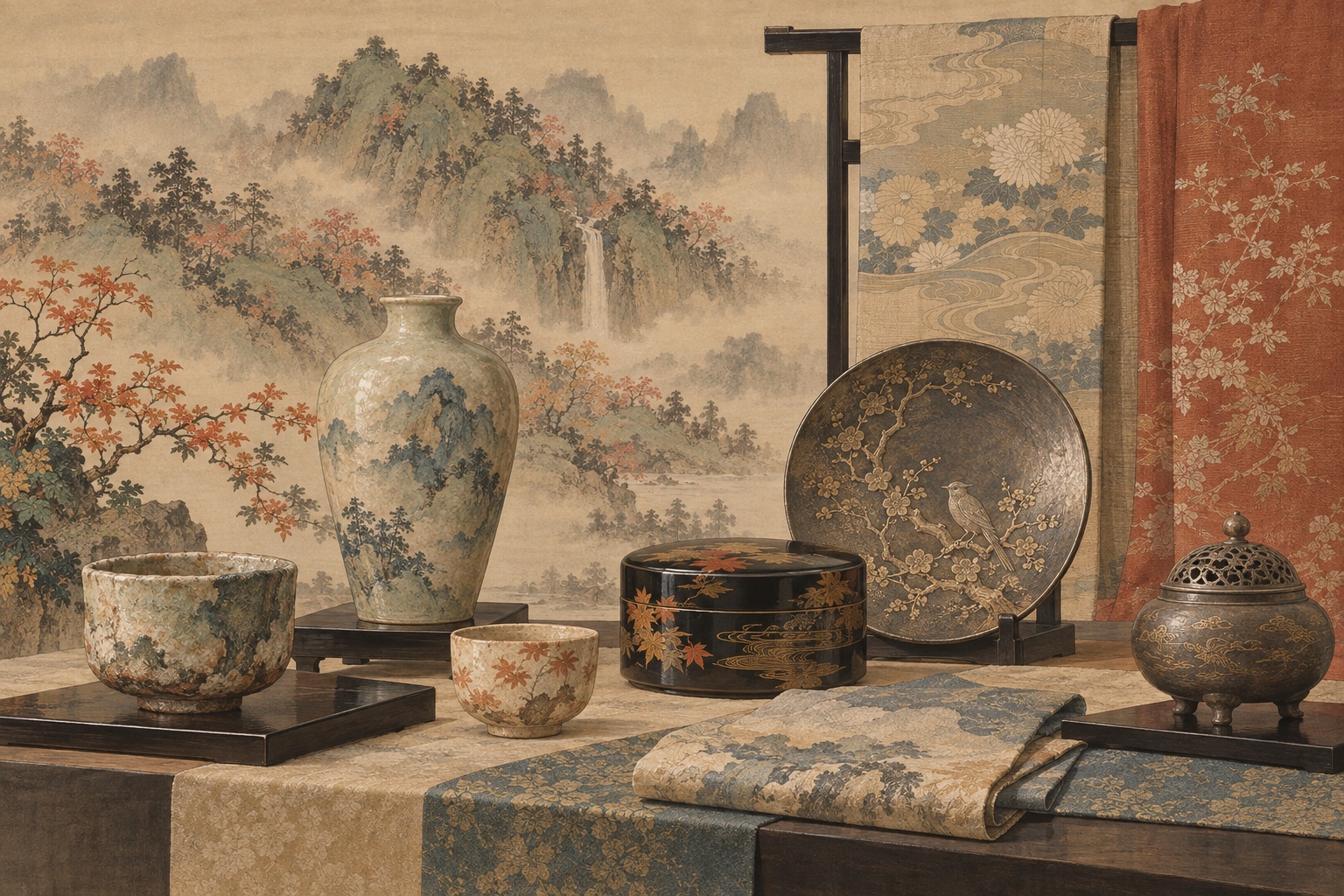
The 73rd Japan Traditional Kōgei Exhibition begins with an unusually direct definition of tradition. Tradition, its official statement says, is “alive and flowing”; it does not mean copying old things or rigidly preserving established technique. That sentence matters because the exhibition at Nihombashi Mitsukoshi is not a retrospective of historical craft. It is a juried survey of work being made now. For 2026, organizers received 1,071 public entries. Of those, 521 were selected, and the Tokyo presentation brings those works together with new pieces by holders of Important Intangible Cultural Property — the artists popularly called Living National Treasures — for a display of roughly 550 works across ceramics, textiles, lacquer, metalwork, wood and bamboo, dolls, and miscellaneous crafts.[1] [2]
The tension is built into the institution. The exhibition exists to protect and develop inherited craft technologies under the spirit of Japan’s Cultural Properties Protection Law. Yet the way it protects them is by requiring artists to keep making. Since 1954, the Japan Kōgei Association has turned preservation into an annual test: can a technique inherited from earlier generations still produce work that belongs unmistakably to the present?[3] [4] [5]
It began in 1954 with the fear that techniques might disappear
The statement for the first exhibition reads like a document from a culture trying to decide what industrial modernization had put at risk. It describes traditional handicrafts being pushed to the margins by modern industry and surviving only because a small number of practitioners continued them with exceptional commitment. After the 1950 Cultural Properties Protection Law created a framework for safeguarding intangible culture, the first exhibition sought to show the public what kinds of traditional craft technology still existed and why they mattered.[4]
That first show was closer to a comprehensive display of protected skill. The institution then changed. From the seventh edition, the exhibition became a nationwide public-entry competition and continued annually. Today the Japan Kōgei Association includes roughly 1,200 regular members, among them holders of Important Intangible Cultural Property, organized through seven specialist divisions and nine regional branches.[3] [5]
The exhibition regulations summarized by the Agency for Cultural Affairs sharpen the point: eligible competitive work is made by the artist, is recent, and is unpublished. Preservation is therefore not achieved by repeatedly showing old masterpieces. It is achieved by making skilled practitioners return to the workshop and produce again.[6]
The 2026 top prize went to bamboo in motion
The Japan Kōgei Association President’s Award — the exhibition’s top honor under the association’s current presidency structure — went to Toshie Ohki’s bamboo flower basket Tōsei, “Sound of the Waves.” Nihombashi Mitsukoshi lists the piece at the head of the 2026 award works. Its object type is deeply traditional: a flower basket. Its visual proposition is not static basketry but movement, rhythm and the implied force of water.[2]
Bamboo is a useful reminder of what this exhibition values. Prestige does not come from expensive material. It comes from knowledge of material. A large bamboo form depends on minute control of strip width, thickness, curvature and tension. Tradition lives in that disciplined control — but the form produced by it does not have to look old.
A kimono turns a childhood memory of mist into structure
Ei Miyairi’s Uki-ori Raw-Silk Kimono “Kisame”, winner of the Minister of Education, Culture, Sports, Science and Technology Award, is built from a personal memory. The Japan Kōgei Association explains that Miyairi recalled summer forests visited with family as a child. Kisame describes droplets falling from mist caught in leaves and branches. Bands of light and green, blue and purple threads produced through warp ikat and floating weave turn that remembered weather into textile structure.[7]
The techniques are inherited. The memory is not. This is the crucial distinction. Kasuri and uki-ori are not being used to recreate an Edo-period pattern; they are being used as a language for humidity, light and falling water remembered by one living maker.
Tamba ash glaze becomes a contemporary field of color
Tokyo Governor's Award winner Shusaku Ichino takes the argument into ceramics. His ash-glazed colored bowl Oboro begins with the vocabulary of Tamba ware and ash glaze. According to the official commentary, several glazes are wiped, sprayed and layered so that colored gradations and vertical flows emphasize the wheel-thrown volume and produce an almost atmospheric image.[8]
Ash glaze is old. The visual field is contemporary. The knowledge of how glaze flows in firing is what allows the maker to manipulate that flow rather than merely accept it. Technical continuity becomes the precondition for controlled departure.
An ancient buried tree carries an image of continuous change
Tetsuya Hayashi’s NHK President's Award work, an ancient zelkova lacquered box titled Seisei Ruten, makes the exhibition’s philosophy almost literal. The lid rises in a twisting twelve-sided structure assembled from curved, carved boards. The exterior is glossy; the inner stacked boxes are matte; wooden pieces form basketry-like patterns at the top and bottom.[9]
The official review interprets the work through the idea that everything changes while memory is inherited. The material — wood altered after centuries buried underground — is old. The form is not nostalgic. It uses old material to speak about transformation itself.
A hoodie, jeans and guitar case can belong to “traditional craft”
Ritsuko Noda’s doll Rhythm, winner of a Japan Kōgei Association Encouragement Award, may be the clearest answer to anyone who equates traditional craft with historical costume. The figure is a contemporary young person in a hoodie and jeans carrying a guitar case. It is made using a lineage of wood-core, paulownia-paste, textile and washi techniques.[10]
The official commentary asks what a traditional craft doll can do with “ordinary contemporary daily life.” That question is more radical than it first sounds. The technique remains recognizable, but the subject walks through a street today. Tradition is relocated from period costume to close observation of the present human body.
Noda’s age makes the piece even more telling: the commentary notes the freshness of the work despite the maker being past her 77th birthday. “New” and “young” are not synonyms. Renewal can come from a senior practitioner looking closely at a younger world.
A newcomer literally puts “2026” in the title
So Urago’s Newcomer Award piece, the pale-blue-white porcelain carved vase Ryūkei—2026—, places the current year in its title. The official description focuses on the relationship between wheel-thrown volume and the sense of flow: subtle relief built into the form, carving added afterward, and shifts of underglaze blue create ridges, shadow and movement.[11]
The existence of a Newcomer Award matters institutionally. The association is centered on some of Japan’s most established craft masters, including Living National Treasures, yet the annual exhibition is also designed to identify new names. Conservation and discovery happen inside the same system.
Kokura stripes become “Abstract Black Butterfly”
Noriko Tsuiki received the Asahi Shimbun Award for a Kokura-stripe cotton obi titled Abstract Black Butterfly. Kokura weaving is associated with dense warp structure and striped textiles from Kitakyushu, but the title announces a contemporary visual problem — abstraction. Tsuiki herself writes that while she holds tradition in deep respect, she continues to seek unknown worlds through thread and color.[12]
That is another form of continuity: retain the material intelligence and woven structure, then ask what a stripe can become when treated as contemporary color and rhythm rather than historical pattern alone.
Living National Treasures and newcomers occupy the same present tense
The Tokyo exhibition also includes recent work by holders of Important Intangible Cultural Property. The association’s 2026 database records, among others, Kunie Komori’s basket-core lacquer tray Nanohana ya…, Fumio Mae’s chinkin vase Seifū, and fifth-generation Sekisui Ito’s Mumyoi nerikomi flower-pattern jar as works of the 73rd exhibition.[13] [14] [15]
A Living National Treasure is often imagined as a custodian of the past. The exhibition makes a different point: holders are still makers. The tacit knowledge being protected — pressure of hand, angle of a blade, selection of material, moment of firing — can only be transmitted fully through continuing practice.
Seven categories organize skill without forcing one visual style
The Japan Kōgei Association divides its work into ceramics, textiles, lacquer, metalwork, wood and bamboo, dolls, and miscellaneous crafts. Those categories matter for training and judging, but they do not produce one unified “traditional” look. Wood can be finished with lacquer; textiles can behave like abstract painting; dolls borrow paper and cloth; lacquer can become vessel, sculpture or surface.
That is why the exhibition’s categories do not freeze aesthetics. They preserve technical lineages precisely enough that viewers can see where artists depart from them. Without names for technique, innovation becomes hard to describe.
The exhibition travels, carrying local craft back into regional contexts
The Tokyo presentation ends September 15, but the 73rd exhibition continues. The official schedule carries works onward through Aichi, Kyoto, Osaka, Miyagi, Ishikawa, Okayama, Shimane, Kagawa, Fukuoka and finally Hiroshima, where the tour runs through March 7, 2027. Regional venues show selected works from the main exhibition.[1]
That circulation is more than logistics. Japanese craft has strong regional geographies. A lacquer work read in Ishikawa, a Kokura textile seen in Fukuoka, or a ceramic shown near its material and kiln culture carries different associations than the same object in Tokyo. Touring allows the national exhibition to reconnect with the local ecosystems from which many techniques come.
- Ask not whether a technique is old, but what the artist is making it express now.
- Look beyond material prestige and examine how completely the maker controls the material's behavior.
- Compare Living National Treasure works and newcomer works as simultaneous present-day production, not simply past versus future.
- Watch how functional forms — bowl, obi, doll, box, basket — move toward autonomous visual expression without abandoning use or structure.
- Notice the language of the titles: mist, haze, continuous change, rhythm and abstraction are contemporary ways of naming inherited craft.
Keeping tradition alive does not mean making the same thing again
The first exhibition in 1954 emerged from fear that valuable skills might disappear. That danger has not vanished. A technique depends on people who produce materials, make tools, teach processes, buy or use objects, and choose to spend years learning difficult work. A photograph of a masterpiece cannot preserve any of that by itself.
But the exhibition’s answer has never been simply “make the old form again.” Its official purpose asks practitioners to refine inherited technique while building something new that belongs to contemporary life. The language survives because it refuses to make preservation and change opposites.
A hoodie-wearing doll, an abstract Kokura obi, a kimono woven from the memory of mist, and a twisting box made from ancient wood can all qualify as traditional kōgei. What unites them is not appearance. It is the depth of technical knowledge beneath a form that could only have been made by this maker, now.
Tradition survives not because it stands still. It survives because it moves without losing the knowledge that lets it move. The 73rd Japan Traditional Kōgei Exhibition is, at its best, an annual public test of that difficult balance.
- Japan Kōgei Association: 73rd Japan Traditional Kōgei Exhibition — purpose, Tokyo dates and national tour
- Nihombashi Mitsukoshi: 73rd exhibition — 1,071 public entries, roughly 550 works shown and major prize winners
- Japan Kōgei Association: organization, approximately 1,200 regular members, seven specialist divisions and nine regional branches
- Japan Kōgei Association: statement for the first exhibition in 1954
- Japan Kōgei Association: exhibition history — annual continuation and nationwide public-entry format from the seventh edition
- Agency for Cultural Affairs: purpose, seven categories, entry requirements and award system
- Japan Kōgei Association: Ei Miyairi, Uki-ori Raw-Silk Kimono 'Kisame,' Minister of Education, Culture, Sports, Science and Technology Award
- Japan Kōgei Association: Shusaku Ichino, ash-glazed colored bowl 'Oboro,' Tokyo Governor's Award
- Japan Kōgei Association: Tetsuya Hayashi, ancient-zingiber? zelkova lacquered box 'Seisei Ruten,' NHK President's Award
- Japan Kōgei Association: Ritsuko Noda, doll 'Rhythm,' Japan Kōgei Association Encouragement Award
- Japan Kōgei Association: So Urago, celadon-white porcelain vase 'Ryukei—2026—,' Newcomer Award
- Noriko Tsuiki official site: Kokura-stripe cotton obi 'Abstract Black Butterfly,' Asahi Shimbun Award
- Japan Kōgei Association: Kunie Komori, holder of the Important Intangible Cultural Property kyushitsu, with a 73rd-exhibition work
- Japan Kōgei Association: Fumio Mae, holder of the Important Intangible Cultural Property chinkin, with a 73rd-exhibition work
- Japan Kōgei Association: fifth-generation Sekisui Ito, holder of the Important Intangible Cultural Property Mumyoi ware, with a 73rd-exhibition work
Editorial note: The figures of 1,071 public entries, 521 selected works and roughly 550 works in the Tokyo presentation come from Nihombashi Mitsukoshi's official exhibition notice. The entry requirements described as recent/self-made/unpublished are drawn from Agency for Cultural Affairs documentation summarizing the Japan Traditional Kōgei Exhibition regulations. Official Japan Kōgei Association work pages were preferred for readings, techniques and award commentary. Where no official work commentary was available, this article does not invent process details.