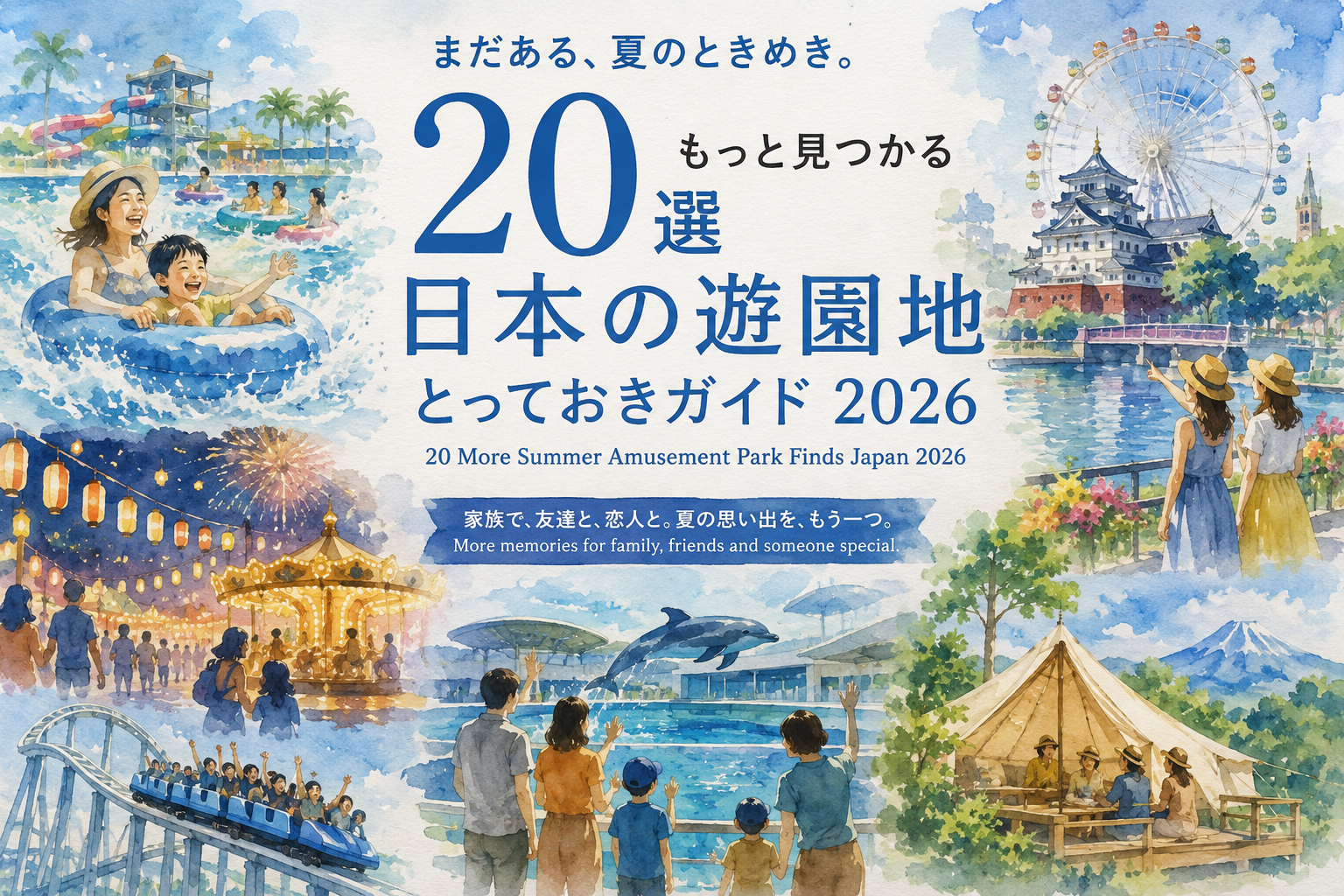
The first 10 reports in this summer amusement-park edition carry the freshest news: USJ, Fuji-Q, Yomiuriland, Huis Ten Bosch, Nagashima, Seibuen, Suzuka, Hakkeijima, Adventure World and Moominvalley. But Japan’s amusement map is much wider than one top list can hold.
This companion guide is built for readers who want to keep exploring. Some of these parks are globally famous. Others are regional, nostalgic, strange, practical or perfect for one specific kind of family trip. Together, they show why Japan’s summer leisure culture is not one thing. It is Disney spectacle, Sanrio cuteness, Edo performance, Okinawan caves, Kyushu coasters, Hokkaido resort air and a Ferris wheel glowing over Yokohama harbor.
1. Tokyo DisneySea
Tokyo DisneySea remains one of Japan’s great pieces of place-making. Built around the myths, moods and ports of the sea, it feels less like a standard ride collection and more like a walkable fantasy geography: volcanoes, canals, harbors, palaces, restaurants and nighttime water reflections folded into one resort day. In summer, that matters. The park’s waterfront atmosphere, evening light and show-driven pacing make the heat feel less like an obstacle and more like part of the journey.
For 2026, the park’s 25th-anniversary “Sparkling Jubilee” context gives DisneySea extra reason to appear in this roundup. It is the Disney park that exists only in Japan, and that uniqueness still carries enormous tourism value. Families come for headline attractions, but the deeper pleasure is the way the park turns walking, dining, waiting, watching and cooling down by the water into a full-day story.
Phone: Tokyo Disney Resort Information Center: 050-3090-2742 / +81-50-3090-2742
Direct website: https://www.tokyodisneyresort.jp/en/tds/
2. Tokyo Disneyland
Tokyo Disneyland opened in 1983 as the first Disney theme park outside the United States, and its impact on Japanese leisure culture is hard to overstate. It helped reset expectations for family entertainment, hospitality, cleanliness, crowd management and seasonal programming. Today it may feel like a familiar classic, but that familiarity is part of its power.
In summer, Tokyo Disneyland becomes especially readable as a family memory machine. The castle photos, cool indoor rides, evening parades, splashy seasonal events and first-time visits for children all work together. This is not the hidden pick of the list. It is the benchmark: the place against which many Japanese summer theme-park days are still measured.
Phone: Tokyo Disney Resort Information Center: 050-3090-2742 / +81-50-3090-2742
Direct website: https://www.tokyodisneyresort.jp/en/tdl/
3. Tokyo Dome City Attractions
Tokyo Dome City Attractions is valuable because it is woven directly into central Tokyo. This free-entry urban amusement area sits beside baseball, concerts, hotels, spa facilities, restaurants and shopping. For travelers, that makes it less a full-day expedition and more a flexible amusement stop that can fit between bigger plans.
In summer, flexibility is everything. Tokyo Dome City works well when the weather changes, when families need a few rides without committing to a resort day, or when visitors want an evening thrill after sightseeing. Its appeal is not total escape from Tokyo. Its appeal is that the amusement park is part of Tokyo’s daily rhythm.
Phone: 03-3817-6001
Direct website: https://en.www.at-raku.com/
4. Yokohama Cosmo World
Yokohama Cosmo World has become part of Yokohama’s skyline. Its Cosmo Clock 21 Ferris wheel anchors the Minato Mirai waterfront, turning the harbor, high-rises, promenades and shopping districts into one highly photogenic city amusement scene. Free admission and pay-per-ride tickets make it easy to use casually.
Summer visits are best in the late afternoon and evening, when the heat softens and the lights come on over the water. Cosmo World is not only about thrill rides. It is about the pleasure of a harbor city using amusement lights to make a walk feel festive.
Phone: 045-641-6591
Direct website: https://cosmoworld.jp/?lang=en
5. Tobu Zoo / Tobu Dobutsu Koen
Tobu Zoo is exactly what its Japanese branding promises: a hybrid leisureland combining zoo, amusement park, seasonal flowers and summer pool culture. For families, that mix is practical. Different children can want different things and still remain inside one destination.
As a suburban day trip from Tokyo, it fits summer especially well. Start with animals, shift to rides, cool down at the pool when available, and slow the pace in green spaces. Tobu Zoo’s strength is not only spectacle. It is the way it helps families keep a long summer day moving.
Phone: 0480-93-1200
Direct website: https://www.tobuzoo.com/
6. Sanrio Puroland
Sanrio Puroland is also one of Tokyo’s most practical summer parks. Because it is indoors, visitors can escape heat, rain and harsh sun while enjoying characters, parades, shows, food and photo spots. It is kawaii, yes, but it is also climate-smart.
Opened in 1990, Puroland turned Japan’s character culture into a place people could physically enter. Hello Kitty, My Melody, Cinnamoroll and the wider Sanrio world become not just merchandise but a destination. For a cool, intensely themed half day in Tokyo, it still works beautifully.
Phone: 042-339-1111
Direct website: https://en.puroland.jp/
7. Harmonyland
Harmonyland in Oita is the outdoor Kyushu counterpart to Sanrio’s Tokyo world. If Puroland is an indoor theater of kawaii, Harmonyland is about sky, hills, parades, rides and family photos in open air. That gives the Sanrio universe a different feeling.
It also pairs naturally with Beppu and Oita travel. For families planning a hot-spring trip, Harmonyland adds a child-centered purpose without breaking the regional itinerary. In summer, plan for heat, use the morning and late afternoon well, and treat the park as part of a wider Kyushu family holiday.
Phone: 0977-73-1111
Direct website: https://www.harmonyland.jp/
8. LEGOLAND Japan Resort
LEGOLAND Japan Resort in Nagoya is built for younger families. Its value lies in rides, LEGO models, workshops, water-play elements, themed hotel stays and SEA LIFE Nagoya rather than extreme thrills. Children are invited to build, steer, discover and participate.
In summer, the park’s mix of indoor and outdoor activity becomes important. The Kinjo-futo location is easy to understand from Nagoya Station via the Aonami Line, making the resort a clean fit for Tokai family travel. This is a place where children can genuinely lead the day.
Phone: 0570-05-8605 / +81-50-5840-0505
Direct website: https://www.legoland.jp/en/
9. Nijigen no Mori
Nijigen no Mori on Awaji Island is a newer kind of Japanese theme park: anime, manga, games and technology placed inside a broad natural park. Rather than enclosing everything in one building, it uses terrain, walking routes, day-to-night changes and large-scale outdoor installations.
For Kansai summer travel, it can connect Osaka, Kobe and Awaji Island into one pop-culture itinerary. Heat planning matters because visitors move outdoors, but the reward is scale and atmosphere. It is a strong example of Japan’s content industry becoming a physical landscape.
Phone: 0799-64-7061
Direct website: https://nijigennomori.com/en/
10. Edo Wonderland Nikko Edomura
Edo Wonderland Nikko Edomura is less an amusement park than a place where visitors step into a performed period. Streets, ninja, samurai, townspeople, shows, costumes, food and gesture combine to make the Edo period walkable and theatrical.
In summer, the outdoor period-drama atmosphere feels especially vivid. Wooden-style streets, performance spaces, costume experiences and ninja shows turn history into movement. For international travelers, it is accessible cultural entertainment; for Japanese visitors, it reconnects theme-park fun with the memory of jidai-geki storytelling.
Phone: 0288-77-1777
Direct website: https://edowonderland.net/en/
11. Shima Spain Village Parque España
Shima Spain Village layers Spanish streets, shows, rides, hotel stays and hot-spring resort elements onto the Ise-Shima coast. Its charm is not only big attendance. It has space, color and a slightly eccentric sincerity that has earned renewed affection online.
In summer, the park works well with parades, evening hours, fireworks and resort stays. Pair it with Ise Grand Shrine, Toba or Kashikojima and it becomes part of a wider Ise-Shima holiday rather than a standalone theme-park visit. The theme is Spain, but the travel feeling is very Japanese: a coastal family resort.
Phone: 0599-57-3333
Direct website: https://www.parque-net.com/foreign/
12. Himeji Central Park
Himeji Central Park combines a safari park and amusement park into one major Kansai leisure destination. Visitors can drive through safari areas, meet animals on foot, ride thrill and family attractions, use the summer pool and return in winter for skating.
Its location also pairs naturally with Himeji Castle tourism. A family day can move from history in the morning to animals, rides and water play later. In summer, the mix of safari, amusement rides and pool culture makes it especially useful for travelers with children.
Phone: 079-264-1611
Direct website: https://www.central-park.co.jp/en/
13. Hirakata Park
Hirakata Park, affectionately known as Hira-pa, is Osaka’s everyday amusement park. Its history reaches back to the early 20th century, and its identity is rooted less in resort spectacle than in repeat local affection from families, students, couples and children.
Summer brings pool culture, seasonal events and easy Keihan Railway access between Osaka and Kyoto. The park’s endurance is its story. Hirakata Park proves that a beloved local amusement park can become part of a region’s emotional infrastructure.
Phone: 0570-016-855
Direct website: https://www.hirakatapark.co.jp/
14. Brazilian Park Washuzan Highland
Washuzan Highland’s greatest asset is its view over the Seto Inland Sea and the Great Seto Bridge. Its Brazilian Park theme, rides, Ferris wheel, coasters and summer pool combine with one of western Japan’s most memorable coastal panoramas.
It works best as part of a Setouchi or Kurashiki-area trip. Instead of stopping with historic streets alone, visitors can add sea, bridge and amusement-park strangeness to the day. It is quirky, nostalgic and visually strong.
Phone: 086-473-5111
Direct website: https://www.w-highland.co.jp/global_en/
15. Kijima Kogen Park
Kijima Kogen Park sits on the highland between Beppu and Yufuin, giving it a different atmosphere from flat urban parks. Its signature wooden coaster Jupiter, thrill rides, family attractions and children’s areas make it a useful amusement addition to an Oita hot-spring trip.
The highland setting matters in summer. Pair Beppu’s onsen culture, Yufuin’s walking streets and Kijima’s rides and the region becomes much easier to enjoy for mixed-age families. It is one of Kyushu’s quietly dependable amusement choices.
Phone: 0977-22-1165
Direct website: https://www.kijimakogen-park.jp/
16. Greenland Kumamoto
Greenland in Arao, Kumamoto is one of western Japan’s major amusement parks, known for scale and variety. With more than 70 attractions, coasters, Ferris wheel, family rides, summer pool, hotel, onsen and golf facilities, it functions as a broad leisure resort.
Its former identity as Mitsui Greenland also connects it to the industrial history of the old coal-mining region. For families who simply want many rides and a full summer day, it is one of Kyushu’s strongest candidates, accessible from Fukuoka, Kumamoto and Nagasaki travel routes.
Phone: 0968-66-1112
Direct website: https://www.greenland.co.jp/park/
17. Rusutsu Resort Amusement Park
Rusutsu Resort is famous for winter skiing, but its summer amusement park deserves attention. Open skies, views toward Mt. Yotei, gondolas, golf, hotels and outdoor rides give it a spacious Hokkaido feeling far from the humidity of mainland summer.
For family travel, it pairs well with Sapporo, Lake Toya and Niseko-area itineraries. In summer, cool air is part of the attraction. Rusutsu is best planned not just as a ride stop but as a resort day with scenery, lodging and room to breathe.
Phone: +81-136-46-3331 / +81-136-46-3111
Direct website: https://rusutsu.com/en/amusement-park/
18. Nago Pineapple Park
Nago Pineapple Park is not a giant thrill park, but it is a delightful Okinawan family attraction. Automatic carts, tropical plants, pineapples, sweets, shopping and winery-like elements make it a manageable, weather-flexible stop in northern Okinawa.
On a summer Okinawa trip, beach-only days can become exhausting. Adding a short, playful stop like this to a Nago-area drive gives children movement and treats while adults get agricultural tourism, local products and an easy break from sun exposure.
Phone: 0980-53-3659
Direct website: https://www.nagopine.com/
19. Okinawa World
Okinawa World packages several Okinawan experiences into one accessible theme park: Gyokusendo Cave, Ryukyu Kingdom-style streets, Eisa performance, craft workshops and the Habu Museum Park. In summer, the coolness of the limestone cave is not just atmospheric; it is practical.
For southern Okinawa sightseeing, it pairs well with sacred sites, peace memorials and coastal drives. This is not a standard amusement park. It is an entry point into Okinawa’s geology, performance, crafts and tourism culture, with welcome shade and underground cool.
Phone: 098-949-7421
Direct website: https://www.gyokusendo.co.jp/okinawaworld/
20. Toei Kyoto Studio Park / Uzumasa Kyoto Village
Toei Kyoto Studio Park, now also presented through the Uzumasa Kyoto Village identity, is a walkable theme park built on Kyoto’s period-drama and studio history. Edo streets, ninja, samurai, costume experiences, shows and the memory of film and television make it a different kind of Kyoto attraction.
With major renewal efforts around 2026, the park is becoming more legible to international travelers and adults while retaining family appeal. Kyoto summer is hot, but for families who need more than temples and museums, the studio park offers culture, photographs, performance and play in one destination.
Phone: 0570-064349
Direct website: https://global.toei-eigamura.com/
Sources and references
This article uses official park websites, official tourism pages and local tourism authority information to verify addresses, phone numbers and direct official websites. Hours, fees, closures and seasonal events can change. Always check each official website before visiting.
- Tokyo Disney Resort / Information Center
- Tokyo Dome City Attractions, Yokohama Cosmo World, Tobu Zoo
- Sanrio Puroland, Harmonyland, LEGOLAND Japan
- Nijigen no Mori, Edo Wonderland, Shima Spain Village
- Himeji Central Park, Hirakata Park, Washuzan Highland
- Kijima Kogen Park, Greenland, Rusutsu Resort
- Nago Pineapple Park, Okinawa World, Toei Kyoto Studio Park