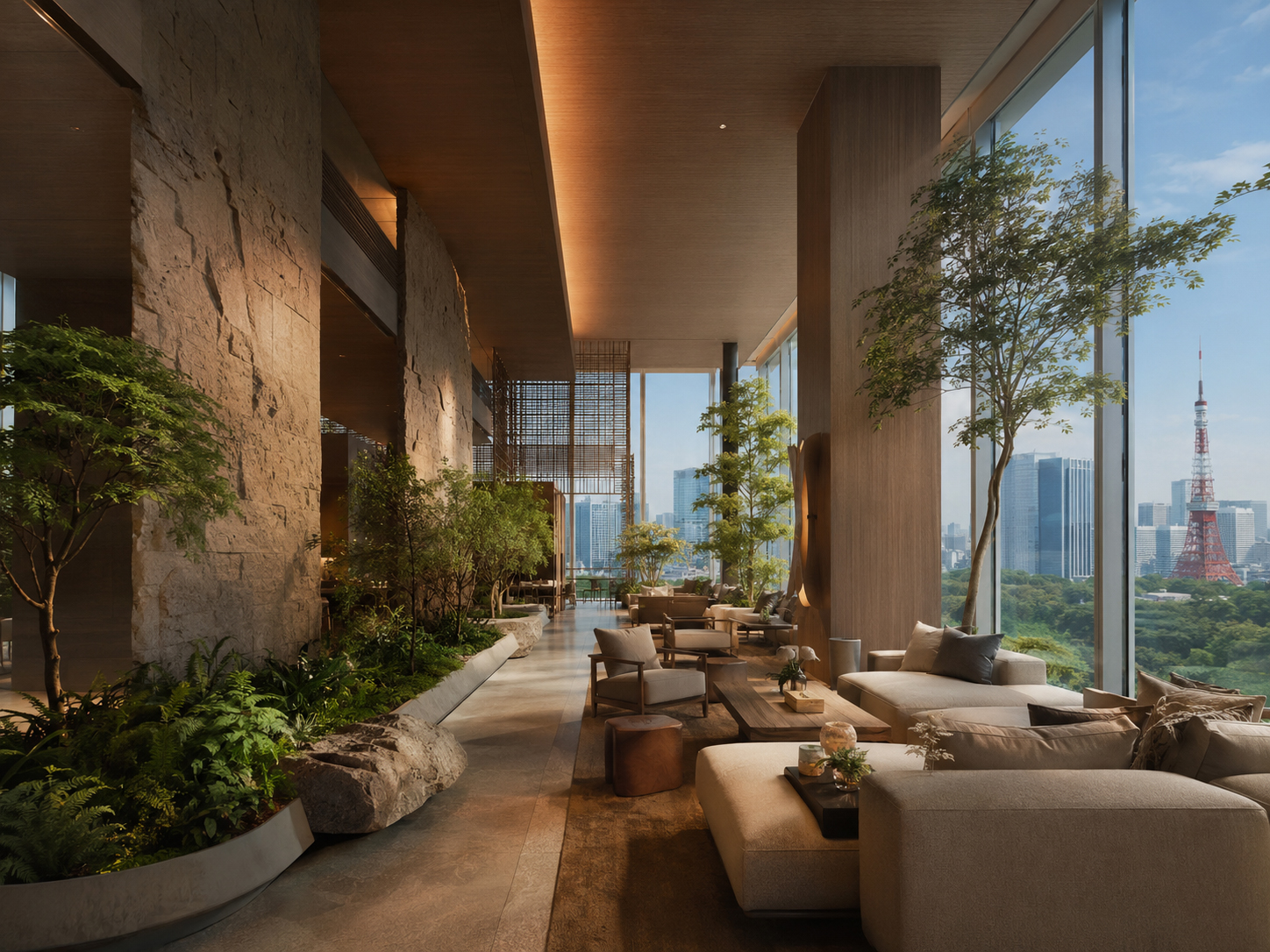
Tokyo hotels have long been machines for framing the city. They lift guests above the traffic and show them the Imperial Palace gardens, Tokyo Tower, the lights of Roppongi, the ministries of Kasumigaseki and the layered skyline that runs toward Tokyo Bay. 1 Hotel Tokyo asks a different question. What if luxury is not more marble, more shine, more spectacle? What if luxury in Tokyo now means a quieter room, a softer material, a living wall, filtered water, better sleep and a reminder that even the world’s largest city is still part of nature?
That is the promise of 1 Hotel Tokyo, the first Japanese property from the nature-led luxury brand. The hotel opened in Akasaka Trust Tower, occupying floors 38 through 43, with 211 guestrooms including 24 suites and three penthouses. Starwood Hotels describes the project as a meeting point between 1 Hotels’ biophilic design philosophy and Japan’s deep respect for materials, craft and restraint. In other words, it is not trying to import a generic green hotel into Tokyo. It is trying to translate the brand through Tokyo.
Why 1 Hotels makes sense in Tokyo
1 Hotels was launched in 2015 as a nature-inspired luxury lifestyle brand. Its founder, Barry Sternlicht, had already changed hotel culture once through W Hotels, turning the hotel from a predictable sleeping box into a place of mood, nightlife and design. 1 Hotels represents a later question: after the age of lifestyle glamour, what should luxury feel like in a warming, crowded, resource-conscious world?
The brand’s answer has been greenery, reclaimed materials, energy-conscious operations, local food, wellness and a softer kind of social life. It wants sustainability to feel desirable rather than punitive. That matters in Japan because the country already has a powerful design tradition built around nature: gardens, borrowed scenery, tea rooms, cedar, stone, moss, seasonal food, shadows and imperfection. The Japanese word often invoked here is wabi-sabi, but the deeper idea is older and broader: beauty is not separate from time, weather, texture and place.
Akasaka: the right stage
Akasaka is one of Tokyo’s most layered neighborhoods. It sits close to the old edge of Edo Castle and between the centers of politics, business, diplomacy and entertainment. The official Tokyo tourism guide describes it as a sophisticated mix of upscale bistros, luxury hotels and corporate headquarters, with shrines, backstreets and major landmarks nearby. It is adult Tokyo: powerful, polished, expensive, discreet and full of history.
That makes Akasaka an intriguing setting for a nature-led hotel. Tokyo World Gate Akasaka was conceived as a mixed-use district bringing business, culture and green space together. Mori Trust president and CEO Miwako Date has described the development as part of Tokyo’s future: a district where hospitality, environmental performance and design integrity can strengthen Akasaka’s evolution. 1 Hotel Tokyo does not simply occupy a tower. It becomes part of an urban-development argument.
From street to canopy
The most poetic idea in the hotel’s opening materials is the ascent. At street level, greenery marks the shift away from Tokyo’s kinetic energy. Guests rise through the tower as if moving up the trunk of a tree, then emerge into a 38th-floor lobby conceived as a canopy. It is a simple metaphor, but a useful one: the guest is not just checking in. The guest is being moved from speed to stillness.
Interiors by CRÈME use organic cues throughout the property. Wood ceiling details suggest bark. Textured walls evoke the movement of air. An Oya stone wall nods to the stonework around the Imperial Palace moat. Rooms include art made from preserved moss and recycled pallets, locally crafted décor and curated greenery. The effect is important because many Tokyo luxury hotels sell the view. 1 Hotel Tokyo sells the view, but also asks guests to look at the materials around them.
The hard part: sustainable luxury
“Sustainable luxury” can sound contradictory. Luxury hotels use water, power, linen, food, air-conditioning, labor and transport. International travel carries its own footprint. A hotel that wants to use sustainability as a central promise must therefore do more than place plants in the lobby. It must change the building, the operation, the guest experience and the story.
1 Hotel Tokyo says it has achieved CASBEE Rank S, the highest level of Japan’s built-environment performance assessment. Opening materials cite reduced energy and water consumption, rainwater and greywater recycling, and furniture, fixtures and equipment made from reclaimed and recycled materials. The official hotel page also highlights filtered water taps, recycled wine-into-water glasses and the “1 Less Thing” clothing-donation program. These are small details, but in luxury hospitality small details are the language.
Making environmental design feel good
The danger for sustainable hotels is moral heaviness. If a guest feels scolded, the hotel has failed. If the design feels like a lecture, the guest checks out emotionally before checkout. 1 Hotels has generally succeeded because it frames sustainability as comfort: softer rooms, warmer textures, better air, better water, less waste, more daylight, more plants, more local connection. It makes doing less feel like receiving more.
Tokyo intensifies that challenge. It is a dense, fast, bright, restless city. The best Tokyo hotels do not fight the city; they give guests the strength to reenter it. A living wall, a quiet lobby, a tactile stone surface or a tree-framed skyline is not just decoration. It is a reset button.
Dining: two coasts, two cultures
The hotel’s main restaurant, NiNi, is one of its most important public faces. Led by head chef Nikko Policarpio, whose résumé includes Michelin-starred restaurants in Tokyo and senior roles with David Chang’s Momofuku group in Toronto, NiNi is described as a meeting of two coasts and two cultures. The name plays on “TwoTwo,” and the food links the relaxed elegance of the French Riviera with Japanese refinement. Provençal herbs, olive oil, seafood and citrus are reworked through Japanese seasonality and restraint.
That matters because modern Tokyo hotels are no longer sealed boxes for travelers. Restaurants, cafés and bars are how locals enter the hotel. A good hotel dining room can become a neighborhood living room, a business lunch room, a weekend-brunch room, a date-night room and a destination for visitors. With NiNi, Spotted Stone and Neighbors Café, 1 Hotel Tokyo is trying to become part of Akasaka’s daily rhythm, not just its skyline.
Wellness as the new Tokyo luxury
The meaning of luxury has changed. A generation ago, it meant grand lobbies, heavy curtains, thick carpets and polished stone. Today, many travelers want sleep, light, movement, fresh air, a good breakfast, a calm spa, a good gym and the ability to work and rest in the same trip. The official hotel page emphasizes a wellness spa, indoor pool, saunas, gym and personal training, along with nature-led rooms and in-room wellness cues.
This is especially relevant in Tokyo. The city can overwhelm even people who love it. Trains, meetings, restaurants, museums, late nights, shopping, crowds and jet lag all accumulate. A hotel that helps guests regulate their bodies becomes more than accommodation. It becomes part of the travel experience itself.
The view upward, the memory downward
The beautiful contradiction of 1 Hotel Tokyo is that it sits high in the sky while constantly pointing back to the ground. The hotel offers tower and city views, but its design language keeps returning to wood, stone, moss, greenery, recycled materials and local craft. That combination is deeply Tokyo. The city is full of towers, but also shrines, gardens, alleys, slopes and seasonal rituals. It is glass and moss at the same time.
Nearby are Hie Shrine, Toyokawa Inari Tokyo Betsuin, the Akasaka Palace, Hotel New Otani’s garden, Kioicho, Toranomon and Roppongi. Politics, diplomacy, prayer, nightlife, food and hospitality all sit close together. 1 Hotel Tokyo adds a new layer to that map: nature-led luxury at the top of a tower.
Where it fits in Japan’s hotel boom
Japan’s hotel landscape has changed dramatically. International luxury brands are expanding. Domestic hotel groups are repositioning. Ryokan traditions are being reimagined. Airport hotels, long-stay hotels, art hotels, wellness resorts and regional food-led inns are all competing for attention. Travelers no longer ask only where to sleep. They ask what the stay says about the city.
That is why 1 Hotel Tokyo is interesting. It brings a point of view. It is not merely another high-end hotel with nice views and expensive rooms. It argues that future luxury in Japan will be measured by materials, environmental performance, wellness, local connection and emotional calm. Those words can become marketing clichés. The test is whether guests feel them without being told.
| Feature | Why it matters |
|---|---|
| Akasaka Trust Tower upper floors | Creates a sky-high urban-resort setting with major city views. |
| Biophilic design | Uses plants, wood, stone and light to soften the city experience. |
| CASBEE Rank S | Gives the sustainability story a Japan-specific performance marker. |
| NiNi restaurant | Connects Riviera lightness with Japanese seasonality and craft. |
| Wellness facilities | Moves Tokyo hotel luxury toward sleep, recovery and restoration. |
Japan.co.jp view
1 Hotel Tokyo deserves to lead a “Best Hotels in Japan” issue because it is more than a new property. It is a sign of where Tokyo hospitality is heading. The old luxury hotel showed the power of the city. The new luxury hotel must also soothe the cost of the city. Tokyo does not need more spectacle. It needs places where spectacle can pause.
There is still a tension at the center of sustainable luxury. High-end travel is not impact-free. No hotel can erase that. But a hotel can change expectations. It can make filtered water normal, reduce single-use plastics, make reclaimed materials beautiful, design for energy efficiency, support local food systems and make guests think differently without making them feel guilty.
That is the promise of 1 Hotel Tokyo. It brings the forest into the tower, not literally but emotionally. It takes the Tokyo skyline and gives it texture. It asks whether the future of luxury is not more, but better: better materials, better sleep, better food, better air, better relationship with the city outside the glass.
For travelers, it offers a refined base in one of Tokyo’s most connected districts. For the hotel industry, it raises the bar. For Akasaka, it adds a new destination. And for Japan, it shows how an international brand can enter the country not by ignoring local culture, but by finding a conversation already waiting there: the conversation between city and nature.
Sources and references
This article is based on public information from 1 Hotels, Starwood Hotels, PR Newswire and GO TOKYO. Hotel services, events, pricing and booking details can change, so travelers should confirm current information with the official hotel site before booking.
- Starwood Hotels: Now Open: 1 Hotel Tokyo — A Nature-Infused Urban Sanctuary.
- 1 Hotels: 1 Hotel Tokyo official hotel page, sustainability, wellness and guest experience details.
- PR Newswire / SH Hotels & Resorts: 1 Hotels to debut in Japan with 1 Hotel Tokyo.
- PR Newswire / Starwood Capital Group: Barry Sternlicht presents Hospitality With A Purpose; launches 1 Hotels brand.
- GO TOKYO: Akasaka area guide and neighborhood context.